
Malaria
Reading File
The query is broad - "Malaria" could mean pathophysiology, clinical features, treatment, complications, or all of the above. Let me clarify before diving in.
Asking for Preferences
What aspect of malaria would you like to focus on?
Finding Sources
Searching PubMed
malaria
Good. The best primary sources are Robbins Pathology (pathology) and Rosen's Emergency Medicine (clinical). Let me read those in parallel along with a broad paragraph search.
Reading File
Reading File
Finding Sources
Excellent. Now I have great content from Robbins, Rosen's, and spotted Harrison's (2025) and Lippincott Pharmacology. Let me read the key sections from those in parallel.
Reading File
Reading File
Reading File
Excellent content gathered. Now let me get the Harrison's clinical features/treatment section and the remaining Lippincott drug section.
Reading File
Reading File
Now let me get the rest of the Lippincott drug section (artemisinins, mefloquine, etc.) and the Harrison's clinical features/severe malaria sections.
Reading File
Reading File
I now have rich content. Let me get the Harrison's treatment/diagnosis section and the remaining drugs from Lippincott.
Reading File
Reading File
I now have comprehensive content. Let me also get the Harrison's diagnosis and clinical features section, and fetch key images.
Reading File
Loading Image
Loading Image
I now have all the key content needed. Let me update the todos and write the comprehensive overview.# Malaria - Comprehensive Overview
1. Overview & Epidemiology
Malaria is an acute infectious disease caused by five protozoan species of the genus Plasmodium, transmitted to humans through the bite of a female Anopheles mosquito. The WHO estimates over 200 million cases annually, with >600,000 deaths - the vast majority from P. falciparum. As Robbins & Kumar Basic Pathology notes, malaria is endemic across Asia and Africa, but with widespread air travel, cases are seen globally.
| Species | Disease Type | Fever Pattern | Notable Feature |
|---|---|---|---|
| P. falciparum | Tertian (malignant) | 48 h cycle | High fatality; drug resistance common |
| P. vivax | Tertian (benign) | 48 h cycle | Hypnozoites; relapse possible |
| P. ovale | Tertian (benign) | 48 h cycle | Hypnozoites; relapse possible |
| P. malariae | Quartan | 72 h cycle | Infects old RBCs; low parasitemia |
| P. knowlesi | Daily | 24 h cycle | Zoonosis (primates); SE Asia; can be severe |
P. falciparum predominates in sub-Saharan Africa and New Guinea; P. vivax is more common in Central/South America and Asia. Most West Africans carry the Duffy-negative phenotype (FyFy) and are resistant to P. vivax, since that species requires the Duffy blood group antigen (Fy^a or Fy^b) to invade red cells. - Harrison's Principles of Internal Medicine 22E (2025), Ch. 231
2. Life Cycle
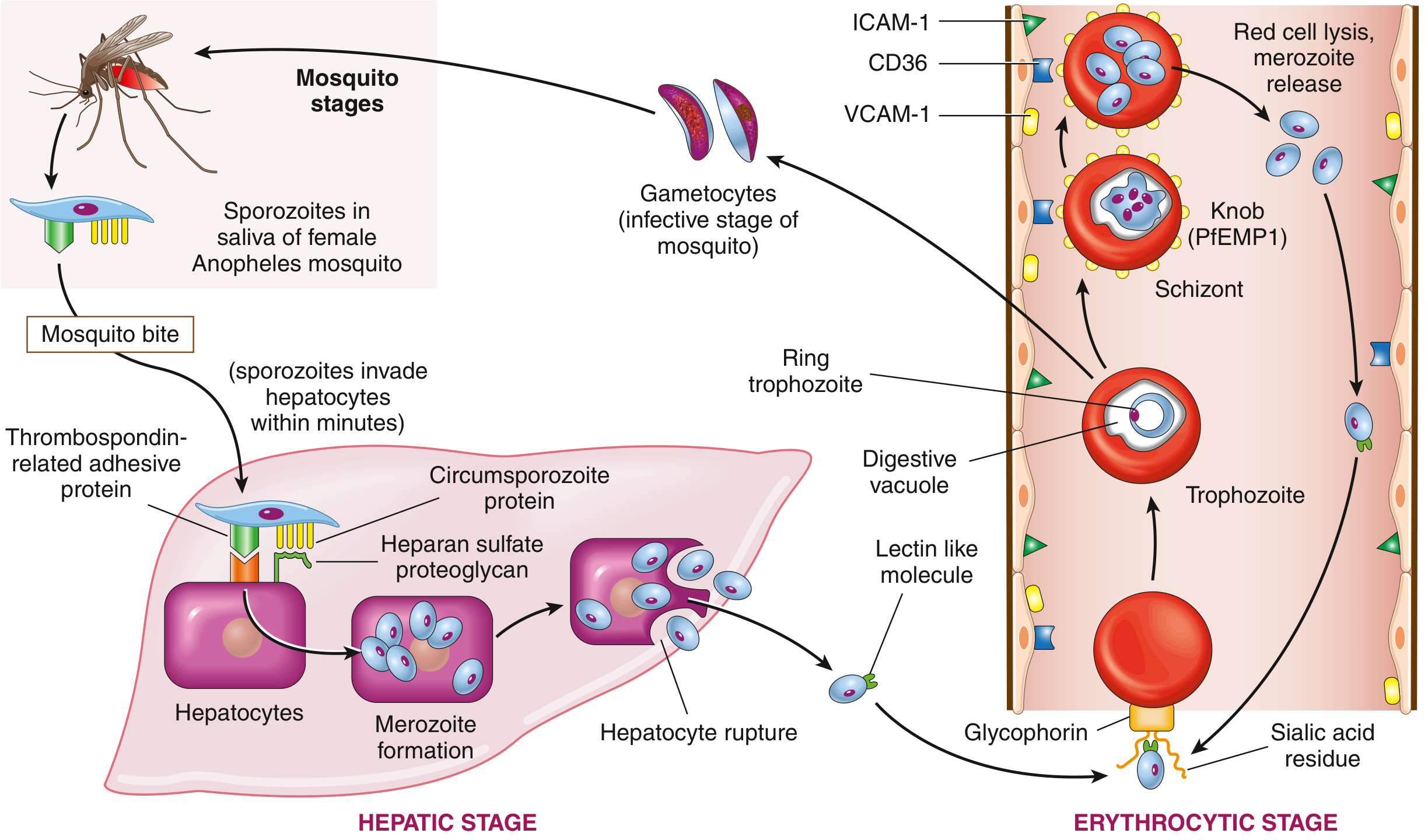
Hepatic (exoerythrocytic) stage:
- Mosquito bite injects sporozoites into the bloodstream
- Sporozoites bind hepatocytes via thrombospondin-related adhesive protein and circumsporozoite protein (binding heparan sulfate proteoglycans)
- Inside hepatocytes, sporozoites differentiate into merozoites (incubation: 1-4 weeks)
- Infected hepatocytes rupture, releasing merozoites into blood
- In P. vivax and P. ovale, some hepatic parasites remain dormant as hypnozoites - the cause of relapse months to years later
Erythrocytic (blood) stage:
- A lectin-like molecule on merozoites binds sialylated glycophorin on red cell surface, allowing invasion into a digestive vacuole
- Inside the RBC, the merozoite becomes a ring form trophozoite, then a mature trophozoite
- Trophozoites become schizonts, which then divide into 6-30 new merozoites
- The RBC ruptures, releasing merozoites to infect fresh cells - this synchronized lysis produces the characteristic fever
- Some trophozoites differentiate into gametocytes (sexual forms); female outnumber males 4:1
Mosquito stage:
-
When a mosquito ingests gametocytes, male gametes fertilize female ones (sexual division/meiosis), forming a zygote → ookinete → oocyst → sporozoites in salivary glands, completing the cycle
-
Robbins & Kumar Basic Pathology, p. 391-392; Harrison's Principles of Internal Medicine 22E, Ch. 231
3. Pathophysiology
Erythrocyte Changes (P. falciparum)
P. falciparum is uniquely dangerous due to cytoadherence. After invading an RBC, it expresses PfEMP1 (Plasmodium falciparum erythrocyte membrane protein 1) on knob-like protrusions on the cell surface. PfEMP1 binds to adhesion molecules on vascular endothelium:
- ICAM-1 and endothelial protein C receptor - brain microvessels
- CD36 - most other organs
- VAR25a (chondroitin sulfate A) - placenta (key in pregnancy)
This causes sequestration of infected RBCs in capillaries and venules of vital organs, blocking microcirculation. Parasitized cells also form rosettes (clumping with uninfected RBCs) and agglutinates. Since only ring forms circulate in peripheral blood, peripheral parasitemia underestimates true parasite burden.
Fever Mechanism
Rupture of schizonts releases merozoites, hemozoin (malaria pigment), and other debris that activate monocytes/macrophages to release proinflammatory cytokines. This produces fever coinciding with each synchronized cycle:
- Quotidian (daily): P. knowlesi
- Tertian (every 48 h): P. vivax, P. ovale, P. falciparum
- Quartan (every 72 h): P. malariae
Anemia
Results from three mechanisms:
- Obligatory RBC destruction during schizogony
- Splenic clearance of both parasitized and nonparasitized (but damaged) RBCs
- Dyserythropoiesis (ineffective erythropoiesis)
Hemoglobin of ≤3 g/dL on presentation is associated with increased mortality. - Harrison's, Ch. 231
Genetic Protection
Sickle cell trait, thalassemias, hemoglobin C/E, hereditary ovalocytosis, and G6PD deficiency all confer some protection against severe falciparum malaria - explaining why these genetic variants have been positively selected in malaria-endemic areas.
4. Clinical Features
Uncomplicated Malaria
- Prodrome: headache, fatigue, myalgia, anorexia
- Classic triad: chills/rigors → high fever (≥40°C) → drenching sweats (coinciding with schizont rupture)
- Nausea, vomiting, diarrhea
- Splenomegaly (on repeat infections), mild hepatomegaly
- Thrombocytopenia (normal platelet count should raise doubt about the diagnosis)
- Mild hemolytic jaundice
Fever is common but not universal at initial presentation - some present with headache and diarrhea alone. - Rosen's Emergency Medicine
Severe Malaria (predominantly P. falciparum)
WHO criteria for severe malaria include any of the following:
| Complication | Details |
|---|---|
| Cerebral malaria | Unarousable coma (GCS ≤11); sequestration in brain capillaries; rapid progression to convulsions, coma, death |
| Severe anemia | Hb <7 g/dL or PCV <20% |
| Acute kidney injury | Creatinine >265 µmol/L; oliguric; may progress to dialysis-dependence |
| Pulmonary edema / ARDS | Non-cardiogenic; can develop even after treatment starts |
| Hypoglycemia | <2.2 mmol/L; from failed hepatic gluconeogenesis + parasite consumption of glucose; compounded by quinine (stimulates insulin) |
| Metabolic acidosis | Lactic acidosis from sequestration-impaired microcirculation; base deficit >8 mEq/L |
| Blackwater fever | Massive intravascular hemolysis → hemoglobinemia + hemoglobinuria → jaundice + AKI |
| Shock / algid malaria | Septicemia complicating severe disease |
| DIC / bleeding | <5% of severe cases |
| Hyperparasitemia | >5% parasitized RBCs; mortality increases sharply at >500,000/µL |
Relative frequency by patient group:
| Complication | Adults | Pregnant women | Children |
|---|---|---|---|
| Anemia | + | ++ | +++ |
| Convulsions | + | + | +++ |
| Hypoglycemia | + | +++ | +++ |
| Jaundice | +++ | +++ | + |
| Renal failure | +++ | +++ | + |
| Pulmonary edema | ++ | +++ | + |
- Harrison's Principles of Internal Medicine 22E, Ch. 231
5. Diagnosis
1. Thick and thin blood smears (Giemsa stain) - gold standard
- Thick smear: higher sensitivity for detection (concentrates RBCs)
- Thin smear: species identification by morphology
- Key morphological differences:
- P. falciparum: ring forms only; multiple rings per cell; banana-shaped gametocytes
- P. vivax: enlarged RBCs; Schuffner's dots; amoeboid trophozoites
- P. ovale: oval/fimbriated RBCs; James's dots
- P. malariae: band-form trophozoites; "rosette" schizonts
2. Rapid Diagnostic Tests (RDTs) - detect malaria antigens (e.g., HRP-2 for P. falciparum, pLDH)
- Useful in field settings; does not quantify parasitemia or provide species ID in all cases
3. PCR - highest sensitivity; useful for low-level parasitemia and species confirmation; not standard point-of-care
4. Complete blood count: anemia, thrombocytopenia, leukopenia (or leukocytosis in severe disease)
5. Blood glucose (hypoglycemia), renal function, liver enzymes, lactate, coagulation studies in severe cases
- Henry's Clinical Diagnosis and Management by Laboratory Methods; Harrison's Principles of Internal Medicine 22E
6. Treatment
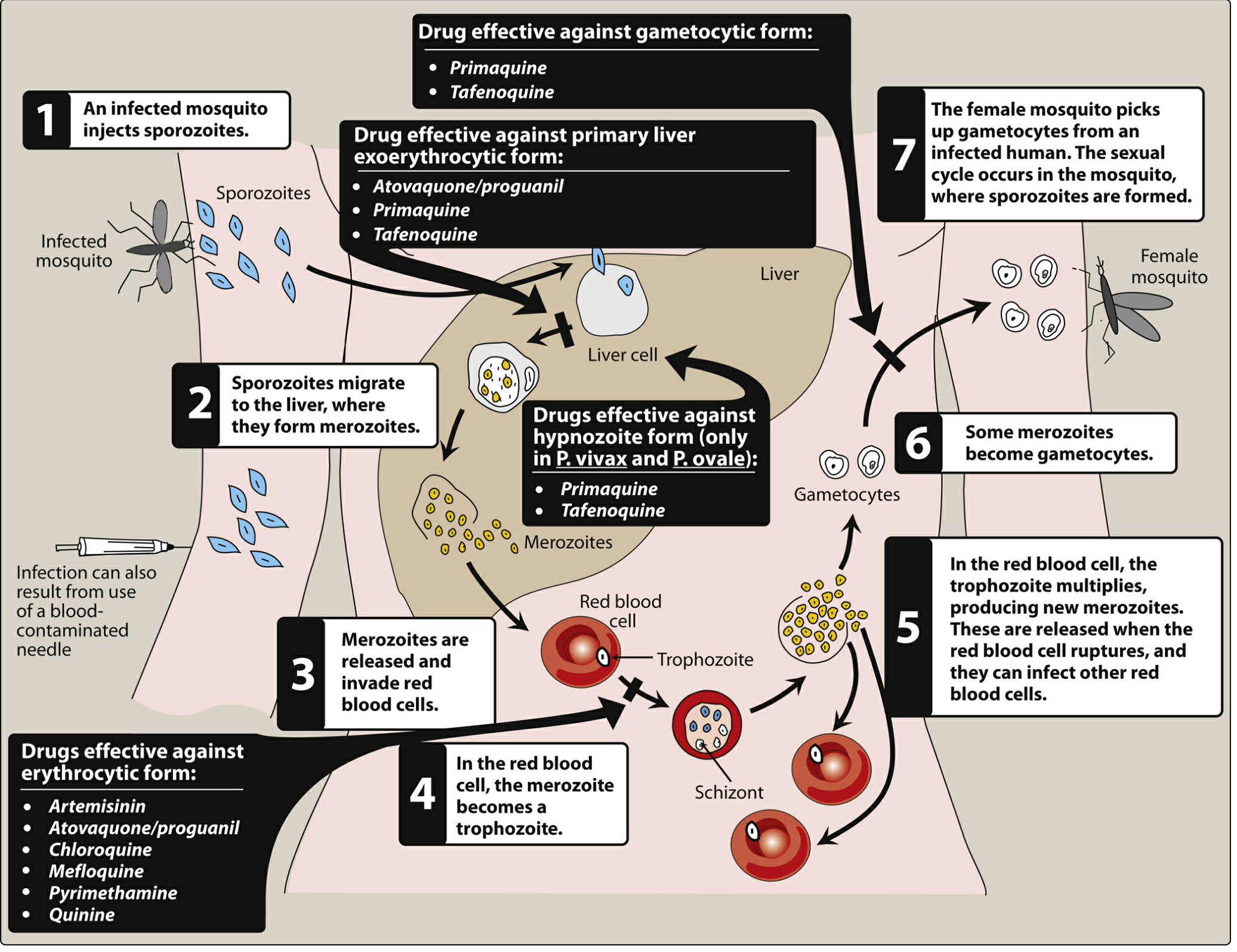
Uncomplicated Malaria
| Scenario | First-line Treatment |
|---|---|
| P. falciparum - chloroquine-resistant region | Artemether-lumefantrine (WHO preferred ACT) OR Atovaquone-proguanil OR Mefloquine/Quinine + doxycycline |
| P. falciparum - chloroquine-sensitive region | Chloroquine |
| P. vivax / P. ovale | Chloroquine + Primaquine (to clear hypnozoites) OR Chloroquine + Tafenoquine |
| P. malariae / P. knowlesi | Chloroquine |
Before using primaquine or tafenoquine, test for G6PD deficiency - these drugs cause severe hemolytic anemia in G6PD-deficient patients.
Severe Malaria
- IV Artesunate is the drug of choice (replaced quinine as first-line globally)
- Follow-on oral therapy after clinical improvement: Artemether-lumefantrine, or Atovaquone-proguanil, or Quinine + doxycycline
Key Drug Mechanisms
| Drug | Class | Mechanism | Target stage |
|---|---|---|---|
| Chloroquine | 4-aminoquinoline | Inhibits heme polymerization to hemozoin → toxic heme accumulates → RBC/parasite lysis | Erythrocytic |
| Artemisinins (artesunate, artemether) | Sesquiterpene lactone | Free radical generation via interaction with intraparasitic iron → parasite protein/membrane damage | Erythrocytic (all stages) |
| Primaquine | 8-aminoquinoline | Oxidant metabolites disrupt plasmodial mitochondria | Liver stages + hypnozoites + gametocytes |
| Tafenoquine | 8-aminoquinoline (long-acting) | Same as primaquine; single-dose for relapse prevention | Liver stages + hypnozoites |
| Atovaquone-proguanil | Combination | Atovaquone inhibits mitochondrial electron transport (Complex III); proguanil inhibits dihydrofolate reductase | Liver + erythrocytic |
| Mefloquine | 4-quinoline methanol | Interferes with heme detoxification (similar to chloroquine) | Erythrocytic |
| Quinine | Cinchona alkaloid | Heme polymerization inhibitor; also stimulates pancreatic insulin secretion | Erythrocytic |
| Pyrimethamine | Antifolate | Inhibits plasmodial dihydrofolate reductase → blocks nucleic acid synthesis | Blood schizonticide + sporonticide |
- Lippincott Illustrated Reviews: Pharmacology, Ch. 35
Chloroquine Resistance
P. falciparum resistance to chloroquine is now present in almost all malaria-endemic areas except parts of Central America. Resistance is mediated by mutations in the pfcrt gene (chloroquine resistance transporter), which effluxes chloroquine from the food vacuole. P. vivax resistance is also increasingly reported.
7. Complications in Specific Populations
Pregnancy: Placental malaria (mediated by PfEMP1 binding to chondroitin sulfate A) leads to placental dysfunction, maternal anemia, intrauterine growth restriction, and low birth weight. Hypoglycemia and pulmonary edema are particularly common. Chloroquine and mefloquine are safe in pregnancy; primaquine/tafenoquine are contraindicated.
Children: In high-transmission areas, children under 5 bear the greatest burden. Cerebral malaria, severe anemia, and hypoglycemia are the most common life-threatening complications. Repeated infections eventually confer partial immunity.
Immunocompromised: HIV/AIDS significantly worsens severity and treatment response.
8. Prevention
- Insecticide-treated bed nets (ITNs) - single most effective personal protection measure
- Indoor residual spraying (IRS)
- Removal of stagnant water (mosquito breeding sites)
- Chemoprophylaxis for travelers:
- Chloroquine-sensitive areas: Chloroquine
- All other areas: Atovaquone-proguanil, Doxycycline, or Mefloquine
- Pregnancy: Chloroquine or Mefloquine
- RTS,S/AS01 vaccine (Mosquirix): contains circumsporozoite protein; provides partial protection (~30-50%) against clinical malaria in children; now recommended by WHO for routine use in high-transmission sub-Saharan Africa. A newer vaccine (R21/Matrix-M) has shown ~75% efficacy in Phase 3 trials.
9. Pathological Findings (Morphology)
-
Hemolytic anemia with elevated bilirubin and LDH
-
Hemozoin (malaria pigment): brown pigment released from ruptured RBCs; deposits in spleen, liver, bone marrow, lymph nodes
-
Splenomegaly: massive, due to hyperplasia of mononuclear phagocytes
-
Cerebral malaria: brain capillaries packed with parasitized RBCs; petechial hemorrhages; Durck's granulomas (microglial nodules around necrotic vessels)
-
Blackwater fever: massive intravascular hemolysis → dark urine; associated with AKI
-
Robbins & Kumar Basic Pathology, p. 392
Sources
- Robbins & Kumar Basic Pathology (Robbins Pathology), pp. 391-392
- Harrison's Principles of Internal Medicine 22E (2025, McGraw Hill), Chapter 231
- Lippincott Illustrated Reviews: Pharmacology, Chapter 35
- Rosen's Emergency Medicine: Concepts and Clinical Practice, Chapter 122
This is a shared conversation. Sign in to Orris to start your own chat.