
Anatomical snuff box
Reading File
The anatomical snuff box is a triangular depression on the radial (lateral) side of the wrist, visible when the thumb is extended. It is bounded by the tendons of the extensor pollicis longus (posteriorly) and extensor pollicis brevis/abductor pollicis longus (anteriorly), with the floor formed by the scaphoid and trapezium. The radial artery passes through it, and tenderness here is a classic sign of scaphoid fracture.
Searching sources...
Finding Sources
Searching the Web
anatomical snuff box anatomy boundaries contents clinical significance
Finding Sources
Reading Web Page
https://teachmeanatomy.info/upper-limb/areas/anatomical-snuf…
Reading File
Reading File
Reading File
Loading Image
Here is a complete overview of the anatomical snuff box:
Anatomical Snuff Box (Radial Fossa)
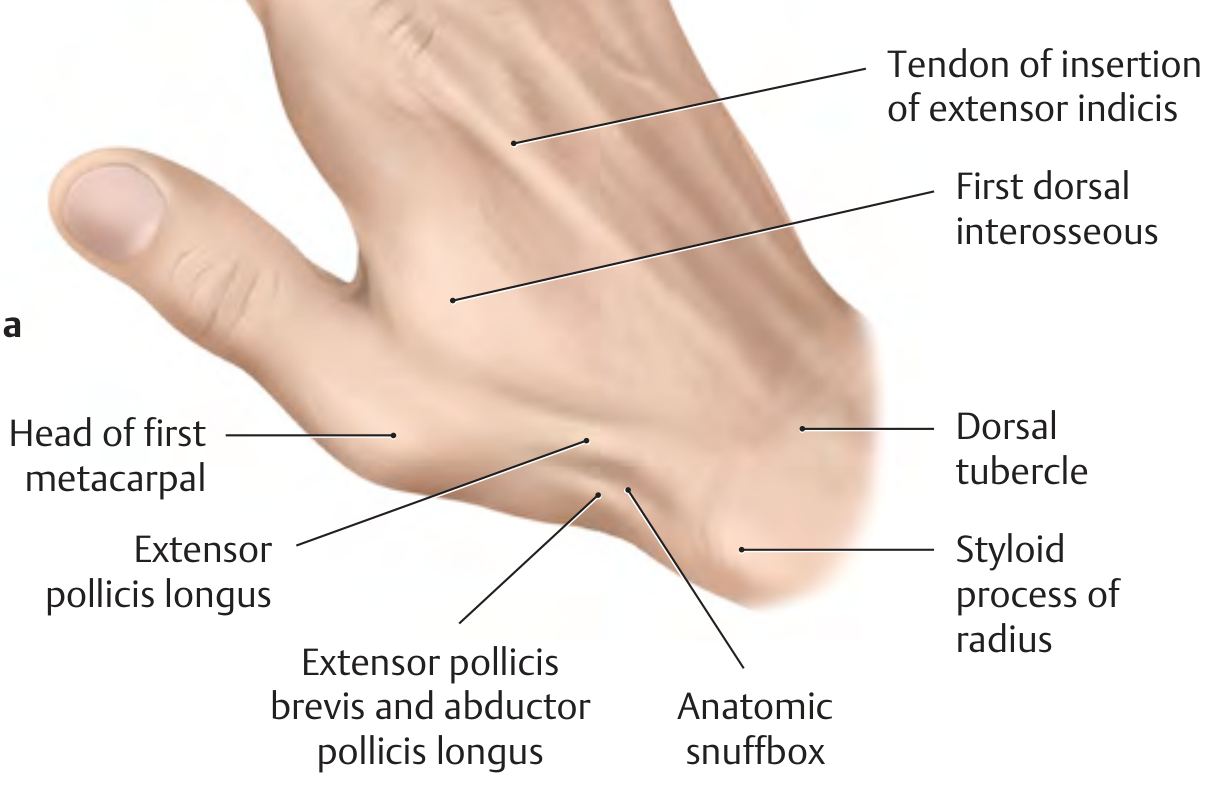
Definition
The anatomical snuff box is a triangular depression on the dorsolateral (posterolateral) aspect of the wrist, best seen when the thumb is fully extended or hyperabducted. Its name comes from the historical practice of placing powdered tobacco ("snuff") there and sniffing it.
Borders
| Border | Structure |
|---|---|
| Lateral (radial/anterior) | Tendons of abductor pollicis longus (APL) and extensor pollicis brevis (EPB) |
| Medial (ulnar/posterior) | Tendon of extensor pollicis longus (EPL) - wraps around the dorsal tubercle (Lister's tubercle) of the radius |
| Proximal | Styloid process of the radius / extensor retinaculum |
| Distal (apex) | Base of the 1st metacarpal (points toward the thumb) |
| Floor | Scaphoid and trapezium carpal bones |
| Roof | Skin and superficial fascia |
The key distinction: APL inserts into the base of the 1st metacarpal; EPB inserts into the base of the proximal phalanx of the thumb; EPL inserts into the base of the distal phalanx and travels more medially.
Contents
Divided into superficial and deep layers relative to the extensor retinaculum and outcropping muscle tendons:
Superficial (within the roof/fascia):
- Cephalic vein - crosses the roof of the snuffbox and begins here
- Dorsal digital branches of the superficial branch of the radial nerve (can be rolled against the EPL tendon)
Deep (in the floor):
- Radial artery - passes obliquely through the floor between the scaphoid and trapezium, then dives between the two heads of the first dorsal interosseous muscle to reach the deep palm and form the deep palmar arch
- Tendons of extensor carpi radialis longus (ECRL) and extensor carpi radialis brevis (ECRB) - run along the floor to insert on the bases of the 2nd and 3rd metacarpals
Mnemonic (Kenhub): CARTs - Cephalic vein, Artery (radial), Radial nerve (superficial branch), Tendons (ECRL + ECRB)
Clinical Significance
1. Scaphoid fracture (most important)
- Scaphoid fracture is the most common carpal bone fracture, typically from a fall on an outstretched hand (FOOSH)
- The scaphoid receives its blood supply from branches of the radial artery that enter distally - fractures at the waist can interrupt this supply, causing avascular necrosis (AVN) of the proximal fragment
- Classic finding: tenderness in the anatomical snuff box on palpation
- Placing the wrist in ulnar deviation brings the scaphoid into a more palpable position within the snuffbox, useful for clinical assessment
- Plain X-rays may be negative in the first 2 weeks - snuffbox tenderness mandates clinical suspicion and further imaging (MRI or CT) even with normal X-rays
- Tintinalli's Emergency Medicine: "There is pain along the radial aspect of the wrist and localized tenderness in the anatomic snuffbox... Snuffbox tenderness is a sensitive but nonspecific finding"
2. Radial artery pulse
- The radial artery pulse can be palpated in the floor of the snuffbox - one of six pulse points in the upper limb
- Not to be confused with the standard radial pulse, which is felt anterolaterally at the distal forearm
- The snuffbox is used as a surgical landmark for arterial access (e.g., in radial artery cannulation or radiocephalic arteriovenous fistula creation for dialysis access)
- Current Surgical Therapy: snuffbox anastomosis can be used for radiocephalic fistulas when the vein anatomy is favorable
3. De Quervain's tenosynovitis
- Affects the 1st dorsal extensor compartment (APL + EPB tendons) - which form the lateral border of the snuffbox
- Presents with radial-sided wrist pain, tenderness over the radial styloid/lateral snuffbox, and a positive Finkelstein test
- Common in new mothers and those with repetitive thumb/wrist use
4. Nerve blocks and venous access
- Superficial branch of the radial nerve can be blocked just proximal to the snuffbox for thumb and radial hand anesthesia
- The cephalic vein at the snuffbox is a well-known site for intravenous cannulation
Radial Artery Path Through the Snuffbox
The radial artery enters the snuffbox proximally (after giving off the superficial palmar branch), crosses the floor running obliquely over the scaphoid and trapezium, then exits distally by passing between the two heads of the first dorsal interosseous muscle. This path is why the artery can be implicated in scaphoid fractures and why pulsation is palpable here.
- Gray's Anatomy for Students: "The radial artery passes through the anatomical snuffbox when traveling laterally around the wrist to reach the back of the hand and penetrate the base of the first dorsal interosseous muscle to access the deep aspect of the palm."
- THIEME Atlas of Anatomy: "The radial artery runs deep in the snuffbox between the trapezium and scaphoid, providing a landmark for dissection."
This is a shared conversation. Sign in to Orris to start your own chat.