
ANATOMY OF NERVOUS SYSTEM
Reading File
The nervous system is divided into the Central Nervous System (CNS) - brain and spinal cord - and the Peripheral Nervous System (PNS) - cranial and spinal nerves. The brain includes the cerebrum, cerebellum, and brainstem. The PNS is further divided into somatic (voluntary) and autonomic (involuntary) divisions.
Searching sources...
Finding Sources
Finding Sources
Finding Sources
Finding Sources
Reading File
Finding Sources
Finding Sources
Reading File
Finding Sources
Finding Sources
Reading File
Reading File
Reading File
Loading Image
Loading Image
Loading Image
Reading File
Loading Image
Loading Image
Now I have rich textbook material and diagrams. Let me compile a comprehensive, well-illustrated answer.
Anatomy of the Nervous System
1. Overview and Divisions
The nervous system is divided into two major anatomical components:
| Division | Components |
|---|---|
| Central Nervous System (CNS) | Brain + Spinal cord |
| Peripheral Nervous System (PNS) | Cranial nerves + Spinal nerves + Ganglia |
The PNS is functionally subdivided into:
- Somatic nervous system - voluntary control of skeletal muscle, conscious sensation
- Autonomic nervous system (ANS) - involuntary control of viscera, glands, smooth muscle
- Sympathetic division (thoracolumbar outflow)
- Parasympathetic division (craniosacral outflow)
2. The Brain
The brain is housed in the cranial cavity, which is subdivided into three fossae:
- Anterior fossa - frontal lobes
- Middle fossa - temporal lobes, pituitary
- Posterior fossa - cerebellum, brainstem
Major Brain Regions
| Region | Key Structures | Functions |
|---|---|---|
| Cerebrum | Frontal, parietal, temporal, occipital lobes; basal ganglia; limbic system | Higher cognition, motor control, sensation, language, memory |
| Diencephalon | Thalamus, hypothalamus, subthalamus, epithalamus | Sensory relay, autonomic regulation, endocrine |
| Brainstem | Midbrain, pons, medulla oblongata | Cranial nerve nuclei, vital centers (respiration, cardiovascular) |
| Cerebellum | Vermis, hemispheres, flocculonodular lobe | Motor coordination, balance, posture |
Meninges and Coverings
The brain is enclosed by three protective membranes:
- Dura mater - outermost, thick fibrous layer; forms major infoldings (falx cerebri, tentorium cerebelli)
- Arachnoid mater - middle, web-like; separated from the pia by the subarachnoid space containing CSF
- Pia mater - innermost, closely adherent to brain surface
The blood-brain barrier is formed by brain capillary endothelial cells sealed together by tight junctions, selectively restricting entry of substances from blood into the CNS.
Ventricular System
- Two lateral ventricles (one per hemisphere) - C-shaped, follow the curve of the caudate nucleus, corpus callosum, and fornix
- Third ventricle - midline, between the thalami
- Fourth ventricle - posterior, between brainstem and cerebellum
- CSF flows from lateral ventricles -> third -> cerebral aqueduct -> fourth -> subarachnoid space
3. The Spinal Cord
The spinal cord is shorter than the vertebral column. It terminates as the conus medullaris at L2 in adults (L3 in neonates). Below the conus, the filum terminale (a fibrous cord) attaches to the first coccygeal segment. The nerve roots below L2 form the cauda equina.
The vertebral column has 33 vertebrae organized as: Occipital-C2, C3-C7 (cervical), T1-T12 (thoracic), L1-L5 (lumbar), Sacrum, and Coccyx.
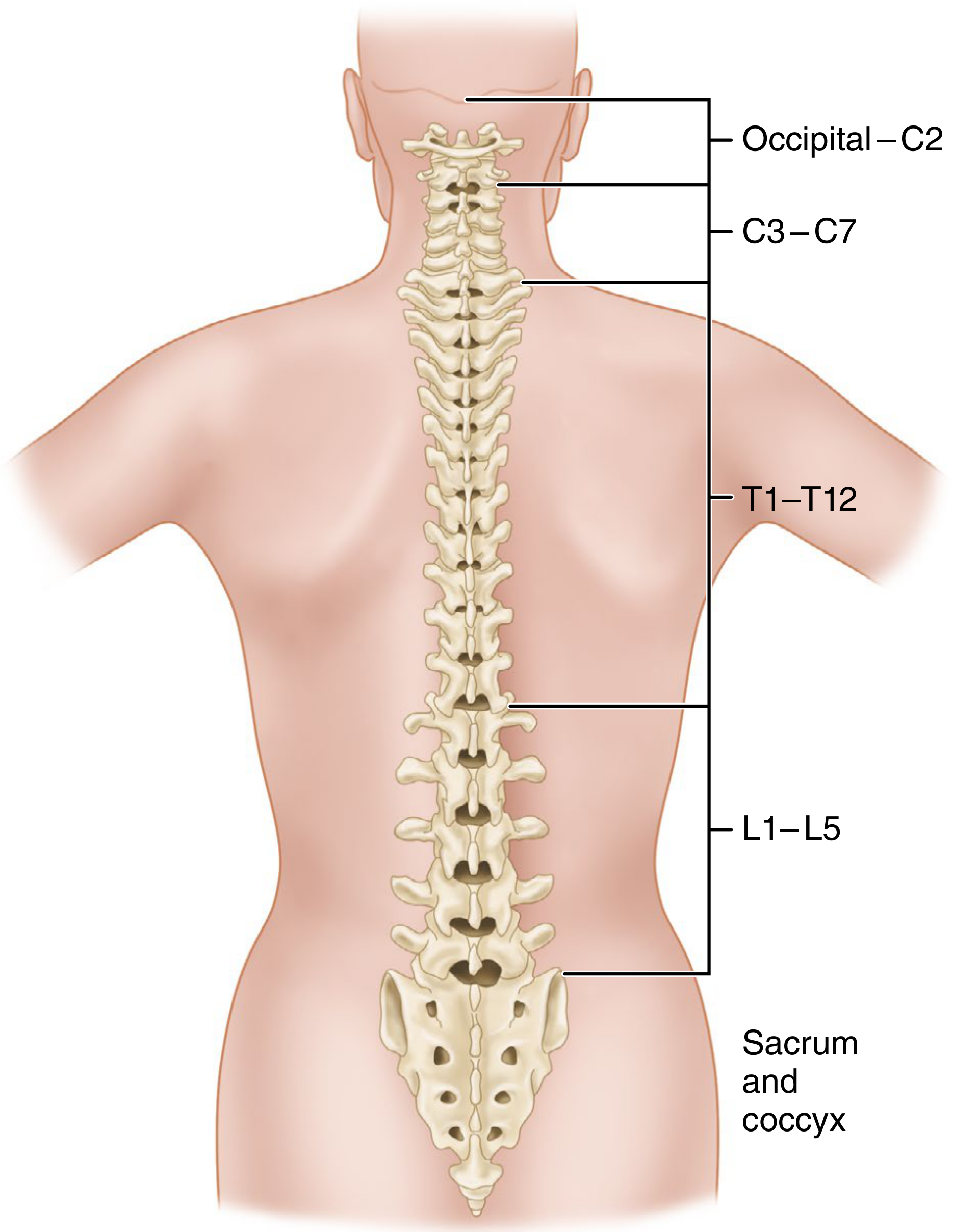
Internal Structure of the Spinal Cord
The cord contains a butterfly-shaped central gray matter surrounded by white matter columns (funiculi):
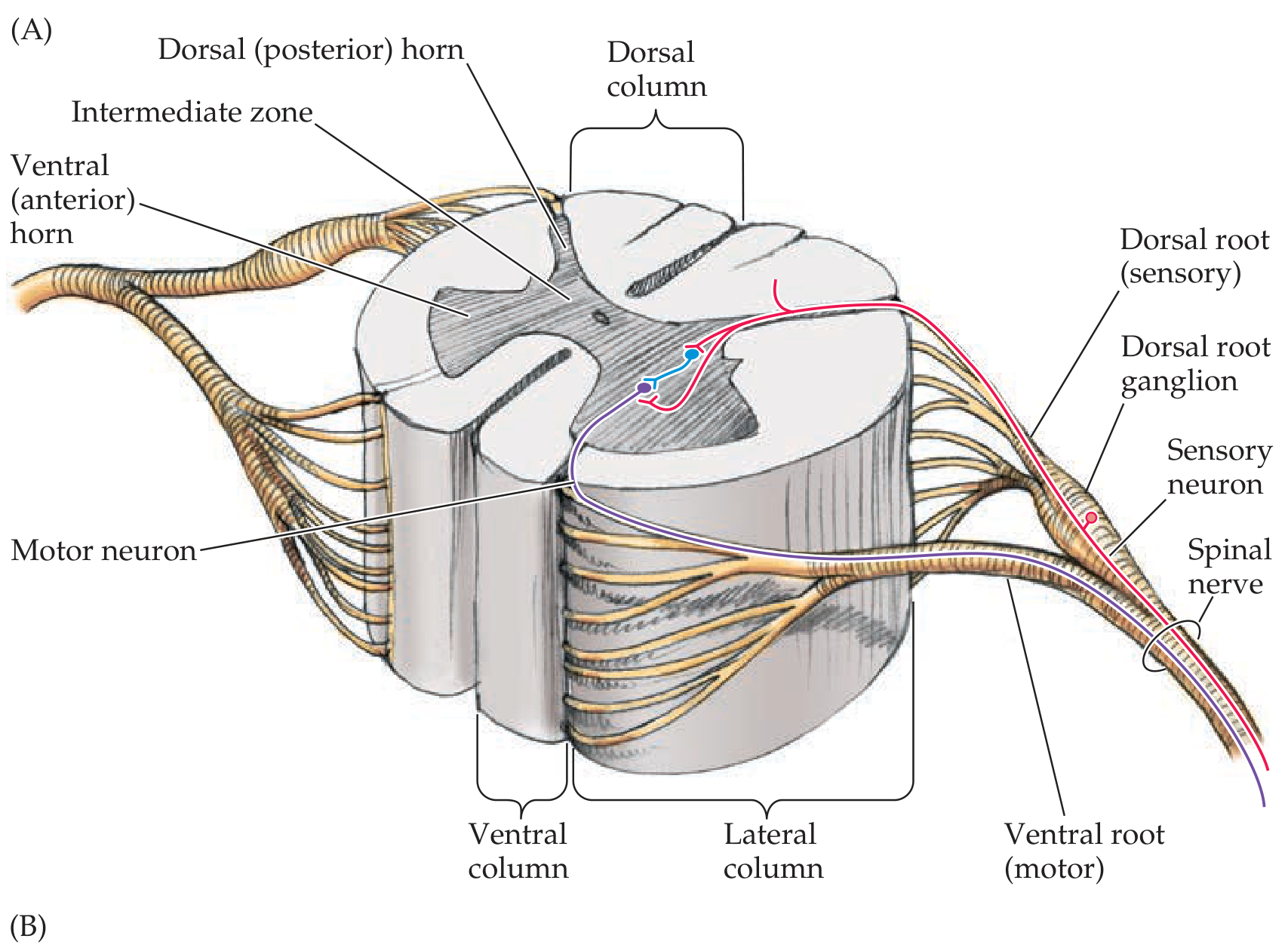
Gray matter horns:
- Dorsal (posterior) horn - sensory processing; receives afferent input via dorsal root filaments
- Intermediate zone - interneurons, autonomic nuclei
- Ventral (anterior) horn - lower motor neurons; axons exit via ventral root filaments
White matter columns:
- Dorsal (posterior) columns - fine touch, vibration, proprioception (ascending)
- Lateral columns - corticospinal tract (descending motor), spinothalamic tracts (ascending pain/temperature)
- Ventral (anterior) columns - mixed ascending/descending tracts
Rexed's Laminae
The gray matter is also divided into 10 functional zones (Rexed's laminae I-X), visible histologically:
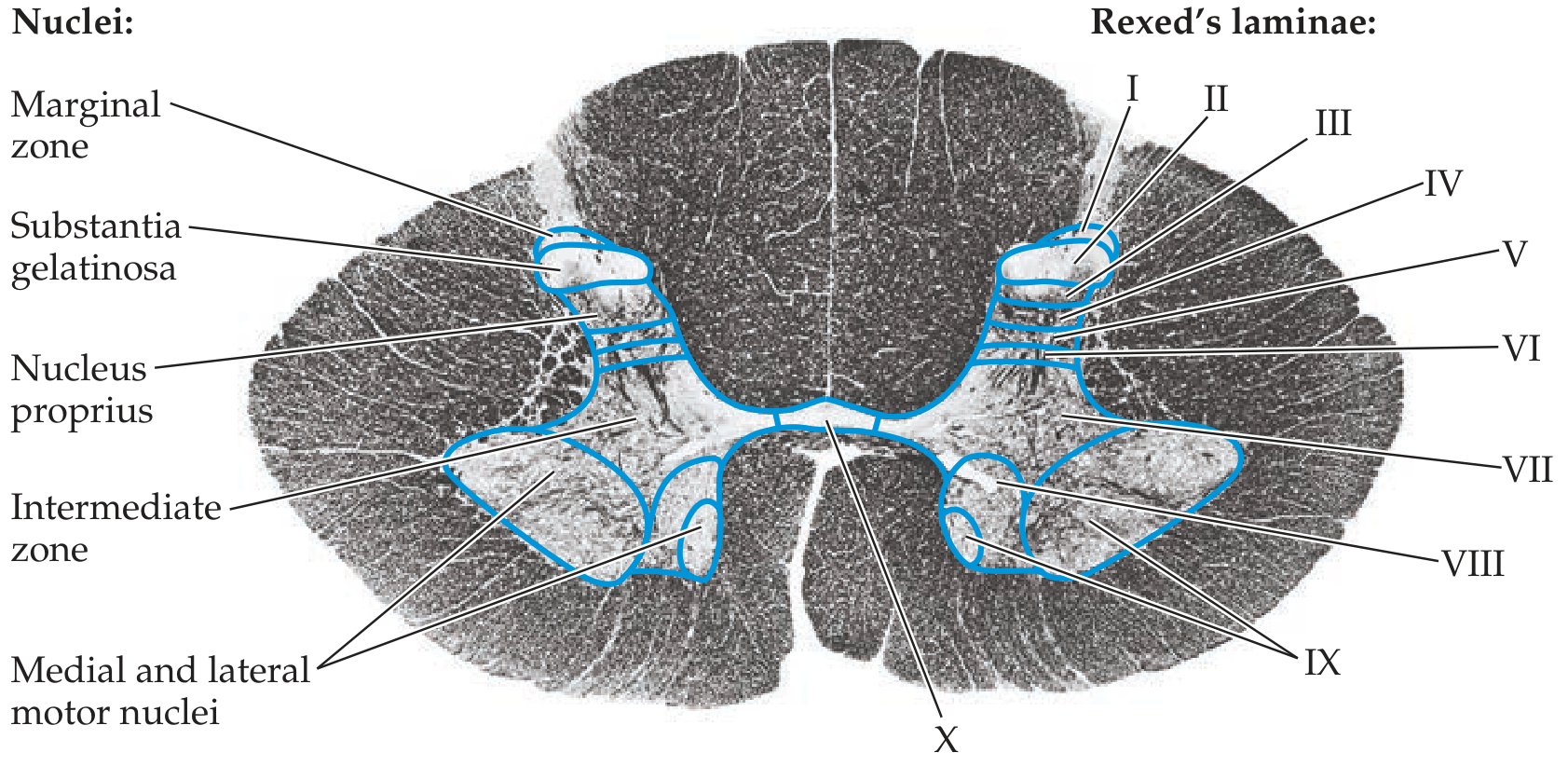
| Lamina | Location | Function |
|---|---|---|
| I | Marginal zone (dorsal horn tip) | Pain, temperature |
| II | Substantia gelatinosa | Modulation of pain |
| III-IV | Nucleus proprius | Discriminative sensation |
| V-VI | Base of dorsal horn / intermediate zone | Proprioception, motor reflexes |
| VII | Intermediate zone | Autonomic (IML); Clarke's column |
| VIII | Ventral horn (medial) | Interneurons |
| IX | Ventral horn (lateral) | Alpha and gamma motor neurons |
| X | Around central canal | Visceral afferents |
Spinal Cord Enlargements
- Cervical enlargement (C4-T1) - gives rise to the brachial plexus (arm innervation)
- Lumbosacral enlargement (L2-S3) - gives rise to the lumbosacral plexus (leg innervation)
The white matter is thickest at cervical levels (most descending/ascending fibers present), and the gray matter is greatest in cervical and lumbosacral regions (more motor neurons for limbs).
Spinal Nerve Roots
- 31 pairs of spinal nerves: 8 cervical, 12 thoracic, 5 lumbar, 5 sacral, 1 coccygeal
- Each spinal nerve forms from a dorsal root (sensory, has dorsal root ganglion) and a ventral root (mostly motor), which join to form a mixed spinal nerve
- Cervical nerves C1-C7 exit above their corresponding vertebral pedicle; C8 exits between C7 and T1; all nerves below C8 exit below their named vertebra
- The dorsal root ganglion contains cell bodies of sensory neurons and is sensitive to pressure and heat
4. Dermatomes and Cutaneous Nerve Distribution
Each spinal nerve supplies a specific skin region (dermatome). The diagram below shows both dermatomal (spinal level) and peripheral nerve distributions:
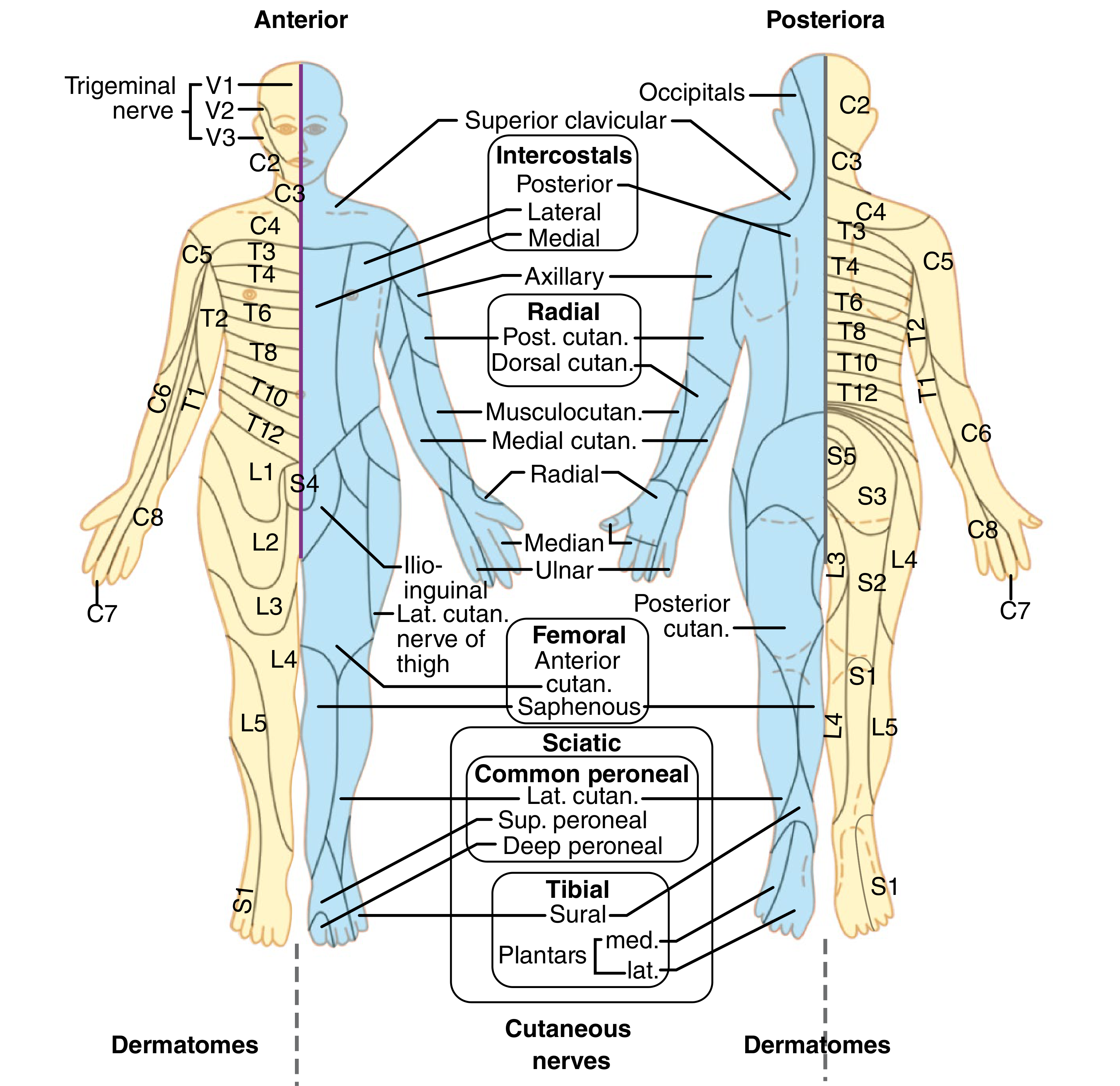
Key dermatomal landmarks:
- C5-C8, T1: upper limb
- T4: nipple line
- T10: umbilicus
- L1: inguinal region
- L4-S1: lower limb
- S2-S4: perineum/saddle area
5. The Autonomic Nervous System (ANS)
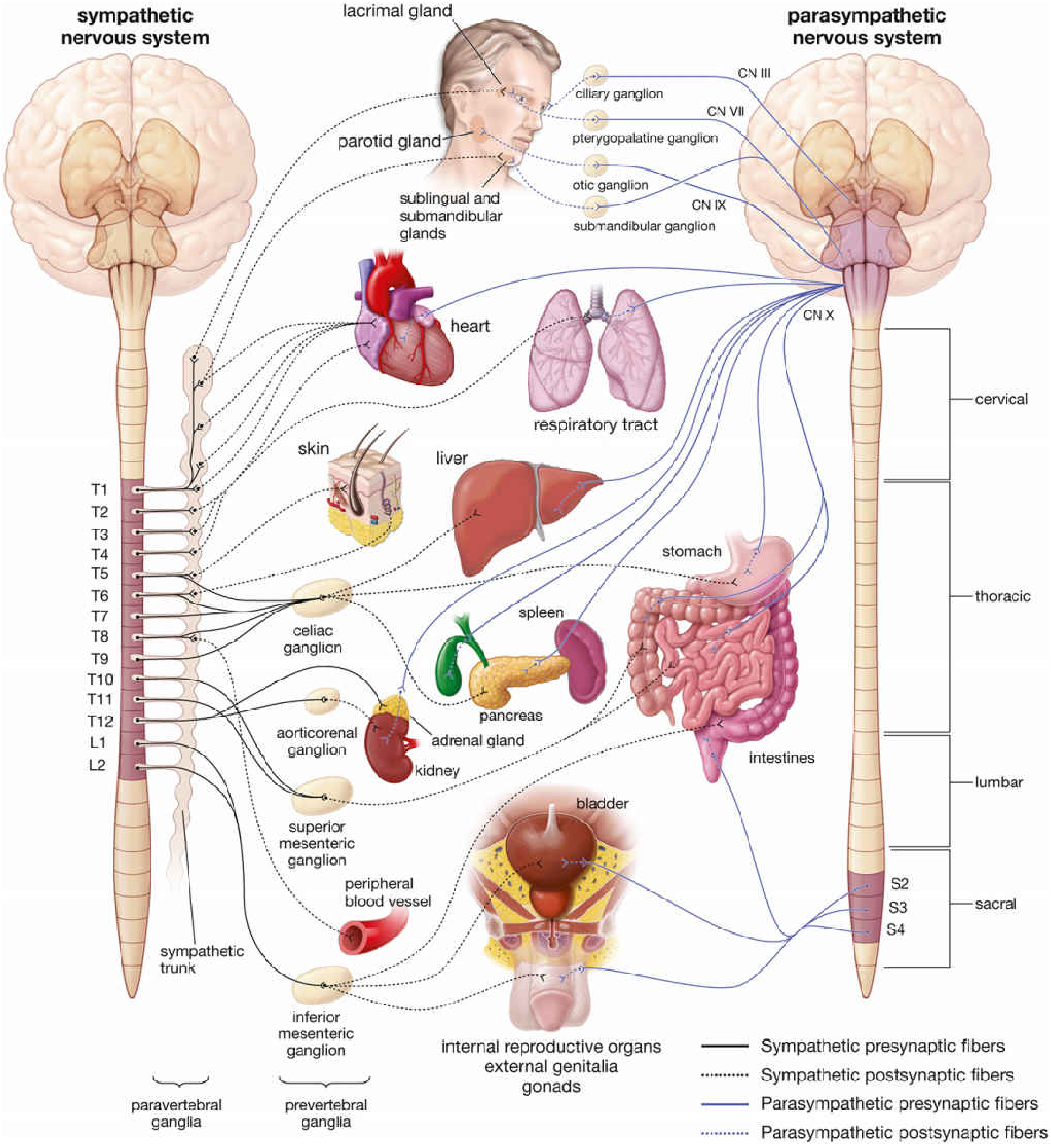
The ANS operates through a two-neuron chain: a presynaptic (preganglionic) neuron in the CNS synapses onto a postsynaptic (postganglionic) neuron in a peripheral ganglion, which then innervates the target organ.
Sympathetic Division ("Thoracolumbar")
- Presynaptic neurons originate in the lateral horn (intermediolateral cell column) of T1-L2 spinal cord
- Presynaptic axons travel to:
- Paravertebral ganglia (sympathetic trunk, bilateral chains flanking the vertebral column)
- Prevertebral ganglia (celiac, aorticorenal, superior/inferior mesenteric ganglia)
- Postsynaptic fibers distribute to viscera, blood vessels, sweat glands, and skin
- The adrenal medulla is a modified sympathetic ganglion innervated by presynaptic fibers directly - releases epinephrine (EPI) and norepinephrine (NE) into the bloodstream
Parasympathetic Division ("Craniosacral")
- Presynaptic neurons originate in:
- Brainstem (midbrain, pons, medulla) - traveling with cranial nerves III, VII, IX, and X
- Sacral spinal cord (S2-S4)
- Presynaptic fibers synapse in terminal ganglia located in or near the wall of target organs
- CN III (ciliary ganglion) - pupillary constriction, lens accommodation
- CN VII (pterygopalatine + submandibular ganglia) - lacrimal, sublingual, submandibular glands
- CN IX (otic ganglion) - parotid gland
- CN X (vagus) - heart, lungs, esophagus, stomach, liver, pancreas, intestines (up to the splenic flexure)
- S2-S4 - descending colon, rectum, bladder, reproductive organs
Sympathetic vs. Parasympathetic: Opposing Actions
| Organ | Sympathetic Effect | Parasympathetic Effect |
|---|---|---|
| Heart rate | Increases | Decreases |
| Bronchi | Dilates | Constricts |
| Pupils | Dilates (mydriasis) | Constricts (miosis) |
| GI motility | Decreases | Increases |
| Bladder | Relaxes detrusor | Contracts detrusor |
| Blood vessels | Constricts (most) | Dilates (selective) |
6. Cranial Nerves (Brief Overview)
There are 12 pairs of cranial nerves that emerge directly from the brain/brainstem:
| # | Name | Function |
|---|---|---|
| I | Olfactory | Smell (sensory) |
| II | Optic | Vision (sensory) |
| III | Oculomotor | Eye movement, pupil constriction, lid elevation |
| IV | Trochlear | Superior oblique muscle (eye) |
| V | Trigeminal | Face sensation + mastication |
| VI | Abducens | Lateral rectus (eye abduction) |
| VII | Facial | Facial expression, taste (anterior 2/3 tongue), lacrimation, salivation |
| VIII | Vestibulocochlear | Hearing + balance |
| IX | Glossopharyngeal | Taste (posterior 1/3), pharyngeal sensation, carotid body |
| X | Vagus | Parasympathetic to thorax/abdomen, phonation, swallowing |
| XI | Accessory | Sternocleidomastoid + trapezius |
| XII | Hypoglossal | Tongue movements |
Summary: Organization at a Glance
Nervous System
├── Central Nervous System (CNS)
│ ├── Brain
│ │ ├── Cerebrum (Frontal, Parietal, Temporal, Occipital lobes)
│ │ ├── Diencephalon (Thalamus, Hypothalamus)
│ │ ├── Brainstem (Midbrain, Pons, Medulla)
│ │ └── Cerebellum
│ └── Spinal Cord
│ ├── Cervical (C1-C8)
│ ├── Thoracic (T1-T12)
│ ├── Lumbar (L1-L5)
│ └── Sacral/Coccygeal (S1-S5, Co1)
│
└── Peripheral Nervous System (PNS)
├── Somatic NS
│ ├── 12 Cranial Nerve Pairs
│ └── 31 Spinal Nerve Pairs
└── Autonomic NS
├── Sympathetic (T1-L2) - "Fight or Flight"
└── Parasympathetic (CN III,VII,IX,X + S2-S4) - "Rest & Digest"
Sources: Neuroanatomy through Clinical Cases, 3rd Edition; Campbell's Operative Orthopaedics, 15th Ed (2026); Histology: A Text and Atlas with Correlated Cell and Molecular Biology; Medical Physiology
This is a shared conversation. Sign in to Orris to start your own chat.