
Vaginal spaculam
Reading File
A vaginal speculum is a medical instrument used to hold the vaginal walls apart during gynecological examinations, allowing visualization of the vagina and cervix.
Searching sources...
Finding Sources
Searching the Web
vaginal speculum types uses technique gynecological examination
Reading File
Finding Sources
Reading File
Reading File
Loading Image
Finding Sources
Finding Sources
Reading File
Finding Sources
Finding Sources
Now I have comprehensive textbook information. Here is a thorough overview of the vaginal speculum:
Vaginal Speculum
Definition
A vaginal speculum is a two-bladed, duck-bill shaped instrument used to retract the vaginal walls, allowing direct visualization of the vaginal canal and cervix. It is an indispensable tool in any gynecological examination.
Types
By Design
| Type | Description | Best Use |
|---|---|---|
| Graves speculum | Wider, curved blades; available in small, medium, large | Standard adult patients, parous women, colposcopy |
| Pederson speculum | Narrower, flatter blades | Nulliparous women, postmenopausal women, virgins |
| Extra-long (e.g., Snowman by CooperSurgical) | Extended blade length | Obese patients, difficult examinations |
| Kogan endocervical speculum | Narrow, tubular | Colposcopy, cervical polyp removal |
| Open-sided (Graves variant) | Side-open design | Hysteroscopy, LEEP procedure |
By Material
- Metal (stainless steel) - Reusable, autoclavable, can be pre-warmed
- Plastic (disposable) - Some have a built-in light source (e.g., Welch Allyn Kleenspec) for improved visualization; nonconductive versions used for LEEP procedures
Sizes
- Small - Narrow vaginal introitus, postmenopausal atrophy, nulliparous patients
- Medium - Standard size for most adult women
- Large - Parous women, colposcopy requiring maximum exposure
Always use the largest size the patient can comfortably tolerate, particularly for colposcopy, to reduce repeated manipulation and improve visualization. - Pfenninger and Fowler's Procedures for Primary Care
Indications / Clinical Uses
- Pelvic examination - Routine gynecologic assessment
- Pap smear (cervical cytology) - Cancer screening
- Colposcopy - Detailed examination of the cervix for abnormal cells
- Culture and swab collection - STI testing (gonorrhea, chlamydia, trichomonas, candida)
- LEEP procedure - Excision of cervical intraepithelial neoplasia (nonconductive speculum used)
- Hysteroscopy - Inserted first to expose the cervical os
- Evaluation of vaginal bleeding - In the second half of pregnancy, a speculum exam is used before any digital examination to evaluate bleeding causes (abruptio, previa) - Tintinalli's Emergency Medicine
- Open pelvic fracture - Vaginal speculum exam is necessary to evaluate for open fractures involving the vaginal canal - Fischer's Mastery of Surgery
- IUD insertion/removal - Cervical visualization required
- Endometrial biopsy and cervical dilation
Insertion Technique
From Berek & Novak's Gynecology:
- Warm the speculum (tap water is sufficient; do not lubricate if smears/cultures are planned)
- Select the proper size based on patient history (parity, age, body habitus)
- Position patient in dorsal lithotomy
- Insert with blades oblique and closed, pressing gently against the perineum
- Advance along the posterior vaginal wall until fully inserted
- Rotate blades to horizontal position, then open them
- Maneuver until the cervix is visualized between the blades
- Gently rotate around the long axis to visualize all surfaces of the vagina and cervix
Tip for colposcopy: A thin layer of water-soluble lubricant on the speculum facilitates insertion and removal and does not interfere with biopsy or Pap smear interpretation.
What to Inspect Once Inserted
Vagina
- Blood, discharge (assess for trichomonas, candida, bacterial vaginosis, gonorrhea/chlamydia)
- Mucosal color, lesions, ulcers, vesicles, vascularity
- Structural abnormalities (congenital or acquired)
- Bluish discoloration = Chadwick sign (pregnancy)
- Prolapse (cystocele, rectocele, enterocele)
Cervix
- Discharge from the os (mucopurulent = cervicitis)
- Polyps (from cervical surface or endocervical canal)
- Unusual bleeding (evaluate for cervical/uterine neoplasia)
- Lesions suspicious for carcinoma (biopsy if indicated)
Gynaecological Instruments Used Alongside the Speculum
The image below shows related gynecological instruments used with the speculum:
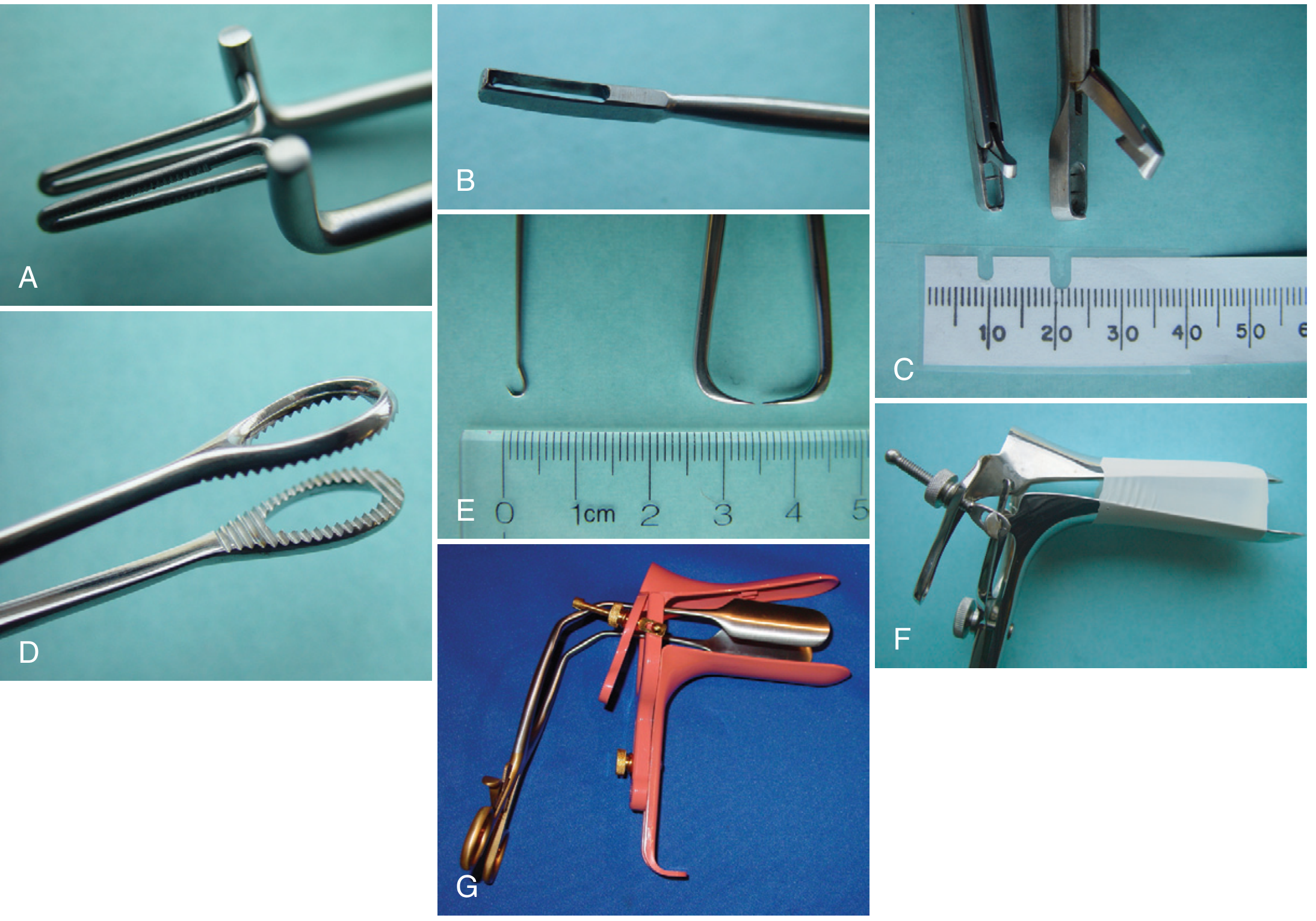
Figure from Pfenninger and Fowler's: (A) Kogan endocervical speculum, (B) Kevorkian endocervical curette, (C) Tischler biopsy forceps, (D) ring forceps, (E) cervical hook, (F) vaginal speculum with glove finger retractor, (G) vaginal speculum with sidewall retractor inserted
Special Situations
| Situation | Modification |
|---|---|
| Obese patient | Extra-long speculum (e.g., Snowman by CooperSurgical) |
| LEEP procedure | Nonconductive, vented plastic speculum |
| Vaginal walls collapsing into view | Use vaginal sidewall retractor, or stretch a cut surgical glove finger over the blades |
| Post-menopausal / atrophic vagina | Smallest Pederson speculum; gentle technique |
| Pregnancy (second half bleeding) | Speculum exam before digital exam to rule out placenta previa |
Sources:
- Berek & Novak's Gynecology, p. 60
- Pfenninger and Fowler's Procedures for Primary Care, 3rd ed., pp. 955, 4775
- Tintinalli's Emergency Medicine
- Fischer's Mastery of Surgery, 8th ed.
- Additional context from the Cleveland Clinic
This is a shared conversation. Sign in to Orris to start your own chat.