
Classify Antianginals; explain organic Nitrate pharmacology
Reading File
Now let me search the medical library in parallel for antianginals classification and organic nitrate pharmacology.
Finding Sources
Finding Sources
Finding Sources
Finding Sources
Reading File
Finding Sources
Good - I have the Goodman & Gilman block 9 with organic nitrates content. Let me read the key sections in parallel.
Reading File
Reading File
Excellent - I have very rich content. The offset=100 read has the full organic nitrates section embedded in it. Let me now read the specific organic nitrate mechanisms section (around line 208) and the Lippincott classification section.
Reading File
Reading File
I have a rich amount of content now. Let me read the rest of the Lippincott organic nitrates section and grab the Goodman & Gilman mechanisms section (around line 208).
Reading File
Reading File
I now have comprehensive content. Let me fetch the mechanism of action diagram and the duration of action figure, and also read the Katzung newer antianginal drugs section.
Loading Image
Loading Image
Reading File
I now have all the information I need to write a comprehensive, well-structured answer. Let me also grab the Goodman & Gilman mechanisms section around line 208 which covers the antianginal efficacy mechanisms in detail.
Reading File
I now have all the content needed for a thorough, textbook-quality answer. Let me compose the full response.
Classification of Antianginal Drugs
Antianginals are organized by mechanism of action into traditional agents (the "big three"), agents used for specific angina subtypes, and newer/adjunct drugs.
I. Classification
A. Traditional (First-Line) Antianginals
| Class | Key Drugs | Primary Mechanism |
|---|---|---|
| Organic Nitrates | Nitroglycerin, ISDN, ISMN | NO donor → venodilation → ↓ preload; coronary vasodilation |
| Beta-blockers | Metoprolol, Atenolol, Carvedilol | ↓ HR, ↓ contractility, ↓ wall stress → ↓ O2 demand |
| Calcium Channel Blockers | Amlodipine, Verapamil, Diltiazem | ↓ vascular resistance (all); ↓ HR/contractility (non-DHP) |
B. Agents by Angina Subtype
| Angina Type | Preferred Agents |
|---|---|
| Stable (effort) | Beta-blockers (first-line), CCBs, long-acting nitrates |
| Variant/Prinzmetal (vasospastic) | CCBs + long-acting nitrates; avoid non-selective beta-blockers |
| Unstable (ACS) | Antiplatelet (aspirin, ADP antagonists), heparin, nitrates, beta-blockers; PCI/stenting |
C. Newer/Adjunct Antianginals
| Drug | Mechanism |
|---|---|
| Ranolazine | Inhibits late INa → ↓ intracellular Ca2+ overload → ↓ diastolic tension |
| Ivabradine | If-channel blocker (SA node) → pure heart rate reduction |
| Nicorandil | K+ channel activator + NO donor → arteriolar + venodilation |
| Trimetazidine | pFOX inhibitor → shifts metabolism from fatty acid to glucose oxidation |
| Molsidomine | Direct NO donor (no bioactivation needed, less tolerance) |
II. Organic Nitrate Pharmacology
Chemistry
Organic nitrates are polyol esters of nitric acid (nitrate esters: -C-O-NO2). The most important members are:
- Glyceryl trinitrate (GTN / nitroglycerin) - short-acting, volatile liquid
- Isosorbide dinitrate (ISDN) - intermediate-acting solid
- Isosorbide-5-mononitrate (ISMN) - long-acting, no first-pass metabolism
All are termed "nitrosodilators" and must be metabolically reduced to release NO gas as the active principle. - Goodman & Gilman's, p. 628
Mechanism of Action
The cascade is:
Organic nitrate → Nitrite → Nitric Oxide (NO) → Activates guanylate cyclase → ↑ cGMP → Dephosphorylation of myosin light chain → Vascular smooth muscle relaxation

The bioactivation to NO requires a mitochondrial enzyme aldehyde dehydrogenase 2 (ALDH2), particularly for GTN. This is why tolerance and cross-tolerance develop with prolonged use. - Goodman & Gilman's, p. 631
Hemodynamic Effects and Antianginal Mechanism
At therapeutic doses, nitrates preferentially dilate venous capacitance vessels rather than arterioles:
-
Preload reduction (dominant effect):
- Venodilation → ↓ venous return → ↓ end-diastolic volume → ↓ ventricular wall tension (via Law of Laplace: T ∝ P × r)
- Also improves subendocardial perfusion by increasing the pressure gradient across the ventricular wall
-
Afterload reduction (modest, mainly at higher doses):
- Dilates large conductance arteries (aorta) and, to a lesser extent, arterioles → ↓ peripheral resistance
-
Coronary vasodilation:
- Dilates large epicardial coronary arteries and collateral vessels
- Redistributes flow toward the ischemia-prone subendocardium
- Especially relevant in variant (Prinzmetal) angina, where vasospasm is the dominant mechanism
Key evidence: When GTN is injected directly into the coronary circulation of patients with CAD, anginal attacks (induced by pacing) are not aborted even when coronary flow increases. But sublingual GTN does relieve pain - proving the major benefit is preload reduction, not coronary dilation in typical stable angina. - Goodman & Gilman's, p. 636
The net result is a reduction in myocardial O2 demand (↓ wall tension, ↓ preload, modest ↓ afterload) with an increase in O2 supply via coronary dilation - effective in all three types of angina.
Pharmacokinetics and Preparations
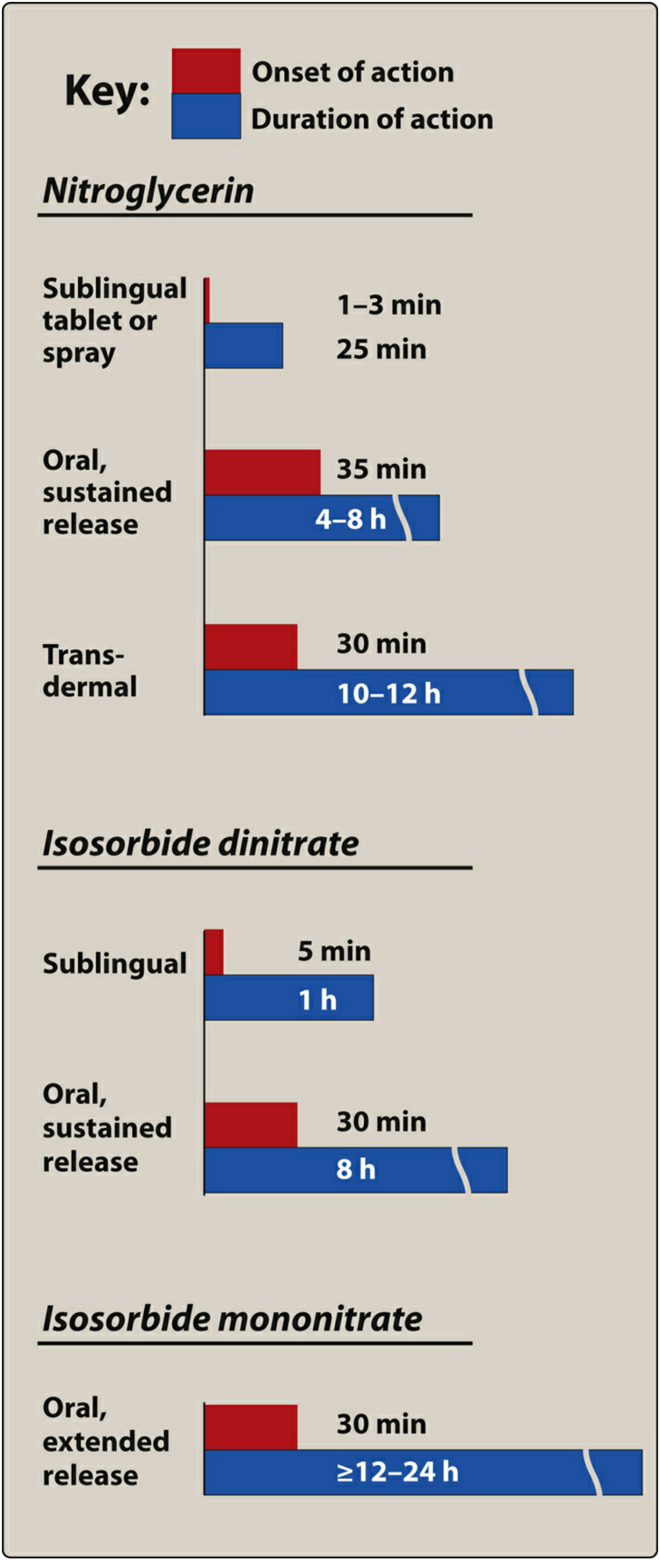
| Drug | Route | Onset | Duration | Notes |
|---|---|---|---|---|
| Nitroglycerin | Sublingual tab/spray | 1-3 min | ~25 min | Drug of choice for acute attack |
| Nitroglycerin | Transdermal patch | 30 min | 10-12 h | Wear 12 h, remove 12 h (nitrate-free interval) |
| Nitroglycerin | IV infusion | Seconds | Duration of infusion | ICU/ACS use; 10-20 mcg/min, up to 400 mcg/min |
| Nitroglycerin | Oral SR | 35 min | 4-8 h | Less used due to tolerance |
| ISDN | Sublingual | 5 min | ~1 h | Slower onset than SL GTN |
| ISDN | Oral SR | 30 min | ~8 h | Prophylaxis |
| ISMN | Oral extended-release | 30 min | ≥12-24 h | High bioavailability; no first-pass metabolism |
GTN undergoes extensive hepatic first-pass metabolism (organic nitrate reductase) - hence sublingual, transdermal, or IV routes are preferred. ISMN is the exception: it has nearly 100% oral bioavailability.
Adverse Effects
| Effect | Mechanism |
|---|---|
| Headache | Meningeal vessel dilation (most common) |
| Postural hypotension + reflex tachycardia | Preload/afterload reduction → compensatory sympathetic activation |
| Facial flushing | Vasodilation |
| Dangerous hypotension with PDE5 inhibitors | Sildenafil/tadalafil block cGMP breakdown → potentiated vasodilation; CONTRAINDICATED combination |
| Methemoglobinemia | Rare, at toxic doses; NO oxidizes Hb-Fe2+ to met-Hb-Fe3+ |
Nitrate Tolerance
Tolerance develops rapidly (within 24-48 hours of continuous exposure) to both the vascular and hemodynamic effects of nitrates. Mechanisms include:
- Depletion of sulfhydryl (-SH) groups required for bioactivation
- Downregulation or inactivation of ALDH2 (mitochondrial aldehyde dehydrogenase) - key mechanism for GTN
- Neurohormonal counter-regulation: Reflex activation of renin-angiotensin-aldosterone system (RAAS) and sympathetic nervous system in response to vasodilation
- Oxidative stress: Superoxide generated during nitrate metabolism scavenges NO
Management of tolerance:
- Provide a nitrate-free interval of 10-12 hours (usually overnight when demand is lowest)
- GTN patches: apply for 12 h, remove for 12 h
- ISMN once-daily extended-release tablet provides a natural nitrate-free period
- Caution: Patients with variant angina may experience rebound vasospasm during the nitrate-free interval - a significant limitation
Drug Interactions
- PDE5 inhibitors (sildenafil, tadalafil, vardenafil): Absolute contraindication - synergistic hypotension can be fatal
- Antihypertensives/vasodilators: Additive hypotension
- Ergotamine: May antagonize nitrate effect and provoke coronary spasm
Clinical Use Summary
| Indication | Choice |
|---|---|
| Acute angina attack | SL nitroglycerin (tablet or spray) |
| Prophylaxis of stable angina | Long-acting nitrates (ISDN SR, ISMN), combined with beta-blocker |
| Variant angina | Nitrates + CCB (especially dihydropyridines) |
| ACS / NSTEMI | IV nitroglycerin + antiplatelet + heparin |
| Heart failure with ischemia | Nitrates (hydralazine-nitrate combination if ACEi intolerant) |
Sources:
- Goodman & Gilman's Pharmacological Basis of Therapeutics, pp. 625-690 - Chapters on ischemic heart disease pharmacotherapy
- Lippincott Illustrated Reviews: Pharmacology, pp. 412-425 - Chapter 12, antianginal agents
- Katzung's Basic and Clinical Pharmacology, 16e, pp. 315-320 - Chapter 12, newer antianginal drugs


+4 more
Give me answer according to this
Here is the answer structured exactly according to your slides:
ANTIANGINAL DRUGS
Classification
ANTIANGINAL DRUGS
├── Nitrates
│ ├── Short acting
│ │ ├── Glyceryl trinitrate (GTN)
│ │ └── Isosorbide dinitrate — sublingual
│ └── Long acting
│ ├── Isosorbide dinitrate — oral
│ ├── Isosorbide mononitrate
│ ├── Erythrityl tetranitrate
│ └── Pentaerythritol tetranitrate
│
├── β-blockers
│ ├── Propranolol
│ ├── Metoprolol
│ ├── Atenolol
│ └── (others)
│
├── Calcium channel blockers
│ ├── Verapamil
│ ├── Diltiazem
│ ├── Amlodipine
│ └── (others)
│
├── Potassium channel opener
│ └── Nicorandil
│
└── Other antianginal drugs
├── Trimetazidine
├── Ranolazine
├── Ivabradine
└── Dipyridamole
Organic Nitrate Pharmacology
Key Points
- All organic nitrates share the same action; they differ only in time course
- The only major action is direct nonspecific smooth muscle relaxation
- Nitroglycerin (GTN) is the prototype drug
- Nitrates have no direct action on the heart
Pharmacological Actions
1. On Vascular Smooth Muscle (Main Action)
Nitroglycerin quickly relieves anginal pain by:
- Decreasing O2 requirement of the myocardium
- Increasing O2 delivery to the myocardium
This happens through three parallel vascular effects:
a) Venodilatation (Predominant Effect)
Peripheral pooling of blood → ↓↓ Venous return to the heart → ↓↓ Preload → ↓↓ Left and right end-diastolic ventricular volume → ↓↓ Cardiac work → ↓↓ O2 requirement of myocardium (↓ O2 demand) → Relief of anginal pain
b) Arteriolar Dilatation
↓↓ PVR (peripheral vascular resistance) → ↓ Afterload → Relief of anginal pain
c) Dilatation of Large Coronary Vessels and Collateral Vessels
Increased blood flow to ischaemic area due to redistribution of coronary blood flow → Increased O2 delivery to ischaemic area → Relief of anginal pain
2. On Other Smooth Muscles
Smooth muscles of the bronchi, oesophagus, biliary tract, etc. are relaxed by nitrates.
Pharmacokinetics
- Organic nitrates are readily absorbed through the buccal mucous membrane, skin, and GI tract
- When ingested orally, all except isosorbide mononitrate undergo extensive and variable first-pass metabolism in the liver
- They are rapidly denitrated by:
- Glutathione reductase
- Mitochondrial aldehyde dehydrogenase (ALDH2)
- The partly denitrated metabolites are less active but have a longer t½
- Metabolites are excreted mainly in urine as glucuronide derivatives
Classification by Duration
| Type | Drugs | Route | Onset |
|---|---|---|---|
| Short-acting | GTN, Isosorbide dinitrate | Sublingual | Rapid (2-5 min) |
| Long-acting | ISDN (oral), ISMN, Erythrityl tetranitrate, PETN | Oral / Transdermal | 30+ min |
- Sublingual route → rapid onset (2-5 minutes) but short duration
- Transdermal route → slow absorption through skin → used for prolonged effect
- Duration of action is governed by the rate of absorption from the site of administration and the rate of metabolism
- GTN and isosorbide dinitrate are both short-acting from sublingual but longer-acting from the oral route
Can u make the answer according to pharmacology II of B.Pharm sem 5 gtu
Let me check the GTU B.Pharm Sem 5 syllabus first.
Searching sources...
Searching the Web
GTU B.Pharm semester 5 Pharmacology II syllabus antianginal drugs 2024
The GTU BP502TP syllabus is confirmed. For anti-anginal drugs, the GTU syllabus specifically requires: classification, mechanism of action, therapeutic effects, clinical uses, side effects and contraindications. Now here is the complete answer exactly as per GTU B.Pharm Sem 5 (BP502TP) format:
ANTI-ANGINAL DRUGS
(As per GTU BP502TP - Pharmacology II, Sem 5)
ANGINA PECTORIS - Introduction
Angina pectoris is a clinical syndrome characterized by paroxysmal chest pain due to transient myocardial ischaemia, caused by an imbalance between myocardial O2 demand and O2 supply.
Types of Angina:
- Stable (Classical/Effort) angina - Fixed atherosclerotic narrowing; pain on exertion
- Unstable angina - Plaque rupture + partial thrombus; pain at rest; medical emergency
- Variant (Prinzmetal) angina - Coronary vasospasm; pain at rest; ECG shows ST elevation
CLASSIFICATION OF ANTI-ANGINAL DRUGS
ANTIANGINAL DRUGS
│
├── 1. NITRATES
│ ├── Short Acting
│ │ ├── Glyceryl trinitrate (GTN) — sublingual
│ │ └── Isosorbide dinitrate — sublingual
│ └── Long Acting
│ ├── Isosorbide dinitrate — oral
│ ├── Isosorbide mononitrate (ISMN)
│ ├── Erythrityl tetranitrate
│ └── Pentaerythritol tetranitrate (PETN)
│
├── 2. β-BLOCKERS
│ ├── Propranolol
│ ├── Metoprolol
│ ├── Atenolol
│ └── (others)
│
├── 3. CALCIUM CHANNEL BLOCKERS (CCBs)
│ ├── Verapamil
│ ├── Diltiazem
│ ├── Amlodipine
│ └── (others)
│
├── 4. POTASSIUM CHANNEL OPENER
│ └── Nicorandil
│
└── 5. OTHER ANTIANGINAL DRUGS
├── Trimetazidine
├── Ranolazine
├── Ivabradine
└── Dipyridamole
ORGANIC NITRATES
A. Mechanism of Action
All organic nitrates share the same mechanism of action and differ only in their time course.
Step-by-step mechanism:
Organic Nitrate → Intracellular conversion (via ALDH2/glutathione reductase) → Nitric Oxide (NO) → Activates Guanylate Cyclase → ↑ cGMP → Dephosphorylation of myosin light chain → Vascular smooth muscle relaxation
B. Pharmacological Actions
Nitroglycerin (GTN) is the prototype drug. Nitrates have NO direct action on the heart.
1. On Vascular Smooth Muscle (Main Action)
Nitrates relieve anginal pain by ↓ O2 demand AND ↑ O2 delivery through three mechanisms:
| Effect | Pathway | Outcome |
|---|---|---|
| Venodilatation (predominant) | ↓ Venous return → ↓ Preload → ↓ End-diastolic volume → ↓ Cardiac work | ↓↓ O2 demand |
| Arteriolar dilatation | ↓ PVR → ↓ Afterload | ↓ O2 demand |
| Coronary vasodilation | Dilates large coronary vessels + collaterals → Redistributes blood to ischaemic zone | ↑ O2 delivery |
Net result: Relief of anginal pain
2. On Other Smooth Muscles
Smooth muscles of bronchi, oesophagus, biliary tract, ureter etc. are relaxed by nitrates (but this has no clinical significance in angina).
C. Pharmacokinetics
| Parameter | Detail |
|---|---|
| Absorption | Readily absorbed via buccal mucosa, skin, and GI tract |
| First-pass metabolism | All nitrates (except isosorbide mononitrate) undergo extensive first-pass hepatic metabolism when given orally |
| Metabolism | Rapidly denitrated by: (i) Glutathione reductase (ii) Mitochondrial aldehyde dehydrogenase (ALDH2) |
| Metabolites | Partly denitrated metabolites — less active but have longer t½ |
| Excretion | Mainly in urine as glucuronide derivatives |
Classification by duration (pharmacokinetic basis):
- Duration is governed by the rate of absorption from the site + rate of metabolism
- GTN and ISDN are short-acting via sublingual, but longer-acting via oral route
| Route | Onset | Duration |
|---|---|---|
| Sublingual | Rapid — 2-5 min | Short |
| Transdermal | Slow (30 min) | Prolonged (10-12 h) |
| Oral SR | 30-35 min | 4-8 h |
| IV | Seconds | Infusion-dependent |
D. Therapeutic Uses (Clinical Uses)
- Acute anginal attack - Sublingual GTN (drug of choice); acts within 2 minutes
- Prophylaxis of stable angina - Long-acting nitrates (ISMN, ISDN oral) combined with β-blockers
- Variant (Prinzmetal) angina - Nitrates + CCBs (dilate coronary spasm)
- Unstable angina / ACS - IV nitroglycerin (along with heparin + antiplatelets)
- Acute LVF / Pulmonary oedema - IV GTN reduces preload rapidly
- Hypertensive emergencies - IV nitroglycerin
- Congestive cardiac failure - Nitrates + hydralazine (if ACE inhibitors not tolerated)
E. Adverse Effects
| Adverse Effect | Mechanism |
|---|---|
| Headache (most common) | Meningeal vessel dilatation |
| Postural hypotension | Venous pooling → ↓ BP |
| Reflex tachycardia | Compensatory sympathetic activation |
| Flushing | Cutaneous vasodilation |
| Methemoglobinemia | At toxic doses - oxidation of Hb Fe2+ → Fe3+ |
| Tolerance | Rapid desensitization (tachyphylaxis) on continuous use |
F. Drug Interactions
| Drug | Interaction | Significance |
|---|---|---|
| PDE-5 inhibitors (Sildenafil, Tadalafil) | Both ↑ cGMP → synergistic severe hypotension | Absolute contraindication |
| Antihypertensives, alcohol | Additive hypotension | Caution |
| Heparin | Nitrates may reduce anticoagulant effect of heparin | Monitor APTT |
G. Contraindications
- Hypotension / hypovolaemia
- Concurrent use of PDE-5 inhibitors (sildenafil, tadalafil) - absolute contraindication
- Severe anaemia
- Raised intracranial pressure
- Constrictive pericarditis / cardiac tamponade
- Hypertrophic obstructive cardiomyopathy (HOCM)
H. Nitrate Tolerance
- Tolerance develops rapidly (within 24-48 hours) of continuous use
- Also called tachyphylaxis
Mechanisms:
- Depletion of -SH (sulfhydryl) groups required for bioactivation
- Inactivation of ALDH2 (mitochondrial aldehyde dehydrogenase)
- Neurohormonal counterregulation - RAAS and sympathetic activation
How to overcome:
- Provide a nitrate-free interval of 10-12 hours (usually overnight)
- GTN patches: apply 12 h, remove for 12 h
- ISMN once-daily extended-release gives a natural free interval
- Note: Variant angina patients may get rebound vasospasm during nitrate-free interval
GTU Exam Tip: For 10-mark questions, cover Classification + Mechanism + Pharmacological Actions + PK + Uses + ADRs + Tolerance. For 5-mark questions focused on nitrates only, cover mechanism (NO → cGMP pathway), three vascular effects (veno > arterio > coronary), PK (first-pass, ISMN exception), ADRs (headache, hypotension, tolerance), and contraindication with sildenafil.
Classify Antianginals; explain organic Nitrate pharmacology
Here is the complete answer as per GTU B.Pharm Sem 5 - BP502TP Pharmacology II:
ANTI-ANGINAL DRUGS
CLASSIFICATION OF ANTI-ANGINAL DRUGS
ANTIANGINAL DRUGS
│
├── 1. NITRATES
│ ├── Short Acting
│ │ ├── Glyceryl trinitrate (GTN) — sublingual
│ │ └── Isosorbide dinitrate — sublingual
│ └── Long Acting
│ ├── Isosorbide dinitrate — oral
│ ├── Isosorbide mononitrate (ISMN)
│ ├── Erythrityl tetranitrate
│ └── Pentaerythritol tetranitrate (PETN)
│
├── 2. β-BLOCKERS
│ ├── Propranolol
│ ├── Metoprolol
│ └── Atenolol
│
├── 3. CALCIUM CHANNEL BLOCKERS
│ ├── Verapamil
│ ├── Diltiazem
│ └── Amlodipine
│
├── 4. POTASSIUM CHANNEL OPENER
│ └── Nicorandil
│
└── 5. OTHER ANTIANGINAL DRUGS
├── Trimetazidine
├── Ranolazine
├── Ivabradine
└── Dipyridamole
ORGANIC NITRATES — PHARMACOLOGY
1. Mechanism of Action
- All organic nitrates share the same mechanism of action
- They differ only in their time course
- The only major action is direct nonspecific smooth muscle relaxation
- Nitroglycerin (GTN) is the prototype drug
- Nitrates have NO direct action on the heart
Step-by-step mechanism:
Organic Nitrate
↓ (Intracellular bioactivation via ALDH2 / glutathione reductase)
Nitric Oxide (NO)
↓
Activates Guanylate Cyclase
↓
↑ cGMP
↓
Dephosphorylation of Myosin Light Chain
↓
Vascular Smooth Muscle Relaxation
2. Pharmacological Actions
A. On Vascular Smooth Muscle (Main Action)
Nitrates relieve anginal pain by decreasing O2 demand AND increasing O2 delivery through three simultaneous vascular effects:
i) Venodilatation — Predominant Effect
Venodilatation
↓
Peripheral pooling of blood
↓
↓↓ Venous return to the heart
↓
↓↓ Preload
↓
↓↓ Left and right end-diastolic ventricular volume
↓
↓↓ Cardiac work
↓
↓↓ O2 requirement of myocardium (↓ O2 demand)
↓
RELIEF OF ANGINAL PAIN
ii) Arteriolar Dilatation
Arteriolar Dilatation
↓
↓↓ PVR
↓
↓ Afterload
↓
RELIEF OF ANGINAL PAIN
iii) Dilatation of Large Coronary Vessels and Collateral Vessels
Dilatation of large coronary vessels + collaterals
↓
Increased blood flow to ischaemic area
(due to redistribution of coronary blood flow)
↓
Increased O2 delivery to ischaemic area
↓
RELIEF OF ANGINAL PAIN
B. On Other Smooth Muscles
Smooth muscles of bronchi, oesophagus, biliary tract, ureter etc. are relaxed by nitrates.
3. Pharmacokinetics
| Parameter | Detail |
|---|---|
| Absorption | Readily absorbed through buccal mucous membrane, skin, and GI tract |
| First-pass metabolism | All nitrates except isosorbide mononitrate undergo extensive and variable first-pass hepatic metabolism when given orally |
| Metabolism | Rapidly denitrated by (i) Glutathione reductase and (ii) Mitochondrial aldehyde dehydrogenase (ALDH2) |
| Metabolites | Partly denitrated metabolites are less active but have longer t½ |
| Excretion | Mainly in urine as glucuronide derivatives |
Key points on duration:
- Duration is governed by the rate of absorption from the site of administration and rate of metabolism
- GTN and ISDN are both short-acting from sublingual but longer-acting from oral route
- Sublingual route → rapid onset (2-5 min) but short duration
- Transdermal route → slow absorption through skin → used for prolonged effect
4. Therapeutic Uses
| Condition | Drug / Route |
|---|---|
| Acute anginal attack | Sublingual GTN — drug of choice; acts in 2 min |
| Prophylaxis of stable angina | Long-acting nitrates (ISMN, ISDN oral) + β-blocker |
| Variant (Prinzmetal) angina | Nitrates + CCBs |
| Unstable angina / ACS | IV nitroglycerin + heparin + antiplatelets |
| Acute LVF / Pulmonary oedema | IV GTN — rapid preload reduction |
| Hypertensive emergencies | IV nitroglycerin |
| CHF (if ACEi not tolerated) | Nitrate + hydralazine combination |
5. Adverse Effects
| Adverse Effect | Mechanism |
|---|---|
| Headache (most common) | Meningeal vessel dilatation |
| Postural hypotension | Venous pooling → ↓ BP |
| Reflex tachycardia | Compensatory sympathetic activation |
| Facial flushing | Cutaneous vasodilation |
| Methemoglobinemia | At toxic doses only |
| Tolerance (Tachyphylaxis) | Rapid desensitization on continuous use |
6. Drug Interactions
| Interacting Drug | Effect | Clinical Significance |
|---|---|---|
| PDE-5 inhibitors (Sildenafil, Tadalafil) | Both ↑ cGMP → synergistic severe hypotension | Absolute contraindication |
| Antihypertensives, alcohol | Additive hypotension | Caution |
7. Contraindications
- Hypotension / hypovolaemia
- PDE-5 inhibitors (sildenafil, tadalafil) — absolute contraindication
- Severe anaemia
- Raised intracranial pressure
- Hypertrophic obstructive cardiomyopathy (HOCM)
- Cardiac tamponade / constrictive pericarditis
8. Nitrate Tolerance
- Tolerance develops rapidly (within 24-48 hours) of continuous exposure
- Also called tachyphylaxis
Mechanisms:
- Depletion of -SH (sulfhydryl) groups needed for bioactivation
- Inactivation of mitochondrial ALDH2
- Neurohormonal counter-regulation (↑ RAAS, ↑ sympathetic tone)
- Oxidative stress — superoxide scavenges NO
Management of Tolerance:
- Provide a nitrate-free interval of 10-12 hours (usually overnight)
- GTN patches: apply for 12 hours, remove for 12 hours
- ISMN once-daily extended-release provides a natural free period
- Caution: Variant angina patients may get rebound vasospasm during the nitrate-free interval
GTU Exam Strategy:
- 10-mark Q: Classification + Mechanism (NO→cGMP pathway) + 3 vascular effects with flowchart + PK table + Uses + ADRs + Tolerance
- 5-mark Q on nitrates: Mechanism + venodilatation flowchart + PK (first-pass, ISMN exception) + 3 ADRs + sildenafil contraindication
- Always draw the mechanism flowchart - it fetches easy marks in GTU theory papers


Screenshot_20260725_124956_PowerPoint.jpg
Screenshot_20260725_124942_PowerPoint.jpg
Classify Diuretics; detail Thiazides mechanism and uses
Here is the complete answer as per your slides and GTU B.Pharm Sem 5 (BP502TP) format:
DIURETICS
(As per GTU BP502TP - Pharmacology II, Sem 5)
CLASSIFICATION OF DIURETICS
(Based on Site of Action in Nephron)
DIURETICS
│
├── 1. CARBONIC ANHYDRASE INHIBITORS
│ Site: Proximal Convoluted Tubule (PCT)
│ Example: Acetazolamide
│
├── 2. LOOP DIURETICS
│ Site: Thick Ascending Limb of Loop of Henle
│ Examples: Furosemide, Bumetanide,
│ Torsemide, Ethacrynic acid
│
├── 3. THIAZIDE & THIAZIDE-LIKE DIURETICS
│ Site: Distal Convoluted Tubule (DCT)
│ ├── Thiazides: Hydrochlorothiazide,
│ │ Chlorothiazide, Bendroflumethiazide,
│ │ Methyclothiazide
│ └── Thiazide-like: Chlorthalidone,
│ Indapamide, Metolazone
│
└── 4. POTASSIUM-SPARING DIURETICS
Site: Collecting Duct
├── Aldosterone Antagonists:
│ Spironolactone, Eplerenone
└── ENaC Inhibitors:
Amiloride, Triamterene
THIAZIDE DIURETICS — DETAILED PHARMACOLOGY
1. Introduction
- Thiazide diuretics increase the excretion of sodium (Na+), chloride (Cl-) and water by inhibiting sodium reabsorption in the Distal Convoluted Tubule (DCT)
- They are widely used as first-line drugs for hypertension
- Also effective in treating oedema
2. Mechanism of Action
Site of action: Early Distal Convoluted Tubule (DCT) of the nephron
Step-by-step Mechanism:
Thiazide diuretic enters the tubular lumen
↓
Acts on DCT cell — Inhibits Na+/Cl- Cotransporter (NCC)
↓
↓ Reabsorption of Na+ and Cl- from lumen into cell
↓
More Na+ reaches the Collecting Duct
↓
↑ Na+/K+ exchange in collecting duct
↓
↑ K+ and H+ secretion into urine
↓
↓ K+ in blood → HYPOKALEMIA
↑ H+ excretion → METABOLIC ALKALOSIS
Effect on Calcium (Important / Unique Feature):
Thiazide inhibits NCC in DCT
↓
↑ Intracellular Na+ depletion in DCT cell
↓
Activates basolateral Na+/Ca2+ exchanger
↓
↑ Ca2+ reabsorption back into blood
↓
↓ Urinary calcium excretion
→ CALCIUM-SPARING EFFECT
→ Useful in nephrolithiasis (calcium kidney stones)
Summary of Ion Effects:
| Electrolyte | Effect in Urine | Effect in Blood |
|---|---|---|
| Sodium (Na+) | ↑ Excretion increases | ↓ Hyponatraemia |
| Chloride (Cl-) | ↑ Excretion increases | ↓ |
| Potassium (K+) | ↑ Excretion increases | ↓ Hypokalaemia |
| Calcium (Ca2+) | ↓ Excretion decreases | ↑ Mild hypercalcaemia |
| Magnesium (Mg2+) | ↑ Excretion increases | ↓ |
| Water (H2O) | ↑ Excreted in urine | ↓ Blood volume |
| Uric acid | ↓ Excretion decreases | ↑ Hyperuricaemia |
3. Pharmacological Actions
A. Diuretic Effect
- Moderate diuresis - increases urine output
- ↓ NaCl and water excretion → reduces extracellular fluid volume
- ↓ Blood volume (initially) → ↓ Cardiac output
B. Antihypertensive Effect
- Initially: ↓ Blood volume → ↓ Cardiac output → ↓ BP
- Long term: ↓ Peripheral vascular resistance → ↓ BP
- Most effective at normal or mildly reduced renal function (GFR > 30 mL/min)
- Except Metolazone — remains effective even at very low GFR
C. Calcium-Sparing Effect
- ↓ Urinary calcium excretion
- Useful in preventing recurrent calcium kidney stones (nephrolithiasis)
- Also used in osteoporosis as adjunct (decreases urinary calcium loss)
4. Therapeutic Uses
| Use | Explanation |
|---|---|
| Hypertension (first-line) | Reduces blood volume and long-term peripheral resistance |
| Oedema | Due to heart failure, liver disease (cirrhosis), kidney disease |
| Diabetes insipidus (nephrogenic) | Paradoxical reduction of urine volume |
| Nephrolithiasis | Calcium kidney stones — reduces urinary Ca2+ excretion |
| Osteoporosis | Adjunct — decreases urinary calcium loss |
| Heart failure | Reduces oedema and preload |
5. Adverse Effects
| Adverse Effect | Mechanism |
|---|---|
| Hypokalaemia (most common/important) | ↑ K+ excretion in collecting duct |
| Hyponatraemia | ↑ Na+ excretion |
| Hypercalcaemia | ↓ Ca2+ excretion (Ca2+ sparing) |
| Hyperuricaemia (may precipitate gout) | Uric acid competes with tubular secretion |
| Hyperglycaemia | ↓ Insulin secretion (K+ depletion impairs β-cell function) |
| Hyperlipidaemia | ↑ LDL, triglycerides |
| Dehydration, dizziness, hypotension | Excessive fluid loss |
| Metabolic alkalosis | ↑ H+ excretion |
| Photosensitivity, allergic reactions | Sulfonamide-related (thiazides are sulfonamide derivatives) |
6. Contraindications
- Severe renal failure (ineffective at very low GFR — except Metolazone)
- Sulfonamide allergy — use with caution
- Severe electrolyte imbalance — absolute contraindication
- Anuria
- Severe hepatic disease (risk of electrolyte disturbance precipitating encephalopathy)
7. Drug Interactions
| Interacting Drug | Effect |
|---|---|
| NSAIDs | Reduce diuretic and antihypertensive effect |
| Digoxin | Hypokalaemia from thiazides increases digoxin toxicity |
| Lithium | Thiazides reduce lithium excretion → lithium toxicity |
| Corticosteroids | Additive hypokalaemia |
| Antidiabetics | Thiazides cause hyperglycaemia → reduced drug efficacy |
8. Quick Summary Table (GTU Favourite)
| Feature | Detail |
|---|---|
| Site of action | Distal Convoluted Tubule (DCT) |
| Transporter blocked | Na+/Cl- cotransporter (NCC) |
| Increases excretion | Na+, Cl-, H2O, K+, Mg2+ |
| Decreases excretion | Ca2+ (calcium sparing) |
| Main uses | Hypertension, oedema, nephrolithiasis, diabetes insipidus |
| Major adverse effect | Hypokalaemia |
| Unique feature | Effective at low GFR: Metolazone only |
MNEMONIC — THIAZIDE
| Letter | Meaning |
|---|---|
| T | Treats hypertension |
| H | Hypokalaemia (main ADR) |
| I | Inhibits Na+/Cl- transporter (NCC) |
| A | Alkalosis (metabolic) |
| Z | Zero ↑ urinary Ca2+ excretion (Ca2+ sparing) |
| I | Increases uric acid |
| D | Distal convoluted tubule (site) |
| E | Edema treatment |
GTU Exam Strategy:
- 10-mark Q: Classification (with sites) + Thiazide mechanism (NCC blockade step-by-step + Ca2+ sparing) + ion effects table + therapeutic uses + ADRs
- 5-mark Q on thiazides: Mechanism (NCC blockade + Ca2+ sparing) + 4 uses + hypokalaemia + hyperuricaemia as key ADRs
- Always mention Metolazone — it works at low GFR unlike other thiazides; this is a common exam distinction
Give answer of the question only
Understood. From now on I will answer only what the question asks — no extra exam tips, strategies, or extra sections beyond the question scope.
Classify Diuretics; detail Thiazides mechanism and uses
DIURETICS
Classification (Site of Action)
DIURETICS
│
├── 1. CARBONIC ANHYDRASE INHIBITORS
│ Site: Proximal Convoluted Tubule (PCT)
│ Example: Acetazolamide
│
├── 2. LOOP DIURETICS
│ Site: Thick Ascending Limb of Loop of Henle
│ Examples: Furosemide, Bumetanide,
│ Torsemide, Ethacrynic acid
│
├── 3. THIAZIDE & THIAZIDE-LIKE DIURETICS
│ Site: Distal Convoluted Tubule (DCT)
│ ├── Thiazides: Hydrochlorothiazide, Chlorothiazide,
│ │ Bendroflumethiazide, Methyclothiazide
│ └── Thiazide-like: Chlorthalidone,
│ Indapamide, Metolazone
│
└── 4. POTASSIUM-SPARING DIURETICS
Site: Collecting Duct
├── Aldosterone Antagonists:
│ Spironolactone, Eplerenone
└── ENaC Inhibitors:
Amiloride, Triamterene
THIAZIDE DIURETICS
Mechanism of Action
Site: Early Distal Convoluted Tubule (DCT)
Primary mechanism — NCC Blockade:
Thiazide acts on DCT
↓
Inhibits Na+/Cl- Cotransporter (NCC)
↓
↓ Reabsorption of Na+ and Cl- into tubular cell
↓
More Na+ delivered to Collecting Duct
↓
↑ Na+/K+ exchange in Collecting Duct
↓
↑ K+ and H+ secretion into urine
↓
↓ K+ in blood → Hypokalaemia
↑ H+ excretion → Metabolic alkalosis
Calcium-sparing mechanism (unique to thiazides):
NCC inhibition → ↑ intracellular Na+ depletion in DCT cell
↓
Activates basolateral Na+/Ca2+ exchanger
↓
↑ Ca2+ reabsorption back into blood
↓
↓ Urinary Ca2+ excretion → Calcium-sparing effect
Net effect on electrolytes:
| Electrolyte | Urinary Excretion | Blood Level |
|---|---|---|
| Na+, Cl- | ↑ Increases | ↓ Hyponatraemia |
| K+ | ↑ Increases | ↓ Hypokalaemia |
| Ca2+ | ↓ Decreases | ↑ Mild hypercalcaemia |
| Mg2+ | ↑ Increases | ↓ |
| Uric acid | ↓ Decreases | ↑ Hyperuricaemia |
Therapeutic Uses
| Use | Basis |
|---|---|
| Hypertension (first-line drug) | Initially ↓ blood volume; long term ↓ peripheral vascular resistance |
| Oedema — cardiac, hepatic, renal | ↑ Na+ and water excretion |
| Nephrogenic Diabetes Insipidus | Paradoxical ↓ urine volume by reducing blood volume → ↑ proximal reabsorption |
| Nephrolithiasis (calcium kidney stones) | Calcium-sparing effect — ↓ urinary Ca2+ prevents stone formation |
| Osteoporosis (adjunct) | ↓ urinary Ca2+ loss |
| Heart failure | Reduces oedema and preload |
This is a shared conversation. Sign in to Orris to start your own chat.