
Gak stat pathway
Reading File
The JAK-STAT pathway is a key intracellular signaling cascade used by many cytokines and growth factors. Let me search the medical library for detailed content.
Searching sources...
Finding Sources
Finding Sources
Good results. Let me read the most comprehensive sections in parallel - Harper's Biochemistry (biochemistry basis) and Roitt's Immunology (immunology perspective), plus fetch the diagram image.
Reading File
Reading File
Reading File
Excellent content retrieved. Now let me fetch the key diagram image and read a bit more from the Rheumatology text on STAT specifics and SOCS inhibition.
Loading Image
Loading Image
Reading File
I now have comprehensive information from multiple authoritative textbooks plus two excellent diagrams. Here is the full answer:
JAK-STAT Pathway
The JAK-STAT (Janus Kinase / Signal Transducer and Activator of Transcription) pathway is a major intracellular signaling cascade used by dozens of cytokines, growth factors, and hormones to regulate gene transcription.
Overview
Cytokines (e.g., interleukins, interferons) and hormones (e.g., growth hormone, erythropoietin, prolactin) do not directly enter cells. Instead, they bind to surface receptors that lack intrinsic kinase activity but are constitutively associated with JAK kinases on their cytoplasmic tails. This allows JAK-STAT signaling to translate extracellular ligand binding into nuclear gene regulation.
The Four JAK Kinases
| JAK | Primary role |
|---|---|
| JAK1 | Broad - cytokines, growth factors |
| JAK2 | Hematopoiesis, growth hormone, EPO |
| JAK3 | Immune response (T cells); limited expression |
| TYK2 | Immune response, IFN signaling |
JAK proteins have a kinase domain and a pseudokinase (regulatory) domain. Their N-terminal SH2 domains act as scaffolds (not classical phosphotyrosine binders). More than 30 Class I and ~12 Class II cytokine receptors activate JAK family members.
Step-by-Step Mechanism
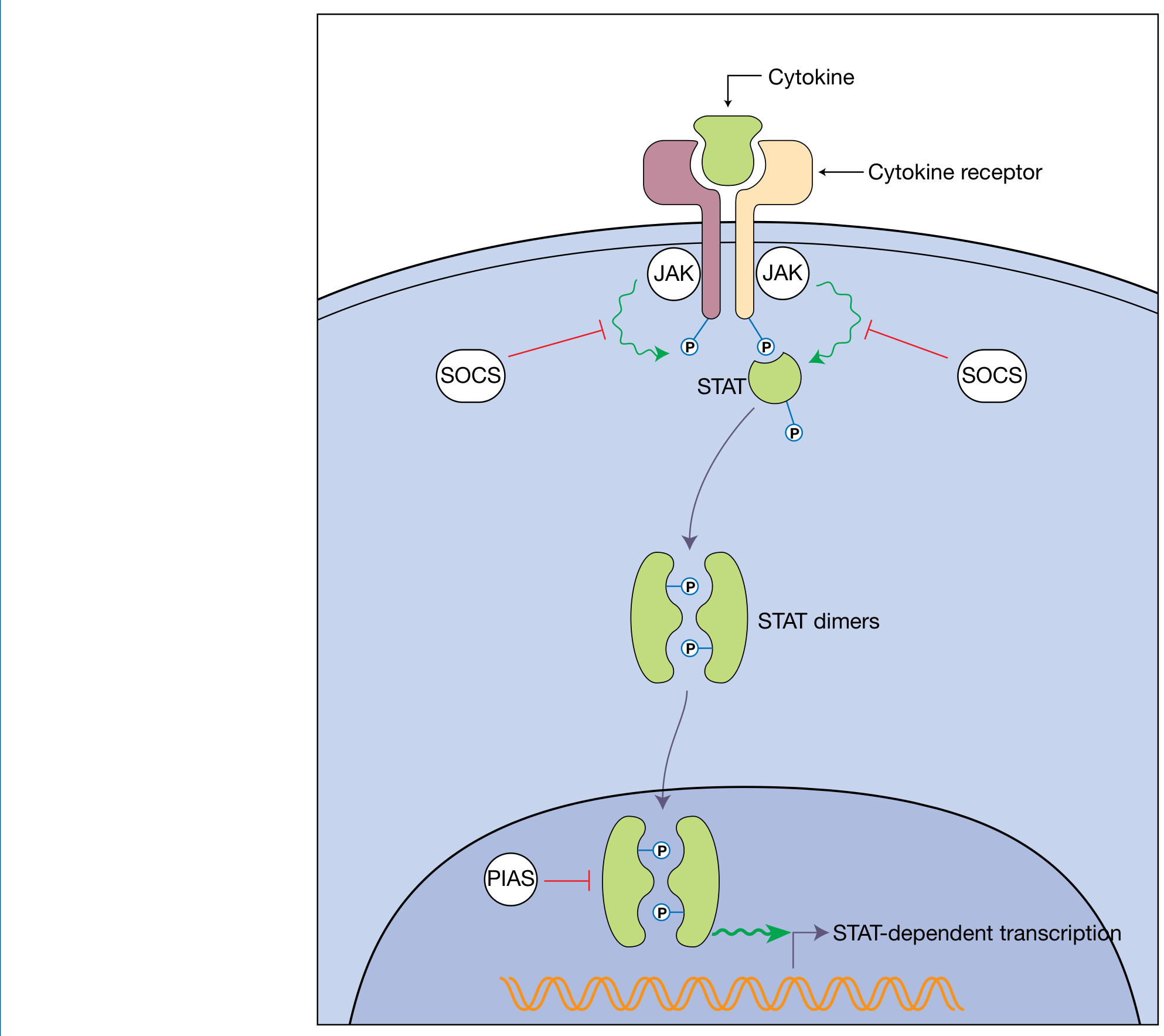
Step 1 - Cytokine Binding and Receptor Dimerization
A cytokine binds to its receptor, inducing dimerization or multimerization of the receptor subunits.
Step 2 - JAK Transphosphorylation
The dimerized receptor brings two associated JAK molecules into close proximity. They reciprocally phosphorylate each other (transphosphorylation), leading to mutual activation.
Step 3 - Receptor Tail Phosphorylation
Active JAKs phosphorylate specific tyrosine residues on the cytoplasmic tails of the receptor, creating docking sites.
Step 4 - STAT Recruitment
Cytoplasmic STAT proteins (which contain SH2 domains) are recruited to these phosphotyrosine docking sites on the receptor.
Step 5 - STAT Phosphorylation
JAKs phosphorylate the recruited STATs on a critical tyrosine residue, triggering a conformational change. The STAT detaches from the receptor.
Step 6 - STAT Dimerization
Phosphorylated STATs dimerize via SH2-phosphotyrosine interactions. Dimers may be homodimers or heterodimers, multiplying signaling diversity.
Step 7 - Nuclear Translocation and Gene Transcription
STAT dimers translocate to the nucleus and bind specific DNA promoter sequences (GAS elements or ISRE elements), activating transcription of target genes.
The Seven STAT Proteins
| STAT | Key cytokines | Main functions |
|---|---|---|
| STAT1 | IFN-α/β, IFN-γ, IL-10 | Anti-viral immunity, inflammation |
| STAT2 | IFN-α/β | Anti-viral (heterodimerizes with STAT1 + IRF9) |
| STAT3 | IL-6, IL-10, IL-11, IL-20, G-CSF | Inflammation, wound healing, B cell function |
| STAT4 | IL-12, IL-23 | T cell differentiation, lymphocyte function |
| STAT5A/5B | IL-2, IL-3, IL-5, EPO, GH, prolactin | Hematopoiesis, cell division, metabolism |
| STAT6 | IL-4, IL-13 | T cell proliferation, Treg function |
Note: STAT1 and STAT4 nuclear entry requires tyrosine phosphorylation + dimerization (creates nuclear localization signal). STAT3, 5, and 6 are imported to the nucleus regardless of phosphorylation state.
Cytokine-JAK-STAT Pairing
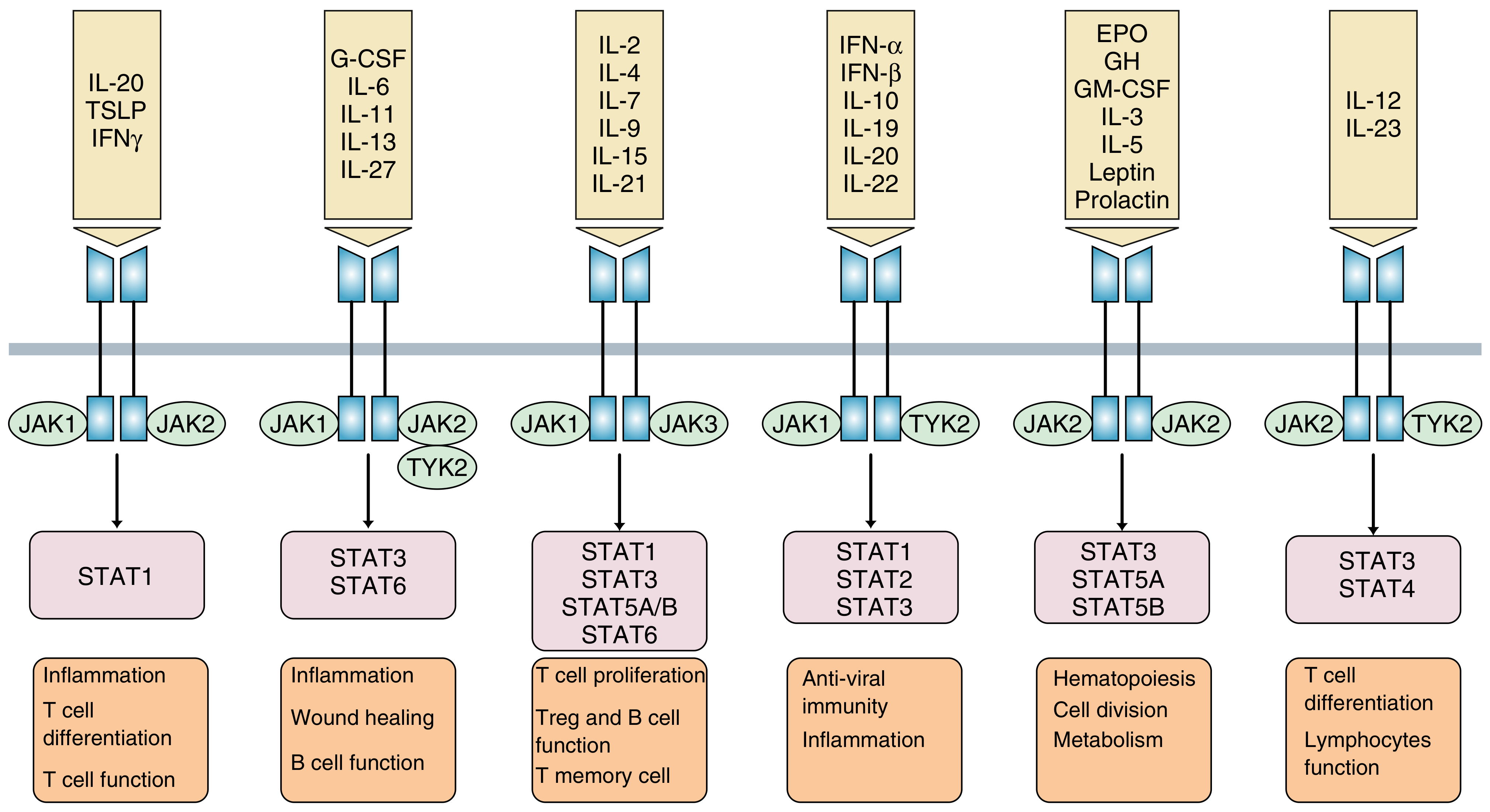
Key pairings:
- IL-6, G-CSF, IL-11 → JAK1/JAK2 (+TYK2) → STAT3/6
- IL-2, IL-4, IL-7, IL-9, IL-15, IL-21 → JAK1/JAK3 → STAT1/3/5/6
- IFN-α/β, IL-10 → JAK1/TYK2 → STAT1/2/3
- EPO, GH, GM-CSF, prolactin → JAK2/JAK2 → STAT3/5A/5B
- IL-12, IL-23 → JAK2/TYK2 → STAT3/4
Downstream Crosstalk
JAK activation also recruits SHP2, Shc, and p85, connecting to:
- Ras/MAPK cascade - proliferation
- PI3K/AKT pathway - survival and metabolism
Negative Regulation (Critical Control Mechanisms)
Three major families keep the pathway in check:
1. SOCS (Suppressors of Cytokine Signaling)
- 8 members: CIS and SOCS1-7
- Induced in a STAT-dependent manner (classical negative feedback)
- Inhibit JAK kinase activity directly, or promote ubiquitin-proteasome-mediated degradation of JAKs/receptors
- SOCS3 specifically binds JAK and the cytokine receptor, blocking STAT3 activation
2. PIAS (Protein Inhibitors of Activated STATs)
- Bind phosphorylated STAT dimers in the nucleus
- Block DNA binding or recruit histone deacetylases (transcriptional co-repressors)
3. PTPs (Protein Tyrosine Phosphatases)
- Include SHP1, SHP2, CD45, T-cell PTP
- Dephosphorylate JAKs and STATs, terminating the signal
Clinical Relevance: JAK Inhibitors (Jakinibs)
Because JAK-STAT signaling mediates responses to pro-inflammatory cytokines (IL-6, IL-12, IL-23, etc.), JAK inhibitors have become major therapeutic targets:
| Drug | JAK target | Indication |
|---|---|---|
| Tofacitinib | JAK1/3 | RA, psoriatic arthritis, UC |
| Baricitinib | JAK1/2 | RA, COVID-19 |
| Ruxolitinib | JAK1/2 | Myelofibrosis, PV |
| Upadacitinib | JAK1 selective | RA, atopic dermatitis |
Sources:
- Roitt's Essential Immunology, p. 256
- Firestein & Kelley's Textbook of Rheumatology, pp. 380-381
- Harper's Illustrated Biochemistry 32nd Ed., p. 528
- Schwartz's Principles of Surgery 11th Ed.
- Basic Medical Biochemistry 6th Ed.
This is a shared conversation. Sign in to Orris to start your own chat.