
Immediate medical management of acute angle closure attack
Reading File
Now let me search the medical library in parallel for acute angle closure management.
Finding Sources
Finding Sources
Searching PubMed
"acute angle closure" AND management
Good results. Now let me read the most detailed sections in parallel - Tintinalli's block20 (most comprehensive with 5 paragraphs), Rosen's block9 (management section), and Wills Eye Manual.
Reading File
Reading File
Reading File
Good content from Tintinalli's and Rosen's. Let me now read the management sections more fully from all three sources.
Reading File
Reading File
Reading File
Excellent. I have very comprehensive content from three major references. Let me read the rest of the Wills Eye treatment section and the Tintinalli disposition/definitive care section.
Reading File
Reading File
I now have comprehensive data from three major references. Let me fetch the key clinical image showing the drug box from Rosen's.
Loading Image
Loading Image
I have all the information needed for a thorough, well-structured answer. Here is the comprehensive response:
Immediate Medical Management of Acute Angle Closure Attack
Acute angle closure glaucoma (AACG) is a true ocular emergency. IOP can exceed 60-80 mmHg (normal 10-20 mmHg), and permanent optic nerve and corneal damage can occur within hours. The goal of immediate medical management is rapid IOP reduction while ophthalmology is consulted for definitive therapy.
Clinical Recognition
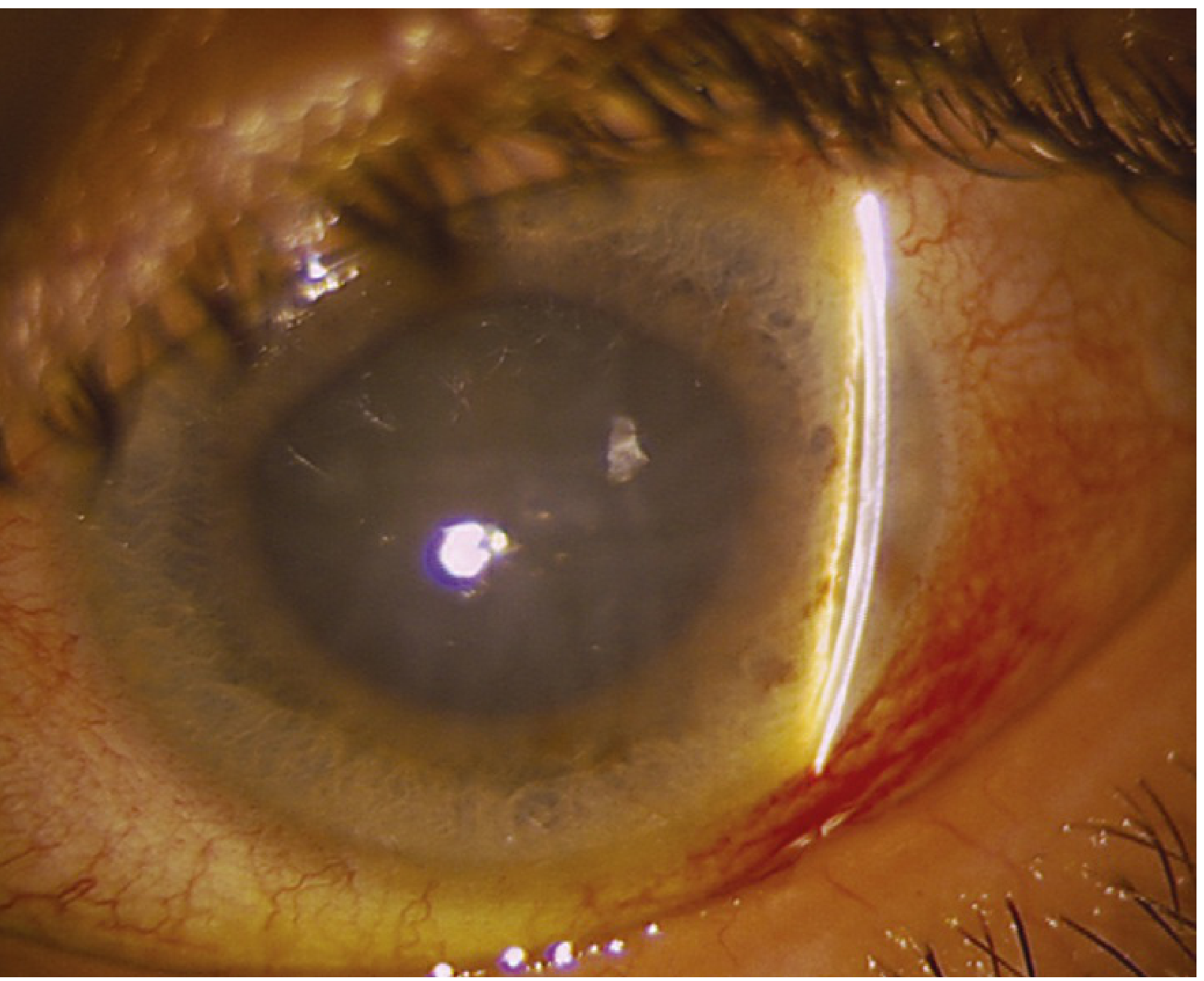
Slit lamp appearance: mid-dilated fixed pupil, shallow anterior chamber, corneal edema - Wills Eye Manual
Classic triad:
- Severe unilateral eye pain + frontal/supraorbital headache
- Nausea, vomiting, blurred vision with halos around lights
- On exam: rock-hard globe, hazy "steamy" cornea, fixed mid-dilated (4-6 mm) pupil, conjunctival injection (most prominent at limbus)
IOP is typically >30 mmHg; the characteristic symptom complex alone is diagnostic even without tonometry.
Immediate Steps
1. Position the patient supine - encourages the lens to fall posteriorly, potentially widening the angle.
2. Emergent ophthalmology consultation - call immediately and work in parallel with medical treatment.
3. Measure IOP (tonopen/applanation) to confirm and baseline.
Medical Treatment (Initiate Immediately, in Combination)
The approach combines agents that reduce aqueous production and increase outflow. Three drug classes are started together at the outset.

Step 1 - Combination Topical + Systemic Therapy (Start immediately)
| Drug Class | Agent & Dose | Notes |
|---|---|---|
| Systemic CAI | Acetazolamide 500 mg IV or PO, then 250 mg q4h (max 1000 mg/day) | First-line backbone; do NOT use in sulfa allergy, sickle cell disease, or sulfonamide-induced closure |
| Topical β-blocker | Timolol 0.5% - 1 drop affected eye, repeat in 30 min | Reduces aqueous production; avoid in asthma, COPD, bradycardia, heart block; alternative: betaxolol 0.5% |
| Topical α2-agonist | Apraclonidine 1% (or brimonidine 0.1%) - 1 drop affected eye | Reduces production + increases uveoscleral outflow |
| Topical CAI | Dorzolamide 2% or brinzolamide 0.5% - 1 drop TID | Alternative to or add-on with systemic CAI |
| Topical prostaglandin | Latanoprost 0.005% - 1 drop | Increases uveoscleral outflow (per Rosen's) |
| Topical steroid | Prednisolone acetate 1% - 1 drop q15-30 min x 4, then q1h | Reduces corneal edema and inflammation |
In urgent/refractory cases, three rounds of topical medications may be given, each round separated by 15 minutes (Wills Eye Manual).
Step 2 - Reassess IOP at 1 Hour
If IOP does not fall significantly (target typically <40 mmHg, with symptom improvement):
| Drug Class | Agent & Dose | Notes |
|---|---|---|
| Hyperosmotic agent | Mannitol 1-2 g/kg IV over 45 minutes (20% solution) | Reduces vitreous volume; contraindicated in CHF, renal failure, and intracranial bleeding; check renal function first |
| Alternative osmotic | Glycerine 1-2 g/kg orally, repeat q5h | Used when IV access unavailable; avoid in diabetics (metabolized to glucose) |
Compression gonioscopy by ophthalmology may break the attack mechanically.
What NOT to Use (Important)
- Pilocarpine - no longer recommended in the acute ED/emergency setting. Though historically used (1-2% q15 min x 2 doses), it can paradoxically shallow the anterior chamber and worsen angle closure. It has also fallen out of favor due to accommodative spasm, headache, and risk of uveitis/retinal detachment. It is contraindicated in aphakic/pseudophakic pupillary block (use mydriatics instead in that scenario).
- Systemic CAIs in sulfonamide-induced angle closure (e.g., topiramate toxicity) - strictly contraindicated. These cases require stopping the offending drug and using cycloplegics (atropine 1% BID-TID) to posteriorly rotate the ciliary body.
- Anticholinergics and sympathomimetics - these precipitate attacks; avoid.
Analgesia and Antiemetics
- Vomiting raises IOP further - treat aggressively
- Fentanyl (IV) lowers IOP and is the analgesic of choice
- Ondansetron has no significant effect on IOP and is appropriate for nausea
- Avoid morphine if possible (can cause nausea)
Special Cases
| Scenario | Key Modification |
|---|---|
| Aphakic/pseudophakic pupillary block | Do NOT use pilocarpine; use cycloplegics (cyclopentolate 1-2% + phenylephrine 2.5%) |
| Topiramate/sulfonamide-induced | Stop drug immediately; NO CAIs; use cycloplegics + IV steroids (methylprednisolone 250 mg q6h) for refractory cases; PI is NOT indicated |
| Phacomorphic glaucoma | Lens removal once IOP controlled |
Procedural Options (Ophthalmology)
- Compression gonioscopy (dynamic gonioscopy) - can break the attack by mechanically opening the angle; performed at the slit lamp
- Anterior chamber paracentesis - 30-gauge needle on open tuberculin syringe at 6 o'clock position; provides immediate IOP reduction in refractory cases
- Laser peripheral iridotomy (YAG-PI) - definitive treatment; performed once cornea clears (typically 1-5 days after attack); treats the anatomical pupillary block
Definitive Treatment
YAG laser peripheral iridotomy (or surgical iridectomy if laser not feasible) is done within 24-48 hours for persistent symptoms, or once the eye is quiet. It creates a patent communication between the posterior and anterior chambers, bypassing pupillary block.
Critical note: The fellow (uninvolved) eye has a 40-80% chance of developing acute angle closure within 5-10 years and should also receive prophylactic PI.
Disposition
- Emergent ophthalmology consultation (do not delay treatment while waiting)
- Admit or observe in ED for serial IOP monitoring
- Discharge (once IOP controlled) on maintenance IOP-lowering drops, topical steroids if inflamed, and close follow-up (IOP check daily initially)
Sources: Tintinalli's Emergency Medicine (9th ed.) | Rosen's Emergency Medicine (9th ed.) | Wills Eye Manual (7th ed.)
This is a shared conversation. Sign in to Orris to start your own chat.