
Explain ascending pathways in simple terms
The question involves neuroanatomy, so I need to invoke the medical-library skill first.
Reading File
Now I'll search the medical library for ascending pathways content, and run a parallel heading search.
Finding Sources
Finding Sources
Excellent results. Let me now read the most relevant sections from Neuroscience: Exploring the Brain and Guyton & Hall, plus the Kandel Principles of Neural Science block, in parallel.
Reading File
Reading File
Reading File
Great content. Let me now read a bit more from Guyton & Hall on the spinothalamic/anterolateral pathway, and fetch the key diagrams simultaneously.
Reading File
Loading Image
Loading Image
Now let me fetch the spinothalamic tract diagram and read the relevant section about it from Guyton & Hall.
Finding Sources
Loading Image
Now let me read the spinothalamic section from Neuroanatomy through Clinical Cases and the anterolateral system from Neuroscience: Exploring the Brain.
Reading File
Reading File
I now have excellent, rich content from multiple authoritative textbooks. Let me fetch the anterolateral system diagram to include in the answer.
Loading Image
I now have all the information and diagrams needed to write a thorough, clear explanation. Here is the full answer:
Ascending Pathways - Simple Explanation
The big idea: Your body constantly picks up information from the outside world - touch, temperature, pain, vibration, body position. Ascending pathways are the "upward highways" in your nervous system that carry all of that sensory information from your body (and face) up to your brain so you can consciously feel and interpret it.
Think of them as a postal delivery chain: a letter (sensation) starts at the skin, gets handed off at a few relay stations, and finally arrives at the brain (the final destination).
The Three-Neuron Chain
Almost every ascending pathway follows the same basic relay structure - three neurons passing a signal like a baton:
| Neuron | Location | Job |
|---|---|---|
| 1st-order (primary) | Sensory organ → spinal cord (dorsal root ganglion) | Detects the sensation and carries it into the spinal cord |
| 2nd-order | Spinal cord or brainstem | Receives the signal and sends it up toward the thalamus |
| 3rd-order | Thalamus | Receives signal from brainstem/cord and sends it to the cortex |
The thalamus is the great relay station of the brain - nearly all sensory information passes through it on the way to consciousness.
The Two Main Ascending Pathways
1. Dorsal Column - Medial Lemniscal Pathway (Touch & Position)
What it carries: Fine touch, vibration, two-point discrimination, proprioception (sense of limb position)
Simple route:
Skin/Joints → Dorsal root ganglion (1st neuron)
↓ travels UP the same side of the spinal cord in the DORSAL COLUMNS
Dorsal column nuclei in the medulla (synapse → 2nd neuron)
↓ crosses to the OPPOSITE side (decussates) → becomes the MEDIAL LEMNISCUS
Thalamus - VPL nucleus (synapse → 3rd neuron)
↓
Somatosensory cortex (postcentral gyrus) - "I feel it!"
Key points:
- The signal travels up on the same side first, then crosses over at the medulla (base of the brain)
- Uses large, fast myelinated axons (Aβ fibres) - signal arrives quickly
- Some of the longest axons in the body run uninterrupted from your big toe all the way to the medulla without a single synapse
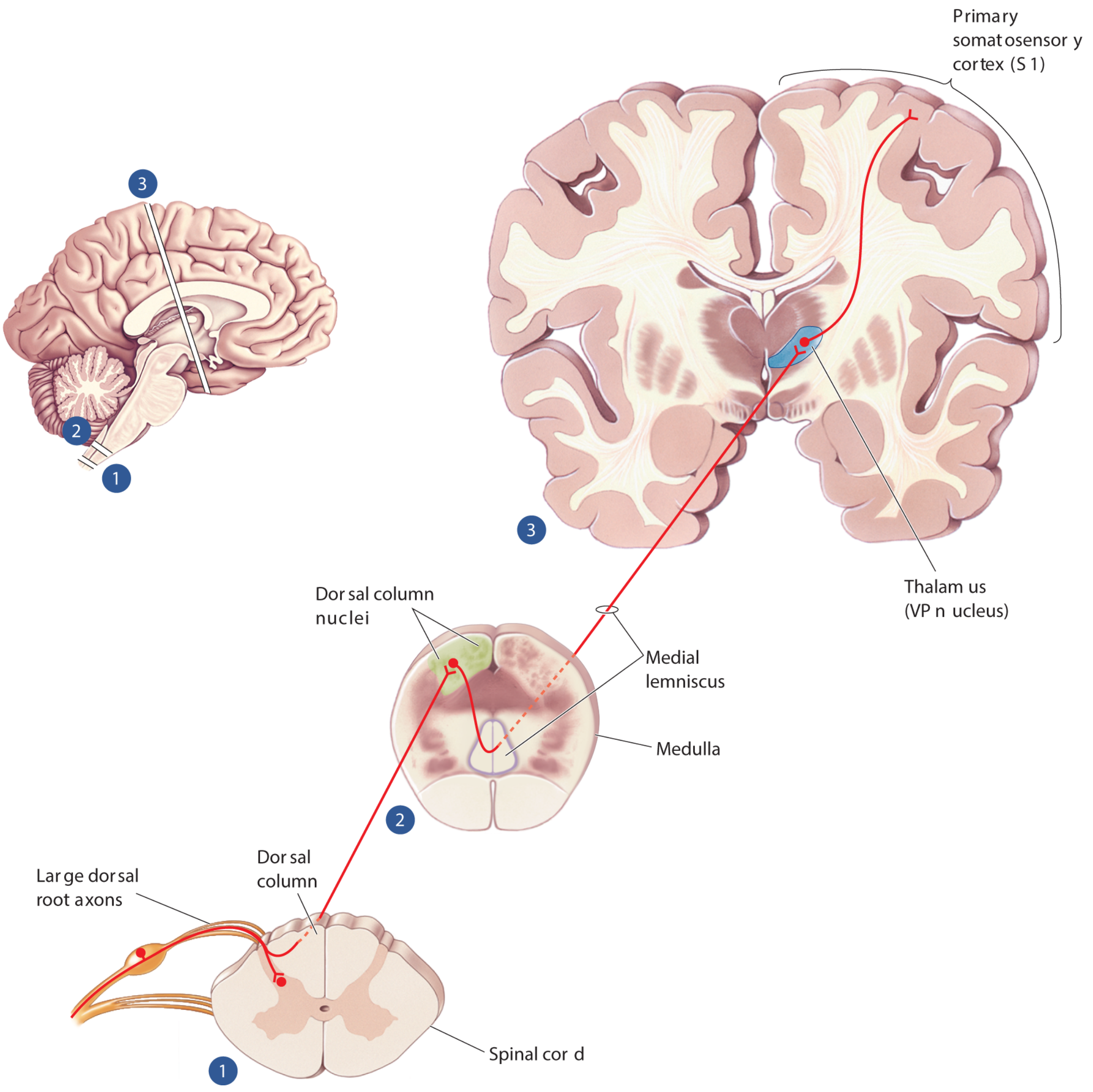
Dorsal column-medial lemniscal pathway. Notice the three-neuron relay: spinal cord → medulla (crosses sides here) → thalamus → cortex. - Neuroscience: Exploring the Brain, 5th Ed.
2. Anterolateral System / Spinothalamic Tract (Pain & Temperature)
What it carries: Pain, temperature, itch, and crude touch
Simple route:
Free nerve endings in skin (Aδ, C fibres) → Dorsal root
↓ enters spinal cord, synapses immediately in the DORSAL HORN (1st neuron ends here)
2nd neuron IMMEDIATELY crosses to the OPPOSITE side (via anterior commissure)
↓ travels UP the ANTEROLATERAL (front-side) column of the cord
Through medulla, pons, midbrain - no stopping
Thalamus - VPL + intralaminar nuclei (synapse → 3rd neuron)
↓
Somatosensory cortex + limbic areas - "Ouch! That hurts!"
Key points:
- Crosses to the opposite side early - right in the spinal cord (compare with the dorsal column pathway which crosses at the medulla)
- Uses small, slow fibres (Aδ = sharp pain; C = burning/aching pain)
- Because it crosses early, a lesion on the LEFT side of the cord below the neck causes pain/temperature loss on the RIGHT side of the body starting a few segments below the injury
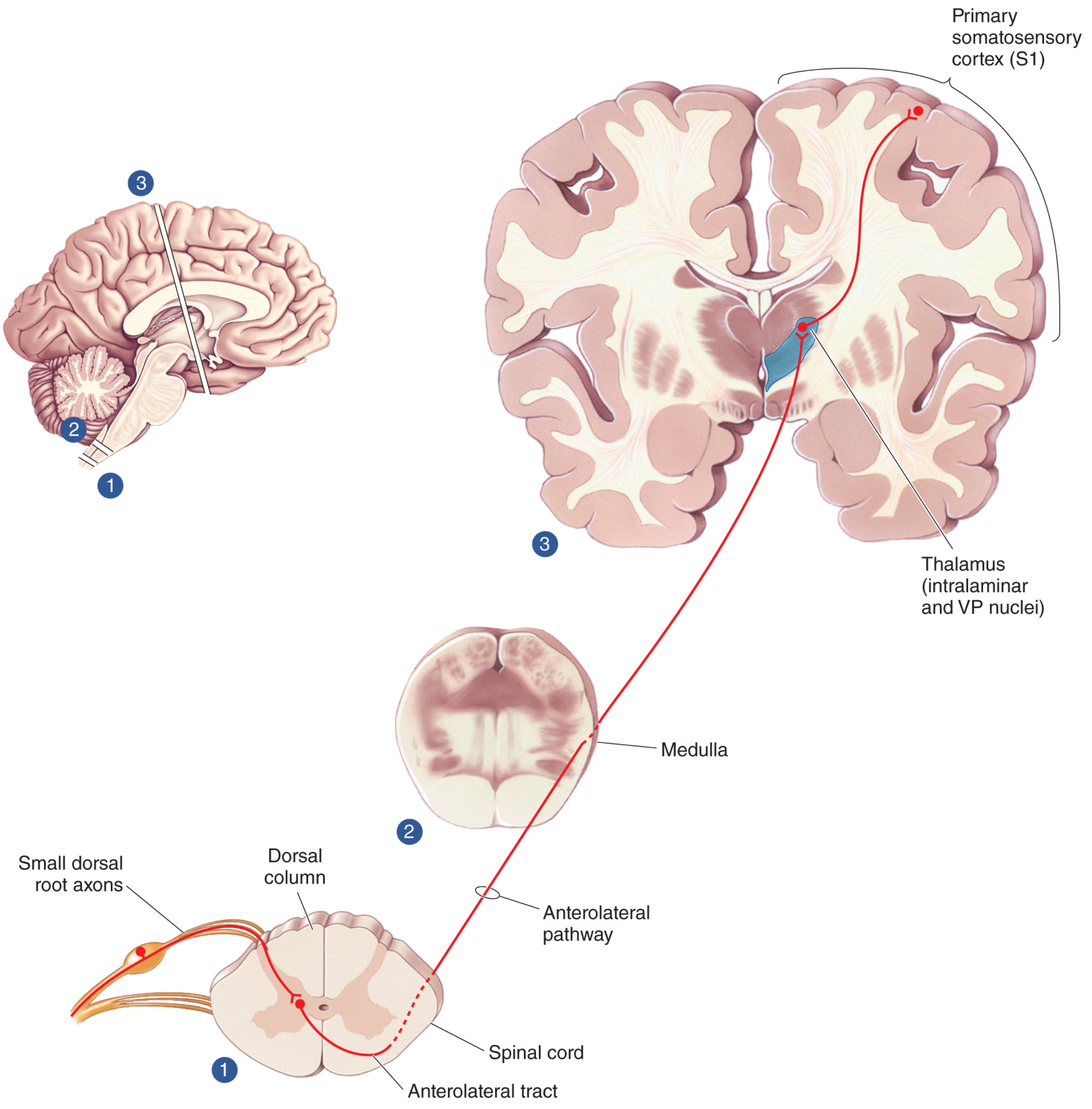
Anterolateral (spinothalamic) system. The signal crosses the spinal cord immediately, then travels up to the thalamus and cortex. - Neuroscience: Exploring the Brain, 5th Ed.
Side-by-Side Comparison
| Feature | Dorsal Column Path | Anterolateral Path |
|---|---|---|
| Sensation | Touch, vibration, position | Pain, temperature, itch |
| Fibres | Large, fast (Aβ) | Small, slow (Aδ, C) |
| Where it crosses | In the medulla | In the spinal cord |
| Spinal cord position | Posterior (dorsal columns) | Anterior-lateral |
| Relay in cord | No synapse until medulla | Synapses immediately in dorsal horn |
The Spinal Cord Cross-Section View
Here is how the two pathways look side by side in a cross-section of the spinal cord:
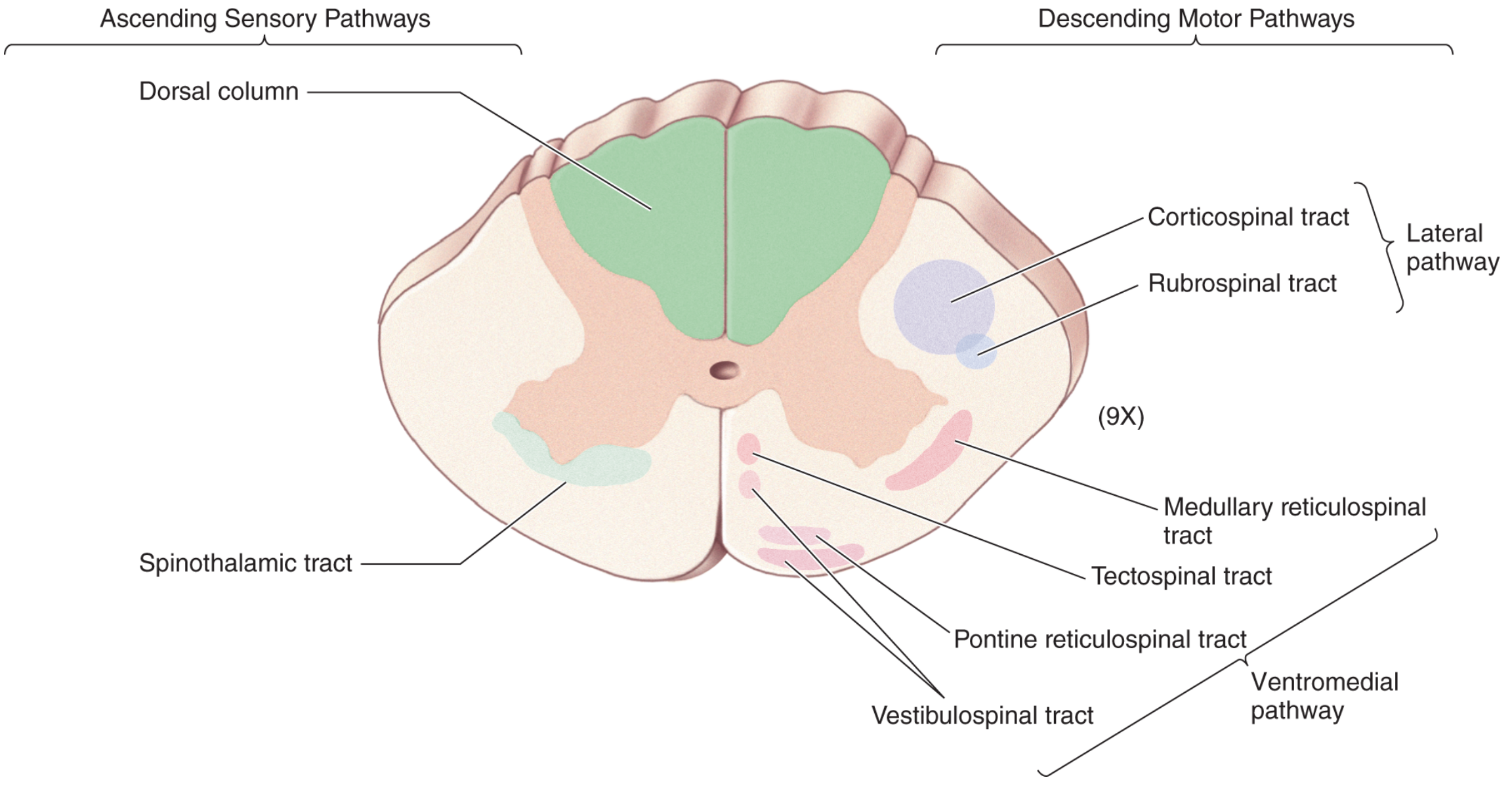
Cross-section of the spinal cord. Green (left) = ascending sensory pathways. Right side = descending motor pathways. - Neuroscience: Exploring the Brain, 5th Ed.
Other Ascending Pathways (Brief)
| Pathway | Carries | Destination |
|---|---|---|
| Spinocerebellar tracts | Unconscious proprioception (body position for balance/coordination) | Cerebellum (NOT cortex - you don't consciously feel this) |
| Spinoreticular tract | Pain (affective/emotional component - "how much does it bother you?") | Brainstem reticular formation → intralaminar thalamus |
| Spinomesencephalic tract | Pain modulation signals | Midbrain (periaqueductal grey) - feeds back to dampen pain |
Why This Matters Clinically
The fact that the two main pathways cross at different levels explains classic spinal cord injury patterns:
- Brown-Séquard syndrome (half cord cut): On the injured side you lose touch/vibration/position; on the opposite side you lose pain/temperature. This is because they cross at different places.
- A tumor in the center of the cord (e.g., syringomyelia) first damages the fibers crossing in the anterior commissure → bilateral loss of pain and temperature at that level, but touch is preserved (since the dorsal columns are untouched).
Sources:
- Neuroscience: Exploring the Brain, 5th Ed., pp. 1160-1209
- Guyton and Hall Textbook of Medical Physiology, pp. 597-599
- Neuroanatomy through Clinical Cases, 3rd Ed., pp. 303-305
This is a shared conversation. Sign in to Orris to start your own chat.