
Cerebral circulation and factors which govern the blood supply of brain in conscious and anaesthetised patients.
Cerebral Circulation and Factors Governing Brain Blood Supply
1. Anatomy of the Cerebral Circulation
Arterial Supply
- Anterior cerebral artery (ACA) — medial frontal and parietal lobes
- Middle cerebral artery (MCA) — lateral frontal, parietal, temporal lobes
- Posterior cerebral artery (PCA) — occipital lobe, inferior temporal
Venous Drainage
- Superficial cortical veins — within the pia mater
- Deep cortical veins — drain deeper structures
- Both empty into dural sinuses (superior/inferior sagittal, straight, transverse, sigmoid) → internal jugular veins
2. Normal Values
| Parameter | Value |
|---|---|
| Total CBF (adult) | 750 mL/min (~50 mL/100 g/min) |
| Gray matter CBF | ~80 mL/100 g/min |
| White matter CBF | ~20 mL/100 g/min |
| % of cardiac output | 12–15% |
| CMRO₂ | ~3.5 mL O₂/100 g/min |
| % of total body O₂ consumption | ~20% |
| EEG slowing threshold | <20–25 mL/100 g/min |
| Isoelectric EEG | <20 mL/100 g/min |
| Irreversible ischaemia | <10 mL/100 g/min |
3. Factors Governing CBF
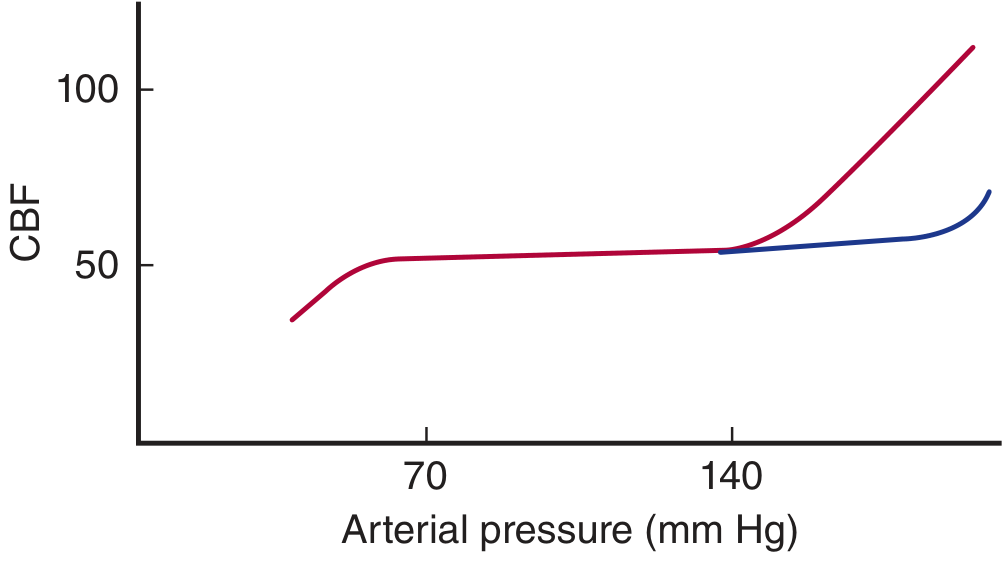
A. Myogenic Autoregulation (Pressure–Flow Autoregulation)
B. Chemical and Metabolic Regulation
Carbon Dioxide (most potent cerebrovascular regulator)
- Hypercapnia (↑PaCO₂): potent vasodilation → ↑CBF. CBF changes ~2–4% per mmHg change in PaCO₂ in the range 20–80 mmHg
- Hypocapnia (↓PaCO₂): vasoconstriction → ↓CBF. This is the basis of controlled hyperventilation to reduce ICP in neurosurgical patients
Oxygen
- Hypoxia (PaO₂ < 50 mmHg): causes vasodilation → ↑CBF
- Normal PaO₂ has little effect on CBF
- Hyperoxia causes mild vasoconstriction
Metabolic/Flow–Metabolism Coupling (Neurovascular Coupling)
- Local CBF tightly matches local neuronal metabolic activity — the neurovascular unit (neurons, astrocytes, pericytes, endothelium)
- Increased neuronal firing → glutamate release → astrocyte activation → release of vasoactive mediators (K⁺, adenosine, NO, arachidonic acid metabolites) → local arteriolar dilation → regional CBF increase
- This is the physiologic basis of fMRI (BOLD signal)
- Gray matter CBF is 4× white matter CBF, matching metabolic demand
C. Intracranial Pressure (ICP) — Monro-Kellie Doctrine
D. Neurogenic Regulation
- Large cerebral vessels receive extrinsic sympathetic (vasoconstriction via noradrenaline), parasympathetic (vasodilation via acetylcholine, VIP), and sensory (trigeminal — substance P, CGRP) innervation
- Intraparenchymal arterioles are primarily under intrinsic/metabolic control
- Sympathetic activation extends the plateau of autoregulation to the right (Fig. 33-9 blue line) — i.e., provides protection against hypertension-induced breakthrough
- Role of autonomic nerves in routine CBF regulation is modest; they become important during extreme BP changes
E. Blood Viscosity and Rheology
- Haematocrit is the main determinant of viscosity
- Increasing viscosity → ↑CVR → ↓CBF (and vice versa)
- Moderate haemodilution (Hct ~30–35%) may paradoxically improve CBF by reducing viscosity, though this must be balanced against reduced O₂-carrying capacity
F. Cardiac Output
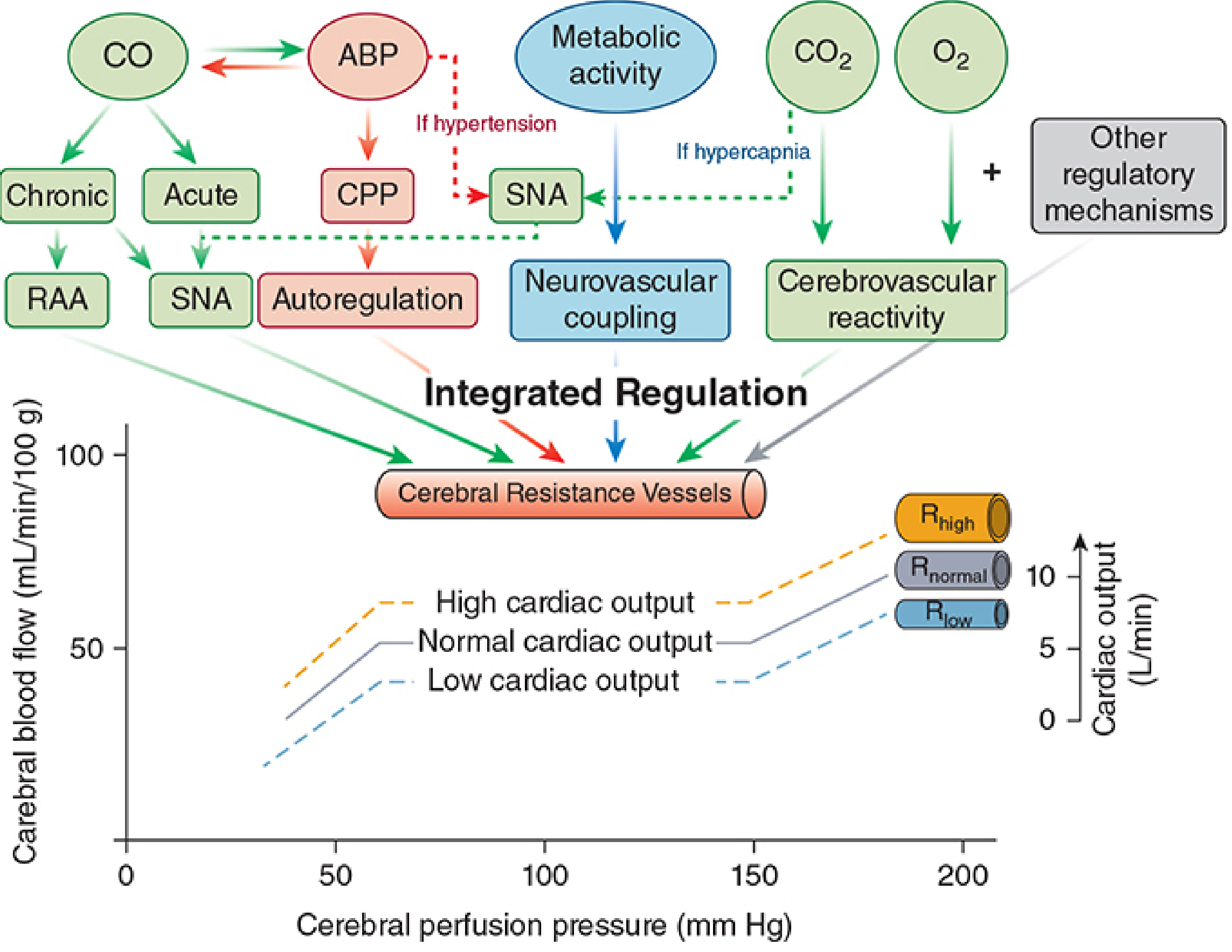
4. Integrated Regulation Framework
- Myogenic tone (MAP/CPP)
- Metabolic demand (neurovascular coupling)
- Blood gas tensions (PaCO₂ > PaO₂)
- Autonomic tone
- Cardiac output and circulating volume
5. CBF in the Conscious Patient
- Total CBF ≈ 750 mL/min (54 mL/100 g/min)
- Flow is highest in the premotor and frontal cortex (cognitive/sensory decoding)
- Voluntary movement → increased regional CBF in corresponding motor/sensory cortex
- Language, visual tasks → increased occipital/temporal CBF
- These dynamic regional changes underlie PET and fMRI neuroimaging
- Autoregulation is intact; cerebrovascular reactivity to CO₂ is robust
- EEG and metabolic coupling are fully preserved
6. CBF Under General Anaesthesia
CBF = f(CMRO₂, direct vascular effects, autoregulatory status)
Cerebral Metabolic Rate (CMRO₂) Under Anaesthesia
- ~60% of brain energy consumption is for electrophysiologic function (ion gradients, neurotransmitter cycling)
- ~40% is for cellular homeostasis ("housekeeping")
- Most anaesthetics (barbiturates, propofol, isoflurane, sevoflurane, desflurane, etomidate) suppress the electrophysiologic component in a dose-dependent manner, tracked by progressive EEG suppression
- Once EEG is isoelectric, no further reduction in CMRO₂ occurs — the housekeeping component is irreducible by anaesthetics
- Exceptions: Ketamine and N₂O increase CMRO₂ and CBF
Effects of Individual Anaesthetic Agents
Volatile Anaesthetics (Halothane, Isoflurane, Sevoflurane, Desflurane)
- All are direct cerebral vasodilators → tend to ↑CBF
- Simultaneously ↓CMRO₂ via EEG suppression → coupled tendency to ↓CBF
- Net effect = balance of direct vasodilation vs. metabolic suppression (uncoupling):
- Halothane: greatest cerebral vasodilation per MAC — significant CBF increase even at low doses
- Isoflurane: CBF minimally changed at <1 MAC (metabolic suppression offsets vasodilation); increases at ≥1.5 MAC
- Sevoflurane and Desflurane: minimal change in CBF up to 1.5 MAC; sevoflurane best preserves autoregulation
- Autoregulation: All volatile agents impair pressure autoregulation in a dose-dependent manner. At high doses, CBF becomes pressure-passive. Sevoflurane best preserves dynamic autoregulation; desflurane and isoflurane impair it more
- CO₂ reactivity is partially preserved under volatile anaesthesia
- ICP: Volatile agents increase CBF (and therefore ICP); this can be attenuated by prior hyperventilation or barbiturate coadministration
Intravenous Agents
| Agent | CBF | CMRO₂ | Autoregulation | ICP |
|---|---|---|---|---|
| Propofol | ↓↓ | ↓↓ | Preserved | ↓ |
| Barbiturates (thiopental) | ↓↓ | ↓↓ | Preserved | ↓↓ |
| Etomidate | ↓ | ↓ | Preserved | ↓ |
| Ketamine | ↑↑ | ↑ | Impaired | ↑↑ |
| Benzodiazepines | ↓ | ↓ | Preserved | ↓ |
| Dexmedetomidine | ↓ modest | ↓ modest | Preserved | ↓ |
| N₂O | ↑ | ↑ | Variable | ↑ |
Temperature and Anaesthesia
- CMRO₂ decreases 6–7% per °C of hypothermia
- Unlike anaesthetic drugs, hypothermia reduces both electrophysiologic and housekeeping components
- At 18–20°C, EEG is isoelectric; CMRO₂ at 18°C is <10% of normothermic values — basis of hypothermic circulatory arrest in cardiac surgery
Glymphatic System and Anaesthesia
Summary: Key Differences — Conscious vs. Anaesthetised
| Feature | Conscious | Anaesthetised |
|---|---|---|
| CBF | 50 mL/100g/min | Variable (drug-dependent) |
| CMRO₂ | 3.5 mL O₂/100g/min | Reduced (except ketamine/N₂O) |
| Flow–metabolism coupling | Intact | May be uncoupled by volatile agents |
| Autoregulation | Intact (MAP 65–150) | Impaired by volatiles (dose-dependent); preserved with IVA |
| CO₂ reactivity | Robust | Partially preserved (all agents) |
| Regional flow variation | High (task-dependent) | Blunted |
| ICP | Normal | ↑ with volatiles; ↓ with IVA |
- Miller's Anesthesia, 10th Ed., Ch. 10 — Cerebral Physiology and the Effects of Anesthetic Drugs
- Morgan & Mikhail's Clinical Anesthesiology, 7th Ed., Ch. 26
- Barash, Cullen & Stoelting's Clinical Anesthesia, 9th Ed., Ch. 18
- Ganong's Review of Medical Physiology, 26th Ed., Ch. 33 — Cerebral Circulation
- Guyton & Hall Textbook of Medical Physiology
Add just a diagram of the anatomy as well and make a pdf
ls /home/daytona/workspace/ 2>/dev/null || mkdir -p /home/daytona/workspace/cerebral-circulation
mkdir -p /home/daytona/workspace/cerebral-circulation && cd /home/daytona/workspace/cerebral-circulation && python3 -c " import urllib.request imgs = { 'anatomy_diagram.png': 'https://cdn.orris.care/cdss_images/0f1d81f00b9d6b40254223b9fc03e1cd650881c74958d14384a78f7e2d1c015d.png', 'autoregulation.png': 'https://cdn.orris.care/cdss_images/ae26a2d0194300de5e94ce0a9ae86b57d8508b0a43ba3ebb0a92a617025e0892.png', 'factors_cbf.png': 'https://cdn.orris.care/cdss_images/6594eafafac6b631be72abe5a14c6e0b82af22c072fef00a1ea259881c51a1a5.png', 'integrated_regulation.png': 'https://cdn.orris.care/cdss_images/7629cd61007d1b2842ba3d047f4bb9c165a7828a7828cabdffcb5cec74d9ba18.png', } for fn, url in imgs.items(): urllib.request.urlretrieve(url, fn) print(f'Downloaded {fn}') "
~/cerebral-circulation/build_pdf.py
from reportlab.lib.pagesizes import A4
from reportlab.lib.units import cm
from reportlab.lib.styles import getSampleStyleSheet, ParagraphStyle
from reportlab.lib.colors import HexColor, white, black
from reportlab.platypus import (
SimpleDocTemplate, Paragraph, Spacer, Image, Table, TableStyle,
HRFlowable, PageBreak, KeepTogether
)
from reportlab.lib.enums import TA_CENTER, TA_LEFT, TA_JUSTIFY
from reportlab.lib import colors
import os
OUTPUT = "/home/daytona/workspace/cerebral-circulation/Cerebral_Circulation.pdf"
IMG_DIR = "/home/daytona/workspace/cerebral-circulation"
# ── Colour palette ──────────────────────────────────────────────────────────
NAVY = HexColor("#1a3a5c")
BLUE = HexColor("#2563a8")
LBLUE = HexColor("#dbeafe")
TEAL = HexColor("#0e7490")
LTEAL = HexColor("#ccfbf1")
GREY = HexColor("#f1f5f9")
DKGREY = HexColor("#475569")
RED = HexColor("#dc2626")
AMBER = HexColor("#d97706")
GREEN = HexColor("#16a34a")
doc = SimpleDocTemplate(
OUTPUT, pagesize=A4,
leftMargin=2*cm, rightMargin=2*cm,
topMargin=2.5*cm, bottomMargin=2.5*cm,
title="Cerebral Circulation",
author="Orris Medical"
)
W = A4[0] - 4*cm # usable width
styles = getSampleStyleSheet()
# Custom styles
def S(name, **kw):
base = kw.pop("parent", "Normal")
return ParagraphStyle(name, parent=styles[base], **kw)
title_s = S("DocTitle", fontSize=22, textColor=white, leading=28, alignment=TA_CENTER, fontName="Helvetica-Bold")
sub_s = S("DocSub", fontSize=12, textColor=LBLUE, leading=16, alignment=TA_CENTER, fontName="Helvetica")
h1_s = S("H1", fontSize=14, textColor=white, leading=18, fontName="Helvetica-Bold", spaceAfter=2)
h2_s = S("H2", fontSize=12, textColor=NAVY, leading=16, fontName="Helvetica-Bold", spaceBefore=10, spaceAfter=4)
h3_s = S("H3", fontSize=10, textColor=TEAL, leading=14, fontName="Helvetica-Bold", spaceBefore=6, spaceAfter=2)
body_s = S("Body", fontSize=9.5, leading=14, alignment=TA_JUSTIFY, textColor=HexColor("#1e293b"), spaceAfter=4)
bullet_s = S("Bullet", fontSize=9.5, leading=14, leftIndent=14, bulletIndent=0, textColor=HexColor("#1e293b"), spaceAfter=2)
caption_s = S("Caption", fontSize=8, leading=11, alignment=TA_CENTER, textColor=DKGREY, fontName="Helvetica-Oblique", spaceAfter=8)
source_s = S("Source", fontSize=7.5, leading=10, textColor=DKGREY, fontName="Helvetica-Oblique", spaceBefore=16)
table_hdr = S("TblHdr", fontSize=8.5, leading=12, fontName="Helvetica-Bold", textColor=white, alignment=TA_CENTER)
table_cel = S("TblCel", fontSize=8.5, leading=12, textColor=HexColor("#1e293b"), alignment=TA_CENTER)
table_lft = S("TblLft", fontSize=8.5, leading=12, textColor=HexColor("#1e293b"), alignment=TA_LEFT)
def section_header(text, level=1):
"""Returns a coloured section header block."""
if level == 1:
bg = NAVY
st = h1_s
pad = 6
else:
bg = TEAL
st = ParagraphStyle("H2B", parent=h2_s, textColor=white, spaceAfter=2, spaceBefore=8)
pad = 4
tbl = Table([[Paragraph(text, st)]], colWidths=[W])
tbl.setStyle(TableStyle([
("BACKGROUND", (0,0), (-1,-1), bg),
("TOPPADDING", (0,0), (-1,-1), pad),
("BOTTOMPADDING", (0,0), (-1,-1), pad),
("LEFTPADDING", (0,0), (-1,-1), 8),
("RIGHTPADDING", (0,0), (-1,-1), 8),
("ROUNDEDCORNERS", [4]),
]))
return tbl
def img(filename, width=None, caption=None):
path = os.path.join(IMG_DIR, filename)
if width is None:
width = W
items = [Image(path, width=width, height=width*0.65, kind='proportional')]
if caption:
items.append(Paragraph(caption, caption_s))
return items
def bullet(text):
return Paragraph(f"<bullet>•</bullet> {text}", bullet_s)
def subbullet(text):
st = S("SB", parent=bullet_s, leftIndent=28)
return Paragraph(f"<bullet>–</bullet> {text}", st)
def hr():
return HRFlowable(width="100%", thickness=0.5, color=HexColor("#cbd5e1"), spaceAfter=4, spaceBefore=4)
# ── Build story ──────────────────────────────────────────────────────────────
story = []
# ── COVER PAGE ───────────────────────────────────────────────────────────────
cover = Table(
[[Paragraph("CEREBRAL CIRCULATION", title_s)],
[Spacer(1, 0.3*cm)],
[Paragraph("Anatomy · Physiology · Regulatory Factors<br/>Conscious & Anaesthetised Patients", sub_s)],
[Spacer(1, 0.5*cm)],
[Paragraph("Based on Miller's Anesthesia 10e · Ganong's Physiology 26e<br/>Morgan & Mikhail 7e · Barash Clinical Anesthesia 9e", sub_s)]],
colWidths=[W]
)
cover.setStyle(TableStyle([
("BACKGROUND", (0,0), (-1,-1), NAVY),
("TOPPADDING", (0,0), (-1,-1), 20),
("BOTTOMPADDING", (0,0), (-1,-1), 20),
("LEFTPADDING", (0,0), (-1,-1), 16),
("RIGHTPADDING", (0,0), (-1,-1), 16),
("ROUNDEDCORNERS", [6]),
]))
story += [cover, Spacer(1, 0.6*cm)]
# ── SECTION 1: ANATOMY ───────────────────────────────────────────────────────
story += [section_header("1. ANATOMY OF THE CEREBRAL CIRCULATION"), Spacer(1, 0.3*cm)]
story += [Paragraph("<b>Arterial Supply</b>", h2_s)]
story += [Paragraph(
"The brain receives its blood from <b>four arteries</b>: the two internal carotid arteries (ICA, anterior circulation) "
"and the two vertebral arteries (posterior circulation). The vertebral arteries unite to form the <b>basilar artery</b>. "
"The ICAs and basilar artery connect below the hypothalamus to form the <b>circle of Willis</b> — a vascular loop "
"permitting collateral flow between anterior/posterior and right/left systems.", body_s)]
story += [Paragraph("<b>Branches from the Circle of Willis:</b>", h3_s)]
for t in [
"<b>Anterior cerebral artery (ACA)</b> — medial frontal and parietal lobes",
"<b>Middle cerebral artery (MCA)</b> — lateral frontal, parietal, temporal lobes; largest branch",
"<b>Posterior cerebral artery (PCA)</b> — occipital lobe and inferior temporal lobe",
"<b>Anterior communicating artery</b> — connects the two ACAs",
"<b>Posterior communicating arteries</b> — link ICAs to PCAs, completing the loop",
]:
story.append(bullet(t))
story.append(Spacer(1, 0.2*cm))
story.append(Paragraph(
"Under normal conditions, equal pressures in both circulations prevent admixing. In arterial occlusion, "
"the circle acts as a collateral shunt. A <b>complete circle of Willis is present in only ~50% of individuals</b> — "
"significant anatomical variation exists (see Fig. 1).", body_s))
# Anatomy diagram — full width, prominent
story += [Spacer(1, 0.3*cm)]
story += img("anatomy_diagram.png", width=W,
caption="Fig. 1 — Vascular anatomy of the brain. (A) Complete circle of Willis showing ACA, MCA, PCA, ICA, "
"basilar artery and communicating arteries. (B) Prevalence of anatomical variations. "
"(C) Cross-sectional structure of cerebral vessels from MCA to capillary level. "
"(Miller's Anesthesia 10e, Fig. 10.1)")
story += [Spacer(1, 0.3*cm)]
story += [Paragraph("<b>Venous Drainage</b>", h2_s)]
for t in [
"<b>Superficial cortical veins</b> — within the pia mater on the brain surface",
"<b>Deep cortical veins</b> — drain deeper cerebral structures",
"Both drain into <b>dural sinuses</b> (superior/inferior sagittal, straight, transverse, sigmoid sinuses)",
"Dural sinuses drain into the <b>internal jugular veins (IJV)</b>",
"In ~65% of patients, <b>right IJV flow dominates</b> — relevant for SjvO₂ catheter placement",
]:
story.append(bullet(t))
story += [Spacer(1, 0.3*cm)]
story += [Paragraph("<b>Normal Quantitative Values</b>", h2_s)]
vals_data = [
[Paragraph("Parameter", table_hdr), Paragraph("Value", table_hdr)],
[Paragraph("Total CBF (adult)", table_lft), Paragraph("750 mL/min (~50 mL/100 g/min)", table_cel)],
[Paragraph("Gray matter CBF", table_lft), Paragraph("~80 mL/100 g/min", table_cel)],
[Paragraph("White matter CBF", table_lft), Paragraph("~20 mL/100 g/min", table_cel)],
[Paragraph("% of cardiac output", table_lft), Paragraph("12–15%", table_cel)],
[Paragraph("CMRO₂", table_lft), Paragraph("~3.5 mL O₂/100 g/min (~20% total body O₂)", table_cel)],
[Paragraph("EEG slowing threshold", table_lft), Paragraph("<20–25 mL/100 g/min", table_cel)],
[Paragraph("Isoelectric EEG", table_lft), Paragraph("<20 mL/100 g/min", table_cel)],
[Paragraph("Irreversible ischaemia", table_lft), Paragraph("<10 mL/100 g/min", table_cel)],
[Paragraph("Normal ICP", table_lft), Paragraph("5–15 mmHg", table_cel)],
]
vals_tbl = Table(vals_data, colWidths=[W*0.5, W*0.5])
vals_tbl.setStyle(TableStyle([
("BACKGROUND", (0,0), (-1,0), NAVY),
("BACKGROUND", (0,1), (-1,-1), GREY),
("ROWBACKGROUNDS", (0,1), (-1,-1), [white, GREY]),
("GRID", (0,0), (-1,-1), 0.5, HexColor("#cbd5e1")),
("TOPPADDING", (0,0), (-1,-1), 5),
("BOTTOMPADDING", (0,0), (-1,-1), 5),
("LEFTPADDING", (0,0), (-1,-1), 8),
("RIGHTPADDING", (0,0), (-1,-1), 8),
("ROUNDEDCORNERS", [4]),
]))
story += [vals_tbl, Spacer(1, 0.3*cm)]
# ── SECTION 2: FACTORS GOVERNING CBF ────────────────────────────────────────
story += [PageBreak(), section_header("2. FACTORS GOVERNING CEREBRAL BLOOD FLOW"), Spacer(1, 0.3*cm)]
story += [Paragraph(
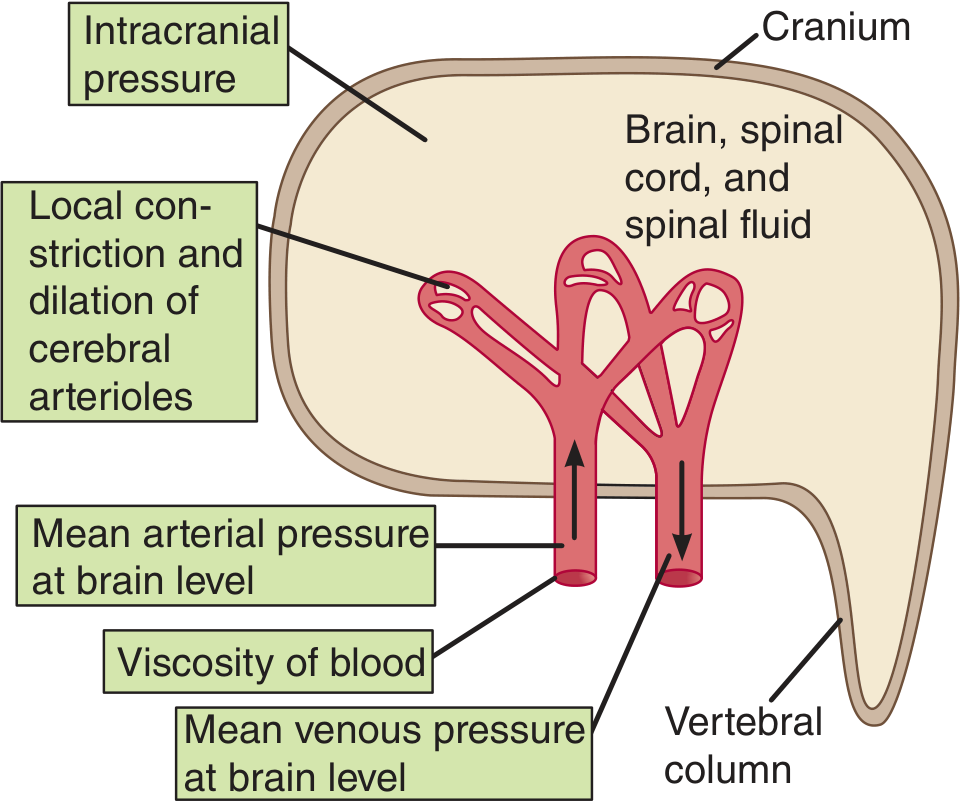
"CBF is determined by <b>cerebral perfusion pressure (CPP)</b> divided by <b>cerebrovascular resistance (CVR)</b>:", body_s)]
story += [Paragraph(
"<para align='center'><b>CBF = CPP / CVR where CPP = MAP − ICP</b></para>",
S("Formula", parent=body_s, fontSize=11, spaceBefore=4, spaceAfter=8, backColor=LBLUE,
leftIndent=20, rightIndent=20))]
story += [Paragraph("<b>Ganong's summary of factors affecting CBF:</b>", h3_s)]
story += img("factors_cbf.png", width=W*0.72,
caption="Fig. 2 — Summary of factors affecting cerebral blood flow including ICP, MAP at brain level, "
"mean venous pressure, viscosity, and local arteriolar tone. (Ganong's Physiology 26e, Fig. 33-8)")
# 2A Autoregulation
story += [Spacer(1, 0.2*cm), section_header("A. Myogenic Autoregulation (Pressure–Flow)", level=2), Spacer(1, 0.2*cm)]
story += [Paragraph(
"CBF is maintained constant over a <b>MAP range of ~65–150 mmHg</b> in conscious adults (classical Lassen curve). "
"Outside this range CBF becomes <b>pressure-passive</b>. The <b>lower limit of autoregulation (LLA)</b> and "
"<b>upper limit (ULA)</b> show substantial inter-individual variability.", body_s)]
for t in [
"<b>Mechanism:</b> Rising arterial pressure → smooth muscle stretch → voltage-gated Ca²⁺ influx → vasoconstriction → ↑CVR → maintained CBF",
"<b>Modulated by:</b> NO from endothelium, perivascular nerves (sympathetic/parasympathetic), astrocytic paracrine mediators",
"<b>Contemporary view (Miller's):</b> The plateau has a gentle positive slope — not truly flat. The autoregulatory range is narrower than classically taught (~±10% MAP). Autoregulation is dynamic, not static.",
"<b>Hypertension:</b> Shifts the entire curve to the right — the LLA is also higher, so these patients tolerate less hypotension",
"<b>Dynamic autoregulation</b> responds over seconds–minutes; <b>static autoregulation</b> is assessed at steady state (~10 min)",
]:
story.append(bullet(t))
story += [Spacer(1, 0.3*cm)]
story += img("autoregulation.png", width=W*0.7,
caption="Fig. 3 — Autoregulation of CBF. Red: pressure-passive below LLA (~65 mmHg) and above ULA (~150 mmHg). "
"Blue: sympathetic stimulation extends the plateau to the right, providing protection against hypertension. "
"(Ganong's Physiology 26e, Fig. 33-9)")
# 2B Chemical/Metabolic
story += [Spacer(1, 0.2*cm), section_header("B. Chemical and Metabolic Regulation", level=2), Spacer(1, 0.2*cm)]
story += [Paragraph("<b>Carbon Dioxide — The Dominant Cerebrovascular Regulator</b>", h3_s)]
for t in [
"<b>Hypercapnia (↑PaCO₂):</b> potent vasodilation → ↑CBF (~2–4% per mmHg in range 20–80 mmHg)",
"<b>Hypocapnia (↓PaCO₂):</b> vasoconstriction → ↓CBF — basis of <i>controlled hyperventilation</i> to reduce ICP",
"<b>Mechanism:</b> CO₂ freely crosses the BBB; extracellular [H⁺] is the effector — perivascular acidosis relaxes smooth muscle",
"CO₂ reactivity is <b>the most clinically useful</b> tool for controlling CBF in the ICU/neurosurgery",
]:
story.append(bullet(t))
story += [Spacer(1, 0.1*cm), Paragraph("<b>Oxygen</b>", h3_s)]
for t in [
"<b>Hypoxia (PaO₂ < 50 mmHg):</b> vasodilation → ↑CBF",
"Normal PaO₂ variations have little effect on CBF",
"Hyperoxia causes mild vasoconstriction",
]:
story.append(bullet(t))
story += [Spacer(1, 0.1*cm), Paragraph("<b>Flow–Metabolism Coupling (Neurovascular Coupling)</b>", h3_s)]
for t in [
"Local CBF tightly matches local neuronal metabolic demand via the <b>neurovascular unit</b> (neurons, astrocytes, pericytes, endothelium)",
"Increased firing → glutamate → astrocyte activation → release of K⁺, adenosine, NO, arachidonic acid metabolites → arteriolar dilation",
"Gray matter CBF is <b>4× white matter CBF</b>, matching metabolic demand",
"This coupling is the physiologic basis of fMRI (BOLD signal) and PET neuroimaging",
]:
story.append(bullet(t))
# 2C ICP
story += [Spacer(1, 0.2*cm), section_header("C. Intracranial Pressure (Monro-Kellie Doctrine)", level=2), Spacer(1, 0.2*cm)]
for t in [
"Skull is a rigid compartment: Brain (~1400 g) + Blood (~75 mL) + CSF (~75 mL) = constant total volume",
"Volume increase in any component must be compensated by reduction in another",
"<b>CPP = MAP − ICP</b> — rising ICP directly reduces CPP and CBF",
"Rising venous pressure raises ICP → reduces CPP; worsened by head-down positioning",
"Normal ICP = 5–15 mmHg; management targets CPP > 60–70 mmHg in TBI",
]:
story.append(bullet(t))
# 2D Neurogenic
story += [Spacer(1, 0.2*cm), section_header("D. Neurogenic Regulation", level=2), Spacer(1, 0.2*cm)]
for t in [
"Large cerebral vessels: <b>extrinsic sympathetic</b> (noradrenaline → vasoconstriction), <b>parasympathetic</b> (ACh, VIP → vasodilation), <b>sensory trigeminal</b> (substance P, CGRP)",
"Intraparenchymal arterioles: primarily under <b>intrinsic/metabolic</b> control",
"Sympathetic activation <b>extends the autoregulatory plateau to the right</b> — protective against hypertensive breakthrough",
"Role modest during routine physiology; becomes important at extreme BP excursions",
]:
story.append(bullet(t))
# 2E Viscosity
story += [Spacer(1, 0.2*cm), section_header("E. Blood Viscosity", level=2), Spacer(1, 0.2*cm)]
for t in [
"Haematocrit is the main determinant; higher Hct → ↑viscosity → ↑CVR → ↓CBF",
"Moderate haemodilution (Hct ~30–35%) may improve CBF by reducing viscosity, but impairs O₂ delivery",
]:
story.append(bullet(t))
# 2F Cardiac Output
story += [Spacer(1, 0.2*cm), section_header("F. Cardiac Output", level=2), Spacer(1, 0.2*cm)]
for t in [
"CO influences CBF via effects on MAP and via sympathetic nervous activity",
"Heart failure, arrhythmias, or reduced preload can compromise autoregulatory capacity, especially at the LLA",
]:
story.append(bullet(t))
# Integrated regulation diagram
story += [Spacer(1, 0.3*cm)]
story += img("integrated_regulation.png", width=W,
caption="Fig. 4 — Integrated regulation of cerebral blood flow. Cardiac output (CO), arterial blood pressure (ABP), "
"metabolic activity, CO₂, O₂, and other mechanisms converge on cerebral resistance vessels. "
"High/normal/low CO shifts the CBF-CPP curve. (Morgan & Mikhail's Clinical Anesthesiology 7e, Fig. 26-2)")
# ── SECTION 3: CONSCIOUS PATIENT ────────────────────────────────────────────
story += [PageBreak(), section_header("3. CBF IN THE CONSCIOUS PATIENT"), Spacer(1, 0.3*cm)]
story += [Paragraph(
"In the awake, resting individual, all regulatory mechanisms are intact:", body_s)]
for t in [
"<b>Total CBF ≈ 750 mL/min</b> (54 mL/100 g/min); highest in <b>premotor and frontal cortex</b> at rest",
"<b>Flow–metabolism coupling fully preserved:</b> voluntary movement → rapid regional CBF increase in corresponding motor/sensory cortex",
"Language → ↑CBF in Broca's/Wernicke's; visual tasks → ↑occipital CBF",
"<b>Autoregulation intact</b> (MAP 65–150 mmHg plateau); CO₂ reactivity robust",
"EEG fully active; electrophysiologic component drives ~60% of energy consumption",
"Gray matter CBF (69 mL/100 g/min) >> White matter (28 mL/100 g/min) in resting conscious humans (Ganong's)",
"Measurement modalities: PET, fMRI (BOLD), ¹³³Xe washout, Kety–Schmidt N₂O method",
]:
story.append(bullet(t))
# ── SECTION 4: ANAESTHETISED PATIENT ────────────────────────────────────────
story += [PageBreak(), section_header("4. CBF UNDER GENERAL ANAESTHESIA"), Spacer(1, 0.3*cm)]
story += [Paragraph(
"General anaesthesia produces <b>drug-specific, dose-related, and reversible</b> alterations in CBF and CMRO₂. "
"The key principle:", body_s)]
story += [Paragraph(
"<para align='center'><b>Net CBF = f(CMRO₂ suppression + direct vascular effects + autoregulatory status)</b></para>",
S("Formula2", parent=body_s, fontSize=10, spaceBefore=4, spaceAfter=8, backColor=LTEAL,
leftIndent=20, rightIndent=20))]
story += [Paragraph("<b>Cerebral Metabolic Rate (CMRO₂) Under Anaesthesia</b>", h2_s)]
for t in [
"~60% of brain energy is for <b>electrophysiologic function</b> (ion gradients, neurotransmitter cycling)",
"~40% is for <b>cellular homeostasis</b> ('housekeeping component') — irreducible by anaesthetic drugs",
"Most agents (barbiturates, propofol, isoflurane, sevoflurane, desflurane, etomidate) suppress the <b>electrophysiologic component</b> dose-dependently, tracked by EEG suppression",
"Once EEG is isoelectric, <b>no further reduction in CMRO₂</b> regardless of additional dose",
"<b>Exceptions: Ketamine and N₂O increase both CMRO₂ and CBF</b>",
]:
story.append(bullet(t))
story += [Spacer(1, 0.2*cm), Paragraph("<b>Volatile Anaesthetic Agents</b>", h2_s)]
story += [Paragraph(
"All volatile agents are <b>direct cerebral vasodilators</b> (↑CBF) and simultaneously <b>reduce CMRO₂</b> "
"(↓CBF tendency). The net effect depends on the balance:", body_s)]
vol_data = [
[Paragraph("Agent", table_hdr), Paragraph("CBF", table_hdr), Paragraph("CMRO₂", table_hdr),
Paragraph("Autoregulation", table_hdr), Paragraph("ICP", table_hdr)],
[Paragraph("Halothane", table_lft), Paragraph("↑↑↑", table_cel), Paragraph("↓↓", table_cel),
Paragraph("Markedly impaired", table_cel), Paragraph("↑↑", table_cel)],
[Paragraph("Isoflurane", table_lft), Paragraph("↑ at >1 MAC", table_cel), Paragraph("↓↓", table_cel),
Paragraph("Dose-dependent impairment", table_cel), Paragraph("↑ mild", table_cel)],
[Paragraph("Sevoflurane", table_lft), Paragraph("Minimal <1.5 MAC", table_cel), Paragraph("↓↓", table_cel),
Paragraph("Best preserved (1 MAC)", table_cel), Paragraph("↑ mild", table_cel)],
[Paragraph("Desflurane", table_lft), Paragraph("Minimal <1.5 MAC", table_cel), Paragraph("↓↓", table_cel),
Paragraph("Dose-dependent impairment", table_cel), Paragraph("↑ mild", table_cel)],
]
vol_tbl = Table(vol_data, colWidths=[W*0.22, W*0.18, W*0.16, W*0.28, W*0.16])
vol_tbl.setStyle(TableStyle([
("BACKGROUND", (0,0), (-1,0), TEAL),
("ROWBACKGROUNDS", (0,1), (-1,-1), [white, GREY]),
("GRID", (0,0), (-1,-1), 0.5, HexColor("#cbd5e1")),
("TOPPADDING", (0,0), (-1,-1), 5),
("BOTTOMPADDING", (0,0), (-1,-1), 5),
("LEFTPADDING", (0,0), (-1,-1), 6),
("RIGHTPADDING", (0,0), (-1,-1), 6),
("ROUNDEDCORNERS", [4]),
]))
story += [vol_tbl, Spacer(1, 0.2*cm)]
story += [Paragraph(
"<b>Autoregulation and volatile agents:</b> All volatile agents impair pressure autoregulation dose-dependently. "
"At high doses, CBF becomes pressure-passive. Sevoflurane best preserves dynamic autoregulation up to ~1 MAC. "
"CO₂ reactivity is <b>partially preserved</b> with all volatile agents — clinically, hyperventilation still "
"reduces CBF and ICP during volatile anaesthesia.", body_s)]
story += [Spacer(1, 0.2*cm), Paragraph("<b>Intravenous Anaesthetic Agents</b>", h2_s)]
iv_data = [
[Paragraph("Agent", table_hdr), Paragraph("CBF", table_hdr), Paragraph("CMRO₂", table_hdr),
Paragraph("Autoregulation", table_hdr), Paragraph("ICP", table_hdr)],
[Paragraph("Propofol", table_lft), Paragraph("↓↓", table_cel), Paragraph("↓↓", table_cel), Paragraph("Preserved", table_cel), Paragraph("↓", table_cel)],
[Paragraph("Barbiturates", table_lft), Paragraph("↓↓", table_cel), Paragraph("↓↓", table_cel), Paragraph("Preserved", table_cel), Paragraph("↓↓", table_cel)],
[Paragraph("Etomidate", table_lft), Paragraph("↓", table_cel), Paragraph("↓", table_cel), Paragraph("Preserved", table_cel), Paragraph("↓", table_cel)],
[Paragraph("Ketamine", table_lft), Paragraph("↑↑", table_cel), Paragraph("↑", table_cel), Paragraph("Impaired", table_cel), Paragraph("↑↑", table_cel)],
[Paragraph("Benzodiazepines", table_lft),Paragraph("↓", table_cel), Paragraph("↓", table_cel), Paragraph("Preserved", table_cel), Paragraph("↓", table_cel)],
[Paragraph("Dexmedetomidine", table_lft),Paragraph("↓ modest", table_cel), Paragraph("↓ modest", table_cel), Paragraph("Preserved", table_cel), Paragraph("↓", table_cel)],
[Paragraph("Nitrous oxide", table_lft), Paragraph("↑", table_cel), Paragraph("↑", table_cel), Paragraph("Variable", table_cel), Paragraph("↑", table_cel)],
]
iv_tbl = Table(iv_data, colWidths=[W*0.24, W*0.16, W*0.16, W*0.28, W*0.16])
iv_tbl.setStyle(TableStyle([
("BACKGROUND", (0,0), (-1,0), NAVY),
("ROWBACKGROUNDS", (0,1), (-1,-1), [white, GREY]),
("GRID", (0,0), (-1,-1), 0.5, HexColor("#cbd5e1")),
("TOPPADDING", (0,0), (-1,-1), 5),
("BOTTOMPADDING", (0,0), (-1,-1), 5),
("LEFTPADDING", (0,0), (-1,-1), 6),
("RIGHTPADDING", (0,0), (-1,-1), 6),
("ROUNDEDCORNERS", [4]),
]))
story += [iv_tbl, Spacer(1, 0.2*cm)]
story += [Paragraph(
"<b>Propofol and barbiturates</b> are preferred in neurosurgery and raised ICP because both CBF and CMRO₂ "
"fall in tandem while autoregulation is preserved. <b>Ketamine</b> is contraindicated in raised ICP "
"(increases CBF and ICP). When complete EEG suppression is achieved, CMRO₂ is similar regardless of agent used.", body_s)]
story += [Spacer(1, 0.2*cm), Paragraph("<b>Temperature</b>", h2_s)]
for t in [
"CMRO₂ decreases <b>6–7% per °C</b> of hypothermia",
"Unlike anaesthetics, hypothermia reduces <b>both</b> the electrophysiologic and housekeeping components",
"EEG isoelectric at ~18–20°C; CMRO₂ at 18°C is <10% of normothermic values — basis of hypothermic circulatory arrest",
]:
story.append(bullet(t))
story += [Spacer(1, 0.2*cm), Paragraph("<b>Glymphatic System and Anaesthesia</b>", h2_s)]
story += [Paragraph(
"The glymphatic pathway (perivascular aquaporin-mediated CSF/waste clearance) is enhanced during sleep and "
"general anaesthesia — the periarterial space expands. <b>Dexmedetomidine</b> better preserves glymphatic function "
"than volatile agents, which reduce lymphatic transport.", body_s)]
# ── SECTION 5: COMPARISON TABLE ─────────────────────────────────────────────
story += [PageBreak(), section_header("5. SUMMARY: CONSCIOUS vs. ANAESTHETISED"), Spacer(1, 0.3*cm)]
cmp_data = [
[Paragraph("Feature", table_hdr), Paragraph("Conscious", table_hdr), Paragraph("Anaesthetised (IVA)", table_hdr), Paragraph("Anaesthetised (Volatile)", table_hdr)],
[Paragraph("CBF", table_lft), Paragraph("50 mL/100g/min", table_cel), Paragraph("↓ (coupled)", table_cel), Paragraph("Variable (drug-dependent)", table_cel)],
[Paragraph("CMRO₂", table_lft), Paragraph("3.5 mL O₂/100g/min", table_cel), Paragraph("↓↓ (both components suppressed progressively)", table_cel), Paragraph("↓ electrophysiologic; housekeeping intact", table_cel)],
[Paragraph("Flow–metabolism coupling", table_lft), Paragraph("Intact", table_cel), Paragraph("Preserved", table_cel), Paragraph("May be partially uncoupled", table_cel)],
[Paragraph("Autoregulation", table_lft), Paragraph("Intact (65–150 mmHg)", table_cel), Paragraph("Preserved", table_cel), Paragraph("Dose-dependent impairment", table_cel)],
[Paragraph("CO₂ reactivity", table_lft), Paragraph("Robust", table_cel), Paragraph("Preserved", table_cel), Paragraph("Partially preserved", table_cel)],
[Paragraph("Regional flow variation", table_lft), Paragraph("High (task-dependent)", table_cel), Paragraph("Blunted", table_cel), Paragraph("Blunted", table_cel)],
[Paragraph("ICP effect", table_lft), Paragraph("Normal", table_cel), Paragraph("↓ (propofol, barbiturates)", table_cel), Paragraph("↑ (dose-dependent)", table_cel)],
[Paragraph("EEG", table_lft), Paragraph("Fully active", table_cel), Paragraph("Suppressed (dose-dependent)", table_cel), Paragraph("Suppressed (dose-dependent)", table_cel)],
]
cmp_tbl = Table(cmp_data, colWidths=[W*0.23, W*0.22, W*0.28, W*0.27])
cmp_tbl.setStyle(TableStyle([
("BACKGROUND", (0,0), (-1,0), NAVY),
("ROWBACKGROUNDS", (0,1), (-1,-1), [white, GREY]),
("GRID", (0,0), (-1,-1), 0.5, HexColor("#cbd5e1")),
("TOPPADDING", (0,0), (-1,-1), 5),
("BOTTOMPADDING", (0,0), (-1,-1), 5),
("LEFTPADDING", (0,0), (-1,-1), 6),
("RIGHTPADDING", (0,0), (-1,-1), 6),
("ROUNDEDCORNERS", [4]),
("VALIGN", (0,0), (-1,-1), "MIDDLE"),
("WORDWRAP", (0,0), (-1,-1), True),
]))
story += [cmp_tbl, Spacer(1, 0.4*cm)]
story += [hr()]
story += [Paragraph(
"<b>Sources:</b> Miller's Anesthesia 10e (Ch. 10) · Morgan & Mikhail's Clinical Anesthesiology 7e (Ch. 26) · "
"Barash, Cullen & Stoelting's Clinical Anesthesia 9e (Ch. 18) · Ganong's Review of Medical Physiology 26e (Ch. 33) · "
"Guyton & Hall Textbook of Medical Physiology",
source_s)]
doc.build(story)
print("PDF built successfully:", OUTPUT)
cd /home/daytona/workspace/cerebral-circulation && python3 build_pdf.py 2>&1
S() helper accepts a string parent name but is being passed an already-instantiated ParagraphStyle object. I'll fix that:~/cerebral-circulation/build_pdf.py
Successfully replaced 1 instance(s) of the string in '/home/daytona/workspace/cerebral-circulation/build_pdf.py'
cd /home/daytona/workspace/cerebral-circulation && python3 build_pdf.py 2>&1
Cerebral Circulation
PDF Document · PDF
- Cover page — titled with source credits
- Section 1 — Anatomy — Circle of Willis, arterial branches, venous drainage, normal values table, plus the full Fig. 1 anatomy diagram from Miller's (showing circle of Willis variants + cross-sections of vessel wall from MCA to capillary)
- Section 2 — Factors governing CBF — Ganong's factors diagram, autoregulation curve, integrated regulation diagram, with subsections covering: myogenic autoregulation, CO₂/O₂/metabolic coupling, ICP (Monro-Kellie), neurogenic, viscosity, and cardiac output
- Section 3 — Conscious patient — regional flow, intact coupling, measurement methods
- Section 4 — Anaesthetised patient — CMRO₂ principles, volatile agent table, IV agent table, temperature effects, glymphatic system
- Section 5 — Comparison table — Conscious vs. IVA vs. Volatile anaesthesia across 8 parameters