
Non propogsted
It looks like your message got cut off or wasn't fully typed. Could you clarify what you meant by "Non propogsted"?
Are you perhaps asking about:
- Non-propagated (in biology, genetics, or signals)?
- Non-propagated action potentials (in physiology)?
- Something else entirely?
Let me know and I'll help right away!
Non propogsted action potential
A non-propagated action potential (also called a local potential or graded potential) is an electrical change in membrane potential that does NOT travel along the full length of a nerve or muscle fiber - it remains localized to the site of stimulation and decrements with distance.
Searching sources...
Reading File
Finding Sources
Finding Sources
Reading File
Reading File
Here is a thorough explanation of non-propagated action potentials, drawn from authoritative physiology textbooks:
Non-Propagated Action Potential (Local / Graded Potential)
What Is It?
A non-propagated action potential - more precisely called a local potential, graded potential, or acute subthreshold potential - is a localized change in membrane potential that:
- Does NOT spread along the full length of the nerve/muscle fiber
- Decays (decrements) with distance from the point of stimulation
- Is proportional to the strength of the stimulus (graded, not all-or-none)
- Fails to trigger a full action potential because it does not reach the threshold voltage
"These local potential changes are called acute local potentials, and when they fail to elicit an action potential, they are called acute subthreshold potentials."
- Guyton and Hall Textbook of Medical Physiology
How It Arises
When a stimulus is applied to an excitable membrane (nerve or muscle):
- A weak stimulus shifts Vm slightly (e.g., from -70 mV to -65 mV)
- This small depolarization is below the threshold (typically around -55 mV)
- Voltage-gated Na+ channels do NOT open sufficiently to trigger the regenerative cycle
- The potential remains localized and decays passively without propagating
Only when the stimulus is strong enough to push Vm above threshold does a true (propagated) action potential fire. - Guyton and Hall Textbook of Medical Physiology
Key Properties: Non-Propagated vs. Propagated
| Feature | Non-Propagated (Local/Graded) | Propagated (True Action Potential) |
|---|---|---|
| Amplitude | Graded - proportional to stimulus | All-or-none - fixed amplitude |
| Propagation | Decays with distance | Travels full length of fiber |
| Threshold | Below threshold | At or above threshold |
| Duration | Brief (local, ~1 ms) | Characteristic waveform |
| Summation | Can summate (spatial + temporal) | Cannot summate |
| Refractory period | None | Has absolute + relative refractory periods |
Why Does It Decay?
The spread of a graded potential obeys cable properties of the membrane:
- The membrane has resistance (Rm) and capacitance (Cm)
- Current leaks out through the membrane as it travels
- The amplitude decays exponentially with distance, governed by the length constant (λ)
"As the graded response spreads, its magnitude decays exponentially with the distance from the site of origin."
- Medical Physiology (Boron & Boulpaep)
Important Examples of Non-Propagated Potentials
| Example | Location | Name |
|---|---|---|
| Synaptic input below threshold | Dendrites / soma | Excitatory/Inhibitory postsynaptic potential (EPSP/IPSP) |
| Sensory stimulus below threshold | Sensory receptor | Receptor/generator potential |
| Neuromuscular junction input | Motor endplate | Endplate potential (EPP) |
| Subthreshold laboratory stimulus | Any excitable cell | Acute subthreshold / local potential |
Functional Significance
- Integration - Dendrites receive many graded potentials; spatial and temporal summation at the axon hillock determines if threshold is reached
- Sensory coding - Graded receptor potentials encode stimulus intensity before converting to a propagated signal
- Synaptic transmission - EPSPs and IPSPs are graded potentials that integrate to either fire or inhibit a neuron
- Reflex arcs - Subthreshold inputs can be summed to produce a reflex response
Visual Summary
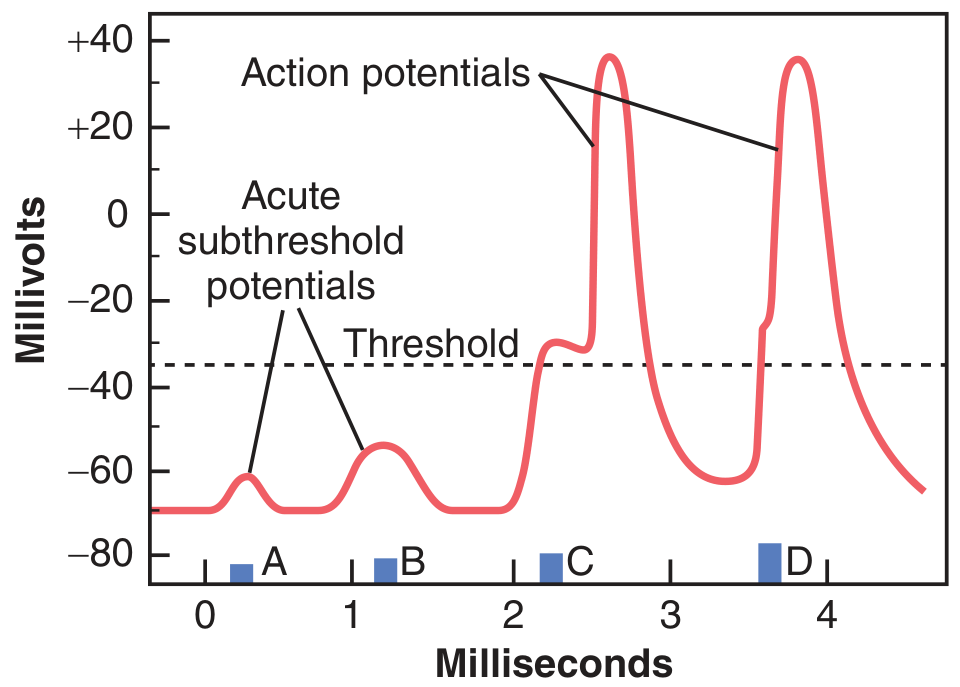
Figure from Guyton & Hall: Stimuli A and B produce local (non-propagated) subthreshold potentials. Stimulus C just reaches threshold, and D clearly fires a full action potential.
In summary: A non-propagated action potential is essentially a failed action potential - a local, graded depolarization that does not reach threshold and therefore cannot self-regenerate or travel down the nerve fiber. It is the building block of neural integration. - Medical Physiology (Boron & Boulpaep), Guyton and Hall Textbook of Medical Physiology
This is a shared conversation. Sign in to Orris to start your own chat.