
Principles of ethology and its application in understanding infant and adult behaviour
Reading File
Ethology is the scientific study of animal behaviour, particularly in natural settings, and its principles have been widely applied to understanding human behaviour across the lifespan - from infant attachment to adult social patterns.
Searching sources...
Finding Sources
Searching the Web
principles of ethology application infant adult behaviour psychology
Reading File
Finding Sources
Searching PubMed
ethology infant behaviour attachment theory
Reading File
Finding Sources
Finding Sources
Reading File
Finding Sources
Finding Sources
Reading File
Reading File
Reading File
Finding Sources
Reading File
Finding Sources
I now have rich material from the textbooks. Let me compile a thorough, well-organized response.
Loading Image
Here is a thorough account of ethology and its application to infant and adult behaviour, drawn primarily from Kaplan and Sadock's Synopsis of Psychiatry and Comprehensive Textbook of Psychiatry.
Principles of Ethology and Their Application in Understanding Infant and Adult Behaviour
1. What is Ethology?
The systematic study of animal behaviour in natural settings is known as ethology. The word comes from the Greek ethos (behaviour or manner). Ethologists assert that behaviour is largely hereditary, shaped by natural selection, and that physiology, genetics, and environment all interact to produce behavioural responses. In 1973, the Nobel Prize in Medicine was awarded jointly to three founding ethologists - Karl von Frisch, Konrad Lorenz, and Nikolaas Tinbergen - highlighting its relevance not only to biology but to psychiatry and medicine.
- Kaplan and Sadock's Synopsis of Psychiatry, p. 3193
2. Core Principles of Ethology
2.1 Fixed Action Patterns (FAPs)
Fixed action patterns are stereotyped, species-specific behaviours that are triggered automatically once an appropriate stimulus is encountered. They represent pre-programmed motor sequences that appear with little variation across individuals of a species. Once activated, the pattern runs to completion without further input from the releasing stimulus.
2.2 Sign Stimuli and Innate Releasing Mechanisms (IRMs)
Lorenz and Tinbergen described innate releasing mechanisms (IRMs) - internal neural "locks" that are activated by specific environmental stimuli called releasers (shapes, colours, sounds). The releaser acts as the "key" that opens the IRM and triggers a fixed action pattern. For example:
-
Big eyes in human infants evoke more caretaking behaviour than small eyes - a releaser operating in adult humans to promote infant care.
-
Sexual, aggressive, or affiliative responses can each be triggered by specific releasers.
-
Kaplan and Sadock's Synopsis of Psychiatry, p. 3193-3194
2.3 Imprinting
Imprinting is perhaps the most widely known ethological concept. It refers to a process in which, during a specific short sensitive period of development, a young animal is highly responsive to a particular stimulus that then provokes a lasting behaviour pattern. Lorenz demonstrated that newly hatched goslings are programmed to follow a moving object and become rapidly imprinted to it. Normally the mother is the first moving object seen, but if something else (including Lorenz himself) is encountered first, the gosling follows that object and may refuse to follow a real goose.
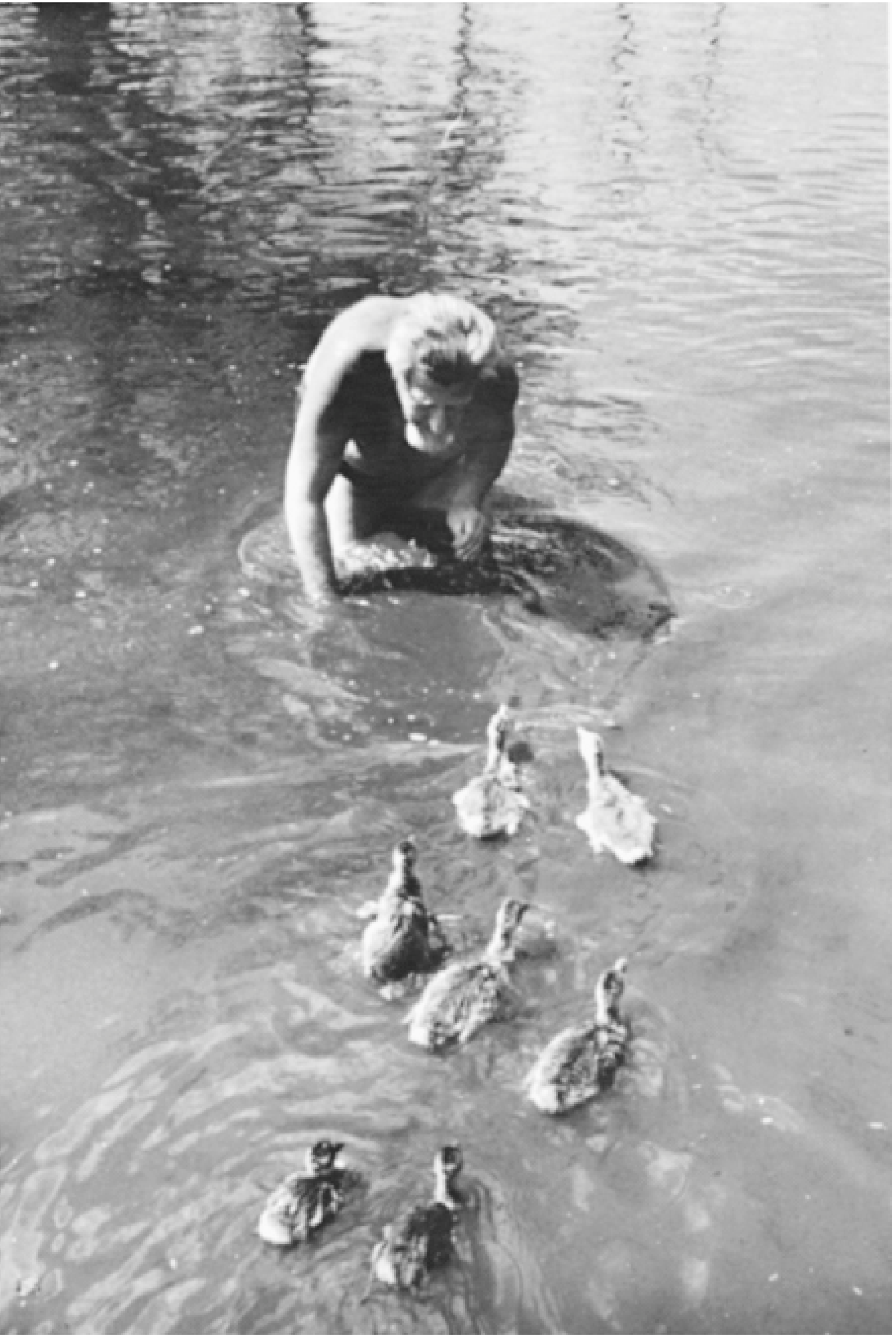
- Kaplan and Sadock's Synopsis of Psychiatry, p. 3193-3194
2.4 Sensitive and Critical Periods
A related concept is the sensitive period (sometimes called critical period) - a time window during which specific experiences have the greatest and most lasting impact on development. After this window closes, the same experiences have diminished effect. This concept, originating in animal ethology, has been productively applied to human development.
2.5 Displacement Activities
Tinbergen described displacement activities - behaviours that appear irrelevant to the situation at hand but occur when an animal faces a conflict (e.g., equal drives to fight and flee). A herring gull defending territory might suddenly start picking grass. Humans engage in analogous displacement activities when under stress - fidgeting, grooming, or performing unrelated tasks when facing anxiety-inducing conflict.
- Kaplan and Sadock's Synopsis of Psychiatry, p. 3193
2.6 Aggression and Territory
Lorenz studied the practical functions of aggression including territorial defence. Aggression among members of the same species is common, but normally a balance exists between fight and flight: the tendency to fight is strongest at the centre of territory, and flight strongest at a distance. Lorenz noted that while this served survival historically (humans in small competing groups), it may now be "outliving its survival value" in an era of weapons capable of mass destruction.
- Kaplan and Sadock's Synopsis of Psychiatry, p. 3194-3195
3. Application in Understanding Infant Behaviour
3.1 Attachment Theory: Ethology Applied to Infancy
John Bowlby (1907-1990), a British psychoanalyst, explicitly built his attachment theory on ethological foundations. He proposed a Darwinian evolutionary basis: attachment behaviour ensures that adults protect their young. Ethological studies demonstrated that non-human primates and other animals exhibit instinctual attachment patterns - with imprinting being the clearest example.
"Attachment constituted a central motivational force and... mother-child attachment was an essential medium of human interaction that had significant consequences for later development and personality functioning."
- Kaplan and Sadock's Synopsis of Psychiatry, p. 3102
Key features of Bowlby's ethologically-informed model:
- Infants are monotropic (tend to attach to one primary person) but can form attachments to several figures.
- Attachment gives infants feelings of security - the preferred person is perceived as stronger and able to reduce anxiety.
- The quality of interaction matters more than the sheer amount of time spent together.
3.2 Phases of Attachment
| Phase | Age | Key Behaviour |
|---|---|---|
| Pre-attachment | Birth to 8-12 weeks | Orients to mother, follows with eyes over 180 degrees, turns toward and moves rhythmically with mother's voice |
| Attachment in the making | 8-12 weeks to 6 months | Becomes attached to one or more persons |
| Clear-cut attachment | 6-24 months | Cries and shows distress on separation; clings on reunion; stranger anxiety emerges around 8 months |
| Goal-corrected partnership | 25 months onward | Can tolerate separation when familiar with surroundings and reassured of mother's return |
- Kaplan and Sadock's Synopsis of Psychiatry, p. 3102-3107
3.3 Signal Indicators
Signal indicators are infants' distress signs that prompt behavioural responses in the caregiver - a direct parallel to releasers in animal ethology. The primary signal is crying, with three types: hunger (most common), anger, and pain. Other reinforcing signals include smiling, cooing, and looking. An adult human voice can reliably prompt these signals.
- Kaplan and Sadock's Synopsis of Psychiatry, p. 3108
3.4 The Secure Base Effect and Ainsworth's Strange Situation
Mary Ainsworth expanded Bowlby's work and showed that the quality of maternal responsiveness during the first year powerfully shapes the infant's behavioural style. She described the secure base effect: attachment to a caregiver enables children to explore their environment, knowing the caregiver is a safe haven.
She developed the Strange Situation protocol to classify attachment quality:
| Episode | Persons Present | Event |
|---|---|---|
| 1 | Parent + infant | Enter room |
| 2 | Parent + infant + stranger | Unfamiliar adult joins |
| 3 | Infant + stranger | Parent leaves |
| 4 | Parent + infant | Parent returns, stranger leaves |
| 5 | Infant alone | Parent leaves |
| 6 | Infant + stranger | Stranger returns |
| 7 | Parent + infant | Parent returns, stranger leaves |
Findings: approximately 65% of infants are securely attached by 24 months. Sensitive responsiveness to infant signals (e.g., cuddling a crying baby) causes infants to cry less in later months rather than reinforcing crying - and counterintuitively, close bodily contact is associated with self-reliance, not clinging dependence, as the child grows. Unresponsive mothers produce anxious babies.
- Kaplan and Sadock's Synopsis of Psychiatry, p. 3107
3.5 Bonding vs. Attachment
These terms are often confused but are distinct:
- Bonding concerns the mother's feelings toward her infant. It is promoted by skin-to-skin, voice, and eye contact, particularly immediately postpartum. Some argue a critical period exists for bonding at birth, though this is disputed - representational thinking about the baby (even in utero) may be equally important.
- Attachment is the infant's emotional tie to the caregiver, developing over the first year of life.
4. Application in Understanding Adult Behaviour
4.1 Aggression, Hierarchy, and Dominance
Ethological studies of dominance hierarchies in animals map directly to adult human social behaviour. Animals in dominant positions gain advantages in mating and feeding. Being more dominant is associated with elation; a fall in hierarchical status is associated with depression. When humans lose jobs, are replaced in organisations, or otherwise lose status, depression commonly follows.
- Kaplan and Sadock's Synopsis of Psychiatry, p. 3202
4.2 Communication
Karl von Frisch's analysis of bee "dances" opened investigation into communication systems across species, including humans. Ethological models of communication emphasise that senders and receivers have distinct evolutionary interests: senders convey information that induces receivers to behave in ways that enhance the sender's fitness. The handicap principle holds that effective signals must be costly to ensure honesty - analogous to human conspicuous consumption as a signal of wealth and fitness.
- Kaplan and Sadock's Synopsis of Psychiatry, p. 3195-3196
4.3 Displacement Activities in Adults
Adult humans regularly display displacement activities under stress or conflict - nail-biting, hair-touching, doodling, or performing trivial tasks when facing a difficult decision. These are functionally equivalent to the displacement activities Tinbergen observed in birds.
4.4 Sociobiological Extensions
Edward O. Wilson's sociobiology (1975) extended ethological thinking to human social behaviour by emphasising that genetically influenced behavioural traits shape social organisation. Key concepts include:
-
Competition for resources and territory - resource holding potential determines social success.
-
Altruism defined as behaviour reducing the initiator's reproductive success while benefiting others. Sociobiologists explain this through kin selection (selfishness at the level of the gene) and group selection.
-
Sexual dimorphism: males tend toward higher variance in reproductive success and more competitive behaviours; female competition tends toward social undermining rather than overt violence.
-
Evolutionary psychiatry: some disorders may be understood as maladaptive expressions of adaptive strategies - e.g., anorexia nervosa partially understood as a strategy to delay mate selection in environments perceived as resource-poor; risk-taking behaviour to obtain resources and social influence.
-
Kaplan and Sadock's Synopsis of Psychiatry, p. 3186
4.5 Losing Attachments and Grief in Adults
Bowlby's framework extends into adult grief. Reactions to the death of a parent or spouse trace to the nature of past attachment to that figure. Absent grief may reflect real rejection and lack of closeness in the relationship. The severing of significant attachments can precipitate depressive disorder, and even suicide. Onset of depression in adults often involves rejection by a significant attachment figure - the adult equivalent of separation anxiety in infants.
- Kaplan and Sadock's Synopsis of Psychiatry, p. 3108-3109
4.6 Disorders of Attachment and Their Adult Sequelae
Attachment disorders arise from maternal deprivation (lack of adequate caregiver interaction). The long-term consequences include:
- Failure-to-thrive syndromes
- Separation anxiety disorder
- Avoidant personality disorder
- Depressive disorders
- Delinquency
- Borderline intelligence
Research on fearful female monkeys (Harry Harlow's tradition) shows that early social deprivation and repeated separation-induced depression in childhood produces high rates of neglect or abuse of first offspring in adulthood (>80%). This illustrates a transgenerational transmission of early attachment disruption - directly relevant to human child maltreatment cycles.
- Kaplan and Sadock's Synopsis of Psychiatry, p. 3202
5. Ethology and Autism - Tinbergen's Contribution
Tinbergen and his wife applied ethological methods to study infantile autistic disorder by observing the behaviour of autistic and typical children meeting strangers - exactly as one would observe animal behaviour. They noted that in animals, a conflict between fear and the need for contact could produce behaviour similar to autistic children. Their hypothesis: in certain predisposed children, fear greatly predominates and is provoked even by stimuli that have positive social value for most children (faces, eye contact). This opened new avenues in autism research.
- Kaplan and Sadock's Synopsis of Psychiatry, p. 3193
6. Nature vs. Nurture - The Twin Studies Perspective
Sociobiological research stimulated the nature-nurture debate. Studies of identical twins reared apart revealed that many personality traits and behavioural patterns have a substantial heritable component, suggesting that ethologically-rooted, genetically influenced behaviours continue to shape adult outcomes even across radically different environments.
- Kaplan and Sadock's Synopsis of Psychiatry, p. 3187
Summary Table
| Ethological Principle | Animal Example | Human Application |
|---|---|---|
| Imprinting / sensitive period | Goslings follow first moving object | Human bonding; early childhood attachment; language acquisition windows |
| Fixed action patterns | Mating dances, aggression displays | Infant crying, smiling; reflexive emotional expressions |
| Sign stimuli / IRMs | Red belly of stickleback triggers aggression | Infant big eyes trigger caregiving; facial expressions as social releasers |
| Displacement activities | Gull picks grass in conflict | Nail-biting, fidgeting, grooming under stress |
| Dominance hierarchy | Alpha animal gets food/mates | Job loss/demotion triggers depression; social competition |
| Aggression | Territorial defence | Territorial and resource-based human conflict |
| Communication signals | Bee dances | Costly signalling, conspicuous consumption |
| Attachment behaviour | Primate infant-mother bond | Bowlby's attachment theory; Ainsworth's Strange Situation |
Sources:
- Kaplan and Sadock's Synopsis of Psychiatry, Chapter 34 (Ethology, Sociobiology, Subhuman Primate Development), pp. 3186-3202
- Kaplan and Sadock's Synopsis of Psychiatry, Chapter 32-34 (Attachment and Development), pp. 3102-3109
- Kaplan & Sadock's Comprehensive Textbook of Psychiatry, Attachment Theory section, p. 771
This is a shared conversation. Sign in to Orris to start your own chat.