
Psoriasis detail
I'll start by reading the medical library skill, then search for comprehensive psoriasis content in parallel.
Reading File
Now let me search the library and PubMed in parallel for comprehensive psoriasis content.
Finding Sources
Searching PubMed
psoriasis pathogenesis treatment
Excellent. Now let me read the main psoriasis sections from Fitzpatrick's and Andrews' in parallel, along with additional sub-headings.
Reading File
Finding Sources
Reading File
Now let me read the main psoriasis chapter from Fitzpatrick's (the dedicated section at line 2148) and also the Fitzpatrick's etiology/epidemiology block which has lots of content.
Reading File
Reading File
Reading File
Let me now read the dedicated psoriasis chapter from Fitzpatrick's block27 and get more from Andrews' on treatment, plus the Goldman-Cecil medicine section.
Reading File
Reading File
Finding Sources
Excellent. Let me read more from Andrews' on pathogenesis + treatment, psoriatic arthritis from Andrews', and Fitzpatrick's block27 for the dedicated psoriasis chapter.
Reading File
Reading File
Finding Sources
Now let me read Andrews' treatment section and also fetch the key clinical images.
Reading File
Loading Image
Loading Image
I now have comprehensive information. Let me fetch a couple more key images and read more treatment content.
Loading Image
Reading File
I now have comprehensive information from multiple authoritative textbooks. Let me compile the detailed response.
Psoriasis - Comprehensive Overview
Sources: Andrews' Diseases of the Skin (10th ed.), Fitzpatrick's Dermatology (9th ed.), Goldman-Cecil Medicine
Definition
Psoriasis is a common, chronic, and recurrent inflammatory disease of the skin characterized by circumscribed, erythematous, dry, scaling plaques of various sizes, usually covered by silvery-white lamellar scales. It is a hyperproliferative disorder driven by a complex cascade of inflammatory mediators.
Epidemiology
- Affects 1-2% of the U.S. population; occurs with equal frequency in men and women
- Mean age of onset: 27 years (range: neonatal period to the seventies)
- Less frequent in tropics; rare in Native Americans, native Fijians, and North/West African Black populations
- Strong genetic component: HLA-Cw6 is the most strongly associated allele; B13, B17 carry a fivefold risk
- Associated comorbidities: metabolic syndrome, cardiovascular disease, celiac disease, lymphoma, depression
- In pregnancy: lesions often improve or disappear, but exacerbate postpartum
- Severe emotional stress aggravates psoriasis in almost half of patients
Pathogenesis
Psoriasis represents a mixed Th1 and Th17 inflammatory disease, with Th17 cells appearing more proximal in the inflammatory cascade.
Key cytokines and mediators:
| Cytokine | Role |
|---|---|
| IL-17 | Proinflammatory; key driver of keratinocyte activation |
| IL-23 | Stimulates survival and proliferation of Th17 cells |
| IL-22 | Retards keratinocyte differentiation |
| IL-12 | Main signal for Th1 development, promotes IFN-γ production |
| TNF-α, IFN-γ | Upregulated in lesions; drive inflammation |
| IL-2, IL-6, IL-8 | Overexpressed; IL-8 drives neutrophil accumulation |
| IL-15 | Triggers inflammatory cell recruitment and angiogenesis |
| IL-10, IL-1RA | Reduced (anti-inflammatory regulators are suppressed) |
Vascular changes:
The capillary loops within the papillary dermis elongate, dilate, and "kiss" the epidermis, remodeling their basement membrane to resemble postcapillary venules. This allows leukocytes to extravasate within the papillary tips - the "squirting papillae" phenomenon - in contrast to eczema, where leukocytes exit from the SVP.
T-cell and dendritic cell role:
The inflammatory infiltrate is predominantly Th1- and Th17-polarized memory T cells, plus neutrophils, macrophages, and increased numbers of dendritic cells. Dendritic cells secrete chemokines that attract and activate T cells.
Clinical Features
Lesions: circumscribed, erythematous, dry plaques with silvery-white micaceous scales (peel in layers), adherent centrally and loose at periphery. Removal of scales produces pinpoint bleeding - the Auspitz sign.
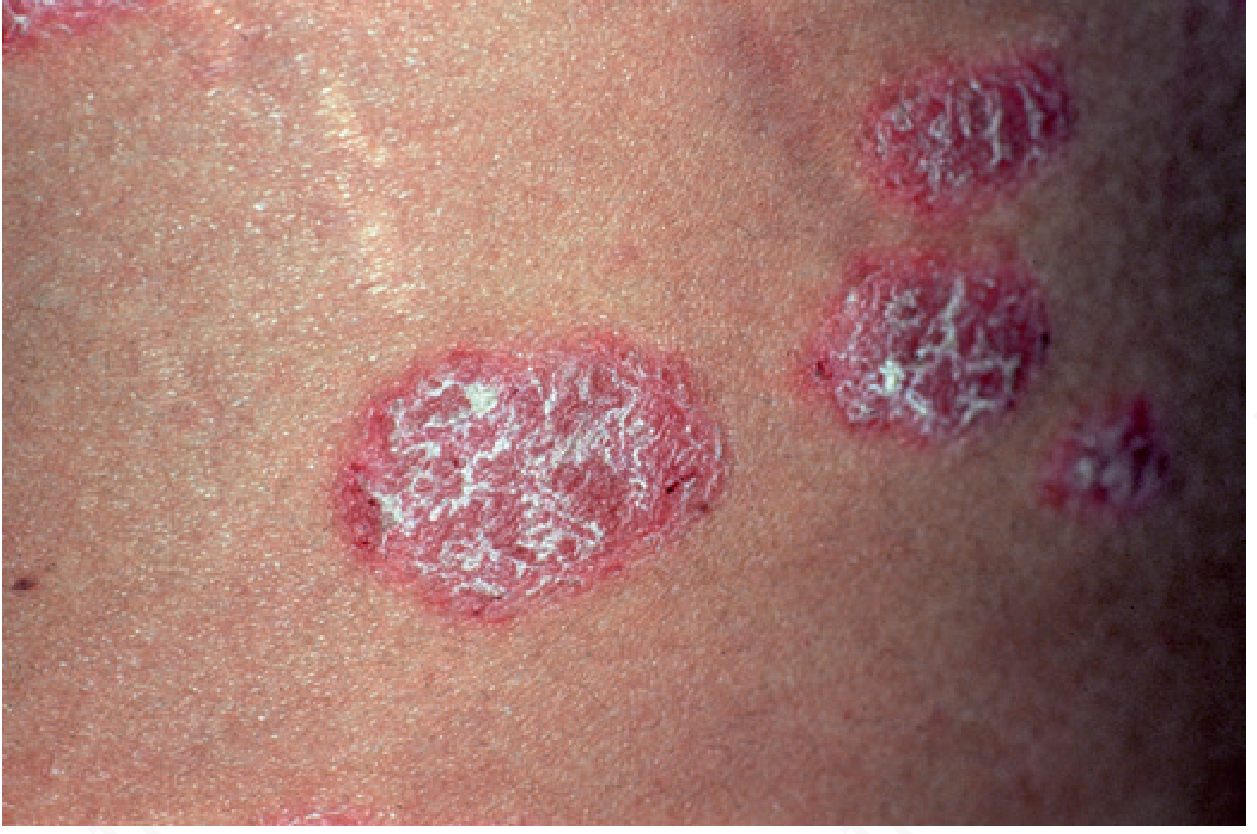
Distribution: Scalp, nails, extensor surfaces of limbs (elbows, knees), umbilical region, and sacrum. Usually symmetrically distributed.
Special signs:
- Auspitz sign: pinpoint bleeding on scale removal
- Koebner phenomenon: lesions appear at sites of trauma
- Woronoff ring: pale halo around resolving plaques
Clinical Types
1. Chronic Plaque Psoriasis (Psoriasis Vulgaris)
The most common type. Stable, persistent lesions on trunk and extremities. Discoid plaques with thick lamellar scales ("psoriasis ostracea" = oyster-shell appearance with thick tough scales).
2. Guttate Psoriasis
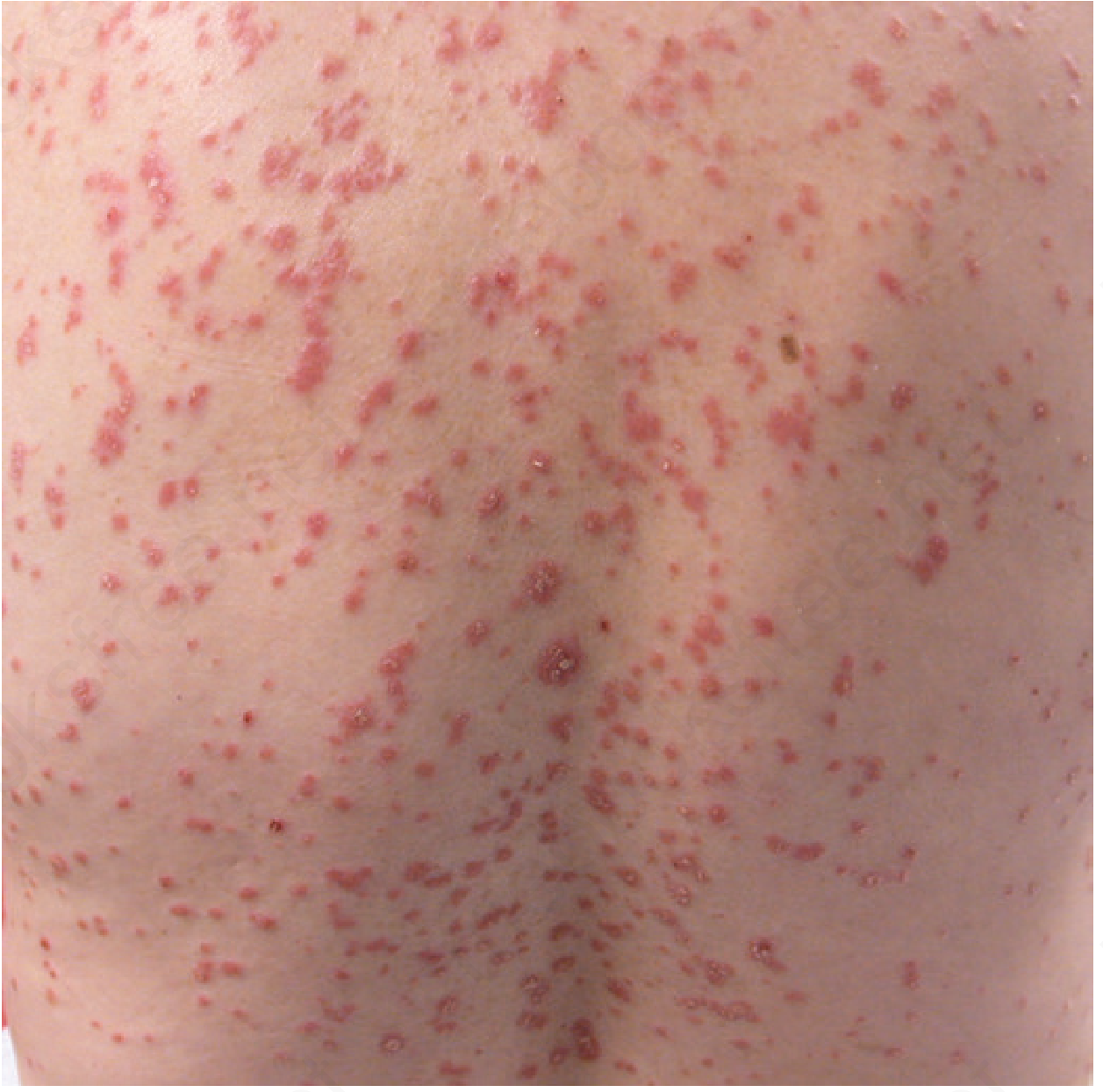
- "Raindrop" lesions 2-5 mm in diameter
- Abrupt eruption, often following streptococcal pharyngitis (groups A, C, G)
- Mostly in patients under 30 years
- Responds rapidly to broad-band UVB at erythemogenic doses
3. Inverse Psoriasis
Predominates in intertriginous areas (axillae, groin, under breasts, perianal). Often lacks scales due to moisture. Can mimic tinea or candidiasis.
4. Pustular Psoriasis
a. Generalized (von Zumbusch):
- Sudden onset with lakes of pus perungually, on palms, and at edges of plaques
- Patient is systemically ill: fever, erythroderma, hypocalcemia, cachexia
- Mucous membrane involvement: geographic/fissured tongue (common)
- Complications: ARDS, pneumonia, CHF, hepatitis
- Often triggered by withdrawal of systemic corticosteroids
- Other triggers: iodides, coal tar, terbinafine, minocycline, hydroxychloroquine, salicylates
- Treatment of choice: acitretin
b. Palmoplantar pustulosis: Chronic, localized to palms and soles; associated with HLA-B8, Bw35
5. Erythrodermic Psoriasis
Generalized erythema covering >90% of BSA; life-threatening; associated with cardiovascular and thermoregulatory compromise.
6. Psoriasiform Variants
- Follicularis, figurata/annulata/gyrata, discoidea, rupioides (crusted, syphilis-like)
Nail Involvement
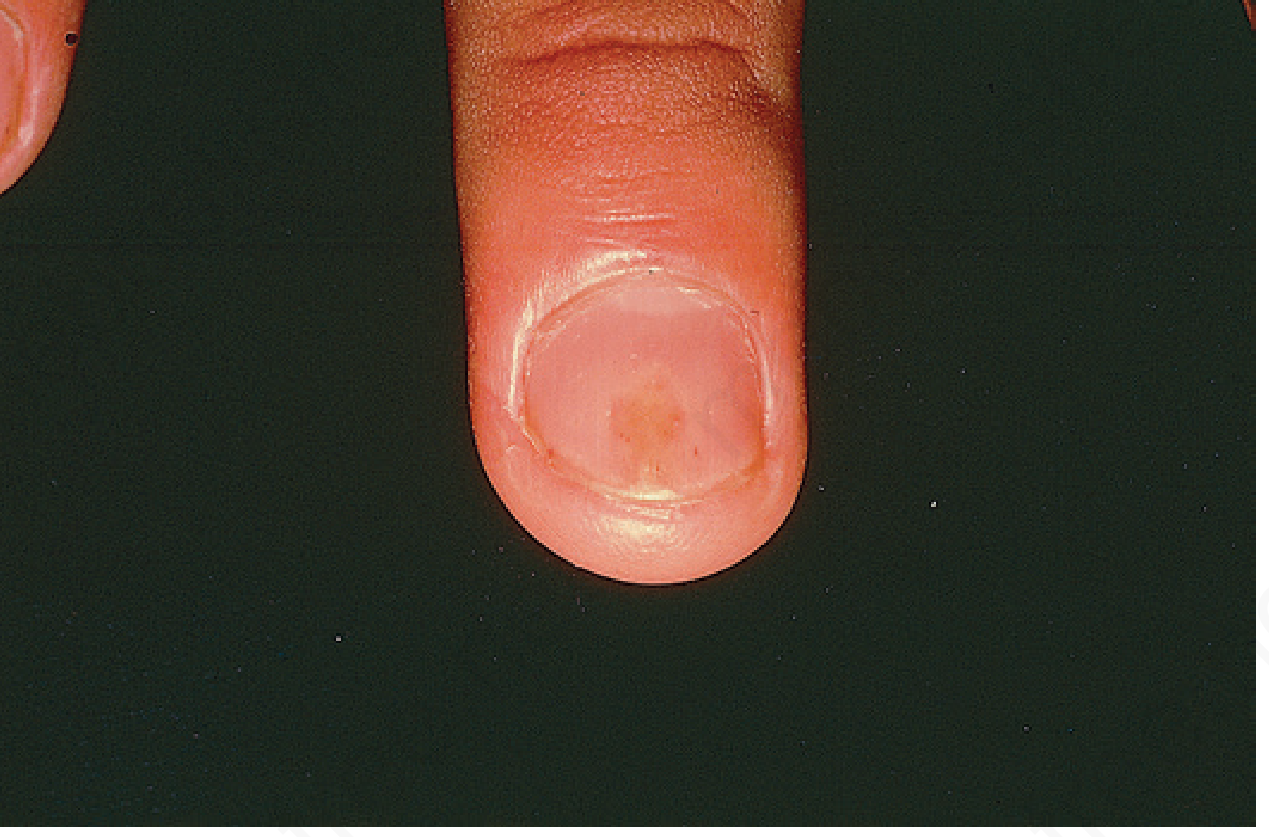
Present in 50-80% of psoriasis patients. Features:
- Pitting (small depressions in nail plate) - most common
- Onycholysis (separation from nail bed)
- Oil drop sign (salmon patch - yellow-brown discoloration under nail)
- Subungual hyperkeratosis
- Beau's lines, leukonychia
Psoriatic Arthritis
Occurs in ~30% of psoriasis patients. Five clinical patterns:
- Asymmetric DIP joint involvement with nail damage (16%)
- Arthritis mutilans - osteolysis of phalanges/metacarpals (5%)
- Symmetric polyarthritis resembling RA (15%)
- Oligoarthritis - swelling of 1-4 joints (70%) - most common
- Ankylosing spondylitis alone or with peripheral arthritis (5%)
Radiographic hallmarks: "pencil-in-cup" deformity, acrosteolysis, bony ankylosis, asymmetric sacroiliitis. Almost half have HLA-B27.
Treatment: NSAIDs for symptoms; MTX, cyclosporine, anti-TNF, anti-IL-17, anti-IL-12/23 agents prevent deformity.
Histopathology
"Histologically, all psoriasis is pustular" - even plaque psoriasis shows microscopic pustules.
Key findings:
- Munro microabscesses - neutrophilic collections in stratum corneum
- Spongiform pustules of Kogoj - in spinous layer
- Regular epidermal acanthosis with long, bulbous rete ridges
- Parakeratosis - retained nuclei in stratum corneum
- Absent or reduced granular layer (stratum granulosum)
- Dilated capillaries in dermal papillae with thinned suprapapillary epidermis
- Scant spongiosis (differentiates from eczema)
- In early guttate lesions: focal parakeratosis with "seagull outline"
Triggers / Exacerbating Factors
| Category | Examples |
|---|---|
| Infections | Streptococcal pharyngitis (guttate), HIV |
| Drugs | β-blockers, lithium, antimalarials, terbinafine, calcium channel blockers, captopril, IFN, IL-2, systemic steroid withdrawal |
| Stress | Psychological stress (in ~50% of patients) |
| Trauma | Koebner phenomenon |
| Metabolic | Alcohol, smoking |
Diagnosis
Primarily clinical. Biopsy when:
- Atypical presentation
- Differential includes lymphoma, tinea corporis, secondary syphilis, pityriasis rubra pilaris
Differential diagnosis:
- Seborrheic dermatitis (scalp)
- Pityriasis rosea (guttate)
- Nummular eczema / hand eczema
- Tinea corporis
- Mycosis fungoides
- Secondary syphilis (psoriasiform syphilid - copper-colored, figurate, serology positive)
Treatment
Step 1 - Topical (for mild/localized disease)
| Agent | Mechanism/Notes |
|---|---|
| Corticosteroids | Most frequently prescribed; Class I for 2-week courses; pulse weekend therapy to reduce side effects; intralesional triamcinolone (2.5-10 mg/mL) for refractory plaques |
| Calcipotriene (Vitamin D3 analog) | Normalizes keratinocyte differentiation; low irritation; combined with corticosteroids for improved efficacy |
| Tazarotene | Retinoid; modulates keratinocyte differentiation and hyperproliferation; combine with corticosteroid to reduce irritation |
| Anthralin (dithranol) | Suppresses neutrophil superoxide generation; inhibits IL-6, IL-8, TNF-α; short-contact therapy (15-30 min) to avoid staining |
| Coal tar | Crude coal tar or LCD; bath oils and shampoos; odor may be offensive |
| Salicylic acid | Keratolytic for thick plaque scale |
Step 2 - Phototherapy (for moderate/widespread disease)
| Modality | Notes |
|---|---|
| Narrow-band UVB (NB-UVB) | Preferred phototherapy; safe in pregnancy |
| Broad-band UVB | Advantage over NB-UVB in guttate psoriasis (erythemogenic doses needed) |
| PUVA (psoralen + UVA) | Highly effective; long-term risk of skin cancer; restricted use |
| Excimer laser (308 nm) | Targeted treatment for limited plaques |
Step 3 - Conventional Systemic (moderate-severe disease)
| Agent | Notes |
|---|---|
| Methotrexate | Gold standard systemic; monitor LFTs, CBC; hepatotoxicity risk |
| Cyclosporine | Rapid onset; not for sustained therapy; nephrotoxic |
| Acitretin (retinoid) | Drug of choice for pustular psoriasis; teratogenic; avoid alcohol (converts to etretinate) |
| Apremilast | PDE-4 inhibitor; oral; GI side effects; no monitoring needed |
Step 4 - Biologic Agents (moderate-severe, or failing systemic)
| Class | Agents | Notes |
|---|---|---|
| Anti-TNF-α | Infliximab (IV), etanercept (SC), adalimumab (SC), certolizumab, golimumab | Infliximab: chimeric mAb; etanercept: fusion protein; adalimumab: fully human mAb |
| Anti-IL-12/23 | Ustekinumab | Blocks both IL-12 and IL-23; less frequent dosing |
| Anti-IL-23 | Guselkumab, risankizumab, tildrakizumab | More selective; newer; excellent PASI 90/100 rates |
| Anti-IL-17A | Secukinumab, ixekizumab | Fastest onset; best for nail psoriasis and PsA |
| Anti-IL-17RA | Brodalumab | Human anti-receptor; risk of suicidal ideation (REMS required) |
Newer anti-IL-17 and anti-IL-23 agents can achieve PASI 100 (complete clearance) in some patients - a dramatic improvement over earlier biologics.
Comorbidities and Systemic Associations
- Cardiovascular disease (independent risk factor, especially with severe psoriasis)
- Metabolic syndrome (obesity, dyslipidemia, hypertension, diabetes)
- Psoriatic arthritis (~30%)
- Inflammatory bowel disease
- Celiac disease (increased prevalence)
- Depression and anxiety
- Lymphoma (increased incidence)
- Patients should be regularly screened for these comorbidities
Psoriasis in HIV
- Severe or atypical presentations (rupioid, multiple morphologies in one patient, acute severe onset) should raise suspicion
- Paradox: HIV destroys T cells, yet psoriasis can worsen - pathogenesis poorly understood
- Treatment: topical therapies + ART (first-line for moderate-severe); caution with TNF inhibitors (worsening immunosuppression, PML risk)
- May emerge late in HIV disease but regress before death in severe AIDS
Prognosis and Monitoring
- Chronic relapsing course; no cure
- Disease severity assessed by PASI score (Psoriasis Area and Severity Index)
- BSA and DLQI (Dermatology Life Quality Index) also used
- Spontaneous remissions occur in 10-40% of patients
- Guttate psoriasis has best prognosis; erythrodermic and generalized pustular have worst
Sources:
- Andrews' Diseases of the Skin: Clinical Dermatology, Chapter 10
- Fitzpatrick's Dermatology in General Medicine, Volumes 1-2 (9th ed.)
- Recent PubMed: GWAS meta-analysis 2025 (PMID 40021644) identifies new susceptibility alleles affecting therapeutic targets; Systematic review on erythrodermic psoriasis management 2025 (PMID 40856907)
This is a shared conversation. Sign in to Orris to start your own chat.