
इस kidney anterior to the stomach or posterior to it? The left one.
The left kidney is posterior to the stomach - the stomach lies anterior (in front) of the left kidney.
Searching sources...
Reading File
Finding Sources
Searching Images
left kidney relations anterior posterior stomach anatomy
The textbook sources confirm this clearly. Let me pull the exact passage from Gray's Anatomy and Sleisenger & Fordtran's for the full picture.
Reading File
Reading File
The answer is confirmed clearly by multiple authoritative textbooks. Here is the full picture:
Left Kidney - Relation to the Stomach
The left kidney is posterior (behind) the stomach. The stomach is an anterior relation of the left kidney.
Anterior Relations of the Left Kidney (structures in front of it)
From the textbook sources:
| Region | Structure |
|---|---|
| Superior pole (medial part) | Left suprarenal (adrenal) gland |
| Superior pole (rest) | Stomach and spleen |
| Middle part | Pancreas (retroperitoneal) |
| Lower half - lateral | Left colic flexure and descending colon |
| Lower half - medial | Jejunum |
So the stomach sits directly anterior to the upper/superior part of the left kidney.
Posterior Relations of Both Kidneys
Posteriorly, the left kidney is related to:
- Diaphragm (superiorly)
- Psoas major, quadratus lumborum, and transversus abdominis muscles
- Ribs XI and XII (the left kidney reaches higher than the right, lying posterior to ribs XI and XII)
- Costodiaphragmatic recess of pleura
In short: The left kidney is behind (posterior to) the stomach. The stomach overlies the superior pole of the left kidney anteriorly.
- Gray's Anatomy for Students, p. 438
- DiMaio's Forensic Pathology, 3rd Ed., p. 172
- Sleisenger & Fordtran's Gastrointestinal and Liver Disease (embryology/anatomy of stomach chapter)
How come it's a gastric impression between the superior and the intermediate border of the pancreas, whereas the renal impression is between the inferior and the intermediate border? Because stomach lies anteriorly, whereas the left kidney lies posteriorly. So, how is it anatomically possible?
Great anatomical thinking. The key is that you're confusing two different structures - the spleen's visceral surface impressions vs. the pancreas's surfaces. Let me clarify before searching.
The gastric and renal impressions you're describing are on the spleen, not the pancreas. The spleen has a visceral surface with impressions from neighboring organs. Since the spleen has both anterior and posterior relations at different poles/borders, this makes geometric sense.
Searching sources...
Finding Sources
Searching Images
spleen visceral surface impressions gastric renal colic borders anatomy diagram
Reading File
Finding Sources
Finding Sources
Finding Sources
Finding Sources
Finding Sources
Reading File
Let me fetch the spleen surfaces diagram and also look for a more detailed description of the borders and impressions.
Loading Image
Reading File
I have everything I need to give a thorough anatomical explanation. The diagram confirms the visceral surface faces medially/anteriorly. Now let me compose the answer.
This is a really sharp anatomical question, and it deserves a careful explanation. You are right that there seems to be a paradox - the stomach is anterior and the kidney is posterior, yet both leave impressions on the same visceral surface of the spleen. Here is why it is not a contradiction at all.
The Key Concept: The Spleen's Orientation
The spleen is not a flat organ with one face pointing purely forward and one pointing purely backward. It sits obliquely in the left hypochondrium, wedged between the diaphragm and the abdominal viscera. It has:
- A diaphragmatic surface - convex, facing posterosuperiorly (upward and backward, against the diaphragm/ribs IX-XI)
- A visceral surface - concave/irregular, facing anteromedially (downward, forward, and inward, toward the abdominal organs)
The entire visceral surface faces roughly the same direction - anteromedially. This is where ALL four impressions (gastric, renal, colic, pancreatic) are located. There is no contradiction in the stomach and kidney both contacting the visceral surface, because:
The visceral surface itself has different regions (upper/lower, medial/lateral) - and these sub-regions face slightly different axes.
Why the Impressions Fall Where They Do
The spleen's visceral surface is subdivided by borders:
| Border | Position | Separates |
|---|---|---|
| Superior border | Upper edge (notched) | Diaphragmatic surface from the gastric area of visceral surface |
| Inferior border | Lower edge | Diaphragmatic surface from the renal/colic area of visceral surface |
| Intermediate (medial) border | Runs through the hilum | Gastric impression (above/anterior) from renal impression (below/posterior) |
So the layout on the visceral surface is:
        [Superior border]
              |
   GASTRIC IMPRESSION  ← faces anteromedially (toward stomach)
              |
   [Intermediate border / Hilum]
              |
   RENAL IMPRESSION    ← faces posteromedially (toward left kidney)
              |
        [Inferior border]
The gastric impression occupies the upper part of the visceral surface, above the hilum. This region faces more anteriorly and superiorly - directly toward the posterior wall of the stomach, which wraps around the upper-anterior part of the spleen.
The renal impression occupies the lower part of the visceral surface, below and behind the hilum. This region faces more posteriorly and inferiorly - toward the left kidney, which lies behind the spleen.
The Geometric Explanation in Plain Terms
Think of the spleen like a wedge tilted in space:
- Its upper-front part of the visceral surface is pressed against the stomach (anterior organ)
- Its lower-back part of the visceral surface is pressed against the left kidney (posterior organ)
The visceral surface is not a flat plane - it is a curved, irregular surface that wraps around multiple organs simultaneously. The intermediate border (hilum) acts as the dividing line between these two contact zones.
As Schwartz's Principles of Surgery confirms: "The spleen's superior border separates the diaphragmatic surface from the gastric impression of the visceral surface." - Schwartz's Principles of Surgery, 11th ed., p. 1546
The stomach contact is from the anteromedial, upper part of the visceral surface. The kidney contact is from the posteromedial, lower part of the same visceral surface. They face in slightly different directions within the same surface - which is precisely why an organ obliquely oriented in space can simultaneously touch an anterior organ (stomach) above and a posterior organ (kidney) below.
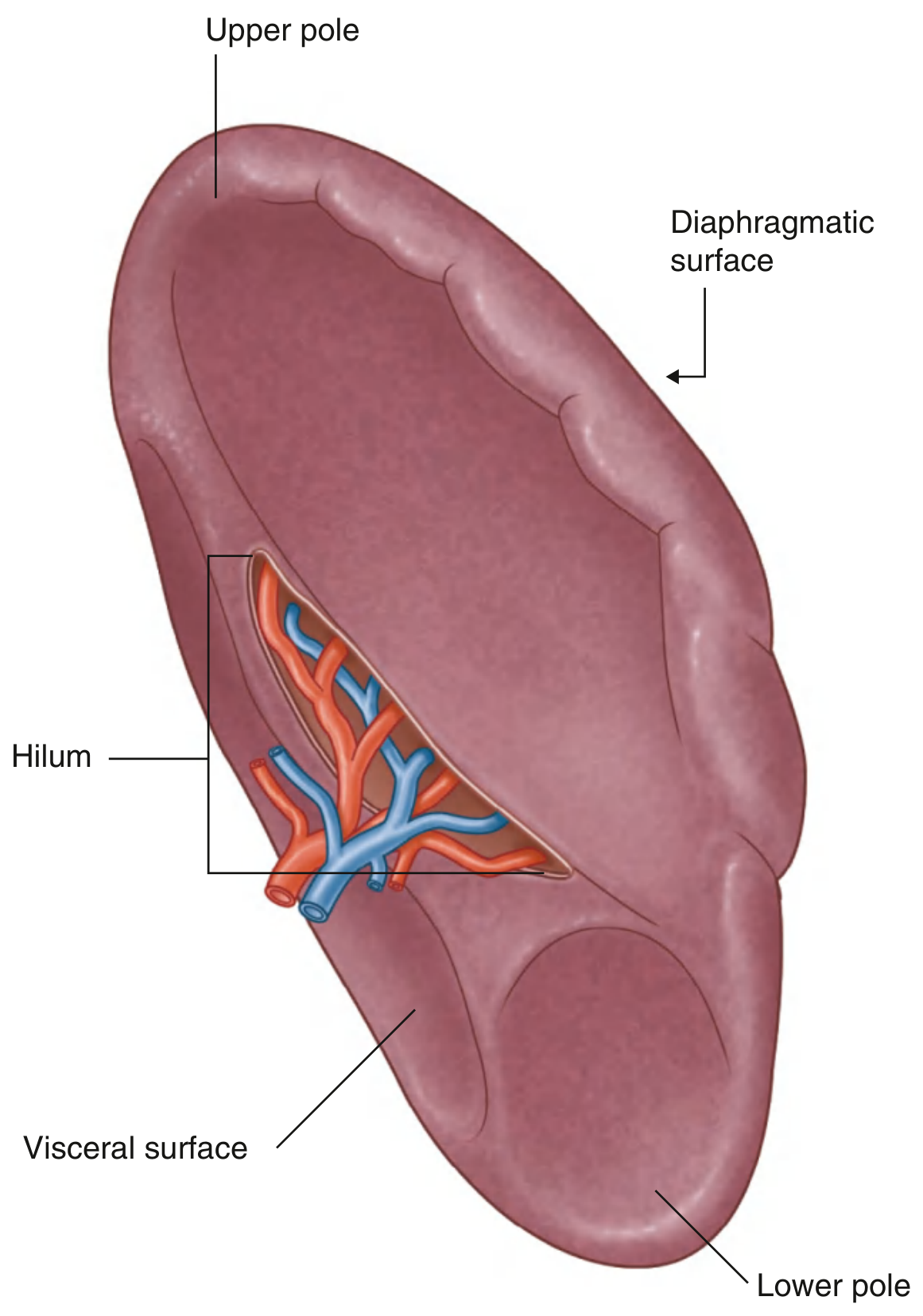
Visceral surface of the spleen showing upper pole (gastric area) and lower pole (renal/colic area) - Gray's Anatomy for Students
This is a shared conversation. Sign in to Orris to start your own chat.