
Role of salt 2 inhibitors in cvs
- They reduce heart failure hospitalizations (especially HFrEF and HFpEF)
- They lower blood pressure and reduce afterload/preload via osmotic diuresis
- They have demonstrated mortality benefit in patients with established CVD or high CV risk
- Key trials: EMPA-REG OUTCOME (empagliflozin), CANVAS (canagliflozin), DECLARE-TIMI 58 (dapagliflozin), DAPA-HF, EMPEROR-Reduced/Preserved
SGLT2 inhibitors cardiovascular outcomes heart failure
SGLT2 inhibitor cardiovascular mechanisms heart failure
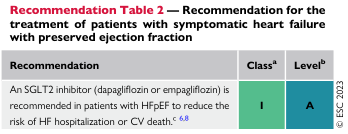
Summary : This table presents the ESC 2023 guideline recommendation for the treatment of patients with symptomatic heart failure with preserved ejection fraction (HFpEF), specifically regarding the use of SGLT2 inhibitors. table: Recommendation Table 2 : • Title: "Recommendation Table 2 — Recommendation for the treatment of patients with symptomatic heart failure with preserved ejection fraction". • Recommendation: "An SGLT2 inhibitor (dapagliflozin or empagliflozin) is recommended in patients with HFpEF to reduce the risk of HF hospitalization or CV death." • Class: I • Level: A • References: c, 6, 8 (as cited in the table). • Source: © ESC 2023 Column Headings : • Recommendation • Classᵃ • Levelᵇ Row Data : • Only one recommendation row is present, as detailed above. Design Encodings : • "Class" cell is shaded green with "I". • "Level" cell is shaded blue with "A". • Table uses bold and coloured text for the title and recommendation header. Analysis : • The table provides a strong (Class I, Level A) recommendation for the use of SGLT2 inhibitors (dapagliflozin or empagliflozin) in patients with HFpEF to reduce hospitalization or cardiovascular death, indicating high-quality evidence and consensus. • Only one therapeutic recommendation is presented, emphasizing its importance in this patient population.
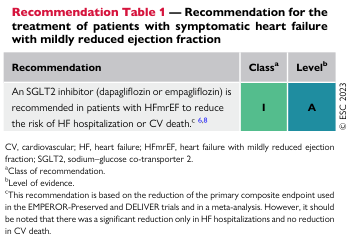
Summary : This table presents the ESC 2023 guideline recommendation for the use of SGLT2 inhibitors in patients with symptomatic heart failure with mildly reduced ejection fraction (HFmrEF), including the class and level of evidence. table: # Recommendation Table 1 — Treatment of Symptomatic Heart Failure with Mildly Reduced Ejection Fraction : • Title: "Recommendation Table 1 — Recommendation for the treatment of patients with symptomatic heart failure with mildly reduced ejection fraction" • Main recommendation: "An SGLT2 inhibitor (dapagliflozin or empagliflozin) is recommended in patients with HFmrEF to reduce the risk of HF hospitalization or CV death." • Class of recommendation: I • Level of evidence: A # Footnotes and Abbreviations : • CV: cardiovascular • HF: heart failure • HFmrEF: heart failure with mildly reduced ejection fraction • SGLT2: sodium–glucose co-transporter 2 • Class of recommendation and level of evidence are defined in the footnotes. • The recommendation is based on reduction of the primary composite endpoint in EMPEROR-Preserved and DELIVER trials and meta-analysis; significant reduction in HF hospitalizations, no reduction in CV death. # Table Layout : • Three columns: Recommendation, Class, Level • Recommendation text spans the first column; Class and Level are in adjacent columns with green and blue backgrounds respectively. Analysis : • The table provides a clear, high-level recommendation (Class I, Level A) for SGLT2 inhibitors in HFmrEF, supported by strong evidence for reducing HF hospitalizations but not CV death. The recommendation is based on large clinical trials and meta-analysis.
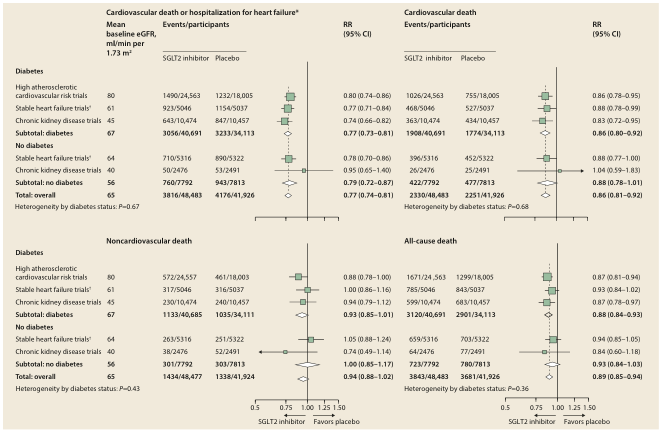
Summary : This figure presents a meta-analysis of the effects of SGLT2 inhibitors versus placebo on three outcomes—cardiovascular death or hospitalization for heart failure, noncardiovascular death, and all-cause death—stratified by diabetes status and clinical trial type. The results are displayed as forest plots with risk ratios (RR) and 95% confidence intervals (CI) for each subgroup and overall. forest plot: # Title & Axes : • Title: "Cardiovascular death or hospitalization for heart failure", "Cardiovascular death", "Noncardiovascular death", "All-cause death". • X-axis: Risk Ratio (RR), scale from 0.5 to 1.5, with 1.0 as the line of no effect. • Y-axis: Subgroups by diabetes status and trial type (High atherosclerotic cardiovascular risk trials, Stable heart failure trials, Chronic kidney disease trials, Overall). • Data columns: Mean baseline eGFR (ml/min per 1.73 m²), Events/participants (SGLT2 inhibitor and placebo), RR (95% CI). # Data Points : • For each outcome, subgroups are listed for "Diabetes" and "No diabetes", with further breakdown by trial type. • Example (Cardiovascular death or hospitalization for heart failure, Diabetes, High atherosclerotic cardiovascular risk trials): – Mean baseline eGFR: 80 – Events/participants: SGLT2 inhibitor 1490/24,563, Placebo 1232/18,005 – RR (95% CI): 0.80 (0.74–0.86) • Subtotal and overall results are provided for each outcome: – Cardiovascular death or hospitalization for heart failure, Total overall: RR 0.77 (0.74–0.81) – Cardiovascular death, Total overall: RR 0.86 (0.81–0.92) – Noncardiovascular death, Total overall: RR 0.94 (0.88–1.02) – All-cause death, Total overall: RR 0.89 (0.85–0.94) • Heterogeneity p-values for diabetes status are shown for each outcome. # Design Encodings : • Forest plots use green squares for point estimates, with horizontal lines for 95% CI. • Diamonds represent subtotal and overall estimates. • Vertical dashed line at RR = 1.0 indicates no effect. • Subgroups are separated by horizontal lines and labeled. • Statistical heterogeneity p-values are provided for diabetes status comparison. # Distribution & Trends : • Most RR estimates are below 1.0, indicating benefit of SGLT2 inhibitors over placebo. • Confidence intervals for most subgroups do not cross 1.0, especially for cardiovascular outcomes. • Noncardiovascular death shows RR close to 1.0, with wider confidence intervals and some crossing 1.0. • All-cause death shows consistent reduction in RR across subgroups. # Analysis : • SGLT2 inhibitors consistently reduce the risk of cardiovascular death or hospitalization for heart failure, cardiovascular death, and all-cause death compared to placebo, with RR values below 1.0 and confidence intervals not crossing 1.0 in most subgroups. • The effect is observed in both diabetes and non-diabetes subgroups, with little heterogeneity by diabetes status (p-values > 0.05). • The reduction in noncardiovascular death is less pronounced, with RR close to 1.0 and confidence intervals often crossing 1.0. • The forest plots visually confirm the consistency and magnitude of benefit for cardiovascular outcomes, with less clear effect for noncardiovascular death.
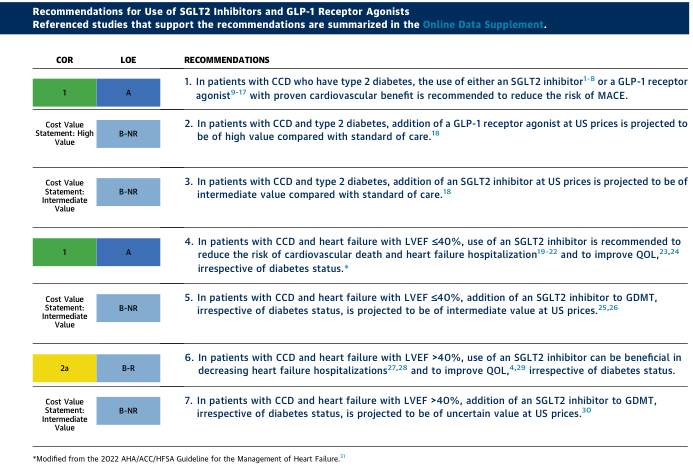
Summary : This figure presents recommendations for the use of SGLT2 inhibitors and GLP-1 receptor agonists in patients with cardiovascular conditions and/or type 2 diabetes, including cost value statements and levels of evidence. table: # Headings : • COR (Class of Recommendation) • LOE (Level of Evidence) • RECOMMENDATIONS # Table Structure : • The table is organized into rows, each representing a specific recommendation, with columns for COR, LOE, and the recommendation text. • Recommendations are grouped by cost value statement (High Value, Intermediate Value, Uncertain Value) and by patient condition (type 2 diabetes, heart failure with LVEF ≤40%, heart failure with LVEF >40%). # COR & LOE Codes : • COR: 1 (green), 2a (yellow) • LOE: A (blue), B-NR (gray), B-R (blue) # Recommendations : • 1. For patients with CCD and type 2 diabetes, use of SGLT2 inhibitor or GLP-1 receptor agonist with proven cardiovascular benefit is recommended to reduce MACE risk (COR 1, LOE A). • 2. For patients with CCD and type 2 diabetes, addition of GLP-1 receptor agonist at US prices is projected to be of high value compared to standard care (Cost Value: High, LOE B-NR). • 3. For patients with CCD and type 2 diabetes, addition of SGLT2 inhibitor at US prices is projected to be of intermediate value compared to standard care (Cost Value: Intermediate, LOE B-NR). • 4. For patients with CCD and heart failure with LVEF ≤40%, use of SGLT2 inhibitor is recommended to reduce cardiovascular death and heart failure hospitalization, and improve QOL, irrespective of diabetes status (COR 1, LOE A). • 5. For patients with CCD and heart failure with LVEF ≤40%, addition of SGLT2 inhibitor to GDMT is projected to be of intermediate value at US prices (Cost Value: Intermediate, LOE B-NR). • 6. For patients with CCD and heart failure with LVEF >40%, use of SGLT2 inhibitor can be beneficial in decreasing heart failure hospitalizations and improving QOL, irrespective of diabetes status (COR 2a, LOE B-R). • 7. For patients with CCD and heart failure with LVEF >40%, addition of SGLT2 inhibitor to GDMT is projected to be of uncertain value at US prices (Cost Value: Intermediate, LOE B-NR). # Design Encodings : • COR is color-coded: green for 1, yellow for 2a. • LOE is color-coded: blue for A and B-R, gray for B-NR. • Cost Value Statements are indicated in the left margin for relevant recommendations. # Footnotes : • Recommendations are modified from the 2022 AHA/ACC/HFSA Guideline for the Management of Heart Failure. • References are cited for each recommendation. # Analysis : • Recommendations with the highest class and evidence (COR 1, LOE A) are for SGLT2 inhibitors or GLP-1 receptor agonists in patients with type 2 diabetes and for SGLT2 inhibitors in heart failure with LVEF ≤40%. • Cost value statements suggest that GLP-1 receptor agonists are of high value for type 2 diabetes, while SGLT2 inhibitors are of intermediate or uncertain value depending on the patient group and US pricing. • The use of SGLT2 inhibitors in heart failure with LVEF >40% is recommended with lower class and evidence (COR 2a, LOE B-R), and their cost value is uncertain. • The table provides a clear, evidence-based framework for clinical decision-making regarding these drug classes in cardiovascular and diabetic populations.
Role of SGLT2 Inhibitors in Cardiovascular Disease
1. Mechanism of Action - Cardiovascular Relevance
- Glycosuria + natriuresis - increased urinary glucose and sodium excretion
- Osmotic diuresis - reduction in plasma volume, preload, and afterload
- Modest blood pressure reduction - both systolic and diastolic (~3-5 mmHg)
- Increased hematocrit - due to volume contraction and possibly erythropoiesis stimulation (improves O2 delivery)
- Slowed GFR decline - after an initial small transient dip, long-term GFR is preserved
- Reduced intraglomerular hypertension - may reduce cardiac afterload indirectly
2. Heart Failure with Reduced Ejection Fraction (HFrEF / HFmrEF)
DAPA-HF Trial (Dapagliflozin)
- 4,744 patients with NYHA class II-IV HF and LVEF ≤40%
- All received dapagliflozin 10 mg/day vs placebo ON TOP OF guideline-directed medical therapy (GDMT)
- Primary outcome (worsening HF or CV death): 26% RRR (HR 0.74; 95% CI 0.59-0.83; p = 0.00001)
- HF hospitalizations reduced: HR 0.70; CV deaths reduced: HR 0.82
- Benefit was identical in patients with AND without diabetes
- Braunwald's Heart Disease, Sodium-Glucose Transporter-2 Inhibitors section
EMPEROR-Reduced Trial (Empagliflozin)
- 3,730 patients with NYHA class II-IV HF and LVEF ≤40%
- Empagliflozin 10 mg/day vs placebo added to standard therapy
- Primary outcome (CV death or HF hospitalization): 25% RRR (HR 0.75; 95% CI 0.65-0.86; p <0.001)
- Again, benefit was consistent regardless of diabetes status
- Braunwald's Heart Disease; Harrison's Principles 22E
EMPA-REG OUTCOME Trial (Empagliflozin - Diabetes + Established CVD)
- Landmark trial in type 2 DM patients with established CV disease
- CV death reduced by 38%
- HF hospitalization reduced by 35% vs placebo
- Progression to end-stage kidney disease also reduced
- Braunwald's Heart Disease, p.159
These results have driven consensus guidelines to consider SGLT2 inhibitors as foundational/pillar therapy for HFrEF alongside ARNI/ACEi, beta-blockers, and MRAs - the "fantastic four" of GDMT. - Harrison's Principles of Internal Medicine 22E
3. Heart Failure with Preserved Ejection Fraction (HFpEF)
EMPEROR-Preserved Trial (Empagliflozin)
- Patients with HFpEF (LVEF >40%)
- Empagliflozin reduced the primary composite of first HF hospitalization or CV death
- Benefit was driven primarily by reduction in HF hospitalizations; benefit declined with increasing EF
- Braunwald's Heart Disease, HFpEF section
DELIVER Trial (Dapagliflozin)
- Also confirmed benefit in HFpEF
- Together with EMPEROR-Preserved, established the Class I, Level A ESC 2023 guideline recommendation for SGLT2 inhibitors in HFpEF
4. Meta-Analysis Summary of CVS Outcomes
| Outcome | Risk Ratio | Significance |
|---|---|---|
| CV death or HF hospitalization | RR 0.77 (0.74-0.81) | Significant |
| CV death | RR 0.86 (0.81-0.92) | Significant |
| All-cause death | RR 0.89 (0.85-0.94) | Significant |
| Non-CV death | RR 0.94 (0.88-1.02) | Not significant |
5. Guideline Recommendations (AHA/ACC and ESC)
| Indication | Recommendation | LOE |
|---|---|---|
| HFrEF (LVEF ≤40%), with or without DM | Class I, LOE A | A |
| HFpEF/HFmrEF, with or without DM | Class I (ESC) / Class IIa (ACC) | A/B-R |
| Type 2 DM + established CVD | Class I, LOE A - to reduce MACE | A |
| DM + CKD with albuminuria | Preferred over other agents alongside RAAS blockade | A |

6. When to Prefer SGLT2 Inhibitors in Diabetes
7. Contraindications and Practical Use
- Contraindications: Type 1 diabetes, history of DKA, eGFR <20 mL/min/1.73m²
- No up-titration needed - single fixed dose (dapagliflozin 10 mg, empagliflozin 10 mg)
- Check kidney function within 1 month of starting
- An initial transient small eGFR dip is expected and not a reason to stop
- Suspend 3 days before elective surgery (risk of euglycemic DKA)
- Genital fungal infections in 5-10% - usually manageable with topical antifungals
- SGLT2 inhibitors mitigate MRA-induced hyperkalemia - an added benefit in GDMT
- If on insulin, do not reduce insulin dose by >25% when starting SGLT2i
- Goldman-Cecil Medicine, SGLT2 Inhibitors practical use
8. Emerging Evidence (2024-2026)
- DAPA ACT HF-TIMI 68 (PMID 40884036, 2025): Dapagliflozin in patients hospitalized for HF - extends benefit to the acute/inpatient setting
- GLP-1 + SGLT2 combination (PMID 39210781, 2024): Additive cardiovascular and kidney benefit vs either alone in type 2 DM
- Frail/elderly patients (PMID 38287703, 2024): Benefits appear consistent even in older or frail patients with DM and HF