
Treatment of mi
Reading File
Now let me search the library and PubMed in parallel for MI treatment.
Finding Sources
Searching PubMed
"myocardial infarction"[MeSH Terms] AND "therapy"[MeSH Terms]
Finding Sources
Searching PubMed
"myocardial infarction" AND treatment
Finding Sources
Finding Sources
Good - I found relevant sections. Let me read the key MI treatment sections from Harrison's and Goldman-Cecil, and the Washington Manual in parallel.
Reading File
Reading File
Reading File
Let me get more of the treatment sections from Harrison's and Washington Manual, specifically the management content.
Reading File
Reading File
Excellent content. Let me read more of the treatment sections.
Reading File
Reading File
I now have enough content to write a thorough, well-sourced answer. Let me also get the reperfusion figure and fetch the key image from Harrison's.
Loading Image
I now have everything I need for a comprehensive answer. Here is the full treatment of MI:
Treatment of Myocardial Infarction (MI)
MI is divided into STEMI (ST-elevation MI) and NSTEMI/UA (non-ST-elevation ACS), which differ in urgency and reperfusion strategy.
1. Immediate General Measures (All MI Types)
| Intervention | Details |
|---|---|
| Aspirin | 160-325 mg chewed (buccal absorption) immediately; then 75-162 mg/day orally. Rapid inhibition of COX-1 reduces thromboxane A2. Essential across all ACS. |
| Supplemental O2 | Only if SpO2 <90%. Not recommended routinely when saturations are normal. |
| Nitroglycerin (NTG) | Sublingual 0.4 mg q5 min x3 for ischemic pain; reduces preload and dilates coronary vessels. Avoid if SBP <90 mmHg or suspected RV infarction (inferior STEMI). IV NTG if symptoms return after sublingual. |
| Morphine | For refractory pain (some caution exists due to possible P2Y12 inhibitor interaction). |
| IV access + monitoring | Continuous ECG, vitals, oximetry. |
- Washington Manual of Medical Therapeutics, p. 148-156; Harrison's Principles of Internal Medicine 22E, p. 2160
2. Reperfusion Therapy (STEMI)
This is the cornerstone of STEMI management. "Time is myocardium."
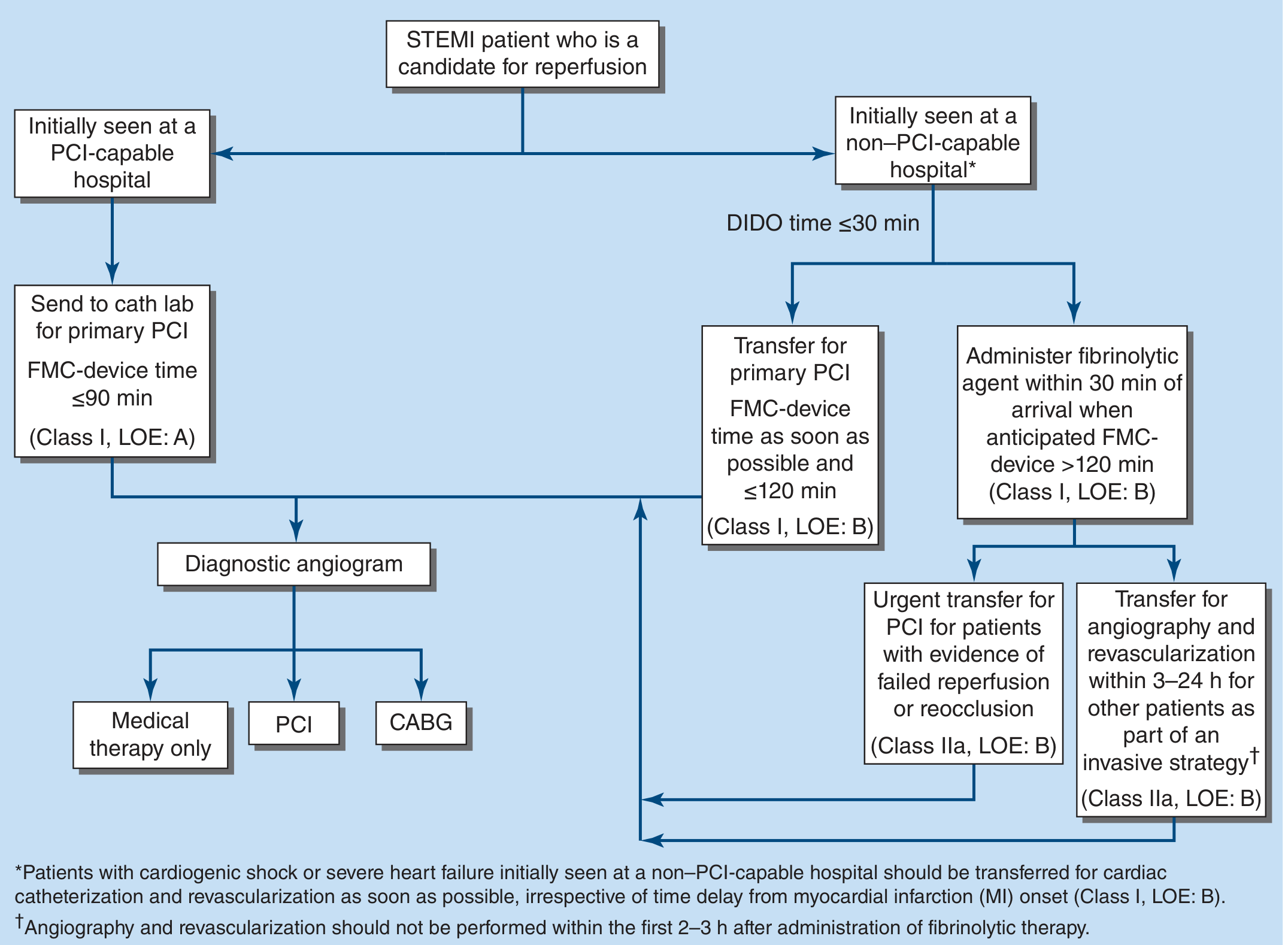
Primary PCI (Preferred)
- Gold standard when available within 90 min of first medical contact (FMC-to-device ≤90 min at PCI-capable center; ≤120 min if transfer required).
- Superior to fibrinolysis: better vessel patency (TIMI 3 flow), less reinfarction, lower intracranial hemorrhage risk, improved survival regardless of age or infarct location.
- Best for symptom onset <12 hours; still offered at 12-24 hours if ongoing symptoms.
- Transradial access is preferred - reduces bleeding and may have a mortality benefit over transfemoral.
- Complete revascularization of non-culprit lesions (either at index procedure or staged) reduces cardiovascular death and future MI.
- CULPRIT-SHOCK exception: In cardiogenic shock, culprit-lesion-only PCI (not multivessel) reduces all-cause mortality and need for renal replacement therapy.
- Coronary stenting (DES preferred) is superior to balloon angioplasty alone.
Fibrinolytic Therapy
- Used when PCI cannot be achieved within 120 min (non-PCI-capable center with anticipated FMC-to-device >120 min).
- Administer within 30 min of hospital arrival ("door-to-needle" ≤30 min).
- Agents: tPA (alteplase), reteplase, tenecteplase (fibrin-specific preferred over streptokinase).
- After successful fibrinolysis: transfer for angiography and revascularization within 3-24 hours.
- Failed reperfusion (persistent ST elevation or hemodynamic instability): urgent transfer for rescue PCI.
Absolute contraindications to fibrinolysis: prior intracranial hemorrhage, ischemic stroke within 3 months, active bleeding, suspected aortic dissection, severe uncontrolled hypertension, intracranial neoplasm.
- Washington Manual of Medical Therapeutics, p. 156; Harrison's 22E, p. 2160-2162
3. Antiplatelet and Anticoagulant Therapy
Dual Antiplatelet Therapy (DAPT)
- Aspirin (see above) +
- P2Y12 inhibitor:
- Ticagrelor 180 mg load then 90 mg BID (preferred in ACS if no contraindication)
- Prasugrel 60 mg load then 10 mg/day (avoid if prior TIA/stroke, age >75, weight <60 kg)
- Clopidogrel 300-600 mg load then 75 mg/day (used when ticagrelor/prasugrel contraindicated, or with fibrinolysis)
- DAPT duration: typically 12 months after ACS/PCI; may be shortened/extended based on bleeding vs. ischemic risk.
- Cessation of P2Y12 inhibitor within 30 days of stent placement carries a 30- to 100-fold increase in stent thrombosis risk.
Anticoagulation (Acute Phase)
- Unfractionated heparin (UFH): IV bolus + infusion; or
- Enoxaparin (LMWH): subcutaneous, often preferred in NSTEMI/UA
- Bivalirudin: direct thrombin inhibitor; alternative in PCI
- Fondaparinux: NSTEMI/medical management; do not use alone for primary PCI
- Anticoagulation is continued until revascularization is complete or through the hospital stay in medically managed patients.
4. Adjunctive Medical Therapy
Beta-Blockers
- Start within 24 hours if no contraindications (HF, low output state, heart block, active bronchospasm).
- Reduce myocardial O2 demand, limit infarct size, reduce ventricular arrhythmias.
- Oral agents preferred (metoprolol, carvedilol); IV beta-blocker if hypertensive or tachycardic without HF.
- Continued indefinitely post-MI for LV dysfunction.
ACE Inhibitors / ARBs
- Start within 24 hours in STEMI, especially anterior MI or EF <40%.
- Prevent ventricular remodeling, reduce mortality.
- ACE inhibitors are "ideal" for long-term management of ventricular dysfunction after STEMI.
- Use ARB if ACE inhibitor intolerant.
- Aldosterone antagonist (eplerenone/spironolactone): add if EF ≤40% with symptomatic HF or diabetes; monitor K+ and renal function.
Statins (High-Intensity)
- Start in-hospital regardless of baseline LDL.
- Atorvastatin 40-80 mg or rosuvastatin 20-40 mg.
- Fasting lipid panel recommended as baseline (note: lipids may fall in first 24-48 hours post-MI).
Nitrates
- Long-term oral nitrates for ongoing angina or HF symptoms.
- Not for routine use post-MI without ongoing ischemia or HF.
5. Management of Specific Complications
Cardiogenic Shock (Killip Class IV)
- Defined by hypotension + evidence of end-organ hypoperfusion.
- Occurs when ≥40% of LV myocardium is infarcted.
- Primary PCI is always preferred even with time delays.
- Inotropes: dobutamine (improves contractility, reduces peripheral resistance).
- Mechanical circulatory support: IABP, Impella, ECMO.
- Swan-Ganz catheter for hemodynamic monitoring in refractory cases.
- In cardiogenic shock with multivessel disease: culprit-only PCI first (CULPRIT-SHOCK trial).
Right Ventricular (RV) Infarction
- Occurs with proximal RCA occlusion causing inferior STEMI.
- Classic triad: hypotension + elevated JVP + clear lung fields.
- ECG: ST elevation ≥1 mm in V1 or V4R lead.
- Management: IV fluids (RV is preload-dependent); avoid nitrates and diuretics.
- If unresponsive: dobutamine + IABP; right-sided mechanical support if needed.
- Temporary pacing if AV block present.
Heart Failure Post-MI
- Loop diuretics (furosemide IV) for pulmonary congestion.
- Nitrates to reduce preload without reducing plasma volume.
- ACE inhibitors for long-term LV dysfunction.
- Digitalis is not useful in post-MI HF.
Arrhythmias
- VF/VT: immediate defibrillation; IV amiodarone or lidocaine for recurrent VT.
- Complete heart block (especially inferior MI - RCA): temporary pacing; resolves in most.
- AF: rate control with beta-blockers; anticoagulation per CHA2DS2-VASc.
LV Thrombus
- Risk in anterior MI with apical akinesis.
- Anticoagulate if thrombus detected.
- Warfarin not routinely prescribed for apical hypokinesis without confirmed thrombus (increased bleeding and death without clear benefit).
6. NSTEMI / Unstable Angina Management
| Strategy | When |
|---|---|
| Early invasive (angiography within 24-48 h) | High-risk: elevated troponins, dynamic ECG changes, TIMI/GRACE score elevated, refractory symptoms |
| Selective invasive (ischemia-guided) | Low-risk, stable patients |
- Same antiplatelet + anticoagulant therapy as STEMI.
- No role for immediate fibrinolysis in NSTEMI.
7. Secondary Prevention (Discharge Medications - "ABCDE")
| Letter | Drug Class | Goal |
|---|---|---|
| A | Aspirin + P2Y12 (DAPT) | Prevent stent thrombosis and recurrent ACS |
| A | ACE inhibitor/ARB | LV remodeling prevention |
| B | Beta-blocker | Reduce mortality, arrhythmia |
| C | Cholesterol (statin, high-intensity) | LDL reduction, plaque stabilization |
| D | Diabetes management / Diet | Modify risk factors |
| E | Exercise rehabilitation | Cardiac rehab program |
Cardiac rehabilitation reduces mortality by ~20-25% and improves functional capacity.
8. CABG
Indicated when:
- Anatomy is unsuitable for PCI (left main disease, multivessel disease with complex anatomy, especially in diabetics).
- Failed PCI with ongoing ischemia.
- Mechanical complications requiring surgical repair (VSR, papillary muscle rupture).
Key Time Targets Summary
| Target | Goal |
|---|---|
| FMC-to-balloon (primary PCI) | ≤90 min (PCI center) / ≤120 min (transfer) |
| Door-to-needle (fibrinolysis) | ≤30 min |
| PCI after fibrinolysis | 3-24 hours (successful lysis) |
| Rescue PCI (failed lysis) | Immediately / urgently |
- Harrison's Principles of Internal Medicine 22E (2025), p. 2160-2170
- Goldman-Cecil Medicine, p. 3557-3560
- Washington Manual of Medical Therapeutics, p. 148-162
This is a shared conversation. Sign in to Orris to start your own chat.