
Layers of retina
Reading File
Finding Sources
Searching Images
layers of retina histology diagram
Reading File
Finding Sources
Loading Image
Finding Sources
Loading Image
Reading File
I now have comprehensive information from the textbooks. Here is a full overview of the layers of the retina.
Layers of the Retina
The retina is a specialized sensory epithelium lining the inner surface of the eye. It contains 10 distinct layers, arranged from the outermost (adjacent to the choroid) to the innermost (adjacent to the vitreous body). Light must pass through most layers before reaching the photoreceptors.
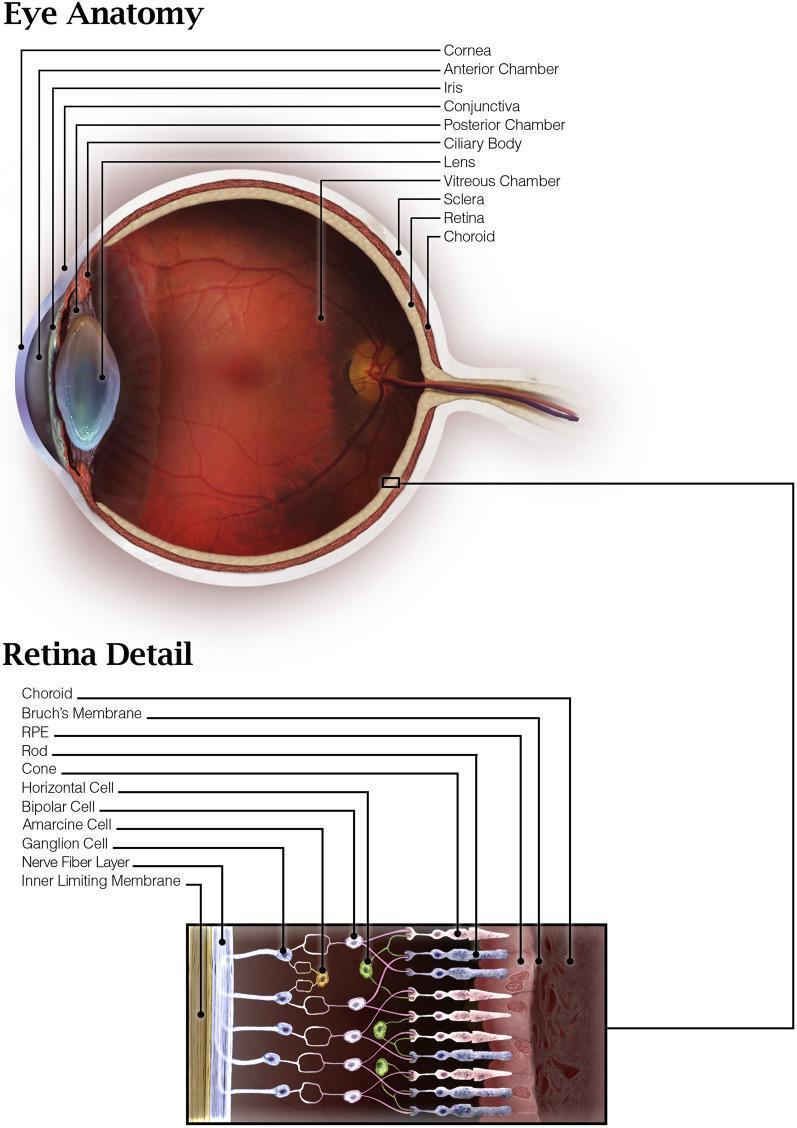
The 10 Layers (Outer → Inner)
| # | Layer | Key Features |
|---|---|---|
| 1 | Retinal Pigment Epithelium (RPE) | Absorbs scattered light; contributes to the blood-retina barrier; converts all-trans-retinal → 11-cis-retinal; phagocytoses shed photoreceptor disc membranes |
| 2 | Photoreceptor Layer (Rods & Cones) | Rods (~120 million): detect light intensity; contain rhodopsin (opsin + retinal). Cones (~7 million): detect color (blue/green/red); contain iodopsin |
| 3 | Outer Limiting Membrane (OLM) | A row of zonulae adherentes between Müller (glial) cells; not a true membrane |
| 4 | Outer Nuclear Layer (ONL) | Contains nuclei of rods and cones |
| 5 | Outer Plexiform Layer (OPL) | First synaptic layer — photoreceptor terminals synapse with bipolar, horizontal, and amacrine cells |
| 6 | Inner Nuclear Layer (INL) | Cell bodies of bipolar cells (B), horizontal cells (H), and amacrine cells (A) |
| 7 | Inner Plexiform Layer (IPL) | Second synaptic layer — bipolar and amacrine cells synapse with ganglion cells |
| 8 | Ganglion Cell Layer (GCL) | Cell bodies of retinal ganglion cells — the output neurons of the retina |
| 9 | Nerve Fiber Layer (NFL) | Axons of ganglion cells coursing toward the optic disc to form the optic nerve |
| 10 | Inner Limiting Membrane (ILM) | Basal lamina of Müller cell end-feet; separates the retina from the vitreous body |
Signal Flow
Light → (passes through inner layers) → Photoreceptors (rods/cones)
       ↓
    Bipolar cells (± horizontal cells for lateral modulation)
       ↓
    Ganglion cells (± amacrine cells for lateral modulation)
       ↓
    Optic nerve → Lateral geniculate nucleus → Visual cortex
The retina is "inverted" — light must traverse the ganglion, bipolar, and nuclear layers before reaching the photoreceptors.
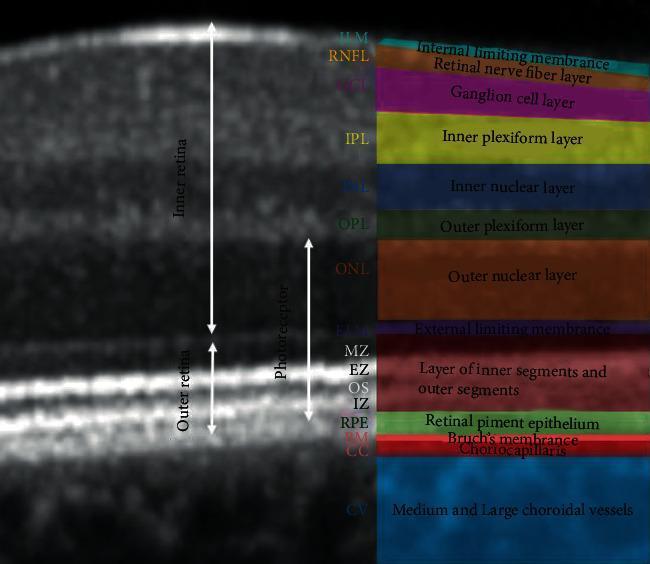
Key Functional Details
Photoreceptors
- Rods: Cylindrical outer segments; maximally sensitive to dim light; highly convergent circuitry (many rods → 1 bipolar → 1 ganglion cell) → high sensitivity, low acuity
- Cones: Conical outer segments; color vision; low convergence — in the fovea, 1 cone → 1 bipolar → 1 ganglion cell → highest visual acuity
- Visual transduction: Light converts 11-cis-retinal → all-trans-retinal → activates opsin → G-protein cascade → hyperpolarization of photoreceptor → detected as nerve impulse by bipolar cells
Special Regions
- Fovea: Densely packed cones only; no rods; inner layers laterally displaced so light reaches photoreceptors directly — highest acuity zone
- Optic disc (blind spot): Where ganglion cell axons converge and exit; no photoreceptors present
Blood Supply
- Inner retinal layers (NFL through INL): Supplied by branches of the central retinal artery (visible on fundoscopy)
- Outer retinal layers (ONL, photoreceptors, RPE): Supplied by diffusion from the choriocapillaris through Bruch's membrane (no direct vessels)
Sources: Costanzo Physiology 7th Edition; Histology: A Text and Atlas with Correlated Cell and Molecular Biology (Pawlina)
This is a shared conversation. Sign in to Orris to start your own chat.