
Primary and secondary ketone bodies
Reading File
Ketone bodies are acetoacetate, beta-hydroxybutyrate, and acetone. Acetoacetate and beta-hydroxybutyrate are the primary metabolically active ones; acetone is a minor byproduct. Let me pull the authoritative textbook content now.
Searching sources...
Finding Sources
Finding Sources
Reading File
Reading File
Reading File
Loading Image
Here is a complete, textbook-grounded answer on ketone bodies.
Ketone Bodies: Primary and Secondary
Overview
Ketone bodies are water-soluble fuel molecules synthesized in the liver from acetyl CoA during states of high fatty acid oxidation (fasting, starvation, prolonged exercise, uncontrolled diabetes mellitus). There are three ketone bodies:
| Ketone Body | Type | Notes |
|---|---|---|
| Acetoacetate | Primary | The "parent" ketone body; first formed in the pathway |
| β-Hydroxybutyrate (D-β-hydroxybutyrate) | Primary | Quantitatively the most abundant in blood |
| Acetone | Secondary | Minor byproduct; not metabolically useful |
Note: Some sources classify acetoacetate and β-hydroxybutyrate together as the "primary" ketone bodies (metabolically active), and acetone as the "secondary" (metabolically inert, volatile byproduct). Strictly speaking, β-hydroxybutyrate is not a true ketone chemically (it has a hydroxyl, not a carbonyl group), but it is functionally grouped with ketone bodies because it is reversibly formed from acetoacetate.
- Tietz Textbook of Laboratory Medicine, 7th Ed., p. 1741
Synthesis Pathway (Ketogenesis) - occurs in hepatic mitochondrial matrix
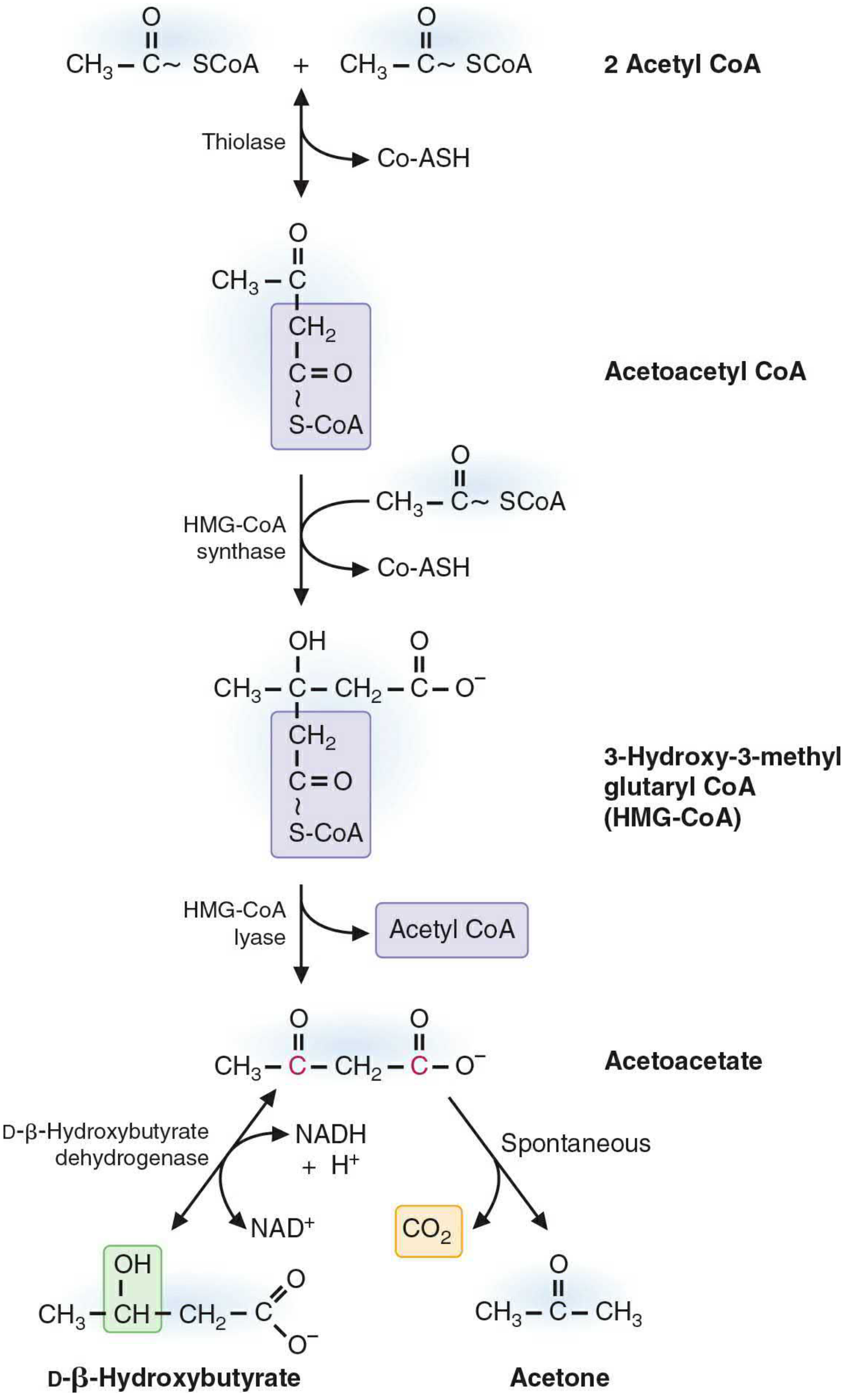
Step-by-step:
- 2 Acetyl CoA → Acetoacetyl CoA - catalyzed by thiolase (reversible reaction; runs forward when acetyl CoA is abundant)
- Acetoacetyl CoA + Acetyl CoA → HMG-CoA - catalyzed by HMG-CoA synthase (the committed, regulated step)
- HMG-CoA → Acetoacetate + Acetyl CoA - catalyzed by HMG-CoA lyase
From acetoacetate, two fates:
-
Reduction → β-hydroxybutyrate: catalyzed by D-β-hydroxybutyrate dehydrogenase (uses NADH → NAD⁺). This reaction is reversible and the ratio of the two is governed by the mitochondrial NADH/NAD⁺ ratio.
-
Spontaneous decarboxylation → Acetone + CO₂: non-enzymatic, irreversible. Acetone is volatile and expelled through the lungs ("fruity breath" in DKA).
-
Basic Medical Biochemistry, 6th Ed., p. 1097-1098
Primary Ketone Bodies in Detail
1. Acetoacetate (Primary)
- The first ketone body formed in the pathway
- A true ketone (has a ketone carbonyl group)
- Can enter the blood directly or be converted to β-hydroxybutyrate
- Detected by nitroprusside-based tests (Ketostix, Acetest) and by Gerhardt's ferric chloride test
- Used by peripheral tissues (muscle, brain, kidney, heart) via conversion back to acetyl CoA through the succinyl CoA transferase (thiophorase) pathway
2. β-Hydroxybutyrate (Primary)
- Quantitatively dominant in blood: normal ratio of β-hydroxybutyrate : acetoacetate ≈ 3:1 (in severe DKA, this can rise to 6:1 due to high NADH)
- Not a true ketone chemically (it is a hydroxy acid), but is functionally equivalent
- Not detected by standard nitroprusside-based urine dipstick tests - this is clinically important!
- In DKA treatment, as β-hydroxybutyrate is converted back to acetoacetate, urine ketone tests may paradoxically become more positive even as the patient improves
- Tietz Textbook, p. 1741
Secondary Ketone Body
3. Acetone (Secondary)
- Formed by spontaneous, non-enzymatic decarboxylation of acetoacetate
- Present in only trace amounts under normal conditions
- Metabolically useless as an energy fuel for most purposes (a small fraction may be metabolized via propylene glycol)
- Expired through the lungs - gives the characteristic "fruity" or "nail-polish remover" smell in ketoacidosis
- Not detected by β-hydroxybutyrate assays; only weakly detected by nitroprusside (which is ~10x more sensitive to acetoacetate than to acetone)
- Tietz Textbook, p. 1741
Blood Levels (Reference)
| State | Total Ketone Bodies |
|---|---|
| Normal (fed) | < 0.2 mM |
| Prolonged fasting | 4-5 mM |
| Ketoacidosis | > 7 mM |
- Basic Medical Biochemistry, 6th Ed., p. 1102
Tissues That Use Ketone Bodies
- Almost all tissues except the liver and red blood cells can oxidize ketone bodies for fuel
- Key consumers: brain (major consumer during prolonged starvation), heart, skeletal muscle, kidney cortex, intestinal mucosa
- The liver produces but cannot use ketone bodies because it lacks succinyl CoA transferase (thiophorase)
- After a 3-day fast, ketone bodies supply 30-40% of the body's total energy needs
- Basic Medical Biochemistry, 6th Ed., p. 1102; Tietz, p. 1741
Regulation of Ketogenesis
- Low insulin/glucagon ratio activates hormone-sensitive lipase → increases free fatty acids
- Low malonyl CoA (due to inhibited acetyl CoA carboxylase) → activates CPT-1 → more fatty acyl CoA enters mitochondria for β-oxidation
- High NADH/NAD⁺ (from β-oxidation) diverts oxaloacetate toward malate/gluconeogenesis, depleting TCA cycle intermediates and shunting acetyl CoA into ketogenesis
- Basic Medical Biochemistry, 6th Ed., p. 1103
Summary in one sentence: Acetoacetate and β-hydroxybutyrate are the primary ketone bodies (metabolically active, interconvertible, used as fuel by peripheral tissues), while acetone is the secondary ketone body (spontaneous, non-enzymatic, metabolically inert byproduct expired through the lungs).
This is a shared conversation. Sign in to Orris to start your own chat.