
create image explaining RAAS mechanism and kidneys role completely using using or whatever you want, diff colours , diff fonts but makesure i understand that whole system properly
A detailed educational diagram explaining the complete RAAS (Renin-Angiotensin-Aldosterone System) mechanism with the kidney's role. The diagram should show: 1. KIDNEY (large, detailed, labeled in bold) at the center-left - showing the juxtaglomerular cells releasing RENIN in response to: low blood pressure, low sodium, sympathetic activation 2. LIVER on the right side producing ANGIOTENSINOGEN 3. An arrow showing RENIN acting on ANGIOTENSINOGEN → converts it to ANGIOTENSIN I 4. LUNGS in the center showing ACE (Angiotensin Converting Enzyme) converting ANGIOTENSIN I → ANGIOTENSIN II 5. ANGIOTENSIN II effects shown with branching arrows: - ADRENAL GLAND (on top of kidney) releasing ALDOSTERONE - Vasoconstriction of blood vessels → increased blood pressure - Hypothalamus/brain → ADH release and thirst - Kidney tubules → Na+ and water reabsorption 6. ALDOSTERONE effects on kidney collecting duct: Na+ reabsorption, K+ excretion, water retention → increased blood volume 7. NEGATIVE FEEDBACK loop shown with a red dashed arrow: increased blood pressure/volume → suppresses renin release 8. Color coding: kidney in red-orange, liver in brown, lungs in pink, adrenal gland in yellow, blood vessels in blue, hormones labeled in purple boxes, effects in green boxes 9. Clear step-by-step numbered sequence (1 through 7) showing the cascade 10. Title at top: "RAAS Mechanism & Kidney's Role" in large bold letters 11. Use different font styles for organ names vs hormone names vs effects 12. Include small icons/symbols: blood pressure gauge, water droplet, Na+ and K+ ions, arrows showing increase/decrease 13. White background, clean medical education style with a professional infographic look
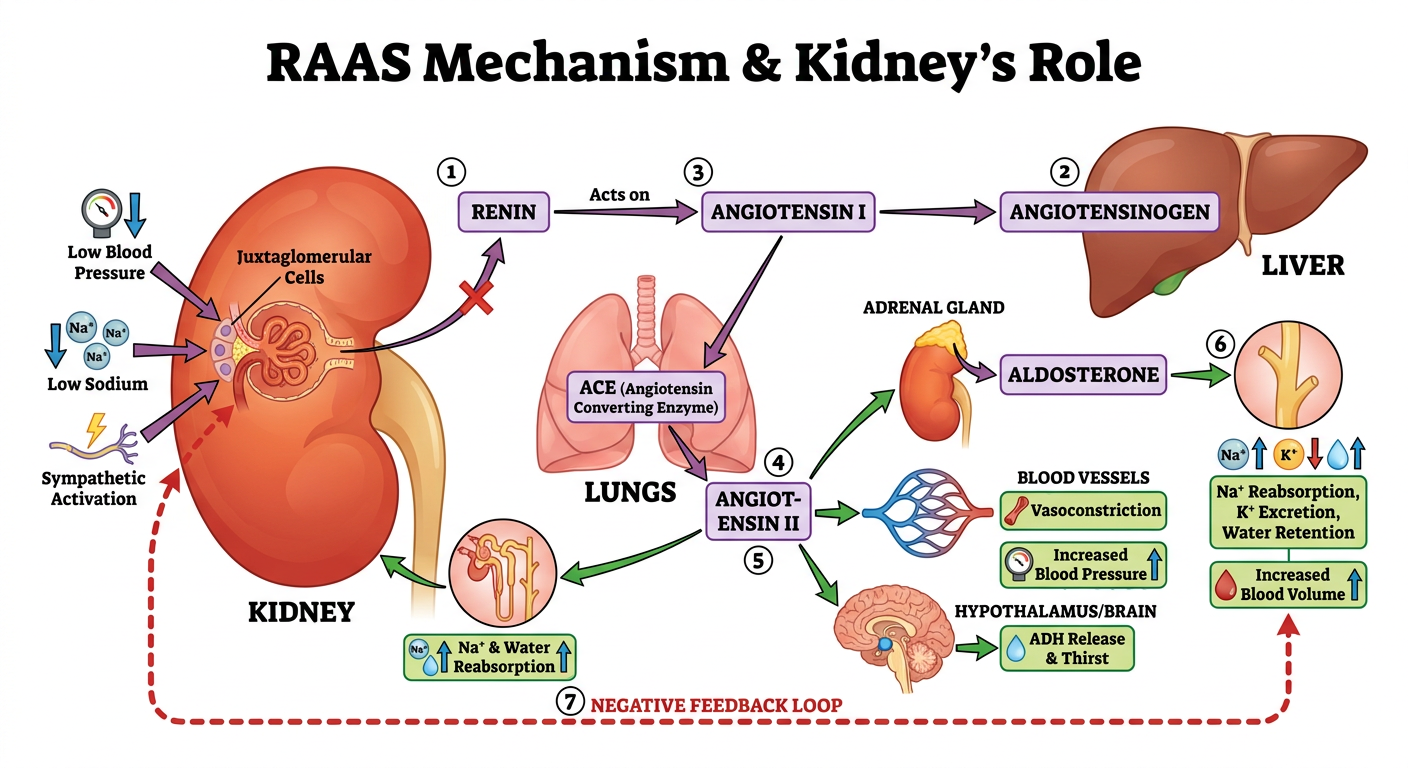
The RAAS Cascade - Step by Step
- Low blood pressure
- Low sodium (Na+) in the filtrate
- Sympathetic nervous system activation (stress/blood loss)
| Target | Effect |
|---|---|
| Blood vessels | Vasoconstriction → raises BP directly |
| Adrenal cortex | Releases Aldosterone |
| Brain/Hypothalamus | Triggers thirst + ADH release |
| Kidney proximal tubule | Directly increases Na+ reabsorption |
- Reabsorb Na+ (water follows osmotically)
- Excrete K+
- Result: increased blood volume → increased BP