
Persistent hypokalemia and hypertension with bilateral lower limb swelling diagnosis apa
The classic triad of persistent hypokalemia + hypertension + bilateral lower limb edema points strongly toward Primary Hyperaldosteronism (Conn's Syndrome) as the top diagnosis.
Searching sources...
Reading File
Finding Sources
Finding Sources
Searching PubMed
primary hyperaldosteronism hypokalemia hypertension diagnosis
Reading File
Reading File
Reading File
Reading File
Loading Image
Finding Sources
Here is a full, evidence-based breakdown of this clinical presentation:
Diagnosis: Primary Hyperaldosteronism (Conn's Syndrome)
The triad of persistent hypokalemia + hypertension + bilateral lower limb edema is the hallmark of primary hyperaldosteronism. Here is the complete picture:
Pathophysiology
The diagram from Robbins Pathology explains it clearly:
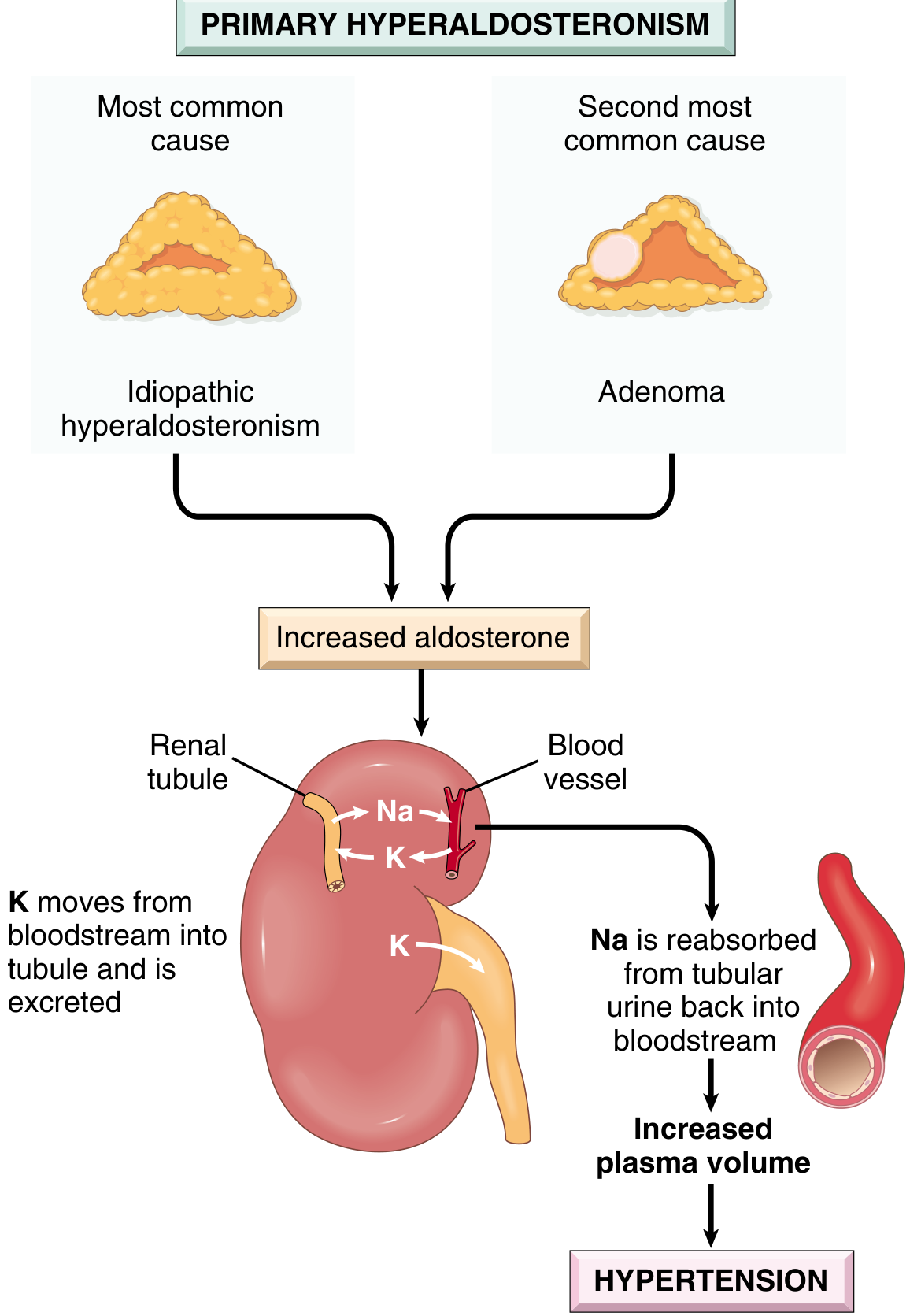
Excess autonomous aldosterone acts on the renal distal tubule:
- Na+ retention → increased plasma volume → hypertension
- K+ wasting into tubular urine → hypokalemia
- Fluid accumulation from Na+ and water retention → bilateral pitting edema of lower limbs
Volume expansion suppresses renin (low plasma renin activity = hallmark finding). - Robbins, Cotran & Kumar Pathologic Basis of Disease
Causes (Subtypes)
| Subtype | Frequency |
|---|---|
| Bilateral idiopathic adrenal hyperplasia | ~60% |
| Unilateral aldosterone-producing adenoma (Conn adenoma) | ~35% |
| Unilateral adrenal hyperplasia | ~2% |
| Familial hyperaldosteronism (FH-I to FH-IV) | ~5% |
| Adrenocortical carcinoma | Rare |
- Brenner & Rector's The Kidney; Robbins Pathologic Basis of Disease
Key Clinical Features
- Hypertension - often severe or resistant to treatment
- Hypokalemia - present in ~48% of adenoma cases, ~17% of bilateral hyperplasia cases (normal K+ does NOT rule it out!)
- Bilateral lower limb edema - from Na+ and water retention
- Muscle weakness, cramps, fatigue (from K+ loss)
- Polyuria/polydipsia (hypokalemia impairs urinary concentrating ability)
- Headache
"Primary hyperaldosteronism is usually diagnosed when a patient with hypertension has unexplained hypokalemia or when a patient has resistant hypertension." - Symptom to Diagnosis: An Evidence-Based Guide, 4th Ed
Who to Screen (Endocrine Society Criteria)
Screen for primary hyperaldosteronism in patients with:
- Sustained BP > 150/100 mmHg
- Resistant hypertension (BP uncontrolled on ≥3 drugs)
- Hypertension + spontaneous or diuretic-induced hypokalemia
- Hypertension + sleep apnea
- Adrenal incidentaloma
- Family history of early-onset hypertension or stroke < 40 years
Diagnostic Steps (3-Step Approach)
Step 1 - Screen: Plasma Aldosterone Concentration / Plasma Renin Activity Ratio (ARR)
- ARR > 20-30 is positive (aldosterone in ng/dL, PRA in ng/mL/hr)
- Best done with patient K+-repleted, liberal Na+ intake
- Use verapamil, hydralazine, or alpha-blockers (minimal effect on ARR); stop ACEi, ARB, diuretics 2-4 weeks prior if possible
Step 2 - Confirm: Refer to endocrinologist for:
- Oral sodium loading test
- Saline infusion test
- Fludrocortisone suppression test
- Captopril challenge test
Step 3 - Subtype:
- Adrenal CT scan
- Adrenal vein sampling (AVS) - gold standard for lateralization
Treatment
| Finding | Treatment |
|---|---|
| Unilateral adenoma (lateralized on AVS) | Laparoscopic adrenalectomy |
| Bilateral hyperplasia / no lateralization | Spironolactone (aldosterone antagonist) ± eplerenone |
Differential Diagnoses to Consider
| Condition | Key Difference |
|---|---|
| Secondary hyperaldosteronism (CHF, cirrhosis, nephrotic) | Renin is HIGH (not suppressed); edema prominent |
| Renovascular hypertension | High renin, bruit on auscultation, renal artery stenosis on imaging |
| Cushing's syndrome | High cortisol, central obesity, striae, moon face |
| Liddle syndrome | Rare monogenic; constitutive Na+ channel activation; low aldosterone AND low renin |
| Glucocorticoid-remediable aldosteronism | Family history, responds to dexamethasone |
Note: Secondary hyperaldosteronism (e.g., CHF, cirrhosis, nephrotic syndrome) also presents with edema and elevated aldosterone, but here renin is elevated because the activation is physiologic. The edema in primary hyperaldosteronism is less pronounced than in secondary causes. - Robbins Pathologic Basis of Disease
Recent Evidence
A 2025 Endocrine Society systematic review (PMID: 40658500) supporting the updated clinical practice guideline on primary aldosteronism management was published in J Clin Endocrinol Metab, confirming the above diagnostic and treatment framework remains current.
Summary: This patient most likely has Primary Hyperaldosteronism - order an ARR first, correct hypokalemia beforehand, and refer to endocrinology for confirmatory testing and adrenal CT/AVS to determine subtype.
This is a shared conversation. Sign in to Orris to start your own chat.