
MODALITIES OF EBM
modalities of evidence-based medicine EBM hierarchy of evidence
evidence based medicine hierarchy of evidence pyramid
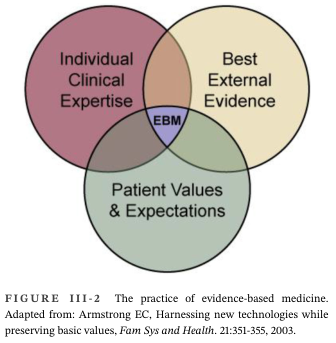
Summary : This Venn diagram illustrates the three core components of evidence-based medicine (EBM): individual clinical expertise, best external evidence, and patient values & expectations, and shows their intersection as the practice of EBM. venn diagram: # Components : • Individual Clinical Expertise (red circle, upper left) • Best External Evidence (yellow circle, upper right) • Patient Values & Expectations (green circle, bottom) # Overlap & Central Concept : • The intersection of all three circles is labeled "EBM" (Evidence-Based Medicine), shaded in blue. • Each pairwise overlap is visually indicated but not separately labeled. # Design Encodings : • Each component uses a distinct color: red, yellow, green. • The central intersection (EBM) is highlighted in blue. • All text is in uppercase or title case for emphasis. # Source & Citation : • Adapted from Armstrong EC, "Harnessing new technologies while preserving basic values," Fam Sys and Health. 21:351-355, 2003. # Analysis : • The diagram visually emphasizes that evidence-based medicine is achieved only when individual clinical expertise, best external evidence, and patient values & expectations are all integrated. No single component alone constitutes EBM; their intersection is essential.
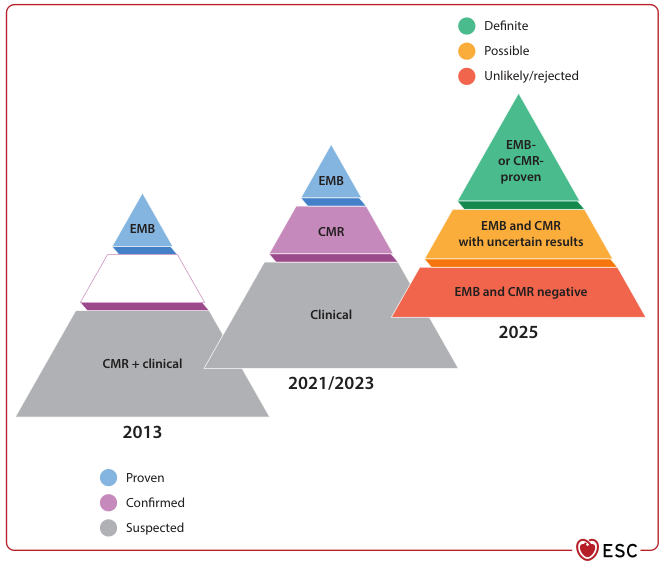
Summary : This figure compares the evolution of diagnostic criteria for myocarditis across three time points (2013, 2021/2023, and 2025), using pyramid diagrams to illustrate the classification hierarchy and terminology changes, as well as the shift in diagnostic certainty categories. pyramid chart: # 2013 Criteria : • Three-level pyramid labeled (from bottom to top): "CMR + clinical" (Suspected, grey), " " (Confirmed, purple), "EMB" (Proven, blue). • Legend: Blue = Proven, Purple = Confirmed, Grey = Suspected. # 2021/2023 Criteria : • Three-level pyramid labeled (from bottom to top): "Clinical" (Suspected, grey), "CMR" (Confirmed, purple), "EMB" (Proven, blue). • Legend: Blue = Proven, Purple = Confirmed, Grey = Suspected. # 2025 Criteria : • Three-level pyramid labeled (from bottom to top): "EMB- or CMR-proven" (Definite, green), "EMB and CMR with uncertain results" (Possible, orange), "EMB and CMR negative" (Unlikely/rejected, red). • Legend: Green = Definite, Orange = Possible, Red = Unlikely/rejected. # Colour Legend : • Green: Definite • Orange: Possible • Red: Unlikely/rejected • Blue: Proven • Purple: Confirmed • Grey: Suspected # Analysis : • The diagnostic framework for myocarditis has evolved from a three-tiered system based on clinical, CMR, and EMB evidence (2013, 2021/2023) to a more streamlined and colour-coded certainty-based system (2025). • The 2025 criteria emphasize diagnostic certainty (definite, possible, unlikely/rejected) rather than the previous "proven/confirmed/suspected" terminology. • The role of EMB and CMR remains central, but the new system explicitly addresses cases with uncertain or negative results, clarifying diagnostic outcomes.

Table 1 Summary of 'The Oxford Levels of Evidence 2'. (Adapted from Oxford Center for Evidence-Based Medicine Levels of Evidence Working Group) <table><thead><tr><th>Level 1</th><th>Level 2</th><th>Level 3</th><th>Level 4</th><th>Level 5</th></tr></thead><tbody><tr><td>Systematic review or meta-analysis</td><td>Randomized trial or observational study with dramatic effect</td><td>Non-randomized, controlled cohort, or follow-up study</td><td>Case series, case-control, or historically controlled study</td><td>Mechanism-based reasoning</td></tr></tbody></table>

Table 1 Summary of 'The Oxford Levels of Evidence 2' (adapted from Oxford Centre for Evidence-Based Medicine Levels of Evidence Working Group) <table><thead><tr><th>Level 1</th><th>Level 2</th><th>Level 3</th><th>Level 4</th><th>Level 5</th></tr></thead><tbody><tr><td>Systematic review or meta-analysis</td><td>Randomized trial or observational study with dramatic effect</td><td>Non-randomized, controlled cohort, or follow-up study</td><td>Case series, case-control, or historically controlled study</td><td>Mechanism-based reasoning</td></tr></tbody></table>
Modalities of Evidence-Based Medicine (EBM)
What is EBM?
- Best External Evidence - current, valid research from clinical studies
- Individual Clinical Expertise - the clinician's accumulated experience and judgment
- Patient Values & Expectations - the patient's unique circumstances and preferences
- Harrison's Principles of Internal Medicine 22E, p. 71
The 5-Step EBM Process
| Step | Action |
|---|---|
| 1. Ask | Formulate a specific, answerable clinical question (using PICO) |
| 2. Acquire | Search literature/databases for applicable research data |
| 3. Appraise | Critically evaluate the evidence for validity and relevance |
| 4. Apply | Integrate the appraisal with the patient's unique aspects and preferences |
| 5. Audit | Monitor outcomes and reassess effectiveness |
The PICO Framework (Structuring the Clinical Question)
| Letter | Meaning | Example |
|---|---|---|
| P | Problem - the specific patient/population | 58-year-old man with HCC post-resection |
| I | Intervention - what is being considered | Serum AFP monitoring |
| C | Comparison - the alternative | Not measuring serum AFP |
| O | Outcome - the measurable endpoint | AFP predictive value for recurrence & survival |
Modalities (Sources/Types of Evidence) - The Evidence Hierarchy
Classic Evidence Pyramid (Low to High)
| Level | Modality | Characteristics |
|---|---|---|
| 5 (Lowest) | Animal/Basic Science Studies | Mechanistic, not directly applicable to humans |
| 5 | Expert Opinion / Editorial | Anecdote, experience-based; most subject to bias |
| 4 | Case Reports / Case Series | Descriptive; no control group; generate hypotheses |
| 3b | Case-Control Studies | Retrospective; compares those with/without disease; susceptible to recall bias |
| 3a | Cohort Studies (Observational) | Prospective or retrospective; follows groups over time; no randomization |
| 2 | Randomized Controlled Trials (RCTs) | Gold standard for therapy; randomization minimizes selection bias |
| 1b | Systematic Reviews of RCTs | Comprehensively summarize evidence on a topic with predefined search strategies |
| 1a (Highest) | Meta-Analysis | Statistically combines data from multiple studies; highest precision |
Detailed Description of Each Modality
1. Expert Opinion & Anecdote (Level 5)
- Based on clinical experience without formal study
- Most subject to cognitive and recall bias
- Useful only when no higher evidence exists
2. Case Reports & Case Series (Level 4)
- Single patient (case report) or small group (case series)
- No control group; cannot establish causation
- Important for identifying rare events or first signals of adverse effects
- "Although they may generate important hypotheses or be the first reports of adverse events or therapeutic benefit, they have no role in formulating modern standards of practice" - Harrison's 22E
3. Observational Studies (Level 3)
a) Cross-Sectional Studies
- Measures exposure and outcome simultaneously (snapshot)
- Good for prevalence; cannot determine temporality
b) Case-Control Studies
- Retrospective; identifies risk factors
- Compares cases (disease) vs. controls (no disease)
- Prone to recall bias and selection bias
c) Cohort Studies
- Prospective (or retrospective); follows exposed vs. unexposed groups
- Better for rare exposures; can establish temporal relationships
- "Carefully collected prospective observational data can at times achieve a level of evidence quality approaching that of major clinical trial data through trial emulation" - Harrison's 22E
4. Randomized Controlled Trials (RCTs) (Level 2)
- Gold standard for evaluating therapeutic interventions
- Random allocation protects against measured and unmeasured confounding (treatment selection bias)
- Features: concurrent controls, blinding (single/double), allocation concealment
- "Double-blinded RCTs are the most valuable because they are the least biased" - Henry's Clinical Diagnosis, p. 124
- Modern variants include:
- Response-adaptive randomized designs
- Pragmatic (real-world) trials
- Crossover trials
- N-of-1 trials (single patient, repeated crossover - most individualized)
5. Systematic Reviews (Level 1b)
- Use predefined, reproducible search strategies with explicit inclusion/exclusion criteria
- Aim to comprehensively identify and critically appraise all relevant studies
- Produced by organizations like the Cochrane Collaboration
- "Systematic reviews are regarded by some as the highest level of evidence in the EBM hierarchy" - Harrison's 22E
- Limitations: only as good as the underlying studies; many are of variable quality; peer review does not reliably detect poor quality
6. Meta-Analysis (Level 1a)
- Statistically combines data from multiple independent studies
- Produces a pooled effect estimate with greater precision than individual studies
- Often included within systematic reviews
- "When appropriate, a meta-analysis is used to quantitatively summarize the systematic review findings" - Harrison's 22E
- Limitations: garbage-in-garbage-out; heterogeneity across studies can make pooling inappropriate
Oxford Centre for EBM - Levels of Evidence (OCEBM)
| Level | Study Type |
|---|---|
| 1 | Systematic review or meta-analysis |
| 2 | RCT or observational study with dramatic effect |
| 3 | Non-randomized controlled cohort/follow-up study |
| 4 | Case series, case-control, or historically controlled study |
| 5 | Mechanism-based reasoning |
The 6S Hierarchy of Evidence Sources (DiCenso 2009)
| Level | Source |
|---|---|
| 6 - Systems | Clinical decision support systems (e.g., UpToDate, integrated into EMR) |
| 5 - Summaries | Evidence-based textbooks and clinical guidelines |
| 4 - Synopses of syntheses | Brief summaries of systematic reviews (e.g., ACP Journal Club) |
| 3 - Syntheses | Full systematic reviews (e.g., Cochrane Database) |
| 2 - Synopses of studies | Brief abstracts of individual studies |
| 1 - Studies | Original primary research articles |
Clinical Practice Guidelines (CPGs)
- Built on top of systematic reviews and meta-analyses
- Developed by professional medical societies and government bodies
- Provide graded recommendations (e.g., Grade A, B, C) based on evidence quality
- Quality depends heavily on the underlying SRs, management of conflicts of interest (COI), and methodological rigor - Henry's Clinical Diagnosis, p. 124
Limitations of the EBM Hierarchy
- Even a strong RCT may not be applicable to an individual patient if the study population differs in age, comorbidities, baseline risk, or clinical setting
- Systematic reviews are "not uniformly the acme of the EBM process" - they fail when few trials exist, when RCTs and observational studies are mixed, or when the evidence base is entirely observational
- The pandemic lesson: thousands of low-quality observational COVID-19 papers created confusion rather than clarity - only well-designed RCTs resolved key uncertainties - Harrison's 22E
- Ethical constraints limit which questions can ever be answered by RCTs (e.g., cannot randomize based on sex, socioeconomic status, or deliberately harmful exposures)