
Rheumatoid arthritis management in adults
Reading File
Now I'll run parallel searches across the library and PubMed simultaneously.
Finding Sources
Searching PubMed
"rheumatoid arthritis"[MeSH Terms] AND "disease management"[MeSH Terms]
Searching the Web
rheumatoid arthritis management guidelines 2025 ACR EULAR
Finding Sources
Searching PubMed
"rheumatoid arthritis"[MeSH Terms] AND treatment
Reading Web Page
https://ard.eular.org/article/S0003-4967(26)00075-0/fulltext
Finding Sources
Searching PubMed
"rheumatoid arthritis"[MeSH Terms] AND "antirheumatic agents"[MeSH Terms]
I found a dedicated RA chapter in Robbins Pathology and Family Medicine. Let me now read the primary management-focused sections and search for DMARD-specific content in parallel.
Finding Sources
Reading File
Reading File
Excellent - the Family Medicine textbook has rich RA management content. Let me read more of it, and also fetch the pathogenesis diagram and search for more management content.
Reading File
Finding Sources
Loading Image
Excellent content. Let me now read the rest of the treatment section and get content from Goldman-Cecil and the Rheumatology textbook for biologics/JAK inhibitors.
Reading File
Finding Sources
Finding Sources
Reading File
Reading File
I now have comprehensive content from multiple authoritative textbooks. Let me also get the biologics/TNF inhibitor section and the 2025 EULAR update content.
Finding Sources
Reading Web Page
https://rheumnow.com/news/2025-update-eular-recommendations-…
I now have excellent, comprehensive content from multiple textbooks plus the 2025 EULAR update. Let me compile the full answer.
Rheumatoid Arthritis: Management in Adults
Pathogenesis (Why This Guides Treatment)
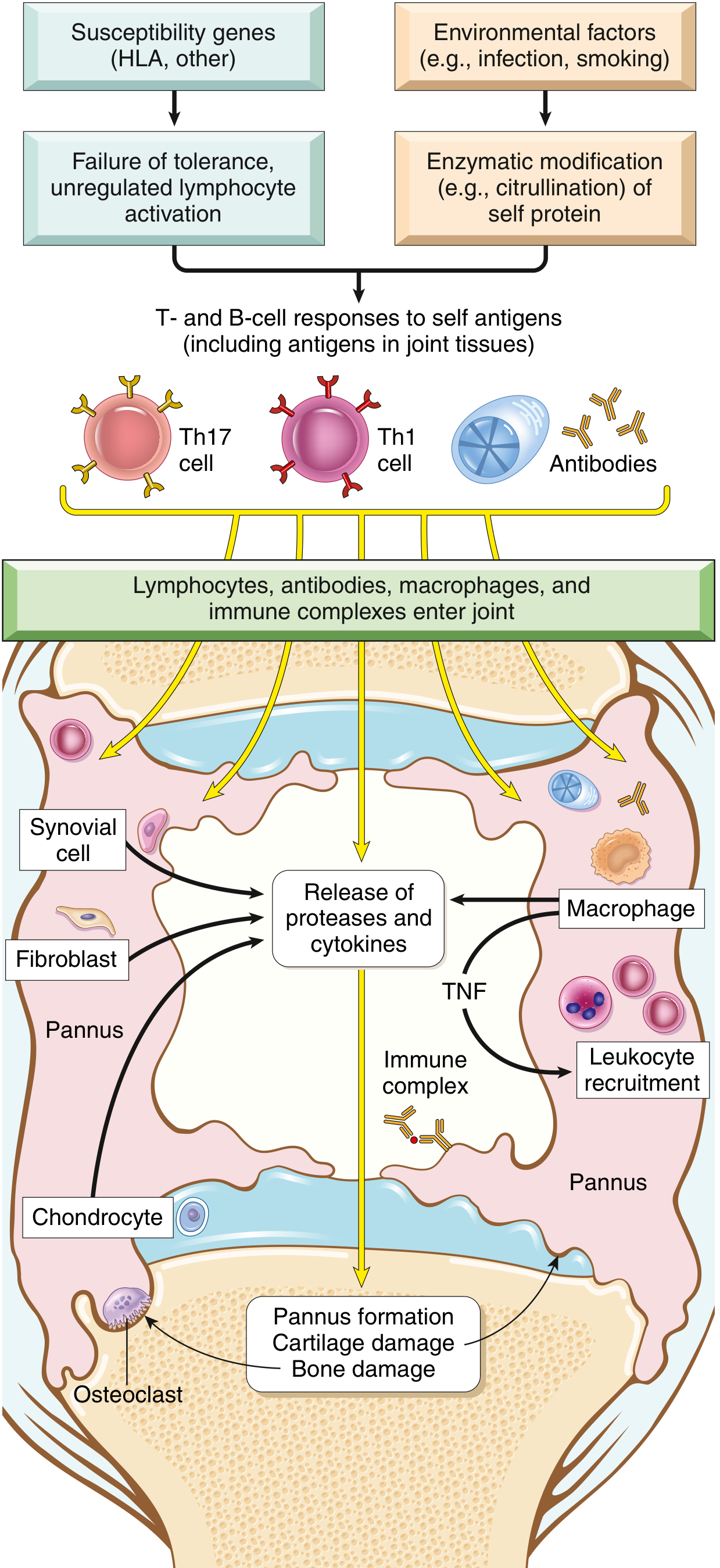
RA is driven by a CD4+ T-cell-mediated autoimmune response against joint antigens. Key mediators include:
- TNF, IL-1, IL-6 (from macrophages) - recruit leukocytes, activate proteases destroying cartilage
- IL-17 (from Th17 cells) - recruits neutrophils and monocytes
- RANKL (from activated T cells) - stimulates osteoclasts causing bone resorption
- Anti-citrullinated peptide antibodies (ACPA) - present in ~70% of patients; associated with disease severity
- Rheumatoid factor (RF) - IgM/IgA autoantibodies binding IgG Fc; present in ~80%
Diagnosis and Classification
The 2010 ACR/EULAR criteria (replacing the 1987 criteria) score patients on:
- Joint involvement (large vs. small, number)
- Serology (RF, ACPA - negative, low positive, high positive)
- Acute phase reactants (CRP, ESR)
- Duration (≥6 weeks)
A score ≥6/10 classifies definite RA.
Key clinical features:
- Symmetric synovitis with morning stiffness >1 hour (hallmark)
- Predilection for MCPs, PIPs, wrists, MTPs
- Extraarticular: rheumatoid nodules, pulmonary fibrosis, vasculitis, sicca, pericarditis
- Poor prognostic factors: functional limitation, extraarticular disease, RF/ACPA positivity, bony erosions on imaging
Treatment Philosophy: Treat-to-Target (T2T)
The foundational principle of modern RA management, endorsed by both EULAR (2025 update) and ACR:
Target = sustained clinical remission (or low disease activity in long-standing/refractory disease). Any disease activity above low disease activity is unacceptable.
- Monitor disease activity every 1-3 months when active
- If no improvement at 3 months after starting treatment, or target not reached at 6 months - adjust therapy
- Once target is sustained, monitoring frequency can decrease
Disease activity is measured using composite scores: DAS28, SDAI, CDAI, or ACR/EULAR Boolean remission criteria.
Pharmacological Management
Step 1: Start DMARDs at Diagnosis
NSAIDs provide only symptomatic relief without altering prognosis. DMARDs must be started as soon as RA is diagnosed - before radiographic erosions appear (which can occur within months to 2 years).
Conventional Synthetic DMARDs (csDMARDs)
| Drug | Dose | Key Points | Monitoring |
|---|---|---|---|
| Methotrexate (first-line) | 7.5-25 mg/week (oral or SC) | Anchor drug; combine with folic acid 1 mg/day to reduce toxicity | CBC, LFTs, creatinine monthly x3 months, then every 3-4 months |
| Hydroxychloroquine | 200-400 mg/day | Least toxic csDMARD; mild RA only | Ophthalmology exam at 6 months, then annually |
| Sulfasalazine | 2-3 g/day in divided doses | Check for sulfa allergy first | CBC, LFTs weekly x1 month, then every 4-6 weeks |
| Leflunomide | 20 mg/day (loading 100 mg/day x3) | Alternative if MTX contraindicated; teratogenic | CBC, LFTs monthly x6 months |
MTX is the anchor csDMARD - it is recommended as part of the first treatment strategy in all patients (EULAR 2025). If MTX is contraindicated or not tolerated, use leflunomide or sulfasalazine.
Triple therapy (MTX + hydroxychloroquine + sulfasalazine) has evidence comparable to biologic combinations in some early RA populations.
MTX mechanism: Inhibits dihydrofolate reductase → reduces purine/pyrimidine synthesis; also elevates adenosine (anti-inflammatory). Dose is ramped up while monitoring for toxicity. Subcutaneous dosing improves bioavailability and reduces GI side effects. Dose reduction needed in renal insufficiency. Avoid alcohol; contraindicated in liver disease. - Goldman-Cecil Medicine, p. 2811
Glucocorticoids
- Short-term use at the start of therapy (alongside MTX) is recommended by EULAR 2025 to bridge until DMARDs take effect
- Low-dose prednisone ≤10 mg/day or intraarticular injections for flares
- Not for long-term monotherapy; taper and discontinue once DMARD is effective
- Risks: osteoporosis, hyperglycemia, infection - co-prescribe calcium/vitamin D and consider bisphosphonate
Step 2: Insufficient Response to csDMARDs (3-6 Months)
If target not reached after adequate trial of csDMARDs, add a biologic DMARD (bDMARD) or targeted synthetic DMARD (tsDMARD) in combination with MTX.
Biological DMARDs (bDMARDs)
TNF Inhibitors (first-line biologics):
| Agent | Mechanism | Route |
|---|---|---|
| Etanercept | Soluble TNF receptor fusion protein | SC weekly |
| Adalimumab | Anti-TNF monoclonal antibody | SC every 2 weeks |
| Infliximab | Anti-TNF monoclonal antibody | IV infusion |
| Certolizumab pegol | PEGylated anti-TNF Fab fragment | SC |
| Golimumab | Anti-TNF monoclonal antibody | SC monthly or IV |
Other bDMARDs (after TNF failure or as alternatives):
| Drug | Target | Notes |
|---|---|---|
| Abatacept | CTLA4-Ig (T-cell costimulation) | SC or IV |
| Rituximab | Anti-CD20 (B-cell depletion) | IV infusion; preferred in RF/ACPA+ disease |
| Tocilizumab | Anti-IL-6 receptor | IV or SC; can be used as monotherapy |
| Sarilumab | Anti-IL-6 receptor | SC |
| Anakinra | IL-1 receptor antagonist | SC daily; less used |
Key principle: If one TNF inhibitor or IL-6R inhibitor fails, can switch to a different mechanism OR try a second TNF/IL-6R inhibitor. - EULAR 2025
Targeted Synthetic DMARDs (tsDMARDs) - JAK Inhibitors
| Drug | Selectivity | Dose |
|---|---|---|
| Tofacitinib | JAK1/3 inhibitor | 5 mg BID or 11 mg XR once daily |
| Baricitinib | JAK1/2 inhibitor | 2 mg or 4 mg once daily |
| Upadacitinib | Selective JAK1 | 15 mg or 30 mg once daily |
Important safety signals (FDA black box warning):
JAK inhibitors carry class-wide warnings for:
- Increased risk of major adverse cardiovascular events (MACE) (HR ~1.33 vs. TNFi)
- Increased malignancy risk (HR ~1.48 vs. TNFi, from ORAL Surveillance trial)
- Increased risk of thromboembolism
- Increased all-cause mortality
The ORAL Surveillance trial compared tofacitinib vs. TNF inhibitors in RA patients over age 50 with ≥1 cardiovascular risk factor; tofacitinib did not meet noninferiority. - Firestein & Kelley's Textbook of Rheumatology, 2-Volume Set
EULAR 2025 guidance: JAK inhibitors can be used after careful consideration of risks, particularly in patients without high CV risk, malignancy history, or thromboembolic risk.
EULAR 2025 Updated Recommendations (Published March 2026)
The 2025 update streamlined from 11 to 9 recommendations:
- Start DMARDs as soon as RA is diagnosed
- Treat-to-target: aim for sustained remission (or low disease activity in refractory/long-standing disease)
- Monitor every 1-3 months; adjust at 3 months if no improvement, or at 6 months if target not reached
- MTX (+ short-term glucocorticoids) as first-line; if contraindicated, use leflunomide or sulfasalazine
- In patients with poor prognostic factors (high disease activity, early erosions, high RF/ACPA), combination csDMARDs or early bDMARD addition is considered
- If csDMARDs insufficient, add bDMARD or tsDMARD (JAKi with risk consideration)
- Biosimilars should be used where appropriate (same efficacy as originators)
- If first bDMARD/JAKi fails, try another (same or different class)
- In sustained remission: continue DMARDs but dose tapering may be considered; stopping often leads to flares
The 2025 EULAR recommendations (Smolen et al., Ann Rheum Dis, 2026) provide the current global standard.
Non-Pharmacological Management
| Modality | Role |
|---|---|
| Physiotherapy | Range-of-motion exercises, joint protection, strengthening |
| Occupational therapy | Splints, adaptive devices, activity modification |
| Patient education | DMARD compliance, disease monitoring, self-management |
| Smoking cessation | Smoking is an established environmental trigger and worsens prognosis |
| Cardiovascular risk management | RA is an independent CVD risk factor; manage lipids, BP, diabetes |
| Bone protection | Calcium, vitamin D; bisphosphonates if on prolonged steroids |
| Surgery | Synovectomy, joint replacement for end-stage disease |
Monitoring Schedule Summary
| Drug | Blood Tests | Frequency |
|---|---|---|
| Methotrexate | CBC, LFTs, creatinine | Monthly x3, then every 3-4 months |
| Sulfasalazine | CBC, LFTs | Weekly x1 month, then every 4-6 weeks |
| Hydroxychloroquine | Eye exam (visual fields) | Baseline, then annually |
| Leflunomide | CBC, LFTs | Monthly x6 months |
| All biologics/JAKi | CBC, infection screen, TB screening before starting | Per product labeling |
Special Populations
- Pregnancy: Stop MTX (teratogenic - category X) and leflunomide (teratogenic) before conception. Hydroxychloroquine and sulfasalazine (+ folic acid) are relatively safer. TNF inhibitors generally compatible in first/second trimester; certolizumab has least placental transfer. JAK inhibitors - avoid.
- Elderly/Renal impairment: Reduce MTX dose; JAK inhibitors also need dose adjustment for renal function.
- Infections/TB: Screen for latent TB (TST or IGRA) before all biologics and JAK inhibitors. Hold immunosuppressives during serious infections.
- Pre-surgery: Decision on holding biologics peri-operatively depends on drug half-life and surgical risk.
Sources:
- Textbook of Family Medicine, 9th edition (Swanson), p. 879-887
- Goldman-Cecil Medicine International Edition, p. 2811
- Robbins & Kumar Basic Pathology, p. 792
- Firestein & Kelley's Textbook of Rheumatology, 2-Volume Set
- EULAR 2025 RA Recommendations (Smolen JS et al., Ann Rheum Dis, 2026) - most current global guideline
Trivial aortic regurgitation
Reading File
Trivial aortic regurgitation (AR) is the mildest grade of AR on echocardiography - essentially a trace finding often seen in normal individuals. It typically causes no symptoms, no significant hemodynamic burden, and requires no treatment, only periodic surveillance. Let me pull comprehensive textbook and guideline data.
Searching sources...
Finding Sources
Finding Sources
Searching the Web
trivial aortic regurgitation clinical significance management guidelines 2025
The Echocardiography textbook has the most relevant dedicated sections. Let me read those and the Braunwald's section in parallel.
Reading File
Reading File
Searching PubMed
"aortic regurgitation" AND severity grading echocardiography
Let me now read the main AR echocardiography content block and Braunwald's section on AR severity grading.
Reading File
Reading File
Reading Article
PMID: 38167345
Let me now read the key AR severity grading section and Braunwald's dedicated AR chapter.
Reading File
Reading File
Now let me get the severity grading table and the key AR quantification criteria from the echocardiography textbook, plus fetch the relevant echo image.
Reading File
Finding Sources
Excellent - the Stages of Chronic AR table was partially returned. Let me read that section more fully to capture Stage A (trivial/trace) and see what it says about progression and management of this stage.
Reading File
Finding Sources
I now have all the key content needed. Let me now fetch the key AR severity grading image and also get a quick search on natural history of trivial AR.
Finding Sources
Loading Image
I have comprehensive content from the Textbook of Clinical Echocardiography (Otto), Braunwald's Heart Disease, and the 2025 ESC/EACTS guidelines. I can now compose a thorough answer.
Trivial Aortic Regurgitation
What Is It?
Trivial (also called trace) aortic regurgitation is the mildest detectable grade of AR on Doppler echocardiography - a small, brief regurgitant jet through the aortic valve in diastole that falls well below the threshold for any clinical grading tier. It represents backflow from the aorta into the left ventricle that is too small to impose any hemodynamic burden.
In major classification systems (ACC/AHA and ESC), trivial/trace AR sits within Stage A - patients "at risk of AR" or with no hemodynamically significant regurgitation (AR severity: none or trace). It does not constitute progressive AR (Stage B) or beyond.
Prevalence - More Common Than You Think
Trivial AR is a common incidental echocardiographic finding:
- Detected in up to 10-15% of echocardiograms in the general adult population
- Prevalence increases steadily with age
- Found in both normal individuals and those with underlying risk conditions (bicuspid aortic valve, hypertension, connective tissue disease, rheumatic heart disease, prior endocarditis)
The Textbook of Clinical Echocardiography (Otto) notes: "The degree of normal prosthetic regurgitation is greater than the trivial amounts of native valve regurgitation seen in normal individuals" - underscoring that small degrees of regurgitation can even be physiologically normal. - Textbook of Clinical Echocardiography, p. 413
Echocardiographic Features
Trivial AR is characterised on Doppler echo by:
| Parameter | Trivial / Trace Findings |
|---|---|
| Colour Doppler jet | Small, narrow jet; jet width <25% of LVOT width |
| Vena contracta | <3.0 mm (mild AR threshold; trivial is smaller) |
| CW Doppler signal | Faint, often incomplete - not holodiastolic; recorded only at beginning or end of diastole due to low signal strength |
| Pressure half-time | >500 ms (flat slope = mild/trivial; steep slope <200 ms = severe) |
| Holodiastolic aortic flow reversal | Absent (only seen in moderate-severe AR) |
| Regurgitant volume | <30 mL/beat |
| Regurgitant fraction | <30% |
| LV dimensions | Normal - no LV dilatation |
| LVEF | Normal |
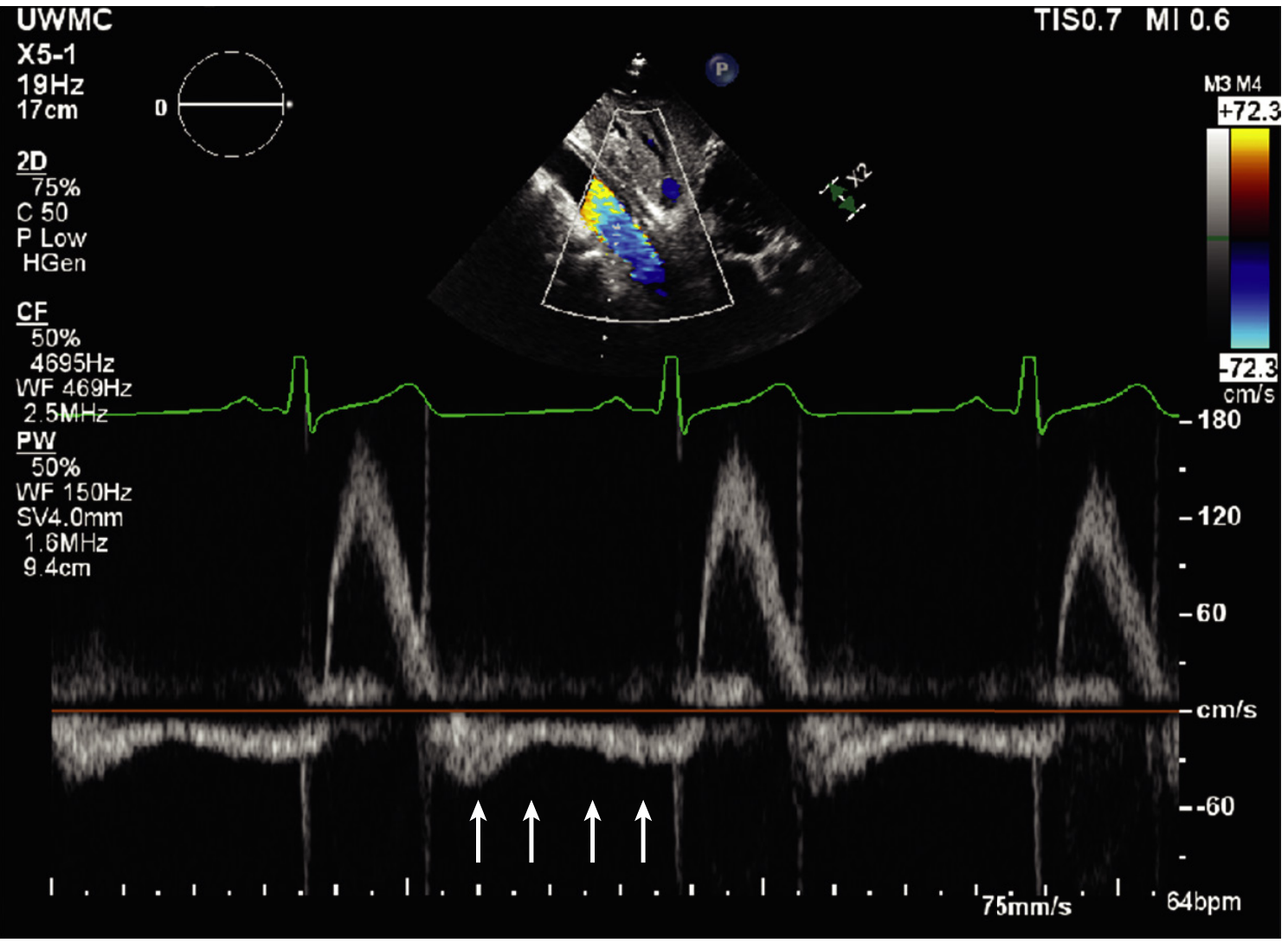
The CW Doppler velocity curve in AR begins at aortic closure and declines during diastole. In trivial AR, the signal is faint and intermittent. By contrast, "in moderate or severe AR, the signal can easily be recorded throughout diastole." - Textbook of Clinical Echocardiography, p. 384
The image below shows holodiastolic aortic flow reversal (arrows) - a feature of severe AR, not seen in trivial AR:
ACC/AHA Staging of Chronic AR
The current guideline classification places trivial AR in Stage A:
| Stage | Definition | AR Severity | Hemodynamic Consequence | Symptoms |
|---|---|---|---|---|
| A | At risk of AR | None or trace | None | None |
| B | Progressive AR | Mild to moderate | Mild LV dilation | None |
| C1 | Severe asymptomatic, compensated | Severe | LV dilation, EF ≥50% | None |
| C2 | Severe asymptomatic, decompensated | Severe | EF <50%, or LVESD >50mm | None |
| D | Severe symptomatic | Severe | Variable LV function | Dyspnoea, angina, HF |
From: Textbook of Clinical Echocardiography, Table 12.5 - Stages of Chronic Aortic Regurgitation
Causes / Associated Conditions
Trivial AR may be found in:
- Normal individuals (physiological / incidental finding)
- Aortic valve risk conditions:
- Bicuspid aortic valve (BAV) - even with no current regurgitation, warrants surveillance
- Aortic valve sclerosis (age-related thickening without stenosis)
- Rheumatic heart disease (prior rheumatic fever)
- Aortic root / ascending aorta conditions:
- Hypertension-related annular dilation
- Marfan syndrome / connective tissue disease
- Dilated aortic sinuses
- Post-infective: Previous infective endocarditis
- Inflammatory conditions: Ankylosing spondylitis, systemic lupus erythematosus
- In ankylosing spondylitis, aortic root inflammation is a well-recognised extraarticular feature; a 2025 study (Bengtsson et al., Clin Rheumatol) followed AR progression in this population
Haemodynamic Significance
Trivial AR has no haemodynamic significance.
- No LV volume overload
- No LV chamber dilation
- No reduction in LV ejection fraction
- No elevated filling pressures
- No symptoms
The heart compensates with chronic LV dilation only in moderate-to-severe AR. With trivial amounts, the regurgitant volume (backflow) is negligible and the LV does not remodel. - Braunwald's Heart Disease
Clinical Presentation
- No symptoms attributable to trivial AR itself
- Physical examination: may be no audible murmur, or occasionally a very faint early diastolic murmur at the left sternal border
- Pulse pressure: normal (widening of pulse pressure occurs in significant AR)
- No peripheral signs of AR (no Corrigan's pulse, no de Musset's sign, no Quincke's pulsation, no Duroziez's murmur)
Management
Trivial AR in an Otherwise Normal Heart
No treatment required. No medications, no surgical or interventional therapy.
Surveillance
The frequency of follow-up echocardiography depends on the underlying aetiology, not the trivial AR itself:
| Clinical Context | Recommended Follow-up |
|---|---|
| Isolated trivial AR, normal aorta, no risk conditions | No specific echocardiographic surveillance required; standard clinical review |
| Trivial AR + bicuspid aortic valve | Annual or biennial echo (to monitor aorta and valve) |
| Trivial AR + dilated aortic root / sinuses | Echo every 1-2 years; consider CMR for aortic dimensions |
| Trivial AR + Marfan / connective tissue disease | Annual echo; CT/MRI for aorta |
| Trivial AR + ankylosing spondylitis / inflammatory disease | Periodic echo surveillance |
| Trivial AR + rheumatic heart disease | Periodic surveillance |
The key message from the 2025 ESC/EACTS and 2021 ACC/AHA Valvular Heart Disease guidelines: Intervention (surgical AVR or TAVR) is only indicated for severe AR with symptoms or LV dysfunction. Trivial and mild AR do not meet any intervention threshold.
Endocarditis Prophylaxis
Per current guidelines (AHA 2007, reaffirmed subsequently), infective endocarditis prophylaxis is NOT recommended for native valve AR unless the patient has a prior history of endocarditis, specific high-risk conditions (prosthetic valve, certain congenital heart diseases), or is undergoing dental procedures in the context of those specific conditions. Trivial native AR alone is not an indication for prophylaxis.
Cardiovascular Risk Factor Management
Patients should have general cardiovascular risk factors addressed (hypertension control, lipids, smoking) - not because of the AR itself, but because hypertension in particular can worsen aortic regurgitation over time by increasing afterload and promoting annular/aortic dilation.
Natural History and Progression
- Most patients with trivial AR remain stable for many years or decades
- Progression to moderate or severe AR is more likely in those with an underlying structural cause (BAV, dilated aorta, connective tissue disease, rheumatic disease) than in those with isolated trivial AR
- Annual progression rate to severe AR in the broad population of mild AR is approximately 1-2% per year
- Regular clinical review (not necessarily annual echo) is appropriate for isolated trivial AR in an otherwise normal heart
Key Take-Home Points
- Trivial AR = Stage A in ACC/AHA classification - no hemodynamic burden, no LV changes, no symptoms
- It is a common incidental finding, present in many normal adults
- No treatment is needed for trivial AR itself
- The management priority is identifying and monitoring any underlying cause (BAV, aortic dilation, connective tissue disease)
- Surveillance echo frequency is dictated by the underlying aetiology, not the trivial AR alone
- Intervention thresholds apply only to severe AR - trivial AR is far from any surgical indication
Sources:
- Textbook of Clinical Echocardiography (Otto CM), Chapter 12 - Valvular Regurgitation, pp. 379-413
- Braunwald's Heart Disease, 2-Volume Set, Chapter on Valvular Heart Disease in Older Adults, p. 2755
- ACC/AHA Stages of Chronic AR (Table 12.5, Otto)
- Tsampasian V et al. "Echocardiographic assessment of aortic regurgitation: a narrative review." Echo Res Pract, 2024 [PMID: 38167345]
- 2025 ESC/EACTS Guidelines for management of valvular heart disease (Praz et al.)
This is a shared conversation. Sign in to Orris to start your own chat.