
Resting membrane potential
Reading File
Now let me search the medical library for resting membrane potential content in parallel.
Finding Sources
Finding Sources
Excellent results. Now let me read the key sections from Guyton & Hall, Costanzo, and Ganong's in parallel - these are the most authoritative physiology sources.
Reading File
Reading File
Reading File
I have rich content. Let me also read the Guyton section on the origin of resting membrane potential and fetch the key diagram from Guyton.
Reading File
Loading Image
Loading Image
I also want the Guyton diagram (Fig 5.5) and the Neuroscience: Exploring the Brain ionic basis section.
Loading Image
Reading File
I now have comprehensive, well-illustrated content from multiple authoritative textbooks. Let me compose the full answer.
Resting Membrane Potential
Definition
The resting membrane potential (RMP) is the voltage difference that exists across the plasma membrane of an excitable cell (nerve, muscle) during the period between action potentials - when the cell is at rest. By convention, it is expressed as the intracellular potential relative to the extracellular potential.
- Typical value in large nerve fibers: -70 mV (Ganong's) to -90 mV (Guyton)
- Skeletal muscle: approximately -80 to -90 mV
- Smooth muscle: approximately -50 to -60 mV
- Most excitable cells fall in the range of -70 to -80 mV (Costanzo)
The negative sign means the inside is more negative than the outside.
Prerequisites for a Membrane Potential
Two conditions must be met (Ganong's Review of Medical Physiology):
- An unequal distribution of ions across the membrane (a concentration gradient)
- Selective membrane permeability to those ions (via ion channels)
The diagram below illustrates how charge separation at the membrane surface creates the potential:
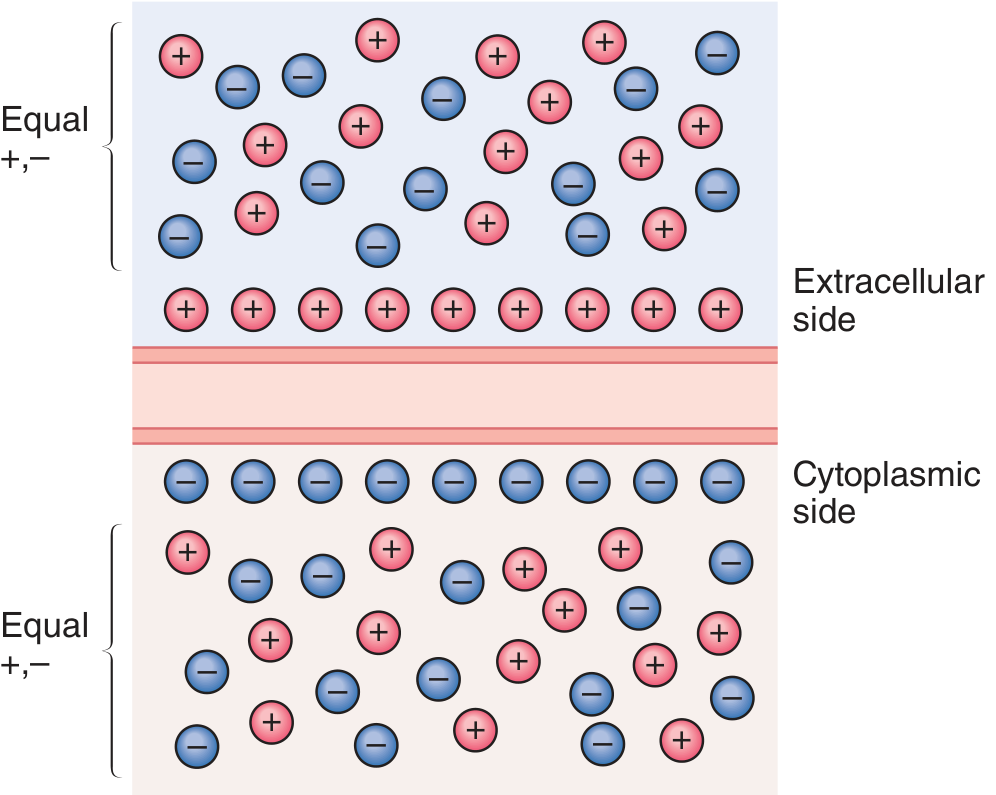
Ion Concentrations Across the Resting Membrane
The Na⁺-K⁺ ATPase pump establishes and maintains the following gradients (Guyton & Hall):
| Ion | Extracellular | Intracellular | Ratio (in/out) | Nernst Potential |
|---|---|---|---|---|
| Na⁺ | 142 mEq/L | 14 mEq/L | 0.1 | +61 mV |
| K⁺ | 4 mEq/L | 140 mEq/L | 35 | -94 mV |
| Cl⁻ | High outside | Low inside | - | ~-90 mV |
| Ca²⁺ | High outside | Very low inside | - | Positive |
The Na⁺-K⁺ pump transports 3 Na⁺ out for every 2 K⁺ in, creating net charge separation:
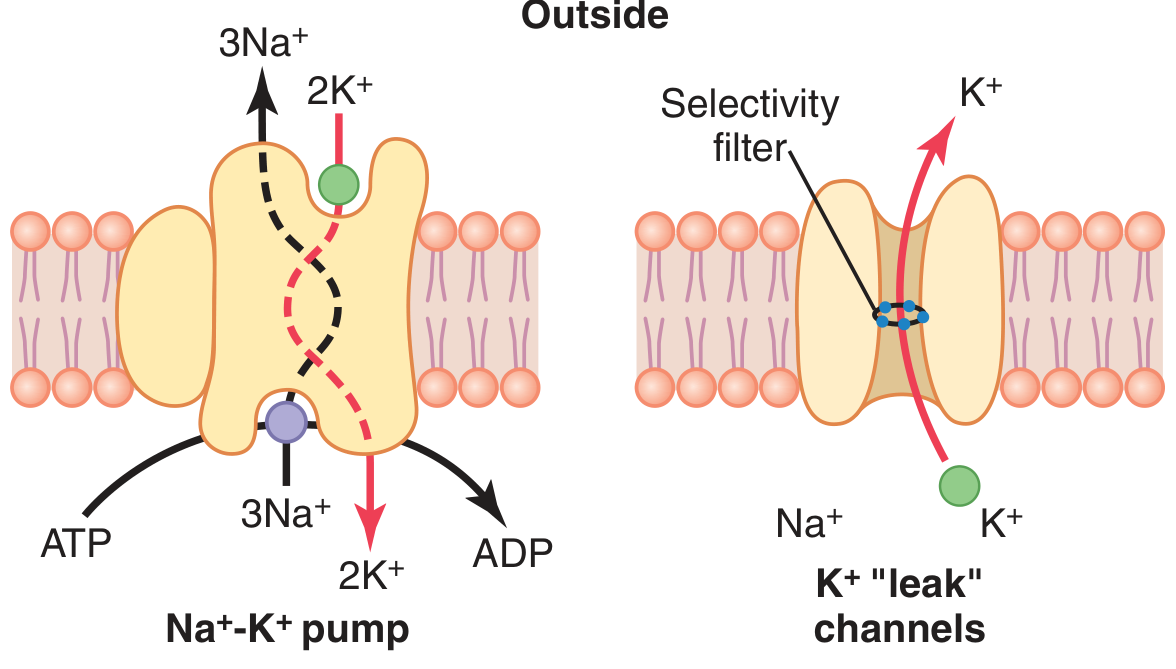
How the Resting Potential is Established
The RMP results from the interplay of three factors. The classic Guyton & Hall diagram (Fig. 5.5) shows each contribution:
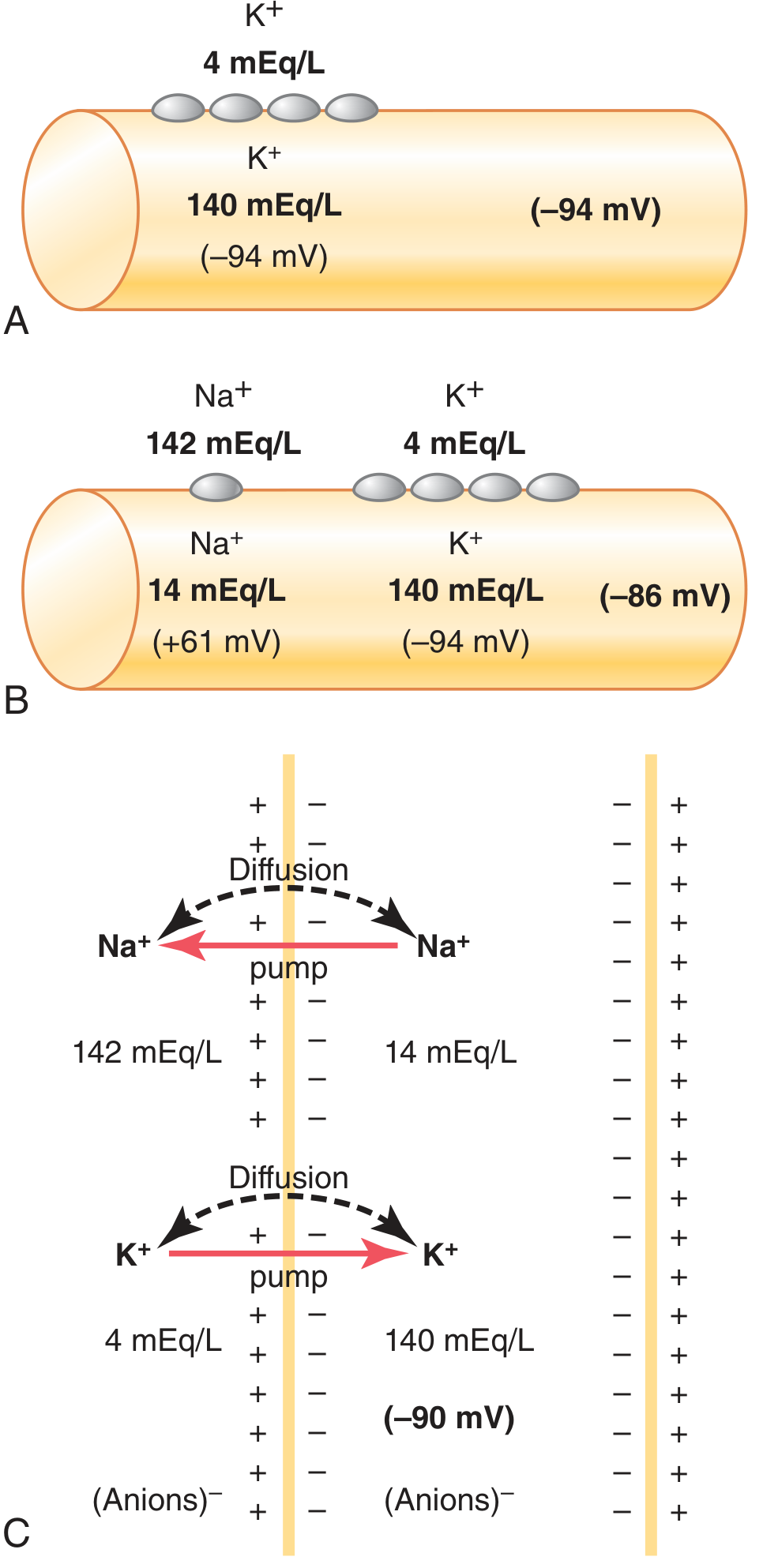
1. Potassium Diffusion Potential (dominant contributor)
At rest, the membrane has abundant K⁺ leak channels (tandem pore domain / K⁺ leak channels). K⁺ is ~100× more permeable than Na⁺. K⁺ follows its concentration gradient and diffuses outward, leaving behind negative intracellular anions. This creates a strong negative intracellular charge.
- K⁺ alone would drive the membrane to the K⁺ Nernst potential: -94 mV
2. Sodium Diffusion (minor opposing effect)
A small amount of Na⁺ leaks inward through the K⁺-Na⁺ leak channels. Since Na⁺ equilibrium potential is +61 mV, this partial Na⁺ permeability slightly reduces the negativity inside.
- With both K⁺ and Na⁺ permeability combined (Goldman equation): approximately -86 mV
- Membrane is ~100× more permeable to K⁺ than Na⁺, so K⁺ dominates
3. Na⁺-K⁺ ATPase Pump (electrogenic contribution)
The pump extrudes 3 Na⁺ for every 2 K⁺ it brings in - a net loss of one positive charge per cycle from the inside. This electrogenic activity contributes an additional -4 mV, bringing the net RMP to approximately -90 mV (Guyton).
Summary of contributions:
K⁺ diffusion: -94 mV → Na⁺ leak offsets to -86 mV → Na⁺-K⁺ pump adds -4 mV → net ≈ -90 mV
The Goldman-Hodgkin-Katz (GHK) Equation
The Goldman equation formally accounts for the relative permeabilities of all permeable ions:
$$E_m = \frac{RT}{F} \ln \frac{P_{K^+}[K^+]o + P{Na^+}[Na^+]o + P{Cl^-}[Cl^-]i}{P{K^+}[K^+]i + P{Na^+}[Na^+]i + P{Cl^-}[Cl^-]_o}$$
Where P = permeability coefficient for each ion.
An equivalent formulation is the chord conductance equation (Costanzo):
$$E_m = \frac{G_{K^+}}{G_T}E_{K^+} + \frac{G_{Na^+}}{G_T}E_{Na^+} + \frac{G_{Cl^-}}{G_T}E_{Cl^-} + \frac{G_{Ca^{2+}}}{G_T}E_{Ca^{2+}}$$
This equation weights each ion's equilibrium potential (from the Nernst equation) by its relative conductance. Ions with the highest conductance pull the membrane potential toward their equilibrium potential.
At rest: G(K⁺) >> G(Cl⁻) >> G(Na⁺) >> G(Ca²⁺)
- So RMP is close to E(K⁺) ≈ -90 to -94 mV
- RMP is far from E(Na⁺) ≈ +61 mV
Role of the Na⁺-K⁺ ATPase
The Na⁺-K⁺ pump contributes to the RMP in two ways (Costanzo):
- Direct electrogenic effect - pumping 3 Na⁺ out per 2 K⁺ in directly adds about -4 mV to the inside
- Indirect (more important) effect - maintaining the K⁺ concentration gradient that drives the dominant K⁺ diffusion potential
Without the pump, K⁺ leaking out and Na⁺ leaking in would eventually dissipate the ion gradients, abolishing the RMP entirely.
Clinical Correlations
Hyperkalemia (high extracellular K⁺)
- Reduces the K⁺ concentration gradient (K⁺ outside/inside ratio decreases)
- K⁺ Nernst potential becomes less negative (e.g., moves from -90 mV toward -70 mV)
- The RMP depolarizes (becomes less negative) - cells become more excitable initially
- Severe hyperkalemia paradoxically causes muscle weakness and cardiac arrhythmias because voltage-gated Na⁺ channels become inactivated at the persistently depolarized membrane
Hypokalemia (low extracellular K⁺)
- Increases the K⁺ gradient
- RMP hyperpolarizes (becomes more negative)
- Cells become less excitable - can cause muscle weakness and arrhythmias
Key Takeaways
| Concept | Value/Fact |
|---|---|
| RMP of large neurons | -70 to -90 mV |
| Primary determinant | K⁺ diffusion (high resting K⁺ permeability) |
| K⁺ equilibrium potential | -94 mV |
| Na⁺ equilibrium potential | +61 mV |
| Na⁺-K⁺ pump stoichiometry | 3 Na⁺ out : 2 K⁺ in |
| Direct pump contribution | ~-4 mV |
| Goldman equation role | Weights each ion by its permeability |
| Resting K⁺:Na⁺ permeability ratio | ~100:1 |
Sources:
- Guyton and Hall Textbook of Medical Physiology (Figs. 5.4 & 5.5) - Chapter 5, p. 78-79
- Costanzo Physiology 7th Edition - Chapter 1, p. 26
- Ganong's Review of Medical Physiology 26th Edition - Chapter 4, p. 99
- Neuroscience: Exploring the Brain 5th Edition - Chapter 3
This is a shared conversation. Sign in to Orris to start your own chat.