
How does niconi beauty de tan will work on skin mechanism
Niconi Beauty De Tan mechanism of action skin ingredients
Niconi Beauty De Tan active ingredients skin depigmentation
skin depigmenting agents tyrosinase inhibitor mechanism niacinamide kojic
skin depigmenting tyrosinase inhibitor hyperpigmentation topical
How "De-Tan" Products Work on Skin — The Mechanism
1. What Is a "Tan"? (The Biology First)
- UV exposure → DNA damage → p53 activation in epidermal cells
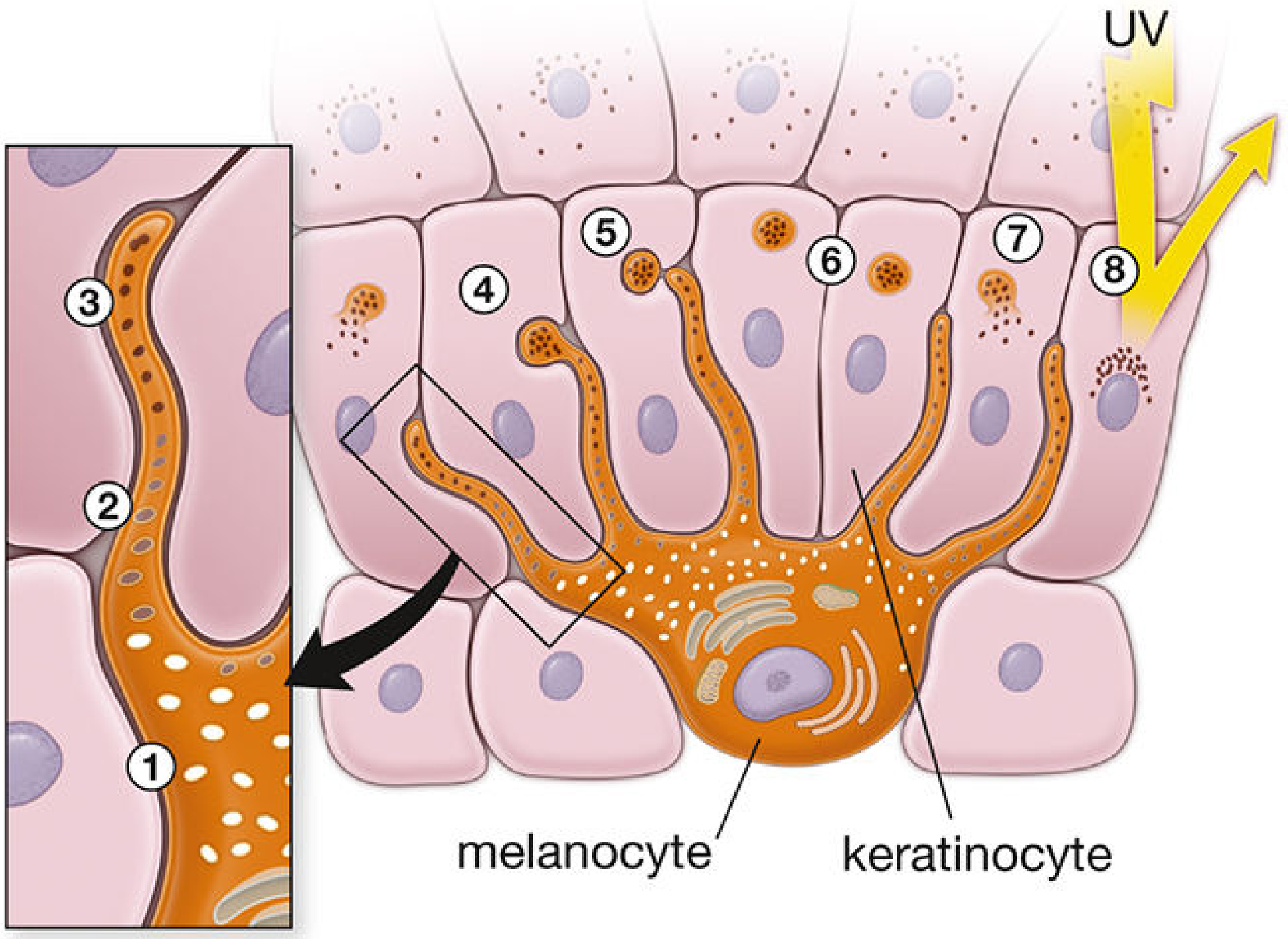
- p53 stimulates melanocytes (pigment cells in the basal layer of the epidermis) to ramp up melanin production
- Melanin is synthesized inside melanosomes (lysosome-related organelles derived from the Golgi apparatus)
- Mature melanosomes are transported along dendritic processes of melanocytes and transferred to surrounding keratinocytes, where they act as a "microparasol" — capping over the nucleus to shield DNA from further UV damage
- This accumulation of melanin in keratinocytes → visible darkening (tan)
| Type | Timing | Mechanism |
|---|---|---|
| Immediate pigment darkening | Within 20 min | Oxidation + redistribution of existing melanin (UVA-driven) |
| Delayed tanning | Peaks ~3 days | New melanin synthesis (mainly UVB-driven) |
2. The Melanin Synthesis Pathway — Where De-Tan Acts
L-Tyrosine → (tyrosinase) → L-DOPA → (tyrosinase) → L-DOPAquinone
- With cysteine present → Pheomelanin (red-yellow)
- Without cysteine → Eumelanin (brown-black), requiring TRP1 & TRP2 enzymes
3. How De-Tan Products (Including Niconi) Work on Skin
A. Tyrosinase Inhibitors (Block New Melanin Production)
- Kojic acid — chelates copper at the active site of tyrosinase, directly inhibiting melanin synthesis
- Alpha-arbutin — a glycosylated hydroquinone derivative; slowly releases hydroquinone to competitively inhibit tyrosinase
- Vitamin C (ascorbic acid) — reduces DOPAquinone back to DOPA, interrupting melanin formation; also reduces existing oxidized melanin
- Niacinamide (Vitamin B3) — does not inhibit tyrosinase but blocks the transfer of melanosomes from melanocytes to keratinocytes (interferes with the melanosome-transfer step), reducing pigmentation without affecting melanocyte number
B. Exfoliants (Remove Pigmented Surface Cells)
- AHAs (glycolic acid, lactic acid), BHAs (salicylic acid) — accelerate the natural shedding of the stratum corneum (dead surface keratinocytes) that carry the already-deposited melanin, physically clearing tanned skin faster
C. Antioxidants (Neutralize UV-Induced Oxidative Stress)
- Ingredients like Vitamin C, Vitamin E, niacinamide neutralize reactive oxygen species generated by UV, reducing the inflammatory signal that triggers melanogenesis in the first place
D. Sunscreens / Photoprotection (Prevent Further Tanning)
- Many de-tan products include SPF filters to break the cycle — preventing new UV-induced pigmentation while the skin lightens
4. The Full Mechanism at a Glance
UV Radiation
      ↓
DNA damage → p53 activation → α-MSH release → MC1R stimulation
      ↓
Tyrosinase activation in melanosomes
      ↓
Tyrosine → DOPA → DOPAquinone → Eumelanin/Pheomelanin
      ↓
Melanosome transfer to keratinocytes → Visible tan/darkening

DE-TAN ACTS AT:
• Tyrosinase inhibition (kojic acid, arbutin, Vit C)
• Melanosome transfer blockade (niacinamide)
• Keratinocyte exfoliation (AHAs/BHAs — remove pigmented cells)
• Antioxidant quenching (Vit C, E — reduce oxidative trigger)
5. Important Limitations
- Dermal melanin (in melanophages below the epidermis, as in dermal melasma) responds poorly to topical agents — de-tan products mainly work on epidermal pigmentation
- Results require consistent use — natural skin turnover takes ~28 days, so visible lightening usually takes 4–8 weeks
- Without sun protection, UV re-exposure quickly re-triggers melanogenesis, reversing any gains
- Histology: A Text and Atlas with Correlated Cell and Molecular Biology, 8th ed.
- Fitzpatrick's Dermatology, 9th ed.
- Dermatology 2-Volume Set, 5th ed.
Give me the other products which work to reduce tanning
What type of de-tan products are you looking for? · Which category interests you most?
best face de-tan creams packs products 2025 dermatologist recommended
topical agents skin hyperpigmentation treatment review
PMID: 33998768
popular de-tan face pack cream India ingredients brands 2024
Products That Reduce Facial Tanning
🧴 A. By Active Ingredient (What to Look for on Labels)
| Ingredient | How It Works | Strength |
|---|---|---|
| Hydroquinone (2–4%) | Inhibits tyrosinase; reduces melanin production | Gold standard — strongest |
| Kojic Acid | Chelates copper at tyrosinase active site; blocks melanin synthesis | Strong, widely used |
| Azelaic Acid (15–20%) | Inhibits tyrosinase; also anti-inflammatory; good for post-acne pigmentation | Moderate, well-tolerated |
| Alpha-Arbutin | Slowly releases hydroquinone; competitive tyrosinase inhibitor | Moderate, gentler alternative |
| Niacinamide (Vitamin B3, 5–10%) | Blocks melanosome transfer from melanocytes to keratinocytes | Moderate; also reduces redness |
| Vitamin C (L-Ascorbic Acid, 10–20%) | Reduces DOPAquinone back to DOPA; antioxidant; reduces existing pigment | Moderate; brightening |
| Retinol / Retinoids | Accelerates skin cell turnover; exfoliates pigmented cells faster | Strong; requires gradual intro |
| Glycolic Acid (AHA) | Exfoliates stratum corneum, removing surface tanned cells | Surface-level; fast results |
| Lactic Acid (AHA) | Gentler exfoliant; also inhibits tyrosinase mildly | Gentle; good for sensitive skin |
| Salicylic Acid (BHA) | Oil-soluble exfoliant; penetrates pores; removes pigmented dead cells | Good for oily/acne-prone skin |
| Tranexamic Acid | Inhibits UV-induced plasmin activation which stimulates melanocytes | Emerging; safe for all skin types |
| Licorice Extract (Glabridin) | Natural tyrosinase inhibitor; anti-inflammatory | Gentle; suitable for sensitive skin |
🏷️ B. Popular Commercial Face De-Tan Products (Brands)
Prescription / Dermatologist-Recommended
| Product | Key Ingredients | Notes |
|---|---|---|
| Tri-Luma Cream | Hydroquinone 4% + Tretinoin + Fluocinolone | Triple combination; melasma/tan gold standard |
| Kligman's Formula | Hydroquinone + Tretinoin + Steroid | Classic prescription blend |
| Cosmelite / Mela-D | Hydroquinone-based | Dermatologist prescribed |
Over-the-Counter / Cosmeceutical Brands
| Product | Key Ingredients | Best For |
|---|---|---|
| Minimalist Alpha Arbutin 2% + HA | Alpha-arbutin + Hyaluronic acid | Even-toned skin, gentle |
| Minimalist Niacinamide 10% + Zinc | Niacinamide + Zinc PCA | Oily/acne-prone with tan |
| The Ordinary Vitamin C Suspension 23% | L-Ascorbic acid | Brightening, tan reduction |
| Dot & Key Pollution + Tan Removal Mask | Kaolin, AHA, kojic | Weekly de-tan face pack |
| Lotus Herbals WhiteGlow De Tan Pack | Kojic acid, fruit extracts | Affordable, Indian brand |
| VLCC De-Tan Face Pack | Papain (papaya enzyme), AHA | Enzymatic exfoliation |
| Mamaearth Bye Bye Blemishes Cream | Mulberry extract, vitamin C | Gentle, sensitive skin |
| Kama Ayurveda Kumkumadi Oil | Saffron, turmeric, sandalwood | Ayurvedic brightening |
| Garnier Bright Complete Vitamin C Serum | Vitamin C 30x | Mass-market brightening |
| Plum Bright Years Vitamin C Serum | Stable Vitamin C | Vegan, cruelty-free |
| Cetaphil Brightening Day Cream SPF 15 | Niacinamide + SPF | Gentle + photoprotection |
| La Roche-Posay Glycolic B5 Serum | Glycolic acid + Vitamin B5 | Exfoliation + tan removal |
🧖 C. Face Packs / Masks (Wash-Off De-Tan)
| Type | What It Does |
|---|---|
| Kaolin / Bentonite clay packs | Absorbs excess sebum, exfoliates surface pigment |
| Papaya enzyme (papain) masks | Enzymatic exfoliation of dead tanned skin cells |
| Multani mitti (Fuller's earth) packs | Physically removes dead cells, mild skin brightening |
| Turmeric + sandalwood packs | Natural anti-inflammatory + mild tyrosinase inhibition (curcumin) |
| Yogurt + honey packs | Lactic acid (gentle exfoliant) + humectant |
☀️ D. Sunscreens (Most Important — Prevents Re-Tanning)
- Broad-spectrum SPF 30–50+ (covers both UVA + UVB)
- PA+++ rating (UVA protection, what actually causes tan)
- Tinted or mattifying formulas for daily face use
⚠️ Key Points to Remember
- Hydroquinone is the most potent but should not be used continuously for more than 3 months — use under dermatologist guidance
- Combination products (e.g., niacinamide + arbutin + Vitamin C) work better than single ingredients
- Sunscreen every day is non-negotiable — UV re-exposure reverses all de-tan progress within 48–72 hours
- Results take 4–8 weeks — skin turnover cycle is ~28 days
- If tan is persistent or worsening, a dermatologist should evaluate for melasma, post-inflammatory hyperpigmentation, or other conditions that need prescription treatment
Make a step-by-step facial skincare routine guide for tan removal
What format would you like this guide in? · Which skin type should the routine be tailored for?
facial skincare routine hyperpigmentation tan removal evidence
mkdir -p /home/daytona/workspace/detan-guide && ls /home/daytona/workspace/detan-guide
~/detan-guide/generate_detan_pdf.py
from reportlab.lib.pagesizes import A4
from reportlab.lib import colors
from reportlab.lib.styles import getSampleStyleSheet, ParagraphStyle
from reportlab.lib.units import cm, mm
from reportlab.platypus import (
    SimpleDocTemplate, Paragraph, Spacer, Table, TableStyle,
    HRFlowable, KeepTogether
)
from reportlab.lib.enums import TA_CENTER, TA_LEFT, TA_JUSTIFY
from reportlab.platypus import PageBreak

OUTPUT = "/home/daytona/workspace/detan-guide/Facial_Tan_Removal_Skincare_Routine.pdf"

# ── Colour palette ──────────────────────────────────────────────────────────
PEACH       = colors.HexColor("#F4A261")
DEEP_ORANGE = colors.HexColor("#E76F51")
CREAM       = colors.HexColor("#FFF8F0")
DARK_BROWN  = colors.HexColor("#3D2B1F")
LIGHT_BROWN = colors.HexColor("#7C5C46")
SAND        = colors.HexColor("#F9E4CC")
WHITE       = colors.white
MID_GREY    = colors.HexColor("#666666")
LIGHT_GREY  = colors.HexColor("#F5F5F5")
GREEN_SOFT  = colors.HexColor("#D4EDDA")
GREEN_DARK  = colors.HexColor("#155724")
WARN_BG     = colors.HexColor("#FFF3CD")
WARN_DARK   = colors.HexColor("#856404")

doc = SimpleDocTemplate(
    OUTPUT, pagesize=A4,
    leftMargin=2*cm, rightMargin=2*cm,
    topMargin=2*cm, bottomMargin=2*cm
)

styles = getSampleStyleSheet()

# Custom styles
TITLE_STYLE = ParagraphStyle(
    "MainTitle", fontSize=26, fontName="Helvetica-Bold",
    textColor=WHITE, alignment=TA_CENTER, spaceAfter=4
)
SUBTITLE_STYLE = ParagraphStyle(
    "SubTitle", fontSize=13, fontName="Helvetica",
    textColor=colors.HexColor("#FFE0C8"), alignment=TA_CENTER, spaceAfter=0
)
SECTION_HEADER = ParagraphStyle(
    "SecHead", fontSize=13, fontName="Helvetica-Bold",
    textColor=WHITE, alignment=TA_LEFT, spaceAfter=0
)
STEP_NUM = ParagraphStyle(
    "StepNum", fontSize=22, fontName="Helvetica-Bold",
    textColor=DEEP_ORANGE, alignment=TA_CENTER
)
STEP_TITLE = ParagraphStyle(
    "StepTitle", fontSize=13, fontName="Helvetica-Bold",
    textColor=DARK_BROWN, spaceAfter=4
)
BODY = ParagraphStyle(
    "Body", fontSize=10, fontName="Helvetica",
    textColor=DARK_BROWN, spaceAfter=3, leading=15
)
BODY_JUSTIFY = ParagraphStyle(
    "BodyJ", fontSize=10, fontName="Helvetica",
    textColor=DARK_BROWN, spaceAfter=3, leading=15, alignment=TA_JUSTIFY
)
BULLET = ParagraphStyle(
    "Bullet", fontSize=10, fontName="Helvetica",
    textColor=DARK_BROWN, leftIndent=14, spaceAfter=2, leading=14,
    bulletIndent=4
)
SMALL_GREY = ParagraphStyle(
    "SmGrey", fontSize=8.5, fontName="Helvetica",
    textColor=MID_GREY, spaceAfter=2, alignment=TA_CENTER
)
NOTE_STYLE = ParagraphStyle(
    "Note", fontSize=9.5, fontName="Helvetica",
    textColor=WARN_DARK, spaceAfter=3, leading=14
)
GREEN_STYLE = ParagraphStyle(
    "GreenNote", fontSize=9.5, fontName="Helvetica",
    textColor=GREEN_DARK, spaceAfter=3, leading=14
)

story = []

# ═══════════════════════════════════════════════════════════════════════════
# COVER BANNER  (table used as a coloured box)
# ═══════════════════════════════════════════════════════════════════════════
cover_data = [[
    Paragraph("✦  FACIAL SKINCARE ROUTINE  ✦", TITLE_STYLE),
]]
cover_table = Table(cover_data, colWidths=[17*cm])
cover_table.setStyle(TableStyle([
    ("BACKGROUND", (0,0), (-1,-1), DEEP_ORANGE),
    ("TOPPADDING", (0,0), (-1,-1), 22),
    ("BOTTOMPADDING", (0,0), (-1,-1), 8),
    ("LEFTPADDING", (0,0), (-1,-1), 10),
    ("RIGHTPADDING", (0,0), (-1,-1), 10),
    ("ROUNDEDCORNERS", (0,0), (-1,-1), [8,8,0,0]),
]))
story.append(cover_table)

sub_data = [[
    Paragraph("For Tan Removal  •  All Skin Types  •  AM & PM Guide", SUBTITLE_STYLE),
]]
sub_table = Table(sub_data, colWidths=[17*cm])
sub_table.setStyle(TableStyle([
    ("BACKGROUND", (0,0), (-1,-1), PEACH),
    ("TOPPADDING", (0,0), (-1,-1), 8),
    ("BOTTOMPADDING", (0,0), (-1,-1), 12),
    ("LEFTPADDING", (0,0), (-1,-1), 10),
    ("ROUNDEDCORNERS", (0,0), (-1,-1), [0,0,8,8]),
]))
story.append(sub_table)
story.append(Spacer(1, 18))

# ── Intro paragraph ─────────────────────────────────────────────────────────
intro = (
    "UV radiation triggers melanin overproduction in skin melanocytes, which is transferred "
    "to surrounding keratinocytes — creating the visible darkening known as a tan. This routine "
    "targets tan removal through three mechanisms: <b>tyrosinase inhibition</b> (blocking melanin "
    "synthesis), <b>cellular exfoliation</b> (removing pigmented dead cells), and "
    "<b>photoprotection</b> (preventing re-tanning). Follow both AM and PM steps consistently "
    "for 4–8 weeks for visible results."
)
story.append(Paragraph(intro, BODY_JUSTIFY))
story.append(Spacer(1, 10))

# ── Key: skin-turnover timeline box ─────────────────────────────────────────
kd = [[Paragraph(
    "⏱  <b>Skin Turnover Cycle:</b> ~28 days  |  "
    "Visible improvement: 4–6 weeks  |  "
    "Full results: 8–12 weeks with consistent use",
    ParagraphStyle("KD", fontSize=9.5, fontName="Helvetica",
                   textColor=WARN_DARK, alignment=TA_CENTER)
)]]
kt = Table(kd, colWidths=[17*cm])
kt.setStyle(TableStyle([
    ("BACKGROUND", (0,0), (-1,-1), WARN_BG),
    ("BOX", (0,0), (-1,-1), 1, WARN_DARK),
    ("TOPPADDING", (0,0), (-1,-1), 8),
    ("BOTTOMPADDING", (0,0), (-1,-1), 8),
    ("ROUNDEDCORNERS", (0,0), (-1,-1), [5,5,5,5]),
]))
story.append(kt)
story.append(Spacer(1, 16))

# ═══════════════════════════════════════════════════════════════════════════
# HELPER — section banner
# ═══════════════════════════════════════════════════════════════════════════
def section_banner(text, bg=PEACH, tc=DARK_BROWN):
    sp = ParagraphStyle("SB", fontSize=14, fontName="Helvetica-Bold",
                        textColor=tc, alignment=TA_LEFT)
    t = Table([[Paragraph(text, sp)]], colWidths=[17*cm])
    t.setStyle(TableStyle([
        ("BACKGROUND", (0,0), (-1,-1), bg),
        ("TOPPADDING", (0,0), (-1,-1), 8),
        ("BOTTOMPADDING", (0,0), (-1,-1), 8),
        ("LEFTPADDING", (0,0), (-1,-1), 14),
        ("ROUNDEDCORNERS", (0,0), (-1,-1), [6,6,6,6]),
    ]))
    return t

# ═══════════════════════════════════════════════════════════════════════════
# HELPER — step card
# ═══════════════════════════════════════════════════════════════════════════
def step_card(num, icon, title, purpose, how_to, ingredients, tip=None, bg=CREAM):
    # Number + title row
    num_cell = Paragraph(f"<b>{num}</b>", ParagraphStyle(
        "SN", fontSize=20, fontName="Helvetica-Bold",
        textColor=DEEP_ORANGE, alignment=TA_CENTER))
    title_cell = Paragraph(f"{icon}  {title}", ParagraphStyle(
        "ST", fontSize=12, fontName="Helvetica-Bold", textColor=DARK_BROWN))
    header = Table([[num_cell, title_cell]], colWidths=[1.4*cm, 14.6*cm])
    header.setStyle(TableStyle([
        ("VALIGN", (0,0), (-1,-1), "MIDDLE"),
        ("LEFTPADDING", (0,0), (0,0), 0),
        ("LEFTPADDING", (1,0), (1,0), 6),
        ("TOPPADDING", (0,0), (-1,-1), 0),
        ("BOTTOMPADDING", (0,0), (-1,-1), 0),
    ]))

    rows = [
        [header]
    ]
    body_rows = []
    body_rows.append(Paragraph(f"<b>Purpose:</b> {purpose}", BODY))
    body_rows.append(Paragraph(f"<b>How to use:</b> {how_to}", BODY))
    body_rows.append(Paragraph(f"<b>Key ingredients:</b> {ingredients}", BODY))
    if tip:
        tip_para = Paragraph(f"<b>💡 Tip:</b> {tip}", NOTE_STYLE)
        body_rows.append(tip_para)

    content = Table([[b] for b in body_rows], colWidths=[16*cm])
    content.setStyle(TableStyle([
        ("TOPPADDING", (0,0), (-1,-1), 1),
        ("BOTTOMPADDING", (0,0), (-1,-1), 1),
        ("LEFTPADDING", (0,0), (-1,-1), 0),
    ]))

    outer = Table([[header], [content]], colWidths=[16*cm])
    outer.setStyle(TableStyle([
        ("BACKGROUND", (0,0), (-1,-1), bg),
        ("BOX", (0,0), (-1,-1), 0.5, PEACH),
        ("TOPPADDING", (0,0), (0,0), 10),
        ("BOTTOMPADDING", (0,0), (0,0), 6),
        ("TOPPADDING", (0,1), (-1,-1), 4),
        ("BOTTOMPADDING", (0,1), (-1,-1), 10),
        ("LEFTPADDING", (0,0), (-1,-1), 12),
        ("RIGHTPADDING", (0,0), (-1,-1), 12),
        ("ROUNDEDCORNERS", (0,0), (-1,-1), [6,6,6,6]),
    ]))
    return outer

# ═══════════════════════════════════════════════════════════════════════════
# ☀️  AM ROUTINE
# ═══════════════════════════════════════════════════════════════════════════
story.append(section_banner("☀️   MORNING ROUTINE (AM)", bg=PEACH, tc=DARK_BROWN))
story.append(Spacer(1, 10))

am_steps = [
    (1, "🧼", "Gentle Cleanser",
     "Remove overnight sebum, sweat, and residue without stripping the skin barrier.",
     "Massage a gentle, low-pH cleanser (pH 4.5–5.5) onto damp skin for 60 seconds. Rinse with cool-lukewarm water. Pat dry — never rub.",
     "Niacinamide-based cleansers, ceramide cleansers, salicylic acid (0.5–1%) for oily skin, or micellar water for sensitive skin.",
     "Avoid hot water — it dilates vessels and increases skin sensitivity, worsening pigmentation."),
    (2, "🧴", "Vitamin C Serum",
     "Reduces existing melanin by interrupting DOPAquinone conversion; neutralises free radicals from UV exposure.",
     "Apply 3–5 drops onto clean, dry skin. Gently press into face and neck. Wait 2–3 minutes to absorb before next step.",
     "L-Ascorbic Acid 10–20%, Ascorbyl Glucoside, Sodium Ascorbyl Phosphate (gentler). Look for pH <3.5 for L-AA.",
     "Vitamin C is unstable — use within 3 months of opening. Store in a cool, dark place. Discard if it turns orange/brown."),
    (3, "💧", "Niacinamide Serum / Moisturiser",
     "Blocks melanosome transfer from melanocytes to keratinocytes — directly reduces pigment delivery to skin surface.",
     "Apply after Vitamin C has absorbed. Use 2–4 pumps, spread evenly. Can be combined with moisturiser if skin is dry.",
     "Niacinamide 5–10%, Alpha-Arbutin 2%, Hyaluronic Acid (for hydration).",
     "Niacinamide + Vitamin C can be layered safely. Wait 2–3 min between serums for best absorption."),
    (4, "🌞", "Broad-Spectrum Sunscreen SPF 50+ PA++++",
     "MOST CRITICAL STEP. Without SPF, UV re-exposure re-triggers melanogenesis within 48–72 hours, reversing all progress.",
     "Apply generously (1/4 tsp / 2 finger-lengths for face + neck) as the LAST step before going outdoors. Reapply every 2 hours in direct sun.",
     "Zinc Oxide / Titanium Dioxide (mineral), or Avobenzone + Octocrylene (chemical). PA++++ = highest UVA protection.",
     "SPF only blocks UVB (sunburn). The PA rating blocks UVA (tan/ageing). You need both. Choose broad-spectrum explicitly."),
]

for num, icon, title, purpose, how_to, ingr, tip in am_steps:
    story.append(step_card(num, icon, title, purpose, how_to, ingr, tip))
    story.append(Spacer(1, 8))

story.append(Spacer(1, 6))

# ═══════════════════════════════════════════════════════════════════════════
# 🌙  PM ROUTINE
# ═══════════════════════════════════════════════════════════════════════════
story.append(section_banner("🌙   EVENING ROUTINE (PM)", bg=colors.HexColor("#C084A8"), tc=WHITE))
story.append(Spacer(1, 10))

pm_steps = [
    (1, "🧼", "Double Cleanse",
     "Remove sunscreen, pollution, and makeup before active ingredients can penetrate.",
     "Step 1: Oil cleanser or micellar water to dissolve SPF/makeup. Step 2: Gentle foaming or gel cleanser to remove residue. Total: ~90 seconds.",
     "Micellar water, cleansing balms, oil-based cleansers for step 1. Low-pH gel cleanser for step 2.",
     "Leaving sunscreen residue on skin overnight can cause congestion and worsen pigmentation over time."),
    (2, "✨", "Exfoliant (3×/week only)",
     "Accelerates stratum corneum turnover — removes pigmented dead skin cells carrying the tan to the surface.",
     "Apply after cleansing on exfoliation nights. Leave on for 5–10 minutes (AHA) or use as directed. Do NOT use with Retinol on same night.",
     "Glycolic Acid 5–10% (AHA, best for normal/dry), Lactic Acid 5–10% (AHA, gentle/sensitive), Salicylic Acid 1–2% (BHA, oily/acne).",
     "Never exfoliate every night — over-exfoliation damages the skin barrier, causing rebound redness and MORE pigmentation."),
    (3, "🌿", "Depigmenting Treatment Serum",
     "Inhibit tyrosinase to slow ongoing melanin production. This is the core tan-reversal step.",
     "Apply a pea-sized amount to entire face after exfoliant (or directly after cleanse on non-exfoliant nights). Avoid eye area.",
     "Alpha-Arbutin 2%, Kojic Acid 1–2%, Azelaic Acid 10–20%, Tranexamic Acid 3–5%, or Hydroquinone 2–4% (dermatologist guidance required).",
     "Rotate or combine ingredients (e.g. Arbutin + Tranexamic Acid) rather than using hydroquinone continuously — do not exceed 3 months."),
    (4, "🔬", "Retinol / Retinoid (2–3×/week)",
     "Accelerates cell turnover to shed pigmented cells faster; also inhibits tyrosinase and stimulates collagen.",
     "Apply a pea-sized amount ONLY at night, after serum. Start at 0.025–0.05% for 2 weeks, then gradually increase concentration.",
     "Retinol 0.025–1% (OTC), Retinaldehyde 0.05–0.1% (more potent, less irritating), Tretinoin 0.025–0.05% (prescription only).",
     "Retinol causes photosensitivity — ALWAYS use SPF the next morning. Introduce slowly to avoid purging and dryness."),
    (5, "💆", "Night Moisturiser / Barrier Repair",
     "Seal in active ingredients; repair the skin barrier overnight to prevent transepidermal water loss (TEWL).",
     "Apply as the final step — generously on face and neck. Use a heavier cream at night than daytime moisturiser.",
     "Ceramides, Hyaluronic Acid, Squalane, Shea Butter, Peptides. Avoid fragrances if skin is sensitised from actives.",
     "Actives (retinol, AHAs) can compromise the skin barrier. A rich occlusive moisturiser at night is essential to prevent irritation."),
]

for num, icon, title, purpose, how_to, ingr, tip in pm_steps:
    story.append(step_card(num, icon, title, purpose, how_to, ingr, tip, bg=colors.HexColor("#FDF0F8")))
    story.append(Spacer(1, 8))

story.append(Spacer(1, 6))

# ═══════════════════════════════════════════════════════════════════════════
# WEEKLY DE-TAN FACE PACK (add-on)
# ═══════════════════════════════════════════════════════════════════════════
story.append(section_banner("🧖   WEEKLY BONUS — De-Tan Face Pack (1–2× per week)", bg=colors.HexColor("#A8D8A8"), tc=DARK_BROWN))
story.append(Spacer(1, 8))

pack_data = [
    ["Pack Type", "Key Ingredients", "Best For", "Time"],
    ["Kaolin Clay Mask", "Kaolin, Bentonite, AHA", "Oily/combination skin", "10–15 min"],
    ["Papaya Enzyme Mask", "Papain enzyme, AHA", "All skin types", "10 min"],
    ["Multani Mitti Pack", "Fuller's Earth + rose water", "Oily skin", "15 min"],
    ["Turmeric + Yogurt Pack", "Curcumin (tyrosinase inhibitor), Lactic acid", "Dry/sensitive skin", "10–15 min"],
    ["Vitamin C Brightening Mask", "Stable Vitamin C, niacinamide", "Dull/tanned skin", "15–20 min"],
]

pack_table = Table(pack_data, colWidths=[3.8*cm, 5.2*cm, 4.2*cm, 2.4*cm])
pack_table.setStyle(TableStyle([
    ("BACKGROUND", (0,0), (-1,0), colors.HexColor("#A8D8A8")),
    ("TEXTCOLOR", (0,0), (-1,0), DARK_BROWN),
    ("FONTNAME", (0,0), (-1,0), "Helvetica-Bold"),
    ("FONTSIZE", (0,0), (-1,-1), 9),
    ("FONTNAME", (0,1), (-1,-1), "Helvetica"),
    ("ROWBACKGROUNDS", (0,1), (-1,-1), [WHITE, colors.HexColor("#F0FAF0")]),
    ("GRID", (0,0), (-1,-1), 0.5, colors.HexColor("#B0C4B0")),
    ("TOPPADDING", (0,0), (-1,-1), 6),
    ("BOTTOMPADDING", (0,0), (-1,-1), 6),
    ("LEFTPADDING", (0,0), (-1,-1), 8),
    ("ALIGN", (3,0), (3,-1), "CENTER"),
    ("VALIGN", (0,0), (-1,-1), "MIDDLE"),
]))
story.append(pack_table)
story.append(Spacer(1, 14))

# ═══════════════════════════════════════════════════════════════════════════
# INGREDIENT COMPATIBILITY TABLE
# ═══════════════════════════════════════════════════════════════════════════
story.append(section_banner("⚗️   Ingredient Pairing Guide", bg=colors.HexColor("#D6E4F0"), tc=DARK_BROWN))
story.append(Spacer(1, 8))

compat_data = [
    ["Ingredient", "Pair With ✅", "Avoid Combining ❌"],
    ["Vitamin C", "Niacinamide, SPF, Ferulic Acid", "AHAs/BHAs (same step), Benzoyl Peroxide"],
    ["Retinol", "Niacinamide, Peptides, Ceramides", "AHAs/BHAs (same night), Vitamin C"],
    ["AHA (Glycolic/Lactic)", "Hyaluronic Acid, SPF (next AM)", "Retinol (same night), Vitamin C"],
    ["Niacinamide", "Almost everything — very versatile", "High-dose Vitamin C (same step)"],
    ["Hydroquinone", "Retinoids, SPF, Azelaic Acid", "Peroxides, Resorcin — causes staining"],
    ["Kojic Acid", "Vitamin C, Niacinamide, SPF", "High pH formulations"],
]

compat_table = Table(compat_data, colWidths=[4*cm, 6.5*cm, 6.1*cm])
compat_table.setStyle(TableStyle([
    ("BACKGROUND", (0,0), (-1,0), colors.HexColor("#D6E4F0")),
    ("TEXTCOLOR", (0,0), (-1,0), DARK_BROWN),
    ("FONTNAME", (0,0), (-1,0), "Helvetica-Bold"),
    ("FONTSIZE", (0,0), (-1,-1), 9),
    ("FONTNAME", (0,1), (-1,-1), "Helvetica"),
    ("ROWBACKGROUNDS", (0,1), (-1,-1), [WHITE, colors.HexColor("#EDF4FB")]),
    ("GRID", (0,0), (-1,-1), 0.5, colors.HexColor("#B0C8D8")),
    ("TOPPADDING", (0,0), (-1,-1), 6),
    ("BOTTOMPADDING", (0,0), (-1,-1), 6),
    ("LEFTPADDING", (0,0), (-1,-1), 8),
    ("VALIGN", (0,0), (-1,-1), "MIDDLE"),
]))
story.append(compat_table)
story.append(Spacer(1, 14))

# ═══════════════════════════════════════════════════════════════════════════
# DO's & DON'Ts
# ═══════════════════════════════════════════════════════════════════════════
story.append(section_banner("📋   Do's & Don'ts for Tan Removal", bg=SAND, tc=DARK_BROWN))
story.append(Spacer(1, 8))

dos_data = [
    [Paragraph("<b>✅ DO</b>", ParagraphStyle("DH", fontSize=11, fontName="Helvetica-Bold", textColor=GREEN_DARK)),
     Paragraph("<b>❌ DON'T</b>", ParagraphStyle("DH2", fontSize=11, fontName="Helvetica-Bold", textColor=colors.HexColor("#8B0000")))],
    [Paragraph("• Use SPF 50+ PA++++ every single morning\n• Patch test new products on inner arm\n• Introduce one new active at a time\n• Reapply sunscreen every 2 hours outdoors\n• Stay consistent for 8+ weeks\n• Drink enough water — hydration supports turnover\n• Use antioxidant serums (Vitamin C) in the morning", BULLET),
     Paragraph("• Don't skip SPF — even on cloudy days (80% UV penetrates clouds)\n• Don't mix Retinol + AHAs on same night\n• Don't over-exfoliate (max 3× per week)\n• Don't use Hydroquinone >3 months without doctor guidance\n• Don't pop pimples — causes post-inflammatory pigmentation\n• Don't steam face excessively — dilates pores and worsens PIH\n• Don't expect overnight results", BULLET)],
]

dos_table = Table(dos_data, colWidths=[8.2*cm, 8.4*cm])
dos_table.setStyle(TableStyle([
    ("BACKGROUND", (0,0), (0,0), GREEN_SOFT),
    ("BACKGROUND", (1,0), (1,0), colors.HexColor("#F8D7DA")),
    ("BACKGROUND", (0,1), (0,1), colors.HexColor("#F0FBF0")),
    ("BACKGROUND", (1,1), (1,1), colors.HexColor("#FFF5F5")),
    ("GRID", (0,0), (-1,-1), 0.5, colors.HexColor("#CCCCCC")),
    ("TOPPADDING", (0,0), (-1,-1), 8),
    ("BOTTOMPADDING", (0,0), (-1,-1), 8),
    ("LEFTPADDING", (0,0), (-1,-1), 10),
    ("VALIGN", (0,0), (-1,-1), "TOP"),
    ("ALIGN", (0,0), (-1,0), "CENTER"),
]))
story.append(dos_table)
story.append(Spacer(1, 14))

# ═══════════════════════════════════════════════════════════════════════════
# QUICK REFERENCE SCHEDULE
# ═══════════════════════════════════════════════════════════════════════════
story.append(section_banner("📅   Weekly Routine At a Glance", bg=SAND, tc=DARK_BROWN))
story.append(Spacer(1, 8))

sched_data = [
    ["", "Mon", "Tue", "Wed", "Thu", "Fri", "Sat", "Sun"],
    ["AM Cleanser", "✔", "✔", "✔", "✔", "✔", "✔", "✔"],
    ["Vitamin C", "✔", "✔", "✔", "✔", "✔", "✔", "✔"],
    ["Niacinamide", "✔", "✔", "✔", "✔", "✔", "✔", "✔"],
    ["SPF 50+", "✔", "✔", "✔", "✔", "✔", "✔", "✔"],
    ["PM Double Cleanse", "✔", "✔", "✔", "✔", "✔", "✔", "✔"],
    ["AHA/BHA Exfoliant", "✔", "", "✔", "", "✔", "", ""],
    ["Depigment Serum", "✔", "✔", "✔", "✔", "✔", "✔", "✔"],
    ["Retinol", "✔", "", "✔", "", "✔", "", ""],
    ["Night Moisturiser", "✔", "✔", "✔", "✔", "✔", "✔", "✔"],
    ["De-Tan Face Pack", "", "✔", "", "", "", "✔", ""],
]

col_w = [3.8*cm] + [1.88*cm]*7
sched_table = Table(sched_data, colWidths=col_w)
sched_table.setStyle(TableStyle([
    ("BACKGROUND", (0,0), (-1,0), PEACH),
    ("BACKGROUND", (0,0), (0,-1), SAND),
    ("FONTNAME", (0,0), (-1,0), "Helvetica-Bold"),
    ("FONTNAME", (0,0), (0,-1), "Helvetica-Bold"),
    ("FONTSIZE", (0,0), (-1,-1), 8.5),
    ("ALIGN", (1,0), (-1,-1), "CENTER"),
    ("ROWBACKGROUNDS", (0,1), (-1,-1), [WHITE, LIGHT_GREY]),
    ("GRID", (0,0), (-1,-1), 0.4, colors.HexColor("#DDDDDD")),
    ("TOPPADDING", (0,0), (-1,-1), 5),
    ("BOTTOMPADDING", (0,0), (-1,-1), 5),
    ("LEFTPADDING", (0,0), (-1,-1), 6),
    ("VALIGN", (0,0), (-1,-1), "MIDDLE"),
    ("TEXTCOLOR", (1,1), (-1,-1), colors.HexColor("#2D6A2D")),
]))
story.append(sched_table)
story.append(Spacer(1, 16))

# ═══════════════════════════════════════════════════════════════════════════
# FOOTER / DISCLAIMER
# ═══════════════════════════════════════════════════════════════════════════
story.append(HRFlowable(width="100%", thickness=0.5, color=PEACH))
story.append(Spacer(1, 6))
story.append(Paragraph(
    "⚕️  <b>Clinical Note:</b> Persistent tan, melasma, or uneven pigmentation that does not "
    "respond to this routine within 8–10 weeks may indicate post-inflammatory hyperpigmentation "
    "(PIH), melasma, or another dermatological condition requiring prescription treatment. "
    "Consult a board-certified dermatologist for personalised evaluation.",
    NOTE_STYLE
))
story.append(Spacer(1, 4))
story.append(Paragraph(
    "Sources: Pfenninger & Fowler's Procedures for Primary Care, 3rd ed. | "
    "Fitzpatrick's Dermatology, 9th ed. | Dermatology 2-Volume Set, 5th ed. | "
    "Nautiyal & Wairkar, Pigment Cell Melanoma Res 2021 (PMID: 33998768)",
    SMALL_GREY
))
story.append(Spacer(1, 4))
story.append(Paragraph(
    "Generated by Orris — Facial Skincare Routine Guide for Tan Removal  |  May 2026",
    SMALL_GREY
))

# ── BUILD ───────────────────────────────────────────────────────────────────
doc.build(story)
print(f"PDF created: {OUTPUT}")
cd /home/daytona/workspace/detan-guide && python generate_detan_pdf.py 2>&1
ls -lh /home/daytona/workspace/detan-guide/Facial_Tan_Removal_Skincare_Routine.pdf
Facial Tan Removal Skincare Routine
PDF Document · PDF
What's inside the PDF:
- Gentle Cleanser
- Vitamin C Serum (tyrosinase interruption + antioxidant)
- Niacinamide Serum (melanosome transfer blocker)
- SPF 50+ PA++++ Sunscreen (the most critical step)
- Double Cleanse
- AHA/BHA Exfoliant (3×/week — removes pigmented dead cells)
- Depigmenting Serum (arbutin, kojic acid, tranexamic acid, etc.)
- Retinol (2–3×/week — accelerates cell turnover)
- Night Moisturiser (barrier repair)
- 🧖 Weekly De-Tan Face Pack table (5 types with timing)
- ⚗️ Ingredient Pairing Guide (what to combine vs. avoid)
- 📋 Do's & Don'ts checklist
- 📅 Full weekly schedule at a glance
- Clinical disclaimer and textbook sources
Face wash under 250
What's your skin type? · What's your main skin concern?
best face wash under 250 rupees India 2025 all skin types dermatologist recommended
🧼 Best Face Washes Under ₹250 in India
FOR OILY / ACNE-PRONE SKIN
| Product | Key Ingredients | Price | Why It Works |
|---|---|---|---|
| Himalaya Purifying Neem Face Wash | Neem + Turmeric | ~₹90–115 | Antibacterial, controls oil, fights breakouts. Most affordable pick. |
| Mamaearth Tea Tree Oil Control Face Wash | Tea Tree Oil + Salicylic Acid | ~₹199 | Unclogs pores, reduces pimples, controls sebum |
| The Derma Co 1% Salicylic Acid Face Wash | Salicylic Acid 1% + Zinc | ~₹199 | Dermatologist-formulated; clears blackheads and whiteheads |
| Minimalist 2% Salicylic Acid Cleanser | Salicylic Acid 2% + Zinc | ~₹199 | Strongest BHA option in budget; best for stubborn oily/acne skin |
FOR DRY / SENSITIVE SKIN
| Product | Key Ingredients | Price | Why It Works |
|---|---|---|---|
| Simple Refreshing Gel Face Wash | Pro-Vitamin B5, no fragrance | ~₹199 | Soap-free, no tightness, suits even irritated or reactive skin |
| Cetaphil Gentle Skin Cleanser | Ceramides, gentle surfactants | ~₹245 (125ml) | Dermatologist's top pick for dry/sensitive skin; non-stripping |
| Biotique Bio Papaya Revitalising Tan Removal Face Wash | Papaya enzymes | ~₹139 | Gentle enzymatic exfoliation; moisturising |
FOR TAN REMOVAL / BRIGHTENING
| Product | Key Ingredients | Price | Why It Works |
|---|---|---|---|
| Mamaearth Ubtan Face Wash | Turmeric + Saffron + Walnut beads | ~₹199 | Brightens, removes tan, mild exfoliation; all skin types |
| Garnier Bright Complete Vitamin C Foam Face Wash | Vitamin C | ~₹175 | Interrupts melanin formation; brightens with daily use |
| WOW Skin Science Vitamin C Face Wash | Vitamin C + Aloe Vera | ~₹199 | Antioxidant cleansing; reduces dullness from sun exposure |
FOR COMBINATION / NORMAL SKIN
| Product | Key Ingredients | Price | Why It Works |
|---|---|---|---|
| Plum Green Tea Pore Cleansing Face Wash | Green Tea + Glycolic Acid | ~₹225 | Controls oil in T-zone, mildly exfoliates, fights bacteria |
| Foxtale Salicylic + Niacinamide Face Wash | Salicylic Acid + Niacinamide | ~₹249 | Dual action: clears pores + reduces pigmentation transfer |
⚡ Quick Pick by Concern
| Concern | Best Budget Pick |
|---|---|
| Acne / Pimples | Minimalist 2% Salicylic (₹199) |
| Tan / Dullness | Mamaearth Ubtan (₹199) |
| Oily / Shiny skin | The Derma Co 1% SA (₹199) |
| Dry / Sensitive | Cetaphil Gentle (₹245) |
| Everyday gentle cleanse | Simple Refreshing Gel (₹199) |
| Brightening | Garnier Vitamin C Foam (₹175) |
✅ What to Always Check on the Label
- Sulfate-free (avoids SLS/SLES which strip the skin barrier)
- pH 4.5–5.5 (matches your skin's natural pH)
- Fragrance-free if you have sensitive or reactive skin
- Avoid: alcohol, artificial dyes, parabens for daily-use cleansers
Note: Face wash alone won't remove tan significantly — it's the first step. Pair it with a Vitamin C serum + SPF in the AM for best results, as covered in the skincare routine guide.