
Management Of Heart Failure
Reading File
Finding Sources
Finding Sources
Searching PubMed
"heart failure" AND management
Now let me read the key sections from the top sources — Braunwald's, Harrison's, and Katzung's — in parallel:
Reading File
Reading File
Reading File
The Harrison's block was about ARF/rheumatic fever, not general HF. Let me now read the Braunwald's general HF management block and Katzung's additional sections, plus Goodman & Gilman's drug treatment block:
Reading File
Reading File
Finding Sources
Reading File
Reading File
Finding Sources
Reading File
Finding Sources
Finding Sources
Reading File
Searching Images
heart failure management algorithm treatment guidelines
I now have comprehensive material. Let me also quickly fetch the Sabiston surgery block for the GDMT/device/advanced therapy content and the Braunwald's HFrEF block:
Reading File
Finding Sources
Reading File
I now have comprehensive, authoritative information from multiple textbooks. Let me compile a complete, structured response.
Management of Heart Failure
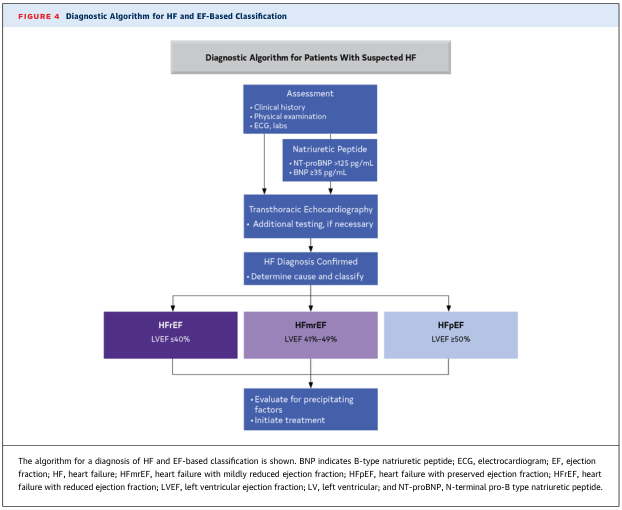
Classification & Diagnosis Framework
Heart failure (HF) is a clinical syndrome in which the heart cannot pump blood at a rate commensurate with tissue requirements, or can do so only at elevated filling pressures. Before initiating treatment, patients are classified by ejection fraction and ACC/AHA stage:
| EF Category | LVEF | Formerly |
|---|---|---|
| HFrEF (reduced) | ≤ 40% | Systolic HF |
| HFmrEF (mildly reduced) | 41–49% | — |
| HFpEF (preserved) | ≥ 50% | Diastolic HF |
ACC/AHA Stages (A → D, progressive):
- Stage A: High risk, no structural disease (HTN, DM, CAD)
- Stage B: Structural disease, no symptoms
- Stage C: Structural disease with current/prior symptoms → active GDMT
- Stage D: Refractory to GDMT → advanced therapies (LVAD, transplant)
General Non-Pharmacological Measures
- Sodium restriction and daily fluid monitoring
- Weight reduction, regular physical activity as tolerated
- Abstinence from alcohol, tobacco, and illicit drugs
- Optimise comorbidities: HTN, diabetes, dyslipidaemia, AF
- Vaccination (influenza, pneumococcal)
- Patient education and adherence counselling
"Before patients with chronic heart failure are referred for heart transplantation or MCS therapies, they are treated medically with a combination of lifestyle modification and GDMT." — Sabiston Textbook of Surgery
HFrEF (LVEF ≤ 40%) — Pharmacological Management
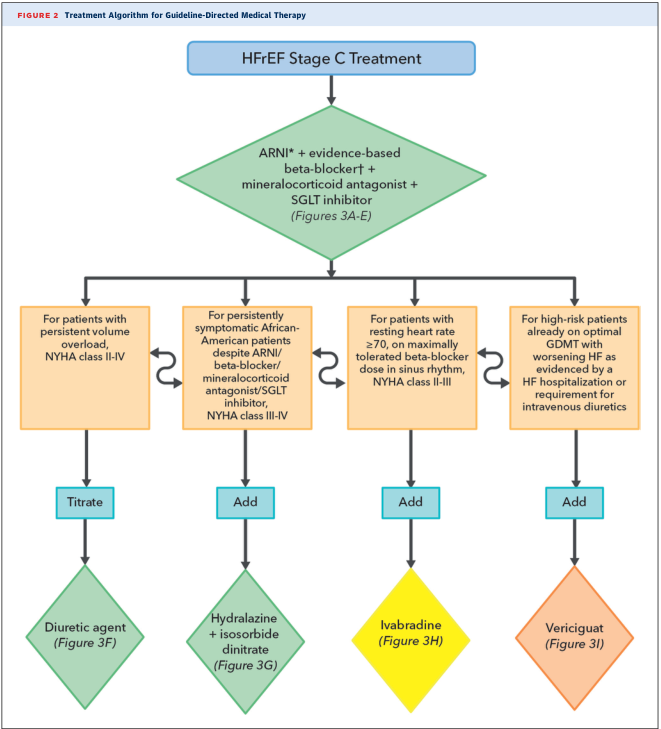
Foundational Quadruple Therapy (GDMT)
The 2022 AHA/ACC/HFSA guidelines, reflected in all major textbooks, endorse four pillars of therapy that each independently reduce mortality:
| Pillar | Drug Class | Examples | Key Benefit |
|---|---|---|---|
| 1 | RAAS inhibitor / ARNI | Sacubitril/valsartan (ARNI preferred); or ACEi/ARB if ARNI not tolerated | Reduces mortality; reverses remodelling |
| 2 | β-blocker (evidence-based) | Carvedilol, metoprolol succinate, bisoprolol | Reduces mortality; slows progression |
| 3 | MRA (mineralocorticoid receptor antagonist) | Spironolactone, eplerenone | Reduces morbidity and mortality |
| 4 | SGLT2 inhibitor | Dapagliflozin, empagliflozin | Reduces HF hospitalisations and CV death |
"Four evidence-based therapies have been shown to improve outcomes in patients with reduced EF heart failure: renin-angiotensin-aldosterone inhibitors with or without a neprilysin inhibitor, β-adrenergic receptor blockers, mineralocorticoid-receptor antagonists, and an SGLT2 inhibitor." — Sabiston Textbook of Surgery
ARNI vs ACEi:
Sacubitril/valsartan (ARNI) is preferred over ACEi in eligible patients. ACEi/ARB are alternatives when ARNI is not tolerated or available. Never combine ARNI with ACEi (risk of angioedema); a 36-hour washout is required when switching from ACEi.
Sacubitril/valsartan (ARNI) is preferred over ACEi in eligible patients. ACEi/ARB are alternatives when ARNI is not tolerated or available. Never combine ARNI with ACEi (risk of angioedema); a 36-hour washout is required when switching from ACEi.
Volume Management: Diuretics
- Loop diuretics (furosemide, torsemide, bumetanide): first-line for congestion/oedema; required in most Stage C patients
- Thiazides (hydrochlorothiazide): mild cases only; synergistic with loop diuretics for diuretic resistance
- Diuretics reduce symptoms but have not been shown to reduce mortality independently
- Monitor for hypokalaemia — supplement potassium or add ACEi/MRA
Add-On Therapies in Selected Patients
| Drug | Indication | Notes |
|---|---|---|
| Hydralazine + Isosorbide dinitrate | Self-identified African-American patients NYHA III–IV despite quadruple therapy; also if RAAS inhibitors not tolerated | Shown to reduce mortality in ISDN/Hyd combination |
| Ivabradine | Sinus rhythm, resting HR ≥ 70 bpm, on max tolerated β-blocker dose, NYHA II–III | Reduces HF hospitalisations |
| Vericiguat | High-risk patients (recent HF hospitalisation or IV diuretic use) on optimal GDMT | sGC stimulator; reduces HF events |
| Digoxin | Persistent symptomatic HF or AF with rapid ventricular rate | Reduces symptoms and rehospitalisation; does not reduce mortality |
HFpEF (LVEF ≥ 50%) — Management
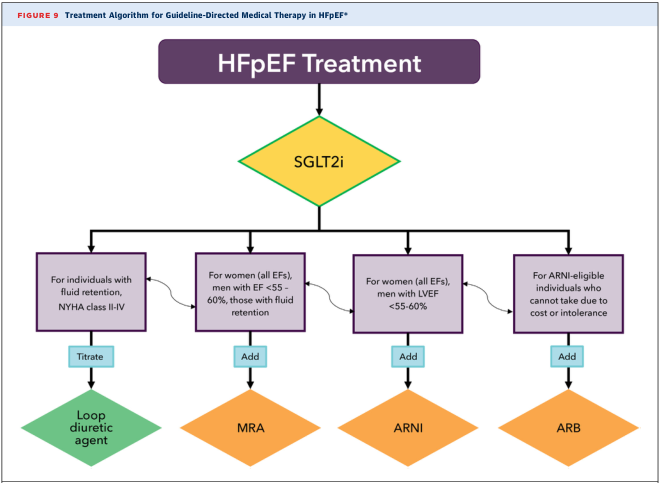
HFpEF management remains less well-defined, but recent guidelines now recommend a treatment hierarchy:
- SGLT2 inhibitors — now considered first-line for all HFpEF patients (empagliflozin, dapagliflozin; reduce HF hospitalisations)
- Loop diuretics — titrated for fluid retention and symptom relief (NYHA II–IV)
- MRA (spironolactone) — added for women (all EFs) and men with EF < 55–60%
- ARNI (sacubitril/valsartan) — added for those eligible; reduces symptoms and NT-proBNP
- ARB — for those unable to tolerate ARNI (cost or intolerance)
- Treat underlying causes: control HTN aggressively, treat dyslipidaemia, consider revascularisation for CAD, rate control of AF
"SGLT2 inhibitors are now considered first-line therapy for HFpEF." — Katzung's Basic and Clinical Pharmacology
Key differences from HFrEF:
- Non-dihydropyridine CCBs and β-blockers useful for HR and BP control
- Nitrates require caution (may cause excessive preload reduction)
- Positive inotropes are not recommended
Acute Decompensated Heart Failure (ADHF)
Common triggers: excess salt/fluid intake, non-adherence to medications, infections, arrhythmia (especially new AF), acute MI, anaemia, NSAIDs.
Management Priorities (IV therapy is the rule)
| Agent | Role |
|---|---|
| IV furosemide (high-dose) | First-line for acute decongestion; acetazolamide add-on improves diuresis |
| IV nitroprusside / nitroglycerin / nesiritide | Vasodilators — reduce preload and afterload; useful when BP is preserved |
| IV dobutamine / dopamine | Positive inotropes for low output / hypotension; prompt onset, short duration |
| Levosimendan | Calcium sensitiser; non-inferior to dobutamine (approved in Europe) |
| Vasopressin antagonists (tolvaptan, conivaptan) | Dilutional hyponatraemia in ADHF; aquaretic effect without worsening renal function |
"Among diuretics, furosemide is most commonly used, usually at high dosage. A recent study suggests that addition of acetazolamide to standard high-dose furosemide has an important additive benefit." — Katzung's Basic and Clinical Pharmacology
For ADHF precipitated by acute MI: emergency revascularisation (PCI with stent or thrombolysis) is the priority.
Device Therapy
| Device | Indication |
|---|---|
| ICD (implantable cardioverter-defibrillator) | HFrEF LVEF ≤ 35%, NYHA II–III, expected survival > 1 year; sudden death prevention |
| CRT (cardiac resynchronisation therapy) | Sinus rhythm, QRS ≥ 120–150 ms (LBBB morphology preferred), NYHA II–IV on GDMT; biventricular pacing improves synchrony, CO, and mortality |
| CRT-D | CRT + ICD combined; most patients with CRT indication |
| Transcatheter TEER (MitraClip) | Secondary/functional MR in patients with advanced HFrEF remaining symptomatic on GDMT |
"Patients with a wide QRS interval (> 120 ms) have impaired synchronization of ventricular contraction… Resynchronization with biventricular pacing has been shown to reduce mortality in patients with chronic heart failure already receiving optimal medical therapy." — Katzung's Basic and Clinical Pharmacology
Advanced / End-Stage HF (Stage D)
For patients refractory to GDMT and device therapy:
Left Ventricular Assist Device (LVAD)
- Bridge to transplantation or destination therapy
- Durable LVADs achieve average survival > 6 years
- Indications include inotrope dependence or inability to wean from temporary MCS
Heart Transplantation
- Definitive therapy for Stage D HF
- Indications: Stage D HF, MCS dependence, inotrope dependence, peak VO₂ ≤ 14 mL/kg/min (off β-blocker) or ≤ 12 mL/kg/min (on β-blocker)
- Absolute contraindication: PVR > 6 Wood units (consider heart-lung transplant)
- Relative contraindication: PVR 4–6 Wood units, age > 70, active malignancy
Summary Drug Table
| Drug Class | Representative Drugs | Mortality Benefit | Use |
|---|---|---|---|
| Loop diuretics | Furosemide, torsemide | ✗ | Symptoms/congestion |
| SGLT2 inhibitors | Dapagliflozin, empagliflozin | ✓ (HFrEF + HFpEF) | Both HF types |
| ACEi | Enalapril, lisinopril | ✓ (HFrEF) | First-line RAAS |
| ARB | Losartan, valsartan | ✓ (HFrEF) | ACEi intolerance |
| ARNI | Sacubitril/valsartan | ✓ (HFrEF + HFpEF) | Preferred over ACEi |
| β-blockers | Carvedilol, metoprolol succinate | ✓ (HFrEF) | All stable HFrEF |
| MRA | Spironolactone, eplerenone | ✓ (HFrEF) | NYHA II–IV |
| Hydralazine + ISDN | — | ✓ (select) | African-American; RAAS intolerance |
| Ivabradine | — | ✗ (↓ hospitalisation) | HR ≥ 70, sinus rhythm |
| Digoxin | — | ✗ (↓ rehospitalisation) | Symptomatic HFrEF, AF |
| Dobutamine/dopamine | — | ✗ | Acute decompensation |
| Levosimendan | — | ✗ | Acute decompensation (Europe) |
Recent Evidence (PubMed, 2024–2025)
A recent RCT + meta-analysis (DAPA ACT HF-TIMI 68, Circulation 2025, PMID 40884036) confirmed that dapagliflozin initiated during hospitalisation for HF is safe and beneficial — supporting early in-hospital initiation of SGLT2 inhibitors rather than waiting for outpatient stabilisation. This aligns with the guideline shift toward initiating all four pillars of GDMT as early as possible.
Sources:
- Katzung's Basic and Clinical Pharmacology, 16th Edition
- Sabiston Textbook of Surgery, Biological Basis of Modern Surgical Practice
- Goodman & Gilman's The Pharmacological Basis of Therapeutics
- Braunwald's Heart Disease, 2-Vol Set
- PMID 40884036 — Dapagliflozin in Hospitalised HF (Circulation, 2025)
This is a shared conversation. Sign in to Orris to start your own chat.