
What is juxtaglomerular apparat
Reading File
The juxtaglomerular apparatus (JGA) is a specialized structure in the kidney located where the distal convoluted tubule passes close to the afferent arteriole of the same nephron. It consists of three cell types: juxtaglomerular cells (in the arteriole wall), the macula densa (in the tubule), and mesangial cells. Its main function is to regulate blood pressure and glomerular filtration rate through the renin-angiotensin-aldosterone system (RAAS).
Searching sources...
Finding Sources
Finding Sources
Good results. Let me read the most comprehensive sources - Ganong's physiology, Histology, and Comprehensive Clinical Nephrology in parallel.
Reading File
Reading File
Reading File
Excellent content. Let me also fetch the JGA diagram from Ganong's for visual clarity.
Loading Image
Reading File
I now have comprehensive information from multiple authoritative textbooks. Here is a detailed answer:
The Juxtaglomerular Apparatus (JGA)
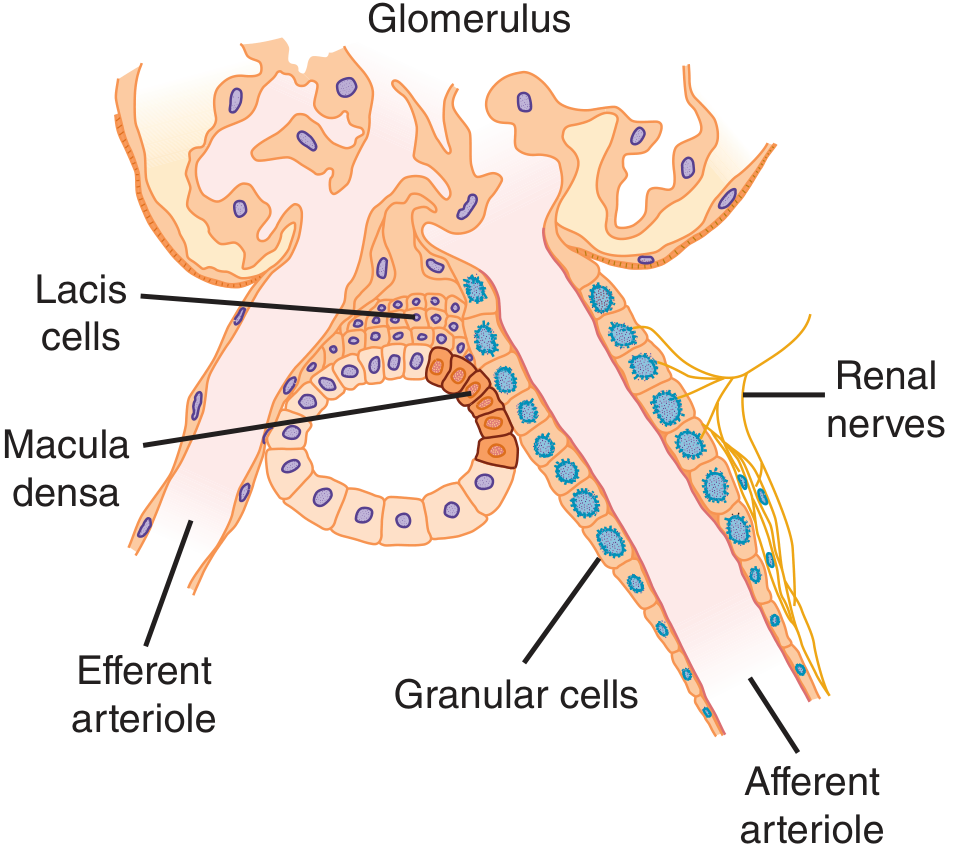
Definition
The juxtaglomerular apparatus is a specialized microscopic structure found at the vascular pole of each glomerulus in the kidney. It is located where the distal straight tubule (thick ascending limb of Henle) returns to make contact with the afferent and efferent arterioles of the same nephron it arose from. - Comprehensive Clinical Nephrology, 7th Ed.
Components (Three Cell Types)
1. Macula Densa
- A plaque of specialized epithelial cells in the wall of the thick ascending limb of Henle at the point it touches the glomerular arterioles.
- Under the microscope, these cells are narrower and taller than ordinary distal tubule cells, with nuclei appearing crowded - giving rise to the name macula densa ("dense spot").
- They have prominent lateral intercellular spaces, tight junctions with very low permeability, and notably high levels of neuronal nitric oxide synthase (nNOS) and cyclooxygenase-2 (COX-2).
- Function: Chemosensor - monitors NaCl (especially Cl⁻) concentration in the tubular lumen.
2. Juxtaglomerular (Granular) Cells
- Modified smooth muscle cells located in the media of the afferent arteriole (and sometimes the efferent arteriole) as it enters the glomerulus.
- Their nuclei are spherical (unlike the elongated nuclei of ordinary smooth muscle cells), and they contain renin-storing secretory granules.
- Under conditions requiring more renin (e.g., volume depletion, renal artery stenosis), additional upstream smooth muscle cells can transform into granular cells.
- Function: Mechanosensor - sense stretch/pressure in the afferent arteriole and are the main site of renin synthesis and secretion in the body.
3. Extraglomerular Mesangial Cells (Lacis Cells / Polkissen Cells)
- Located at the junction between the afferent and efferent arterioles, filling the triangular space between the macula densa and the two arterioles.
- Heavily branched cells interconnected by gap junctions, with prominent microfilament bundles.
- They physically interconnect all structures at the glomerular entrance.
- They also contain some renin, though its significance there is uncertain.
Two Major Functions
1. Tubuloglomerular Feedback (TGF)
When GFR rises, more NaCl is delivered to the macula densa. The macula densa senses this increase and signals the afferent arteriole to constrict, reducing blood flow into the glomerulus and bringing GFR back down. This provides intrinsic autoregulation of filtration at the single-nephron level. - Comprehensive Clinical Nephrology, 7th Ed., p. 32
2. Control of Renin Release - the RAAS
The JGA is the major source of renin in the body. Renin release is regulated by three inputs:
| Stimulus | Effect on Renin |
|---|---|
| Decreased afferent arteriolar pressure (stretch) | Increases renin |
| Decreased NaCl at macula densa | Increases renin |
| Increased sympathetic activity (β₁ receptors) | Increases renin |
| Increased afferent arteriolar pressure | Decreases renin |
| Increased NaCl at macula densa | Decreases renin |
| Angiotensin II (negative feedback) | Decreases renin |
| Vasopressin | Decreases renin |
- Ganong's Review of Medical Physiology, 26th Ed.
The RAAS Cascade (triggered by JGA)
Once released, renin (an aspartyl protease) cleaves angiotensinogen (a circulating α₂-globulin made in the liver) into Angiotensin I (decapeptide). Angiotensin I is then converted by angiotensin-converting enzyme (ACE) in the lungs to Angiotensin II, one of the most potent vasoconstrictors in the body. Angiotensin II then stimulates aldosterone release from the adrenal cortex, which promotes Na⁺ retention and K⁺ excretion - ultimately restoring blood volume and pressure. - Histology: A Text and Atlas, Correlated Cell and Molecular Biology
Clinical Significance
- Hypertension: Overactivation of RAAS via JGA is a key mechanism in renovascular hypertension (e.g., renal artery stenosis). ACE inhibitors (e.g., enalapril) and ARBs (e.g., losartan) target this pathway directly.
- Heart failure & volume depletion: Reduced renal perfusion activates the JGA, driving RAAS-mediated fluid retention.
- Renin-secreting tumors (juxtaglomerular cell tumor): Rare cause of severe hypertension.
Key sources:
- Ganong's Review of Medical Physiology, 26th Ed. - pp. 703-704
- Comprehensive Clinical Nephrology, 7th Ed. - pp. 31-32
- Histology: A Text and Atlas (Correlated Cell and Molecular Biology) - p. 1887
This is a shared conversation. Sign in to Orris to start your own chat.