
Orris you became a teacher daily teach me one electrolyte like na, k, ca, mg, etc the complete details such as what it is, is low what it called, it causes, sign, diagnosis, management all topics related to it i wantbwith picture reference for easy understanding today you teach me about sodium and it low level condition, tomorrow hyper neck day like that go on ok
Reading File
Finding Sources
Finding Sources
Reading File
Reading File
Reading File
Reading File
Loading Image
Loading Image
Reading File
Finding Sources
Finding Sources
Reading File
Finding Sources
Reading File
I now have all the content I need for a comprehensive, well-illustrated lesson. Let me now compose the complete Day 1 lesson.
🧂 ELECTROLYTE SERIES — DAY 1
SODIUM (Na⁺) & HYPONATREMIA (Low Sodium)
PART 1: WHAT IS SODIUM?
Sodium (Na⁺) is the most abundant cation in extracellular fluid (ECF). Think of it as the body's "master volume knob" - it controls how much water stays in your blood vessels and tissues.
| Parameter | Value |
|---|---|
| Normal serum range | 135 - 145 mmol/L (mEq/L) |
| Main location | Extracellular fluid (plasma + interstitial fluid) |
| Daily intake | ~150 mmol/day (average Western diet) |
| Regulated by | ADH (vasopressin), aldosterone, thirst |
| Main functions | ECF volume, osmolality, nerve impulse transmission, acid-base balance |
Key Physiology Points
- Plasma Na⁺ concentration is the main determinant of plasma osmolality. Over 90% of ECF osmolality comes from Na⁺ and its associated anions (mainly Cl⁻).
- ADH (Arginine Vasopressin / AVP) is the primary hormone regulating water balance - it acts on renal collecting ducts to reabsorb water, concentrating urine.
- Aldosterone regulates Na⁺ reabsorption at the distal tubule, directly controlling total body Na⁺ content and thus ECF volume.
- A critical concept: plasma Na⁺ tells you about water balance, NOT volume status. A patient can be hyponatremic while being hypovolemic, euvolemic, OR hypervolemic.
PART 2: HYPONATREMIA - THE LOW SODIUM CONDITION
Definition
Hyponatremia = serum Na⁺ < 135 mmol/L
It is one of the most common electrolyte disorders, occurring in up to 22% of hospitalized patients (Harrison's, 22e).
Severity Classification
| Severity | Na⁺ level | Symptoms typical |
|---|---|---|
| Mild | 130 - 134 mmol/L | Often none |
| Moderate | 120 - 129 mmol/L | Headache, nausea, confusion |
| Severe | < 120 mmol/L | Seizures, coma, death |
PART 3: PATHOPHYSIOLOGY - HOW DOES HYPONATREMIA DEVELOP?
The underlying mechanism is almost always one of these:
- Too much water retained (with normal or even high ADH) = dilutional hyponatremia
- Too much sodium lost from the body (vomiting, diarrhea, diuretics)
- Both - sodium lost + water replaced with hypotonic fluids
The Kidney's Dilution Mechanism (and where it fails):
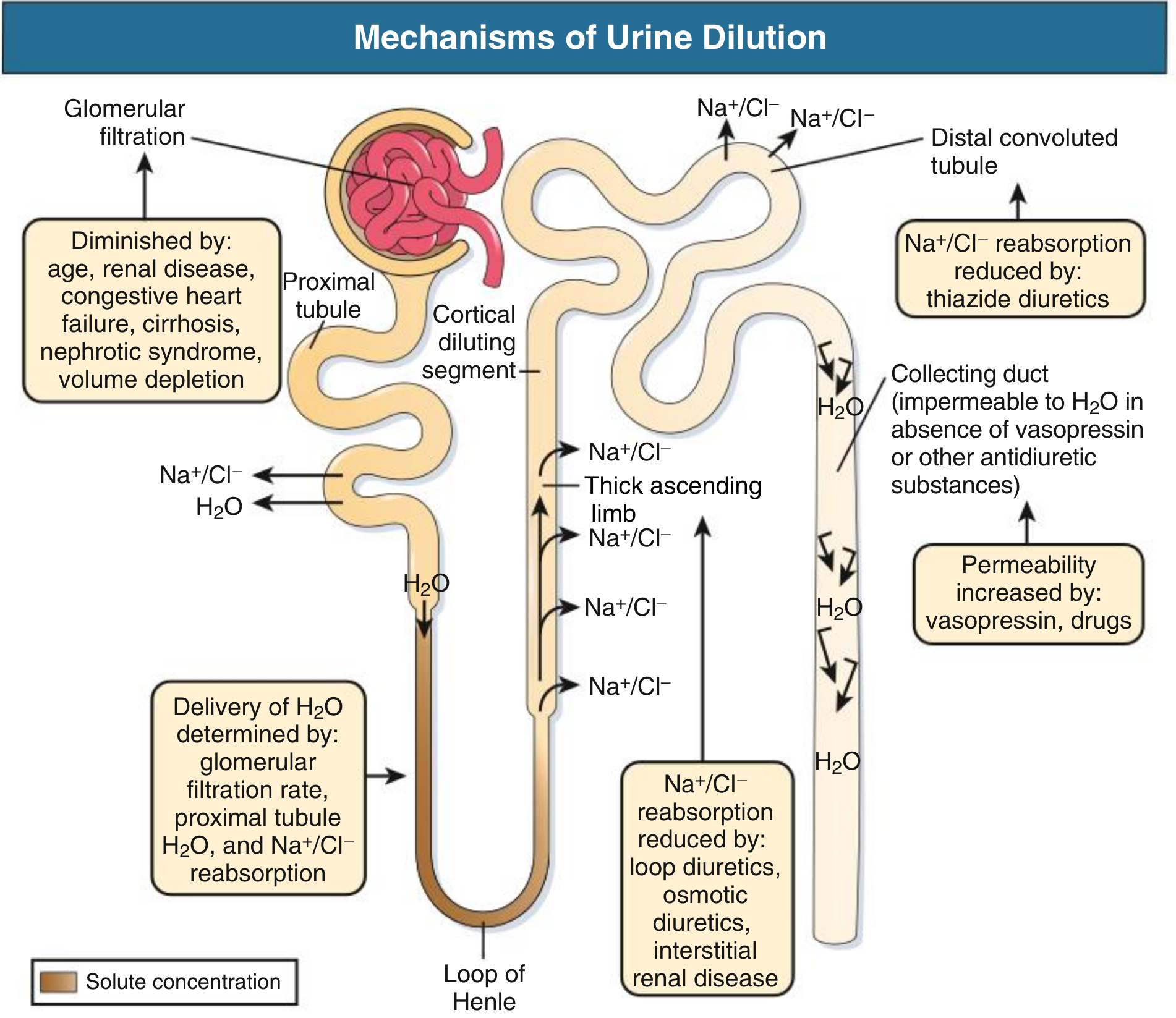
This diagram (from Comprehensive Clinical Nephrology) shows every site in the nephron where normal dilution can be disrupted, leading to water retention and hyponatremia.
Key points from the diagram:
- Reduced GFR (from CHF, cirrhosis, age) = less filtrate delivered to diluting segments
- Loop diuretics block Na⁺/Cl⁻ reabsorption in the thick ascending limb
- Thiazides block Na⁺/Cl⁻ reabsorption in the distal convoluted tubule
- Vasopressin makes the collecting duct water-permeable, trapping water = most common cause of hyponatremia
PART 4: CLASSIFICATION BY VOLUME STATUS
This is the critical framework for diagnosing hyponatremia. Always classify first by volume status:
1. HYPOVOLEMIC Hyponatremia (Low total body Na⁺)
- Na⁺ is lost in excess of water
- Volume depletion stimulates ADH non-osmotically (baroreceptor reflex)
- ADH causes water retention despite low Na⁺
Non-renal causes (Urine Na⁺ < 20 mmol/L):
- Vomiting, diarrhea, tube drainage
- Burns, sweating, insensible losses
Renal causes (Urine Na⁺ > 20 mmol/L):
- Thiazide diuretics (most common drug cause)
- Addison's disease (aldosterone deficiency)
- Salt-losing nephropathies
- Cerebral salt wasting (CSW) - seen after subarachnoid hemorrhage, TBI
2. EUVOLEMIC Hyponatremia (Normal total body Na⁺)
- Water is retained, Na⁺ is normal - pure water excess
- SIADH is the most common cause (covered below)
- Other causes: Hypothyroidism, secondary adrenal insufficiency (pituitary disease), psychogenic polydipsia, beer potomania, MDMA ("Ecstasy")
3. HYPERVOLEMIC Hyponatremia (High total body Na⁺)
- Both Na⁺ and water are increased, but water retained disproportionately
- Urine Na⁺ typically very low (< 10 mmol/L) due to avid Na⁺ retention
- Causes: Congestive heart failure (CHF), cirrhosis, nephrotic syndrome, acute/chronic kidney failure
PART 5: SIADH - THE KEY CAUSE YOU MUST KNOW
SIADH = Syndrome of Inappropriate Antidiuretic Hormone Secretion
(Also now called SIAD = Syndrome of Inappropriate Antidiuresis)
Causes of SIADH:
| Category | Examples |
|---|---|
| Pulmonary | TB, pneumonia, lung abscess, COPD, mechanical ventilation |
| CNS | Meningitis, encephalitis, stroke, subarachnoid hemorrhage, head injury |
| Malignancy | Small cell lung cancer (most common), pancreatic cancer, lymphoma |
| Drugs | SSRIs, TCAs, carbamazepine, cyclophosphamide, NSAIDs, opioids |
| Other | HIV/AIDS, pain, nausea, postoperative state |
Diagnostic Criteria for SIADH:
Essential Criteria (all must be present):
- Serum osmolality < 275 mOsm/kg
- Urine osmolality > 100 mOsm/kg (inappropriately concentrated)
- Clinical euvolemia (no edema, no dehydration)
- Urine Na⁺ > 20-30 mmol/L on normal salt/water intake
- Normal thyroid, adrenal, renal, and pituitary function
- No recent diuretic use
Supplemental Criteria:
- Hypouricemia with elevated fractional excretion of uric acid (>10%)
- No correction with volume expansion, but correction with fluid restriction
(Source: Comprehensive Clinical Nephrology, 7e)
PART 6: CAUSES OF ACUTE HYPONATREMIA (Rapid Onset)
| Cause |
|---|
| Postoperative hypotonic fluids (especially premenopausal women - at highest risk!) |
| MDMA ("Ecstasy") ingestion - stimulates both thirst and AVP |
| Exercise-associated hyponatremia (marathons, endurance events) |
| Thiazide diuretics started recently |
| Psychogenic polydipsia |
| Colonoscopy preparation fluids |
| TURP / uterine surgery (glycine irrigation) |
(Source: Harrison's Principles of Internal Medicine, 22e)
PART 7: SIGNS AND SYMPTOMS
Symptoms are primarily neurological - caused by brain cell swelling (cerebral edema) when water moves into cells down the osmotic gradient.
Acute Hyponatremia (rapid drop, < 48 hours):
- Mild: Headache, nausea, vomiting, malaise
- Moderate: Confusion, lethargy, muscle cramps, gait disturbance
- Severe (Na⁺ < 120 mmol/L): Seizures, obtundation, respiratory arrest, central herniation, death
- Premenopausal women and children are at highest risk of severe neurological sequelae
Chronic Hyponatremia (> 48 hours):
- Brain adapts by extruding organic osmolytes (taurine, glutamate, myoinositol, creatine, betaine)
- Symptoms are less severe at the same Na⁺ level
- But even "asymptomatic" patients have: increased risk of falls, gait disturbance, cognitive deficits, increased fracture risk (from both neurological dysfunction AND reduced bone density)
PART 8: DIAGNOSIS - STEP BY STEP
Diagnostic Algorithm:
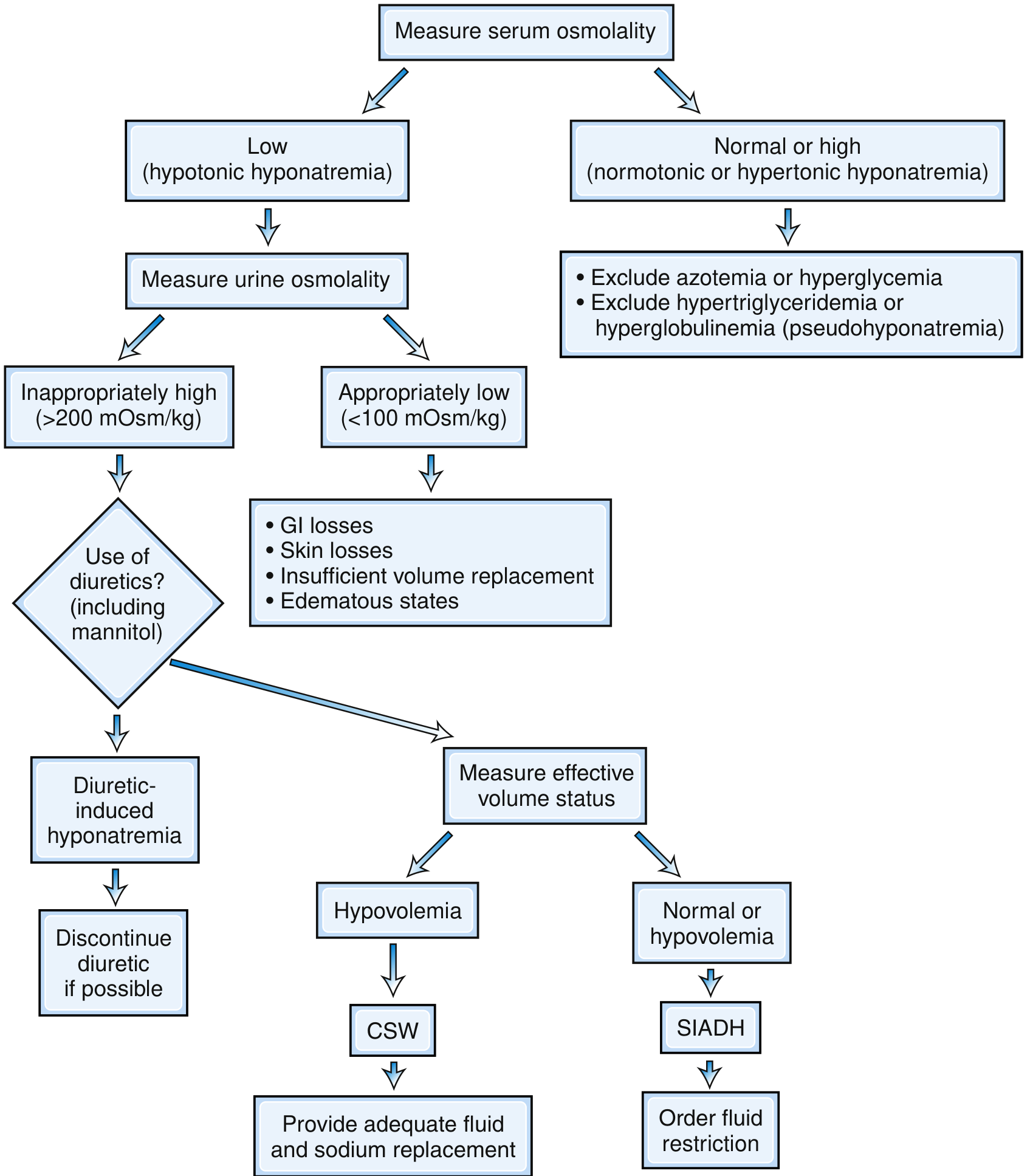
Follow this flowchart whenever you face a hyponatremic patient (from Bradley and Daroff's Neurology in Clinical Practice)
Step-by-step approach:
Step 1: Check Serum Osmolality
- Low (< 275 mOsm/kg) = True hypotonic hyponatremia → proceed to step 2
- Normal or High = Pseudohyponatremia OR translocational:
- Pseudohyponatremia: severe hypertriglyceridemia, hyperglobulinemia (lab artifact - Na⁺ is actually normal)
- Translocational: hyperglycemia, mannitol, sorbitol (osmotically active substances draw water out, diluting Na⁺)
- Correct formula: for every 100 mg/dL rise in glucose above 100, add ~1.6-2.0 mmol/L to measured Na⁺
Step 2: Check Urine Osmolality
- < 100 mOsm/kg (maximally dilute urine) = ADH is suppressed = Psychogenic polydipsia, beer potomania, low solute intake
- > 200 mOsm/kg (inappropriately concentrated) = ADH is active = proceed to step 3
Step 3: Assess Volume Status
- Hypovolemic → Check Urine Na⁺:
- Urine Na⁺ < 20: extrarenal losses (GI, skin)
- Urine Na⁺ > 20: renal losses (diuretics, Addison's, salt-wasting nephropathy, CSW)
- Euvolemic → SIADH, hypothyroidism, secondary adrenal insufficiency
- Hypervolemic → CHF, cirrhosis, nephrotic syndrome, renal failure
Key Lab Tests:
- Serum Na⁺, K⁺, glucose, BUN/creatinine, uric acid
- Serum osmolality
- Urine osmolality + urine Na⁺ + urine K⁺
- TSH (rule out hypothyroidism)
- Cortisol/ACTH stimulation test (rule out adrenal insufficiency)
PART 9: MANAGEMENT
Three Governing Principles (Harrison's):
- Symptom severity determines urgency - acute severe symptoms = emergency
- Chronic hyponatremia must NOT be corrected too fast - risk of Osmotic Demyelination Syndrome (ODS)
- Response to treatment is unpredictable - frequent monitoring is mandatory
A. ACUTE SEVERE SYMPTOMATIC Hyponatremia (Seizures / Herniation)
Goal: Raise Na⁺ by 4-6 mmol/L rapidly to stop brain herniation
Treatment: 3% Hypertonic Saline (100-150 mL IV bolus over 20 minutes)
- Can repeat x2 if no improvement
- Once symptoms controlled, slow the rate
- Total correction limit: 8-10 mmol/L in first 24 hours
B. HYPOVOLEMIC Hyponatremia
Treatment: IV Normal Saline (0.9% NaCl)
- Repletes volume → ADH levels fall → kidneys excrete free water → Na⁺ rises
- Caution: Na⁺ can rise very rapidly once volume is corrected - monitor every 2-4 hours!
C. EUVOLEMIC Hyponatremia (SIADH)
Treatment options (in order):
- Fluid restriction - cornerstone of therapy
- Use the urine-to-plasma electrolyte ratio (urine [Na⁺ + K⁺] / plasma Na⁺) to guide restriction level:
- Ratio > 1: restrict to < 500 mL/day
- Ratio ~1: restrict to 500-700 mL/day
- Ratio < 1: restrict to < 1 L/day
- Use the urine-to-plasma electrolyte ratio (urine [Na⁺ + K⁺] / plasma Na⁺) to guide restriction level:
- Treat the underlying cause (e.g., stop the offending drug, treat underlying cancer or infection)
- Increased dietary sodium and protein intake (raises solute excretion)
- Tolvaptan or Conivaptan (V2 receptor antagonists / "vaptans") - block ADH at kidney
- Cause aquaresis (pure free water excretion without electrolyte loss)
- Used for persistent, severe SIADH
- Monitoring intensive - risk of overcorrection
- Demeclocycline (causes nephrogenic DI, older agent, rarely used now)
- Urea - oral urea increases solute excretion, effective but unpalatable
D. HYPERVOLEMIC Hyponatremia (CHF / Cirrhosis)
Treatment:
- Treat underlying disease (optimize CHF medications, manage cirrhosis)
- Fluid restriction + dietary Na⁺ restriction
- Loop diuretics (furosemide) - promote free water loss
- Vaptans (tolvaptan) - FDA approved for CHF-related hyponatremia
- Avoid isotonic saline (will worsen fluid overload)
⚠️ THE DREADED COMPLICATION: Osmotic Demyelination Syndrome (ODS)
Previously called: Central Pontine Myelinolysis (CPM)
How it happens:
- In chronic hyponatremia (>48 hrs), brain cells adapt by extruding osmolytes to prevent swelling
- If Na⁺ is corrected TOO rapidly, brain osmolality rises faster than cells can recapture osmolytes
- Hypertonic stress in oligodendrocytes → ER stress → unfolded protein response → apoptosis → myelin sheath destruction
Correction limits to prevent ODS:
| Time period | Maximum safe correction |
|---|---|
| First 24 hours | ≤ 8-10 mmol/L |
| First 48 hours | ≤ 18 mmol/L |
High-risk groups for ODS:
- Beer potomania (hypokalemia + alcoholism + malnutrition)
- Severe malnutrition
- Liver disease
- Hypokalemia (K⁺ correction also raises Na⁺ - count it toward your correction limit!)
Clinical features of ODS:
- Appears 2-6 days after rapid correction
- Dysarthria, dysphagia
- Spastic quadriplegia
- Locked-in syndrome (in severe cases)
- Irreversible in many cases
If you overcorrect: Consider DDAVP (desmopressin) + D5W to re-lower Na⁺ ("rescue therapy")
PART 10: QUICK MEMORY AID
HYPONATREMIA MNEMONIC - "LOW SALT"

L - Lethargy, Low urine Na in non-renal causes
O - Osmolality (serum) - always check first
W - Water excess is the core mechanism

S - SIADH is #1 euvolemic cause
A - ADH is almost always involved
L - Limit correction rate (≤10 mmol/L/24h for chronic)
T - Treat volume status (hypo/eu/hypervolemic approach)
SUMMARY TABLE
| Feature | Details |
|---|---|
| Condition name | Hyponatremia |
| Definition | Serum Na⁺ < 135 mmol/L |
| Prevalence | Up to 22% of hospitalized patients |
| Core mechanism | Excess water retention relative to sodium |
| Key hormone | ADH/AVP (almost always elevated inappropriately) |
| #1 cause | SIADH |
| Most dangerous | Acute severe with cerebral edema |
| Most common drug cause | Thiazide diuretics |
| Symptoms | Neurological: headache → seizures → herniation |
| Key investigations | Serum + urine osmolality, urine Na⁺, TSH, cortisol |
| Acute severe Rx | 3% hypertonic saline (4-6 mmol/L rapid correction) |
| Chronic Rx | Fluid restriction + treat cause; max 8-10 mmol/L/24h |
| Feared complication | Osmotic Demyelination Syndrome (ODS) from over-correction |
📅 COMING UP TOMORROW - DAY 2
Hypernatremia (High Sodium - Na⁺ > 145 mmol/L)
- What is it, why does it happen
- Diabetes insipidus (central vs. nephrogenic)
- Signs, diagnosis, management
- The flip side of today's lesson!
Sources: Harrison's Principles of Internal Medicine 22e | Comprehensive Clinical Nephrology 7e | Guyton & Hall Textbook of Medical Physiology | Bradley & Daroff's Neurology in Clinical Practice
This is a shared conversation. Sign in to Orris to start your own chat.