
Pituitary gland
Reading File
Reading File
Reading File
Finding Sources
Finding Sources
Searching PubMed
"Pituitary Gland"[MeSH Terms]
Searching the Web
pituitary gland anatomy physiology hormones Merck Manual
Finding Sources
Finding Sources
Searching Images
pituitary gland anatomy diagram anterior posterior lobes hypothalamus
Reading Web Page
https://www.merckmanuals.com/home/hormonal-and-metabolic-dis…
Reading File
Reading File
Reading File
Pituitary gland
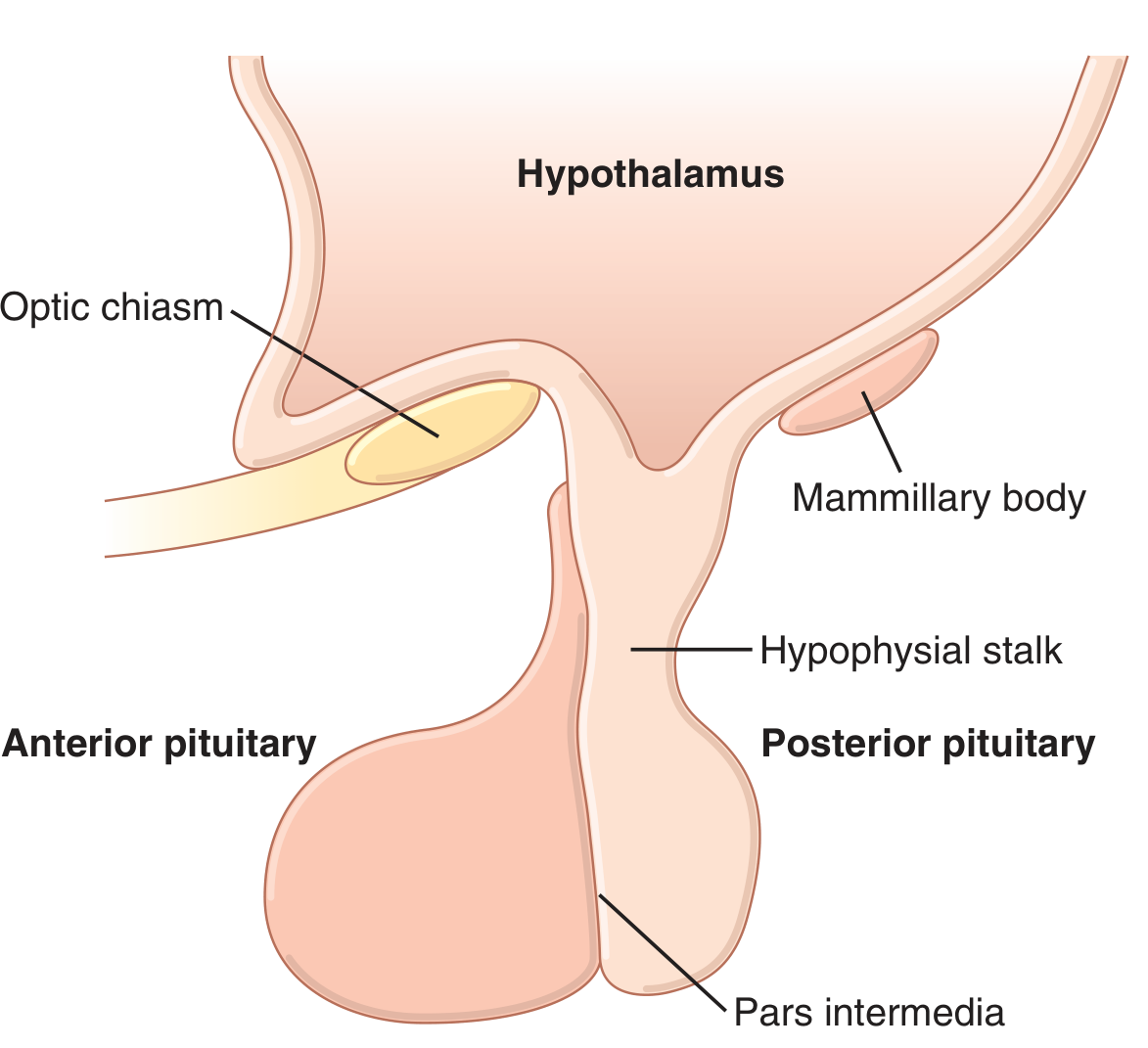
The pituitary gland (hypophysis) is a small endocrine gland, about 1 cm wide, located in the sella turcica at the base of the brain. It is connected to the hypothalamus by the pituitary stalk (infundibulum). It coordinates growth, thyroid and adrenal activity, reproduction, lactation, and body-water balance. - Guyton and Hall Textbook of Medical Physiology, p. 893
Parts
| Part | Also called | Key feature |
|---|---|---|
| Anterior pituitary | Adenohypophysis | True glandular tissue that synthesizes and secretes hormones |
| Posterior pituitary | Neurohypophysis | Neural extension of the hypothalamus; stores and releases hypothalamic hormones |
| Pars intermedia | Intermediate lobe | Small and relatively undeveloped in humans |
The anterior and posterior lobes have different embryological origins: the anterior lobe develops from Rathke pouch (oral ectoderm), while the posterior lobe arises from neural tissue of the hypothalamus. - Guyton and Hall Textbook of Medical Physiology, p. 893
Anterior pituitary hormones
| Hormone | Main target/action |
|---|---|
| GH - growth hormone | Promotes growth and metabolic effects, largely through IGF-1 |
| TSH - thyroid-stimulating hormone | Stimulates thyroid secretion of T3 and T4 |
| ACTH - adrenocorticotropic hormone | Stimulates adrenal cortex, especially cortisol production |
| FSH | Follicle development in ovaries; spermatogenesis in testes |
| LH | Ovulation and corpus luteum function; testosterone secretion in testes |
| Prolactin | Breast development and milk production |
Posterior pituitary hormones
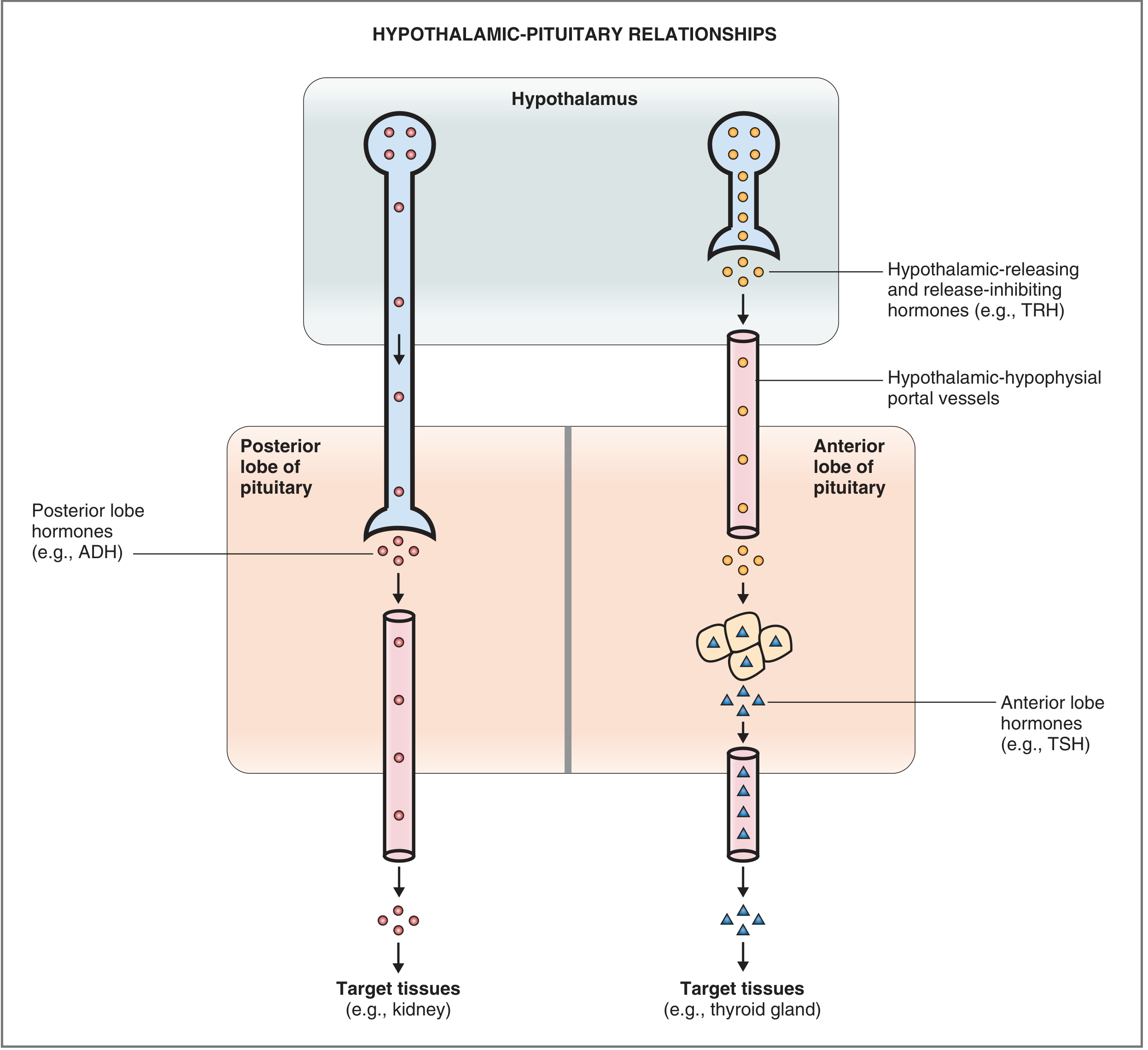
The posterior pituitary does not synthesize its two main hormones. They are produced by hypothalamic neurons, transported down their axons, and stored and released from the posterior pituitary. - Color Atlas of Human Anatomy, Vol. 2, p. 570
| Hormone | Main action |
|---|---|
| ADH (vasopressin) | Increases renal water reabsorption and helps maintain body-fluid osmolality |
| Oxytocin | Causes uterine contraction and milk ejection during breastfeeding |
Hypothalamic control
- The hypothalamus controls the anterior pituitary through releasing and inhibiting hormones carried in the hypophyseal portal circulation.
- It controls the posterior pituitary through direct neural pathways.
- Hormones from peripheral endocrine organs usually inhibit hypothalamic and pituitary secretion through negative feedback.
Clinical relevance
Common pituitary disorders include:
- Pituitary adenoma, which may produce excess hormone or compress normal gland tissue
- Hypopituitarism, causing deficiency of one or more pituitary hormones
- Prolactinoma, a prolactin-secreting adenoma
- Acromegaly/gigantism, due to excess GH
- Diabetes insipidus, often related to insufficient ADH action
- Cushing disease, due to ACTH-secreting pituitary adenoma
The Merck pituitary overview also summarizes how pituitary hormone excess or deficiency affects target endocrine organs.
This is a shared conversation. Sign in to Orris to start your own chat.