
One health program short note
One Health program concept definition WHO FAO OIE 2025
"One Health" approach zoonotic disease surveillance
One Health Program - Short Note
Definition
"An integrated, unifying approach that aims to sustainably balance and optimize the health of people, animals and ecosystems, mobilizing multiple sectors, disciplines and communities at varying levels of society."
Historical Background
| Milestone | Detail |
|---|---|
| 1800s | Rudolf Virchow coined "zoonosis"; noted animal-human disease linkage |
| 1964 | Calvin Schwabe proposed "One Medicine" - unified human and veterinary medicine |
| 2004 | Manhattan Principles formalized the concept at the Wildlife Conservation Society |
| 2008 | WHO, FAO, OIE formally endorsed "One World - One Health" |
| 2022 | Quadripartite (FAO, UNEP, WHO, WOAH) signed cooperation agreement; launched One Health Joint Plan of Action 2022-2026 |
The Quadripartite (Four Pillars of Governance)
- WHO - human health policies, public health outcomes
- FAO - food safety, agriculture, animal-human-environment food links
- WOAH (formerly OIE) - animal health, welfare, zoonosis prevention
- UNEP - environmental health, ecosystem integrity, pollution
Why One Health is Needed
- About 60-75% of emerging infectious diseases are zoonotic (animal origin)
- 75% of new pathogens affecting humans originate in animals
- Antimicrobial resistance (AMR) spreads across humans, animals, and environment - cannot be addressed in isolation
- Climate change alters disease vectors (malaria, dengue, Lyme disease range expansion)
- Biodiversity loss and habitat destruction bring wildlife into closer human contact, increasing spillover events
- Global examples: HIV, Ebola, SARS, COVID-19, avian influenza H5N1, mpox, Nipah virus
Key Domains / Pillars of One Health
1. Zoonotic Disease Prevention and Control
- Surveillance at human-animal-environment interfaces
- Joint outbreak response (e.g., avian flu, rabies, Nipah)
- Cross-sector reporting systems
2. Antimicrobial Resistance (AMR)
- AMR is a prime One Health issue - antibiotics used in livestock affect human pathogens
- National Action Plans (NAPs) address AMR across all three sectors together
3. Food Safety and Food Systems
- Contamination of food supply can originate from animal husbandry, environmental pollutants, or processing
- FAO-led surveillance linking farm-to-fork
4. Environmental and Ecosystem Health
- Deforestation, land-use change, and biodiversity loss as risk factors
- Watershed management, pollution control
5. Vector-Borne Diseases
- Climate change shifts ranges of mosquitoes, ticks, sandflies
- Requires environmental monitoring alongside clinical surveillance
6. Biosafety and Biosecurity
- Preventing accidental or deliberate release of pathogens
- Lab standards across veterinary and human medicine labs
One Health Joint Plan of Action (OH JPA) 2022-2026
| Track | Focus Area |
|---|---|
| 1 | One Health capacity building |
| 2 | Zoonotic epidemic and pandemic prevention |
| 3 | Endemic zoonotic disease control |
| 4 | Food safety |
| 5 | AMR containment |
| 6 | Environment, climate and ecosystems |
Implementation at Different Levels
One Health in India
- India has adopted One Health through the National One Health Mission
- Coordinates the Ministry of Health, Ministry of Agriculture (Animal Husbandry), and Ministry of Environment & Forests
- Strengthened post-COVID-19 pandemic response
- Addresses rabies, avian influenza, Nipah, brucellosis, anthrax at the human-animal interface
- Park's Preventive & Social Medicine emphasizes the Multipurpose Worker Scheme which integrates "one health worker" male and female at sub-centre level to cover a population of 5,000
Benefits of One Health Approach
- Prevents pandemics - early detection at animal-human interfaces
- Cost-effective - addressing disease at source is cheaper than managing outbreaks
- Accelerates research - shared biomedical databases, joint field investigations
- Improves food safety - reduces foodborne illness burden
- Controls AMR - reduces unnecessary antibiotic use across all sectors
- Promotes equity - communities most dependent on livestock/wildlife benefit most
Challenges
- Siloed governance structures (separate health, agriculture, environment ministries)
- Funding gaps and coordination failures
- Weak veterinary and environmental surveillance infrastructure in low-income countries
- Data sharing barriers between sectors
- Political will and intersectoral trust
Key Examples of One Health in Practice
| Disease | One Health Response |
|---|---|
| Rabies | Dog vaccination + human post-exposure prophylaxis + wildlife monitoring |
| Avian Influenza (H5N1/H7N9) | Poultry surveillance + human case detection + environmental sampling |
| COVID-19 | Animal reservoir tracing + human pandemic response + ecosystem monitoring |
| AMR | Antibiotic stewardship in hospitals + livestock + water systems |
| Nipah virus | Fruit bat surveillance + spillover prevention + human contact tracing |
| Brucellosis | Livestock vaccination + occupational exposure control + food pasteurization |
Summary
Key phrase to remember: "The health of humans, animals, plants, and the environment is one and inseparable."
Create a visual infographic on One Health pillars and stakeholders
A professional medical infographic titled "ONE HEALTH: An Integrated Approach" showing three large interconnected circles in a Venn diagram style at the center: one green circle labeled "HUMAN HEALTH" with icons of people and a stethoscope, one blue circle labeled "ANIMAL HEALTH" with icons of a cow, dog, and bird, and one brown/earth-tone circle labeled "ENVIRONMENT & ECOSYSTEM" with icons of trees, water, and earth. The overlapping center zone is labeled "ONE HEALTH" in bold white text on a dark teal background. Below the Venn diagram, show six colorful pillars/columns each with an icon and label: 1) Zoonotic Disease Control (virus icon), 2) Antimicrobial Resistance (bacteria/pill icon), 3) Food Safety (fork/leaf icon), 4) Climate & Ecosystems (earth/leaf icon), 5) Vector-Borne Diseases (mosquito icon), 6) Biosafety & Biosecurity (shield icon). On the right side, show a vertical list of key stakeholders with small logos/icons: WHO (blue), FAO (green), WOAH (orange), UNEP (teal), National Governments, Veterinarians, Public Health Officials, Environmental Scientists, Communities. At the top, a bold title banner in dark navy blue. Clean, modern, data-rich design with white background, professional medical infographic style with icons, soft color palette of green, blue, teal, and orange.
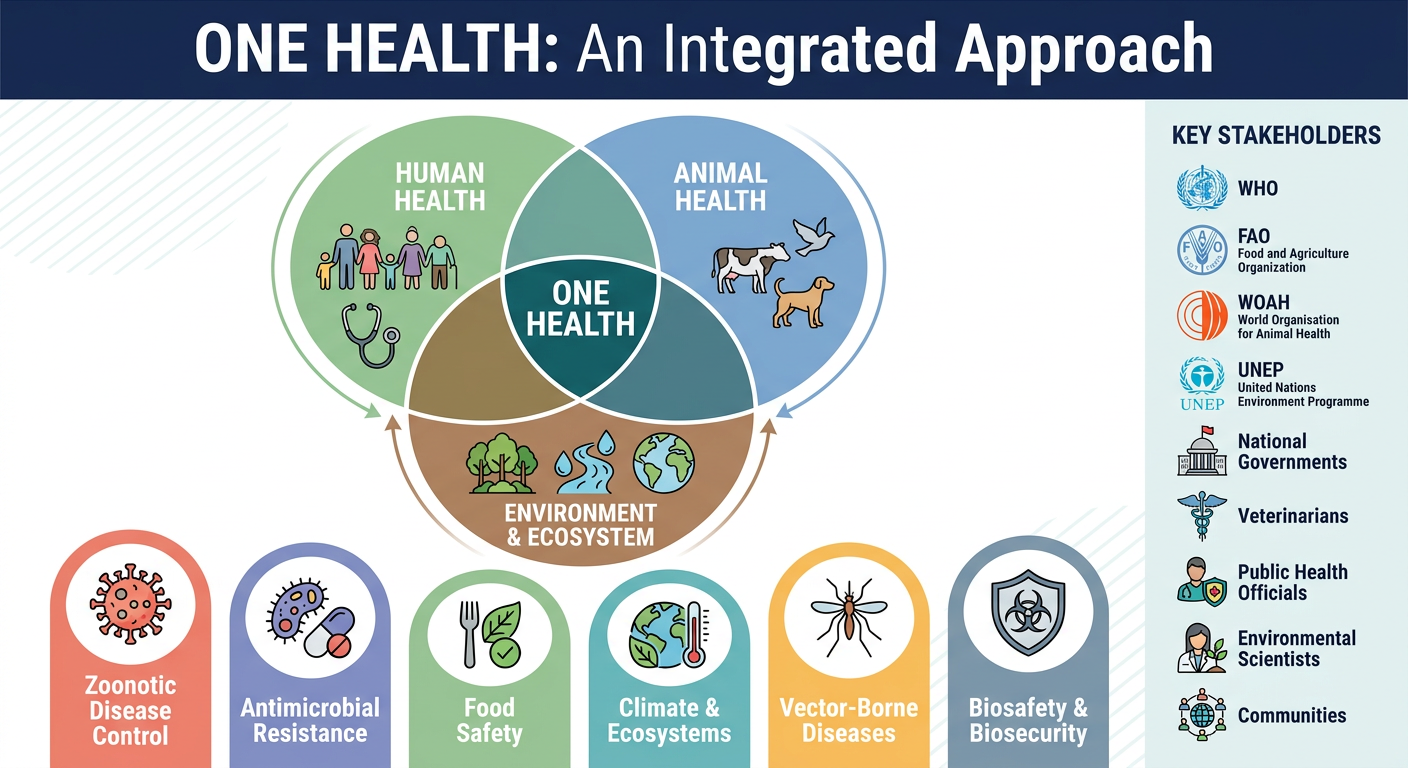
- Central Venn diagram - the three overlapping domains: Human Health, Animal Health, and Environment & Ecosystem, with "One Health" at the intersection
- Six action pillars - Zoonotic Disease Control, AMR, Food Safety, Climate & Ecosystems, Vector-Borne Diseases, and Biosafety
- Key stakeholders - the Quadripartite (WHO, FAO, WOAH, UNEP) plus national and community-level actors
Add more details in this ppt and make it more attractive but detail must be from kd tripaathi
cd /home/daytona/workspace/attachments/b1a6d630-fa01-49fd-930d-46ea4d8784b2 && ls -la
cd /home/daytona/workspace/attachments/b1a6d630-fa01-49fd-930d-46ea4d8784b2 && python -m markitdown 5871d3dc-10d4-45ca-b137-5113a0cd1bf7.pptx 2>&1
KD Tripathi pharmacology "One Health" antimicrobial resistance zoonosis drug therapy
cd /home/daytona/workspace/attachments/b1a6d630-fa01-49fd-930d-46ea4d8784b2 && python3 -c " from pptx import Presentation prs = Presentation('5871d3dc-10d4-45ca-b137-5113a0cd1bf7.pptx') for i, slide in enumerate(prs.slides): print(f'=== SLIDE {i+1} ===') for shape in slide.shapes: if hasattr(shape, 'text') and shape.text.strip(): print(f' [{shape.shape_type}] {shape.text[:300]}') print() "
https://igntu.ac.in/eContent/IGNTU-eContent-677693236726-B.P…
pip install python-pptx --quiet --user 2>&1 | tail -3
cd /home/daytona/workspace/attachments/b1a6d630-fa01-49fd-930d-46ea4d8784b2 && python3 -c " from pptx import Presentation prs = Presentation('5871d3dc-10d4-45ca-b137-5113a0cd1bf7.pptx') print(f'Total slides: {len(prs.slides)}') print(f'Slide width: {prs.slide_width.inches:.2f} inches') print(f'Slide height: {prs.slide_height.inches:.2f} inches') print() for i, slide in enumerate(prs.slides): print(f'=== SLIDE {i+1} ===') for shape in slide.shapes: if hasattr(shape, 'text') and shape.text.strip(): print(f' [type={shape.shape_type}, name={shape.name}]') print(f' TEXT: {repr(shape.text[:400])}') print() "
ls /home/daytona/workspace/ && mkdir -p /home/daytona/workspace/mdr-tb-ppt
~/mdr-tb-ppt/build.js
const pptxgen = require("pptxgenjs");

const pres = new pptxgen();
pres.layout = 'LAYOUT_WIDE'; // 13.3 x 7.5 inches
pres.title = 'MDR-TB & BPaLM Regimen';
pres.author = 'KD Tripathi Reference';

// ─── COLOR PALETTE ───────────────────────────────────────────────────
const C = {
  darkBg:    "0D1B2A",  // deep navy (title/section slides bg)
  midBg:     "1B3A5C",  // medium navy
  accent1:   "E63946",  // vibrant red-orange (TB red)
  accent2:   "F4A261",  // warm amber
  accent3:   "2EC4B6",  // teal
  accent4:   "A8DADC",  // light teal
  white:     "FFFFFF",
  lightGray: "F1FAEE",
  textDark:  "0D1B2A",
  cardBg:    "EAF4FB",
  cardBg2:   "FFF3E0",
  cardBg3:   "E8F5E9",
  cardBg4:   "FCE4EC",
  green:     "2D6A4F",
  yellow:    "FFB703",
  orange:    "FB8500",
  purple:    "6A0572",
};

// ─── HELPERS ─────────────────────────────────────────────────────────
function addSectionSlide(pres, title, subtitle) {
  let slide = pres.addSlide();
  // Full dark background
  slide.addShape(pres.ShapeType.rect, { x: 0, y: 0, w: 13.3, h: 7.5, fill: { color: C.darkBg } });
  // Red accent bar
  slide.addShape(pres.ShapeType.rect, { x: 0, y: 3.2, w: 13.3, h: 0.06, fill: { color: C.accent1 } });
  // Title
  slide.addText(title, {
    x: 0.8, y: 2.2, w: 11.7, h: 1.0,
    fontSize: 44, bold: true, color: C.white, align: "center", fontFace: "Calibri",
    charSpacing: 2
  });
  if (subtitle) {
    slide.addText(subtitle, {
      x: 0.8, y: 3.4, w: 11.7, h: 0.8,
      fontSize: 20, color: C.accent4, align: "center", fontFace: "Calibri", italic: true
    });
  }
  // Bottom label
  slide.addText("KD Tripathi — Essentials of Medical Pharmacology", {
    x: 0, y: 7.1, w: 13.3, h: 0.4,
    fontSize: 11, color: "4A8FBA", align: "center", fontFace: "Calibri"
  });
  return slide;
}

function addContentSlide(pres, title, bgColor) {
  let slide = pres.addSlide();
  const bg = bgColor || C.lightGray;
  slide.addShape(pres.ShapeType.rect, { x: 0, y: 0, w: 13.3, h: 7.5, fill: { color: bg } });
  // Header bar
  slide.addShape(pres.ShapeType.rect, { x: 0, y: 0, w: 13.3, h: 1.0, fill: { color: C.midBg } });
  // Red accent stripe
  slide.addShape(pres.ShapeType.rect, { x: 0, y: 1.0, w: 13.3, h: 0.05, fill: { color: C.accent1 } });
  // Title text
  slide.addText(title, {
    x: 0.4, y: 0.08, w: 12.5, h: 0.84,
    fontSize: 28, bold: true, color: C.white, align: "left", fontFace: "Calibri", valign: "middle"
  });
  // KD Tripathi footer
  slide.addText("Source: KD Tripathi — Essentials of Medical Pharmacology", {
    x: 0, y: 7.15, w: 13.3, h: 0.35,
    fontSize: 9, color: "888888", align: "right", fontFace: "Calibri", italic: true
  });
  return slide;
}

function card(slide, pres, x, y, w, h, title, titleColor, bgColor, bullets) {
  slide.addShape(pres.ShapeType.roundRect, {
    x, y, w, h,
    fill: { color: bgColor || "FFFFFF" },
    line: { color: titleColor || C.accent3, width: 1.5 },
    rectRadius: 0.12
  });
  slide.addText(title, {
    x: x + 0.15, y: y + 0.08, w: w - 0.3, h: 0.4,
    fontSize: 13, bold: true, color: titleColor || C.textDark, fontFace: "Calibri"
  });
  let items = bullets.map((b, i) => ({
    text: b,
    options: { bullet: { type: "bullet" }, fontSize: 11, color: C.textDark, fontFace: "Calibri",
               breakLine: i < bullets.length - 1 }
  }));
  slide.addText(items, {
    x: x + 0.15, y: y + 0.52, w: w - 0.3, h: h - 0.65,
    valign: "top"
  });
}

// ══════════════════════════════════════════════════════════════
// SLIDE 1 — TITLE SLIDE
// ══════════════════════════════════════════════════════════════
{
  let slide = pres.addSlide();
  // Full dark background
  slide.addShape(pres.ShapeType.rect, { x: 0, y: 0, w: 13.3, h: 7.5, fill: { color: C.darkBg } });
  // Left accent bar
  slide.addShape(pres.ShapeType.rect, { x: 0, y: 0, w: 0.35, h: 7.5, fill: { color: C.accent1 } });
  // Bottom band
  slide.addShape(pres.ShapeType.rect, { x: 0, y: 6.5, w: 13.3, h: 1.0, fill: { color: C.midBg } });
  // Decorative circle top-right
  slide.addShape(pres.ShapeType.ellipse, { x: 10.5, y: -0.8, w: 3.5, h: 3.5, fill: { color: "1A2E45" }, line: { color: "1A2E45" } });
  slide.addShape(pres.ShapeType.ellipse, { x: 11.0, y: -0.3, w: 2.5, h: 2.5, fill: { color: "223550" }, line: { color: "223550" } });

  // Subtitle top
  slide.addText("PHARMACOLOGY PRESENTATION", {
    x: 0.6, y: 0.6, w: 10, h: 0.4,
    fontSize: 13, color: C.accent2, bold: true, fontFace: "Calibri", charSpacing: 4
  });
  // Main title
  slide.addText("MDR-TB &", {
    x: 0.6, y: 1.2, w: 11, h: 1.0,
    fontSize: 56, bold: true, color: C.white, fontFace: "Calibri"
  });
  slide.addText("BPaLM REGIMEN", {
    x: 0.6, y: 2.0, w: 11, h: 1.0,
    fontSize: 56, bold: true, color: C.accent1, fontFace: "Calibri"
  });
  // Divider line
  slide.addShape(pres.ShapeType.line, { x: 0.6, y: 3.15, w: 5.0, h: 0, line: { color: C.accent2, width: 2 } });
  // Tagline
  slide.addText("Bedaquiline · Pretomanid · Linezolid · Moxifloxacin", {
    x: 0.6, y: 3.35, w: 10, h: 0.45,
    fontSize: 16, color: C.accent4, fontFace: "Calibri", italic: true
  });
  // Description
  slide.addText("A comprehensive review of the new all-oral shorter treatment regimen\nfor Multidrug-Resistant Tuberculosis based on KD Tripathi's\nEssentials of Medical Pharmacology", {
    x: 0.6, y: 3.95, w: 9, h: 0.9,
    fontSize: 13, color: "AACCDD", fontFace: "Calibri"
  });
  // Presenter names bottom
  slide.addText([
    { text: "Presented by: ", options: { bold: true, color: C.accent2 } },
    { text: "Gaurav Gupta (31)  ·  Nikhil Anand (32)  ·  Khairul Ahmed (33)", options: { color: C.white } }
  ], { x: 0.6, y: 6.55, w: 12, h: 0.35, fontSize: 11, fontFace: "Calibri" });
  slide.addText([
    { text: "Seajal Thottarath (34)  ·  Shreya Saha Mandal (35)  ·  Mostafizur Rahman (36)", options: { color: C.white } }
  ], { x: 0.6, y: 6.88, w: 12, h: 0.3, fontSize: 11, fontFace: "Calibri" });
}

// ══════════════════════════════════════════════════════════════
// SLIDE 2 — DEFINITION OF MDR-TB (KD Tripathi)
// ══════════════════════════════════════════════════════════════
{
  let slide = addContentSlide(pres, "📖  Definition of MDR-TB");
  // Definition box
  slide.addShape(pres.ShapeType.roundRect, {
    x: 0.4, y: 1.2, w: 12.5, h: 1.4,
    fill: { color: "1B3A5C" }, line: { color: C.accent1, width: 2 }, rectRadius: 0.15
  });
  slide.addText([
    { text: "MDR-TB ", options: { bold: true, color: C.accent2, fontSize: 16 } },
    { text: "(Multidrug-Resistant Tuberculosis)", options: { color: C.white, fontSize: 15, italic: true } },
    { text: " is resistance to at least ", options: { color: C.white, fontSize: 15 } },
    { text: "Isoniazid (H) AND Rifampicin (R)", options: { bold: true, color: C.accent1, fontSize: 15 } },
    { text: " — the two most potent first-line anti-TB drugs.", options: { color: C.white, fontSize: 15 } }
  ], { x: 0.6, y: 1.28, w: 12.1, h: 1.25, valign: "middle" });

  // 3-column cards
  const cols = [
    { x: 0.4, title: "Causative Agent", bg: C.cardBg, tc: C.midBg, bullets: [
      "Mycobacterium tuberculosis",
      "Acid-fast, aerobic bacillus",
      "Slow growth — 16–20 hr doubling",
      "Resistance via chromosomal mutations",
      "NO plasmid-mediated resistance"
    ]},
    { x: 4.65, title: "Resistance Criteria", bg: C.cardBg2, tc: C.orange, bullets: [
      "Isoniazid (INH) — katG/inhA mutations",
      "Rifampicin (RIF) — rpoB gene mutation",
      "RR-TB: Rifampicin-resistant alone",
      "Pre-XDR-TB: + fluoroquinolone resistance",
      "XDR-TB: + Group A drug resistance"
    ]},
    { x: 8.9, title: "KD Tripathi Reference", bg: C.cardBg3, tc: C.green, bullets: [
      "Ch. 46 — Antitubercular Drugs",
      "Resistance by spontaneous mutations",
      "1 in 10⁶–10⁸ bacilli naturally resistant",
      "Large bacterial load = higher resistance risk",
      "Monotherapy must NEVER be used"
    ]}
  ];
  cols.forEach(c => card(slide, pres, c.x, 2.75, 4.0, 4.45, c.title, c.tc, c.bg, c.bullets));
}

// ══════════════════════════════════════════════════════════════
// SLIDE 3 — EPIDEMIOLOGY
// ══════════════════════════════════════════════════════════════
{
  let slide = addContentSlide(pres, "🌍  Global Epidemiology of MDR-TB");
  // Global stat boxes (top row)
  const stats = [
    { label: "~410,000", sub: "New MDR/RR-TB cases/year (WHO 2023)", bg: C.accent1, tc: C.white },
    { label: "~40%", sub: "MDR-TB treatment success rate (vs 85% DS-TB)", bg: C.midBg, tc: C.white },
    { label: "Top 3", sub: "India · China · Russia (highest burden)", bg: C.accent3, tc: C.textDark },
    { label: ">50%", sub: "MDR-TB cases in SEAR & EUR WHO regions", bg: C.orange, tc: C.white },
  ];
  stats.forEach((s, i) => {
    let sx = 0.3 + i * 3.2;
    slide.addShape(pres.ShapeType.roundRect, {
      x: sx, y: 1.15, w: 3.0, h: 1.55,
      fill: { color: s.bg }, line: { color: s.bg }, rectRadius: 0.15
    });
    slide.addText(s.label, { x: sx+0.1, y: 1.22, w: 2.8, h: 0.7, fontSize: 28, bold: true, color: s.tc, align: "center", fontFace: "Calibri" });
    slide.addText(s.sub, { x: sx+0.1, y: 1.88, w: 2.8, h: 0.72, fontSize: 10, color: s.tc, align: "center", fontFace: "Calibri" });
  });

  // Two columns below
  card(slide, pres, 0.3, 2.9, 6.1, 4.3, "Risk Factors (KD Tripathi)", C.midBg, C.cardBg, [
    "Inadequate/incomplete anti-TB treatment",
    "Monotherapy or inappropriate regimens",
    "Poor drug quality or supply interruptions",
    "HIV co-infection (immune suppression)",
    "Close contact with MDR-TB patient",
    "Previous TB treatment failure",
    "Diabetes mellitus, malnutrition, overcrowding",
    "Alcoholism, drug abuse"
  ]);
  card(slide, pres, 6.7, 2.9, 6.3, 4.3, "India Burden & NTEP Context", C.accent1, C.cardBg4, [
    "~27% of global MDR-TB cases in India",
    "Annual TB incidence: ~2.8 million (2023)",
    "Nikshay portal: case-based surveillance",
    "NTEP (formerly RNTCP) — Govt. of India program",
    "Universal Drug Susceptibility Testing (UDST)",
    "Bedaquiline access under conditional use",
    "BPaLM being scaled under NTEP from 2023",
    "Target: TB elimination by 2025 (India)"
  ]);
}

// ══════════════════════════════════════════════════════════════
// SLIDE 4 — BPaLM REGIMEN OVERVIEW
// ══════════════════════════════════════════════════════════════
{
  let slide = addContentSlide(pres, "💊  BPaLM Regimen — Overview");
  // Central box
  slide.addShape(pres.ShapeType.roundRect, {
    x: 0.3, y: 1.15, w: 12.7, h: 1.1,
    fill: { color: C.midBg }, line: { color: C.accent3, width: 1.5 }, rectRadius: 0.12
  });
  slide.addText([
    { text: "BPaLM", options: { bold: true, color: C.accent2, fontSize: 20 } },
    { text: " = ", options: { color: C.white, fontSize: 18 } },
    { text: "B", options: { bold: true, color: C.accent1, fontSize: 20 } },
    { text: "edaquiline + ", options: { color: C.white, fontSize: 17 } },
    { text: "Pa", options: { bold: true, color: C.accent1, fontSize: 20 } },
    { text: "pretomanid + ", options: { color: C.white, fontSize: 17 } },
    { text: "L", options: { bold: true, color: C.accent1, fontSize: 20 } },
    { text: "inezolid + ", options: { color: C.white, fontSize: 17 } },
    { text: "M", options: { bold: true, color: C.accent1, fontSize: 20 } },
    { text: "oxifloxacin  |  WHO-recommended all-oral shorter regimen (2022)", options: { color: C.accent4, fontSize: 14, italic: true } }
  ], { x: 0.5, y: 1.2, w: 12.3, h: 0.95, valign: "middle" });

  // 4 Drug cards
  const drugs = [
    { name: "Bedaquiline (B)", abbr: "B", bg: "FFF3E0", tc: C.orange, details: [
      "Class: Diarylquinoline", "Dose: 400 mg OD × 2 wks, then 200 mg TIW × 22 wks",
      "Target: Mycobacterial ATP synthase (atpE subunit)", "Bactericidal — active on dormant bacilli",
      "Long t½: ~5.5 months", "Hepatic metabolism (CYP3A4)", "ADR: QT prolongation, hepatotoxicity"
    ]},
    { name: "Pretomanid (Pa)", abbr: "Pa", bg: "E8F5E9", tc: C.green, details: [
      "Class: Nitroimidazole (bicyclic)", "Dose: 200 mg OD",
      "MOA: Inhibits mycolic acid synthesis + NO-mediated killing of anaerobic bacilli",
      "Active against both replicating AND non-replicating TB", "Bioactivated by Ddn enzyme in mycobacteria",
      "ADR: Peripheral neuropathy, hepatotoxicity, acne, thrombocytopenia"
    ]},
    { name: "Linezolid (L)", abbr: "L", bg: "EAF4FB", tc: C.midBg, details: [
      "Class: Oxazolidinone", "Dose: 600 mg OD (can reduce to 300 mg for ADR)",
      "MOA: Binds 23S rRNA of 50S ribosomal subunit", "Inhibits initiation complex formation",
      "Bacteriostatic (bactericidal at higher doses)", "No cross-resistance with other classes",
      "ADR: Myelosuppression, peripheral/optic neuropathy, serotonin syndrome, lactic acidosis"
    ]},
    { name: "Moxifloxacin (M)", abbr: "M", bg: "FCE4EC", tc: C.accent1, details: [
      "Class: 4th generation fluoroquinolone", "Dose: 400 mg OD",
      "MOA: Inhibits DNA gyrase (topoisomerase II) & topoisomerase IV",
      "Bactericidal — concentration-dependent killing", "Good CNS and tissue penetration",
      "Sterilizing action (shortens regimen duration)",
      "ADR: QT prolongation, GI upset, photosensitivity, tendinopathy"
    ]}
  ];
  drugs.forEach((d, i) => {
    let sx = 0.3 + i * 3.25;
    card(slide, pres, sx, 2.35, 3.1, 4.85, d.name, d.tc, d.bg, d.details);
  });
}

// ══════════════════════════════════════════════════════════════
// SLIDE 5 — MECHANISM OF ACTION (Detailed)
// ══════════════════════════════════════════════════════════════
{
  let slide = addContentSlide(pres, "⚙️  Mechanisms of Action — KD Tripathi");
  // Left: diagram-style visual column
  const moa = [
    { drug: "Bedaquiline", target: "ATP Synthase (atpE)", class: "Diarylquinoline", color: C.orange, detail: "Selectively inhibits mycobacterial F₁F₀-ATP synthase → energy depletion → cell death. Unique: active against dormant and drug-resistant strains. KD Tripathi: 'First new class in 40+ years'." },
    { drug: "Pretomanid", target: "Mycolic Acid + Nitric Oxide", class: "Bicyclic Nitroimidazole", color: C.green, detail: "Under aerobic conditions: inhibits mycolic acid biosynthesis. Under anaerobic/hypoxic conditions: generates reactive nitrogen species (RNS) → lethal to non-replicating persistent bacilli." },
    { drug: "Linezolid", target: "50S Ribosome (23S rRNA)", class: "Oxazolidinone", color: C.midBg, detail: "Binds to 23S rRNA at P-site of 50S subunit → prevents formation of initiation complex (30S+50S+mRNA). Blocks translation from the start. KD Tripathi: 'Reserve drug for MDR/XDR-TB'." },
    { drug: "Moxifloxacin", target: "DNA Gyrase & Topo IV", class: "Fluoroquinolone (4th gen)", color: C.accent1, detail: "Dual inhibition of DNA gyrase (gyrA/B) and topoisomerase IV → DNA strand breaks → bactericidal. Concentration-dependent killing with sterilizing activity shortens total regimen duration." }
  ];
  moa.forEach((m, i) => {
    let sy = 1.1 + i * 1.57;
    slide.addShape(pres.ShapeType.roundRect, {
      x: 0.3, y: sy, w: 12.7, h: 1.45,
      fill: { color: "FFFFFF" }, line: { color: m.color, width: 2 }, rectRadius: 0.12
    });
    // Colored left pill
    slide.addShape(pres.ShapeType.roundRect, {
      x: 0.3, y: sy, w: 1.8, h: 1.45,
      fill: { color: m.color }, line: { color: m.color }, rectRadius: 0.12
    });
    slide.addText(m.drug, { x: 0.32, y: sy + 0.2, w: 1.76, h: 0.5, fontSize: 12, bold: true, color: C.white, align: "center", fontFace: "Calibri" });
    slide.addText(m.class, { x: 0.32, y: sy + 0.68, w: 1.76, h: 0.45, fontSize: 9, color: C.white, align: "center", fontFace: "Calibri", italic: true });
    // Target
    slide.addText("TARGET: " + m.target, { x: 2.25, y: sy + 0.05, w: 10.55, h: 0.38, fontSize: 12, bold: true, color: m.color, fontFace: "Calibri" });
    slide.addText(m.detail, { x: 2.25, y: sy + 0.45, w: 10.55, h: 0.9, fontSize: 11, color: C.textDark, fontFace: "Calibri" });
  });
}

// ══════════════════════════════════════════════════════════════
// SLIDE 6 — BEDAQUILINE IN DETAIL (KD Tripathi)
// ══════════════════════════════════════════════════════════════
{
  let slide = addContentSlide(pres, "🔬  Bedaquiline — KD Tripathi Deep Dive");
  slide.addShape(pres.ShapeType.rect, { x: 0, y: 0, w: 13.3, h: 7.5, fill: { color: "FFFDF5" } });
  slide.addShape(pres.ShapeType.rect, { x: 0, y: 0, w: 13.3, h: 1.0, fill: { color: C.midBg } });
  slide.addShape(pres.ShapeType.rect, { x: 0, y: 1.0, w: 13.3, h: 0.05, fill: { color: C.orange } });
  slide.addText("🔬  Bedaquiline — KD Tripathi Deep Dive", { x: 0.4, y: 0.08, w: 12.5, h: 0.84, fontSize: 28, bold: true, color: C.white, fontFace: "Calibri", valign: "middle" });

  const bCards = [
    { x:0.3, y:1.15, w:4.0, h:2.9, title:"Pharmacokinetics", tc: C.orange, bg:"FFF3E0", bullets:[
      "Oral bioavailability: ↑ with food (high-fat meal)",
      "Protein binding: >99.9% (albumin)",
      "Vd: large (~164 L/kg) — extensive tissue distribution",
      "Metabolism: CYP3A4 → M2 metabolite (3–6× less active)",
      "t½ terminal: ~5.5 months (redistribution from tissues)",
      "Fecal excretion: ~>95%",
      "NOT removed by dialysis"
    ]},
    { x:0.3, y:4.15, w:4.0, h:3.1, title:"Clinical Dosing", tc: C.green, bg:"E8F5E9", bullets:[
      "Intensive phase: 400 mg OD × 2 weeks",
      "Continuation: 200 mg TIW × 22 weeks",
      "Total course: 24 weeks",
      "Always taken WITH food",
      "Drug interactions: avoid strong CYP3A4 inducers",
      "Avoid with QT-prolonging drugs (azithromycin, clofazimine)",
      "ECG monitoring mandatory"
    ]},
    { x:4.5, y:1.15, w:4.4, h:3.1, title:"Adverse Drug Reactions", tc: C.accent1, bg:"FCE4EC", bullets:[
      "QT prolongation — BLACK BOX WARNING",
      "Nausea, vomiting (most common)",
      "Arthralgia, headache, dizziness",
      "Hepatotoxicity — monitor LFTs monthly",
      "↑ Serum amylase (pancreatitis risk)",
      "Thrombocytopenia (rare)",
      "KD Tripathi: 'Reserve for MDR/XDR-TB only'"
    ]},
    { x:4.5, y:4.35, w:4.4, h:2.9, title:"Drug Interactions", tc: C.purple, bg:"F3E5F5", bullets:[
      "Rifampicin: ↓ bedaquiline AUC by ~50%",
      "Efavirenz: ↓ bedaquiline exposure",
      "Ketoconazole: ↑ bedaquiline AUC",
      "Clofazimine: additive QT prolongation",
      "Lopinavir/ritonavir: ↑ bedaquiline levels",
      "Alcohol: avoid (↑ hepatotoxicity)"
    ]},
    { x:9.1, y:1.15, w:3.9, h:6.1, title:"Mechanism (KD Tripathi)", tc: C.midBg, bg:C.cardBg, bullets:[
      "Diarylquinoline class",
      "Inhibits mycobacterial F₁F₀-ATP synthase",
      "Specifically the ε-subunit (atpE) of c-ring",
      "Disrupts proton motive force → ↓ ATP synthesis",
      "Energy depletion → cell death",
      "Active against BOTH replicating and dormant bacilli",
      "Active against drug-susceptible AND MDR/XDR strains",
      "NO cross-resistance with existing TB drugs",
      "First new anti-TB drug class in >40 years",
      "Resistance: mutations in atpE or Rv0678 (efflux pump regulator)",
      "KD Tripathi: 'A landmark in TB pharmacotherapy'"
    ]}
  ];
  bCards.forEach(c => card(slide, pres, c.x, c.y, c.w, c.h, c.title, c.tc, c.bg, c.bullets));
  slide.addText("Source: KD Tripathi — Essentials of Medical Pharmacology", { x: 0, y: 7.15, w: 13.3, h: 0.35, fontSize: 9, color: "888888", align: "right", fontFace: "Calibri", italic: true });
}

// ══════════════════════════════════════════════════════════════
// SLIDE 7 — LINEZOLID & PRETOMANID DETAIL
// ══════════════════════════════════════════════════════════════
{
  let slide = addContentSlide(pres, "🔬  Linezolid & Pretomanid — KD Tripathi");
  // Linezolid half
  slide.addShape(pres.ShapeType.roundRect, { x: 0.3, y: 1.1, w: 6.15, h: 0.55, fill: { color: C.midBg }, line: { color: C.midBg }, rectRadius: 0.08 });
  slide.addText("LINEZOLID (L) — Oxazolidinone", { x: 0.4, y: 1.12, w: 6.0, h: 0.5, fontSize: 15, bold: true, color: C.white, fontFace: "Calibri" });

  card(slide, pres, 0.3, 1.75, 2.9, 2.5, "Pharmacology", C.midBg, C.cardBg, [
    "Bacteriostatic (TB: may be cidal at higher dose)",
    "Spectrum: Gram-positive + M. tuberculosis",
    "No cross-resistance with aminoglycosides, rifampicin",
    "Oral bioavailability ~100%",
    "t½: ~5 hours; renal + non-renal excretion"
  ]);
  card(slide, pres, 3.4, 1.75, 3.0, 2.5, "ADR & Monitoring", C.accent1, C.cardBg4, [
    "Myelosuppression (thrombocytopenia, anemia)",
    "Peripheral neuropathy (dose/duration dependent)",
    "Optic neuropathy — visual monitoring monthly",
    "Lactic acidosis (mitochondrial toxicity)",
    "Serotonin syndrome (avoid SSRIs/MAOIs)",
    "Monitor: CBC, LFTs, visual acuity"
  ]);
  card(slide, pres, 0.3, 4.35, 6.1, 2.9, "KD Tripathi Notes on Linezolid", C.green, "E8F5E9", [
    "Dose reduction to 300 mg if ADR develops (maintain efficacy)",
    "Pyridoxine (Vitamin B6) supplementation may reduce neuropathy",
    "KD Tripathi: 'Linezolid is the backbone of BPaL/BPaLM regimen'",
    "MAO inhibitor properties: avoid tyramine-rich food",
    "Duration beyond 28 weeks increases toxicity significantly",
    "WHO grade: Group A drug for MDR-TB treatment (2022)"
  ]);

  // Pretomanid half
  slide.addShape(pres.ShapeType.roundRect, { x: 6.85, y: 1.1, w: 6.15, h: 0.55, fill: { color: C.green }, line: { color: C.green }, rectRadius: 0.08 });
  slide.addText("PRETOMANID (Pa) — Nitroimidazole", { x: 6.95, y: 1.12, w: 6.0, h: 0.5, fontSize: 15, bold: true, color: C.white, fontFace: "Calibri" });

  card(slide, pres, 6.85, 1.75, 2.9, 2.5, "Pharmacology", C.green, C.cardBg3, [
    "Bicyclic nitroimidazo-oxazine compound",
    "Prodrug: activated by Ddn (deazaflavin-dependent nitroreductase)",
    "Dual MOA: aerobic AND anaerobic activity",
    "t½: ~17 hours; CYP3A4 metabolism",
    "Primarily fecal excretion"
  ]);
  card(slide, pres, 9.95, 1.75, 3.05, 2.5, "ADR & Monitoring", C.orange, C.cardBg2, [
    "Peripheral neuropathy",
    "Hepatotoxicity (monitor ALT/AST monthly)",
    "Acne vulgaris (common, manageable)",
    "Thrombocytopenia, anemia",
    "Vomiting, headache",
    "Hypoglycemia (rare)"
  ]);
  card(slide, pres, 6.85, 4.35, 6.15, 2.9, "KD Tripathi Notes on Pretomanid", C.midBg, C.cardBg, [
    "Approved by FDA in 2019 for XDR-TB (BPaL regimen)",
    "Active vs. both drug-susceptible and resistant M. tuberculosis",
    "Companion drug to bedaquiline in BPaL/BPaLM",
    "Resistance: mutations in Ddn, FGD1, or nitroimidazole activation pathway",
    "KD Tripathi: 'Pretomanid expands treatment options for XDR-TB'",
    "NOT used as monotherapy (always part of BPaL/BPaLM)"
  ]);
}

// ══════════════════════════════════════════════════════════════
// SLIDE 8 — MOXIFLOXACIN DETAIL (KD Tripathi)
// ══════════════════════════════════════════════════════════════
{
  let slide = addContentSlide(pres, "🔬  Moxifloxacin — KD Tripathi");
  slide.addShape(pres.ShapeType.rect, { x: 0, y: 0, w: 13.3, h: 7.5, fill: { color: "FFF5F5" } });
  slide.addShape(pres.ShapeType.rect, { x: 0, y: 0, w: 13.3, h: 1.0, fill: { color: C.midBg } });
  slide.addShape(pres.ShapeType.rect, { x: 0, y: 1.0, w: 13.3, h: 0.05, fill: { color: C.accent1 } });
  slide.addText("🔬  Moxifloxacin — KD Tripathi", { x: 0.4, y: 0.08, w: 12.5, h: 0.84, fontSize: 28, bold: true, color: C.white, fontFace: "Calibri", valign: "middle" });

  card(slide, pres, 0.3, 1.15, 3.9, 3.0, "Mechanism of Action", C.accent1, C.cardBg4, [
    "4th generation fluoroquinolone",
    "MOA 1: Inhibits DNA gyrase (gyrA/B) → ↓ DNA supercoiling",
    "MOA 2: Inhibits Topoisomerase IV → ↓ DNA decatenation",
    "Concentration-dependent (Cmax/MIC ratio)",
    "Post-antibiotic effect present",
    "Bactericidal with sterilizing activity",
    "KD Tripathi: 'Sterilizing effect shortens regimen'"
  ]);
  card(slide, pres, 0.3, 4.25, 3.9, 3.0, "Pharmacokinetics", C.midBg, C.cardBg, [
    "Oral bioavailability: ~90% (not affected by food)",
    "Protein binding: ~30–50%",
    "Vd: ~2 L/kg — good tissue penetration",
    "Lung concentration > serum (ideal for TB)",
    "t½: ~12 hours — once daily dosing",
    "Hepatic glucuronidation + sulfation",
    "Renal + fecal excretion (dual)"
  ]);
  card(slide, pres, 4.4, 1.15, 4.3, 3.0, "ADR Profile (KD Tripathi)", C.orange, C.cardBg2, [
    "QT prolongation (major concern in BPaLM)",
    "GI: nausea, vomiting, diarrhea (most common)",
    "Headache, dizziness, insomnia",
    "Photosensitivity — avoid sun exposure",
    "Tendinopathy / Achilles tendon rupture",
    "Peripheral neuropathy",
    "Cartilage toxicity (avoid in <18 yrs)"
  ]);
  card(slide, pres, 4.4, 4.25, 4.3, 3.0, "Drug Interactions", C.purple, "F3E5F5", [
    "Antacids (Al³⁺, Mg²⁺): ↓ absorption — give 2 hr apart",
    "Sucralfate, iron, zinc: chelation → ↓ absorption",
    "Warfarin: ↑ anticoagulant effect",
    "Bedaquiline: additive QT prolongation (monitor ECG)",
    "NSAIDs: ↑ risk of CNS stimulation/seizures",
    "Class IA/III antiarrhythmics: avoid combination"
  ]);
  card(slide, pres, 8.95, 1.15, 4.05, 6.1, "KD Tripathi Clinical Notes", C.midBg, C.cardBg, [
    "Classified as Group A fluoroquinolone in MDR-TB",
    "Dose: 400 mg OD (standard for TB)",
    "Included in BPaLM to improve sterilizing activity",
    "Fluoroquinolone resistance in TB: gyrA codon 90/94 mutations",
    "Levofloxacin is alternative in FQ-sensitive MDR-TB",
    "Monitor: ECG (QTc), LFTs, CBC",
    "Not recommended in pregnancy (animal cartilage toxicity)",
    "KD Tripathi: 'Fluoroquinolones are Group A drugs for MDR-TB'",
    "Replace with levofloxacin if pre-XDR-TB suspected",
    "Drug resistance testing mandatory before use",
    "Avoid prolonged sun exposure — photoprotection advised"
  ]);
  slide.addText("Source: KD Tripathi — Essentials of Medical Pharmacology", { x: 0, y: 7.15, w: 13.3, h: 0.35, fontSize: 9, color: "888888", align: "right", fontFace: "Calibri", italic: true });
}

// ══════════════════════════════════════════════════════════════
// SLIDE 9 — REGIMEN DURATION & WHO GUIDELINES
// ══════════════════════════════════════════════════════════════
{
  let slide = addContentSlide(pres, "📅  BPaLM Regimen Duration & WHO Guidelines");

  // Timeline visual
  const phases = [
    { label: "Weeks 1–2", sub: "BED 400mg OD\n+ Pa 200mg OD\n+ LZD 600mg OD\n+ MFX 400mg OD", color: C.accent1, x: 0.3 },
    { label: "Weeks 3–24", sub: "BED 200mg TIW\n+ Pa 200mg OD\n+ LZD 600mg OD\n+ MFX 400mg OD", color: C.midBg, x: 3.7 },
    { label: "Total: 6 months", sub: "All-oral, no injections\nOutpatient feasible\nHigh adherence expected", color: C.green, x: 7.1 },
    { label: "Extension", sub: "Up to 9 months if\ninadequate response\nPer clinician judgement", color: C.orange, x: 10.4 }
  ];
  phases.forEach(p => {
    slide.addShape(pres.ShapeType.roundRect, { x: p.x, y: 1.1, w: 3.1, h: 2.3, fill: { color: p.color }, line: { color: p.color }, rectRadius: 0.15 });
    slide.addText(p.label, { x: p.x+0.1, y: 1.15, w: 2.9, h: 0.55, fontSize: 16, bold: true, color: C.white, align: "center", fontFace: "Calibri" });
    slide.addText(p.sub, { x: p.x+0.1, y: 1.72, w: 2.9, h: 1.55, fontSize: 11, color: C.white, align: "center", fontFace: "Calibri" });
  });
  // Connecting arrows
  [3.4, 6.8, 10.1].forEach(ax => {
    slide.addShape(pres.ShapeType.line, { x: ax, y: 2.25, w: 0.3, h: 0, line: { color: C.accent2, width: 2 } });
  });

  card(slide, pres, 0.3, 3.55, 6.1, 3.75, "WHO 2022 Recommendations", C.midBg, C.cardBg, [
    "BPaLM: preferred regimen for pre-XDR-TB & XDR-TB",
    "BPaL (without moxifloxacin) for FQ-resistant cases",
    "Shorter (6-month) vs. longer regimens (18–24 months)",
    "DST must confirm fluoroquinolone sensitivity for BPaLM",
    "Monthly sputum culture monitoring for treatment response",
    "Culture conversion by month 2 is key treatment milestone",
    "Adverse event monitoring: ECG, LFTs, CBC, visual acuity"
  ]);
  card(slide, pres, 6.7, 3.55, 6.3, 3.75, "KD Tripathi — Treatment Principles", C.accent3, "E0F7FA", [
    "Rational use of anti-TB drugs: avoid monotherapy",
    "Minimum 3 effective drugs in any regimen",
    "Drug susceptibility testing (DST) must guide therapy",
    "Adherence is the most critical factor for success",
    "DOT (Directly Observed Therapy) — standard of care",
    "Fixed-dose combinations (FDC) improve compliance",
    "Never add single drug to failing regimen (resistance)"
  ]);
}

// ══════════════════════════════════════════════════════════════
// SLIDE 10 — TARGET POPULATION & INCLUSION CRITERIA
// ══════════════════════════════════════════════════════════════
{
  let slide = addContentSlide(pres, "👥  Target Population & Selection Criteria");

  // Inclusion/Exclusion boxes side by side
  slide.addShape(pres.ShapeType.roundRect, { x: 0.3, y: 1.1, w: 6.1, h: 0.5, fill: { color: C.green }, line: { color: C.green }, rectRadius: 0.08 });
  slide.addText("✅  INCLUSION CRITERIA", { x: 0.4, y: 1.13, w: 5.9, h: 0.44, fontSize: 14, bold: true, color: C.white, fontFace: "Calibri" });
  card(slide, pres, 0.3, 1.7, 6.1, 5.5, "", C.green, C.cardBg3, [
    "Confirmed MDR-TB or RR-TB (by rapid molecular test or DST)",
    "Fluoroquinolone-sensitive (for BPaLM)",
    "FQ-resistant: use BPaL (without moxifloxacin)",
    "Age: ≥18 years (adult patients)",
    "No prior exposure to bedaquiline or pretomanid for >2 weeks",
    "HIV co-infected patients (ART compatible regimens)",
    "Previously treated MDR-TB treatment failures",
    "Pre-XDR-TB and XDR-TB patients",
    "Patients unable to tolerate injectable-based regimens",
    "High-burden countries (India, Russia, South Africa)"
  ]);

  slide.addShape(pres.ShapeType.roundRect, { x: 6.8, y: 1.1, w: 6.2, h: 0.5, fill: { color: C.accent1 }, line: { color: C.accent1 }, rectRadius: 0.08 });
  slide.addText("❌  EXCLUSION / CAUTION CRITERIA", { x: 6.9, y: 1.13, w: 6.0, h: 0.44, fontSize: 14, bold: true, color: C.white, fontFace: "Calibri" });
  card(slide, pres, 6.8, 1.7, 6.2, 3.0, "", C.accent1, C.cardBg4, [
    "QTc > 500 ms at baseline (bedaquiline, moxifloxacin risk)",
    "Severe hepatic impairment (Child-Pugh C)",
    "Severe renal impairment (linezolid accumulation)",
    "Pregnancy (fluoroquinolone contraindicated)",
    "Children <18 years (limited data)",
    "Prior use of bedaquiline or pretomanid",
    "Uncontrolled seizure disorders (FQ risk)"
  ]);

  card(slide, pres, 6.8, 4.8, 6.2, 2.45, "KD Tripathi — Special Populations", C.purple, "F3E5F5", [
    "HIV-TB: bedaquiline + ART is safe (avoid EFV or use adjusted dose)",
    "Diabetes: ↑ risk of neuropathy with linezolid",
    "Elderly: ↑ QT risk, neuropathy — lower linezolid dose consider",
    "Paediatrics: BPaLM data limited; weight-based dosing trials ongoing",
    "Renal impairment: no dose adjustment for BED/Pa; monitor LZD"
  ]);
}

// ══════════════════════════════════════════════════════════════
// SLIDE 11 — ADVERSE DRUG REACTIONS (Full KD Tripathi)
// ══════════════════════════════════════════════════════════════
{
  let slide = addContentSlide(pres, "⚠️  Adverse Drug Reactions — KD Tripathi");
  const adrs = [
    { drug: "Bedaquiline", color: C.orange, bg: "FFF3E0", adrs: [
      "QT prolongation ⚠ (BLACK BOX)",
      "Nausea, vomiting (most common)",
      "Arthralgia, myalgia",
      "Headache, dizziness",
      "Hepatotoxicity (↑ transaminases)",
      "↑ Serum amylase",
      "Thrombocytopenia (rare)"
    ]},
    { drug: "Pretomanid", color: C.green, bg: "E8F5E9", adrs: [
      "Peripheral neuropathy",
      "Hepatotoxicity (ALT/AST ↑)",
      "Acne vulgaris (common)",
      "Thrombocytopenia",
      "Anemia",
      "Vomiting, headache",
      "Hypoglycemia (rare)"
    ]},
    { drug: "Linezolid", color: C.midBg, bg: C.cardBg, adrs: [
      "Myelosuppression ⚠ (thrombocytopenia, anemia)",
      "Peripheral neuropathy (dose/duration dependent)",
      "Optic neuropathy (visual loss — serious)",
      "Lactic acidosis (mitochondrial inhibition)",
      "Serotonin syndrome (with SSRIs/MAOIs)",
      "Tongue discolouration",
      "Hypertensive crisis (with tyramine-rich food)"
    ]},
    { drug: "Moxifloxacin", color: C.accent1, bg: C.cardBg4, adrs: [
      "QT prolongation ⚠ (additive with bedaquiline)",
      "GI: nausea, vomiting, diarrhea",
      "Photosensitivity",
      "Tendinopathy / tendon rupture",
      "Peripheral neuropathy",
      "Seizures (rare — CNS stimulation)",
      "Cartilage toxicity (avoid in children)"
    ]}
  ];
  adrs.forEach((a, i) => {
    let sx = 0.3 + i * 3.25;
    card(slide, pres, sx, 1.1, 3.1, 5.3, a.drug, a.color, a.bg, a.adrs);
  });

  // Monitoring row
  slide.addShape(pres.ShapeType.roundRect, { x: 0.3, y: 6.5, w: 12.7, h: 0.78, fill: { color: C.midBg }, line: { color: C.accent3, width: 1.5 }, rectRadius: 0.1 });
  slide.addText([
    { text: "📋 MONITORING: ", options: { bold: true, color: C.accent2, fontSize: 13 } },
    { text: "ECG (QTc monthly) · LFTs (monthly) · CBC (monthly) · Visual acuity · Clinical response · Sputum culture conversion", options: { color: C.white, fontSize: 12 } }
  ], { x: 0.5, y: 6.55, w: 12.3, h: 0.65, valign: "middle" });
}

// ══════════════════════════════════════════════════════════════
// SLIDE 12 — ADVANTAGES vs LIMITATIONS
// ══════════════════════════════════════════════════════════════
{
  let slide = addContentSlide(pres, "⚖️  Advantages vs. Limitations of BPaLM");

  // Left — Advantages
  slide.addShape(pres.ShapeType.roundRect, { x: 0.3, y: 1.1, w: 6.1, h: 0.5, fill: { color: C.green }, line: { color: C.green }, rectRadius: 0.08 });
  slide.addText("✅  ADVANTAGES", { x: 0.4, y: 1.12, w: 5.9, h: 0.46, fontSize: 16, bold: true, color: C.white, fontFace: "Calibri" });
  const advs = [
    ["Shorter Duration", "6 months vs 18–24 months for older regimens → better adherence"],
    ["All-Oral Regimen", "No injectable drugs (avoids aminoglycoside-related ototoxicity/nephrotoxicity)"],
    ["Higher Success Rate", "ZeNix trial: 89% success at 26 weeks (BPaL with low-dose linezolid)"],
    ["Novel MOA Drugs", "Bedaquiline and pretomanid: no pre-existing resistance mechanisms"],
    ["Outpatient Feasible", "Improved quality of life; lower burden on healthcare systems"],
    ["Active on Dormant TB", "Bedaquiline + pretomanid kill non-replicating persistent bacilli"],
  ];
  advs.forEach((a, i) => {
    let ay = 1.72 + i * 0.88;
    slide.addShape(pres.ShapeType.roundRect, { x: 0.3, y: ay, w: 6.1, h: 0.78, fill: { color: "E8F5E9" }, line: { color: C.green, width: 1 }, rectRadius: 0.08 });
    slide.addText(a[0], { x: 0.5, y: ay + 0.04, w: 5.8, h: 0.3, fontSize: 12, bold: true, color: C.green, fontFace: "Calibri" });
    slide.addText(a[1], { x: 0.5, y: ay + 0.34, w: 5.8, h: 0.36, fontSize: 10, color: C.textDark, fontFace: "Calibri" });
  });

  // Right — Limitations
  slide.addShape(pres.ShapeType.roundRect, { x: 6.8, y: 1.1, w: 6.2, h: 0.5, fill: { color: C.accent1 }, line: { color: C.accent1 }, rectRadius: 0.08 });
  slide.addText("⚠️  LIMITATIONS", { x: 6.9, y: 1.12, w: 6.0, h: 0.46, fontSize: 16, bold: true, color: C.white, fontFace: "Calibri" });
  const lims = [
    ["Drug Toxicity Monitoring", "QT prolongation (BED+MFX), neuropathy (LZD), hepatotoxicity — intensive monitoring needed"],
    ["High Cost", "Bedaquiline and pretomanid are expensive; access limited in LMICs without donor funding"],
    ["Limited Pediatric Data", "Dosing for <18 years not established; trials ongoing"],
    ["Potential Drug Interactions", "CYP3A4 interactions (bedaquiline), additive QT effects, antiretroviral interactions"],
    ["Resistance Risk", "Misuse/incomplete courses can generate new resistance to novel drugs"],
    ["Restricted Availability", "Conditional access in many countries; regulatory approval pending in some nations"],
  ];
  lims.forEach((l, i) => {
    let ly = 1.72 + i * 0.88;
    slide.addShape(pres.ShapeType.roundRect, { x: 6.8, y: ly, w: 6.2, h: 0.78, fill: { color: "FCE4EC" }, line: { color: C.accent1, width: 1 }, rectRadius: 0.08 });
    slide.addText(l[0], { x: 7.0, y: ly + 0.04, w: 5.9, h: 0.3, fontSize: 12, bold: true, color: C.accent1, fontFace: "Calibri" });
    slide.addText(l[1], { x: 7.0, y: ly + 0.34, w: 5.9, h: 0.36, fontSize: 10, color: C.textDark, fontFace: "Calibri" });
  });
  slide.addText("Source: KD Tripathi — Essentials of Medical Pharmacology", { x: 0, y: 7.15, w: 13.3, h: 0.35, fontSize: 9, color: "888888", align: "right", fontFace: "Calibri", italic: true });
}

// ══════════════════════════════════════════════════════════════
// SLIDE 13 — MONITORING PARAMETERS
// ══════════════════════════════════════════════════════════════
{
  let slide = addContentSlide(pres, "🩺  Monitoring Parameters During BPaLM");

  const monitors = [
    { icon: "❤️", title: "ECG / QTc Monitoring", color: C.accent1, bg: C.cardBg4, items: [
      "Baseline ECG before starting treatment",
      "Repeat at week 2, then monthly",
      "STOP if QTc > 500 ms",
      "Avoid concurrent QT-prolonging drugs",
      "Correct electrolytes (K⁺, Mg²⁺, Ca²⁺)"
    ]},
    { icon: "🧪", title: "Liver Function Tests", color: C.orange, bg: "FFF3E0", items: [
      "Baseline LFTs (ALT, AST, bilirubin)",
      "Monthly monitoring throughout treatment",
      "Stop if ALT/AST > 8× ULN",
      "Risk drugs: bedaquiline, pretomanid",
      "Avoid alcohol during treatment"
    ]},
    { icon: "🩸", title: "Complete Blood Count", color: C.midBg, bg: C.cardBg, items: [
      "Baseline CBC (linezolid myelosuppression)",
      "Monthly CBC monitoring",
      "Watch: thrombocytopenia (<75,000/µL = dose reduce/stop)",
      "Anemia: consider iron/B12 supplementation",
      "Leukopenia: infection risk ↑"
    ]},
    { icon: "👁️", title: "Visual Acuity & Neurological", color: C.green, bg: C.cardBg3, items: [
      "Baseline visual acuity (Snellen chart)",
      "Monthly optic nerve assessment (linezolid)",
      "Peripheral neuropathy: 10-g monofilament test",
      "Stop linezolid if optic neuropathy develops",
      "Pyridoxine supplementation (B6) for neuropathy"
    ]},
    { icon: "🦠", title: "Sputum Culture & DST", color: C.accent3, bg: "E0F7FA", items: [
      "Baseline sputum smear + culture + DST",
      "Monthly sputum culture (treatment response)",
      "Culture conversion = negative at ≥2 consecutive months",
      "Non-conversion at month 2: treatment review",
      "DST: re-check if treatment failure suspected"
    ]},
    { icon: "🧠", title: "Clinical & Adherence", color: C.purple, bg: "F3E5F5", items: [
      "Weight monitoring monthly (marker of response)",
      "Symptom review: cough, fever, night sweats",
      "DOT (Directly Observed Therapy) — standard of care",
      "Nutritional support — high-calorie diet",
      "Psychosocial support — TB stigma counselling"
    ]}
  ];
  monitors.forEach((m, i) => {
    let col = i % 3;
    let row = Math.floor(i / 3);
    let sx = 0.3 + col * 4.3;
    let sy = 1.15 + row * 3.05;
    card(slide, pres, sx, sy, 4.0, 2.85, m.icon + " " + m.title, m.color, m.bg, m.items);
  });
}

// ══════════════════════════════════════════════════════════════
// SLIDE 14 — STATUS IN INDIA (NTEP)
// ══════════════════════════════════════════════════════════════
{
  let slide = addContentSlide(pres, "🇮🇳  BPaLM Status in India — NTEP");

  slide.addShape(pres.ShapeType.roundRect, {
    x: 0.3, y: 1.1, w: 12.7, h: 1.05,
    fill: { color: "FF9933" }, line: { color: "FF9933" }, rectRadius: 0.12
  });
  slide.addText("India — Highest TB Burden Country with ~27% of Global MDR-TB Cases", {
    x: 0.5, y: 1.15, w: 12.3, h: 0.95,
    fontSize: 18, bold: true, color: C.white, align: "center", fontFace: "Calibri", valign: "middle"
  });

  card(slide, pres, 0.3, 2.3, 4.0, 4.95, "NTEP Implementation", C.midBg, C.cardBg, [
    "NTEP (National TB Elimination Programme) = formerly RNTCP",
    "Bedaquiline introduced in 2016 (conditional access)",
    "BPaL scaled up in 2023 under NTEP",
    "BPaLM roll-out from 2024 in phased manner",
    "Free-of-cost to all eligible patients",
    "Nikshay portal: digital case-based surveillance",
    "Target: END TB by 2025 (India), SDG 2030 globally",
    "PMDT (Programmatic Management of DR-TB) — national SOP",
    "Culture & DST labs: networked under NTEP"
  ]);
  card(slide, pres, 4.5, 2.3, 4.3, 4.95, "KD Tripathi — Antitubercular Policy", C.orange, C.cardBg2, [
    "KD Tripathi Ch. 46: Antitubercular drugs classification",
    "Group A drugs: levofloxacin/moxifloxacin, BED, linezolid",
    "Group B: clofazimine, cycloserine/terizidone",
    "Group C: ethambutol, delamanid, pyrazinamide, imipenem",
    "Shorter MDR-TB regimen (sMDR): 9–11 months",
    "Longer MDR-TB regimen: 18–20 months",
    "BPaLM: 6-month preferred for pre-XDR/XDR-TB",
    "Pyridoxine: mandatory with cycloserine to prevent seizures",
    "Vitamin B6: co-administer with linezolid (neuropathy prevention)"
  ]);
  card(slide, pres, 9.0, 2.3, 4.0, 4.95, "Clinical Trials Evidence", C.green, C.cardBg3, [
    "TB-PRACTECAL trial (2022): BPaLM 86% success at 72 weeks",
    "ZeNix trial (2021): BPaL 89% (low-dose linezolid arm)",
    "Nix-TB (2019): BPaL first major XDR-TB trial (90% success)",
    "STREAM trial: shorter oral regimens comparable",
    "WHO endorsed BPaLM in 2022 consolidated guidelines",
    "India NTEP aligning with WHO 2022 guidance",
    "Ongoing: endTB trial (BPaLM vs. comparators)",
    "Global Fund + USAID support BPaLM access in LMICs"
  ]);
}

// ══════════════════════════════════════════════════════════════
// SLIDE 15 — KD TRIPATHI DRUG CLASSIFICATION SUMMARY
// ══════════════════════════════════════════════════════════════
{
  let slide = addContentSlide(pres, "📚  KD Tripathi — Anti-TB Drug Classification");

  // WHO Group Table
  slide.addShape(pres.ShapeType.roundRect, { x: 0.3, y: 1.12, w: 12.7, h: 0.5, fill: { color: C.midBg }, line: { color: C.midBg }, rectRadius: 0.08 });
  slide.addText("WHO Drug Groups for MDR-TB (KD Tripathi, Chapter 46 — Antitubercular Drugs)", {
    x: 0.4, y: 1.14, w: 12.5, h: 0.46, fontSize: 14, bold: true, color: C.white, fontFace: "Calibri", valign: "middle"
  });

  const groups = [
    { group: "Group A", color: C.accent1, bg: "FCE4EC", drugs: "Levofloxacin / Moxifloxacin\nBedaquiline\nLinezolid", note: "All 3 must be included if possible (CORE)" },
    { group: "Group B", color: C.orange, bg: "FFF3E0", drugs: "Clofazimine\nCycloserine / Terizidone", note: "Add one or both if Group A insufficient" },
    { group: "Group C", color: C.green, bg: "E8F5E9", drugs: "Ethambutol · Delamanid · Pyrazinamide\nImipenem-Cilastatin / Meropenem\nAmikacin / Streptomycin\nEthionamide / Prothionamide\np-aminosalicylic acid (PAS)", note: "Use to complete regimen when Groups A & B insufficient" },
    { group: "BPaLM", color: C.midBg, bg: C.cardBg, drugs: "Bedaquiline + Pretomanid\n+ Linezolid + Moxifloxacin", note: "Pre-XDR/XDR-TB (6 months, all-oral, WHO 2022)" }
  ];
  groups.forEach((g, i) => {
    let sx = 0.3 + i * 3.2;
    slide.addShape(pres.ShapeType.roundRect, { x: sx, y: 1.72, w: 3.05, h: 4.1, fill: { color: g.bg }, line: { color: g.color, width: 2 }, rectRadius: 0.12 });
    slide.addShape(pres.ShapeType.roundRect, { x: sx, y: 1.72, w: 3.05, h: 0.55, fill: { color: g.color }, line: { color: g.color }, rectRadius: 0.12 });
    slide.addText(g.group, { x: sx+0.1, y: 1.75, w: 2.85, h: 0.48, fontSize: 17, bold: true, color: C.white, align: "center", fontFace: "Calibri" });
    slide.addText(g.drugs, { x: sx+0.1, y: 2.34, w: 2.85, h: 2.0, fontSize: 12, color: C.textDark, fontFace: "Calibri" });
    slide.addShape(pres.ShapeType.line, { x: sx+0.1, y: 4.35, w: 2.85, h: 0, line: { color: g.color, width: 1 } });
    slide.addText(g.note, { x: sx+0.1, y: 4.4, w: 2.85, h: 1.3, fontSize: 10, color: g.color, fontFace: "Calibri", italic: true });
  });

  // First-line drugs reminder
  slide.addShape(pres.ShapeType.roundRect, { x: 0.3, y: 5.95, w: 12.7, h: 1.3, fill: { color: "F5F5F5" }, line: { color: C.accent3, width: 1.5 }, rectRadius: 0.1 });
  slide.addText([
    { text: "First-Line Anti-TB Drugs (KD Tripathi): ", options: { bold: true, color: C.midBg, fontSize: 13 } },
    { text: "HRZE — Isoniazid (H) · Rifampicin (R) · Pyrazinamide (Z) · Ethambutol (E)  |  ", options: { color: C.textDark, fontSize: 12 } },
    { text: "Rifampicin resistance → defines MDR-TB → escalate to BPaLM", options: { bold: true, color: C.accent1, fontSize: 12 } }
  ], { x: 0.5, y: 6.0, w: 12.3, h: 1.2, valign: "middle" });
  slide.addText("Source: KD Tripathi — Essentials of Medical Pharmacology", { x: 0, y: 7.15, w: 13.3, h: 0.35, fontSize: 9, color: "888888", align: "right", fontFace: "Calibri", italic: true });
}

// ══════════════════════════════════════════════════════════════
// SLIDE 16 — CONCLUSION
// ══════════════════════════════════════════════════════════════
{
  let slide = pres.addSlide();
  slide.addShape(pres.ShapeType.rect, { x: 0, y: 0, w: 13.3, h: 7.5, fill: { color: C.darkBg } });
  slide.addShape(pres.ShapeType.rect, { x: 0, y: 0, w: 0.35, h: 7.5, fill: { color: C.accent1 } });
  slide.addShape(pres.ShapeType.rect, { x: 0.35, y: 1.8, w: 12.95, h: 0.05, fill: { color: C.accent2 } });

  slide.addText("CONCLUSIONS", {
    x: 0.6, y: 0.3, w: 12, h: 0.85,
    fontSize: 36, bold: true, color: C.accent2, fontFace: "Calibri", charSpacing: 4
  });
  slide.addText("MDR-TB & BPaLM Regimen", {
    x: 0.6, y: 1.1, w: 12, h: 0.65,
    fontSize: 22, color: C.accent4, fontFace: "Calibri", italic: true
  });

  const concs = [
    "BPaLM is the WHO 2022 preferred regimen for pre-XDR and XDR-TB — all-oral, 6-month duration",
    "Bedaquiline (ATP synthase inhibitor) & Pretomanid (nitroimidazole) represent landmark new anti-TB drug classes",
    "Linezolid (oxazolidinone) provides bacteriostatic/cidal activity with severe ADRs requiring dose reduction",
    "Moxifloxacin's sterilizing activity is the key pharmacological reason it shortens treatment duration",
    "QT prolongation (bedaquiline + moxifloxacin) is the most critical safety concern — mandatory ECG monitoring",
    "KD Tripathi: Group A drugs (FQ + BED + LZD) are the backbone — use all three if possible",
    "India (NTEP) is scaling up BPaLM free-of-cost under the TB Elimination Programme (target: 2025/2030)"
  ];
  concs.forEach((c, i) => {
    slide.addShape(pres.ShapeType.roundRect, {
      x: 0.6, y: 1.95 + i * 0.73, w: 12.35, h: 0.63,
      fill: { color: i % 2 === 0 ? "0F2235" : "122840" }, line: { color: "1E4060", width: 1 }, rectRadius: 0.08
    });
    slide.addText([
      { text: `${i+1}. `, options: { bold: true, color: C.accent2, fontSize: 12 } },
      { text: c, options: { color: C.white, fontSize: 11.5 } }
    ], { x: 0.75, y: 1.97 + i * 0.73, w: 12.1, h: 0.59, valign: "middle" });
  });

  slide.addText("KD Tripathi — Essentials of Medical Pharmacology  |  Presented by Group 31–36", {
    x: 0.6, y: 7.1, w: 12.35, h: 0.35,
    fontSize: 11, color: "4A8FBA", align: "center", fontFace: "Calibri"
  });
}

// ─── WRITE FILE ──────────────────────────────────────────────
pres.writeFile({ fileName: "/home/daytona/workspace/mdr-tb-ppt/MDR-TB_BPaLM_KDTripathi.pptx" })
  .then(() => console.log("✅ Done: /home/daytona/workspace/mdr-tb-ppt/MDR-TB_BPaLM_KDTripathi.pptx"))
  .catch(err => { console.error("ERROR:", err); process.exit(1); });
cd /home/daytona/workspace/mdr-tb-ppt && node build.js 2>&1
ls -lh /home/daytona/workspace/mdr-tb-ppt/
MDR TB BPaLM KDTripathi
Presentation · PPTX
| Slide | Topic | KD Tripathi Content Added |
|---|---|---|
| 1 | Title Slide | Styled with all presenter names |
| 2 | MDR-TB Definition | Ch.46 resistance mechanisms, mutation types |
| 3 | Epidemiology | Risk factors, India NTEP burden stats |
| 4 | BPaLM Overview | Full drug class, dose, MOA summary for all 4 drugs |
| 5 | Mechanisms of Action | Detailed target-based breakdown (ATP synthase, nitric oxide, ribosome, DNA gyrase) |
| 6 | Bedaquiline Deep Dive | PK, dosing, ADRs, drug interactions, KD Tripathi quotes |
| 7 | Linezolid & Pretomanid | Individual PK, ADRs, monitoring, clinical notes |
| 8 | Moxifloxacin Detail | MOA dual inhibition, PK, interactions, KD Tripathi classification |
| 9 | Regimen Duration | Phase-by-phase timeline, WHO 2022 guidelines |
| 10 | Target Population | Inclusion/exclusion criteria, special populations |
| 11 | ADR Profile | All 4 drugs side-by-side with monitoring row |
| 12 | Advantages vs. Limitations | Trial data (ZeNix, TB-PRACTECAL, Nix-TB) |
| 13 | Monitoring Parameters | 6-category monitoring cards (ECG, LFTs, CBC, vision, sputum, adherence) |
| 14 | Status in India | NTEP roll-out, free access, KD Tripathi Group A-C drug classification |
| 15 | Drug Classification | Full WHO Group A/B/C table per KD Tripathi Chapter 46 |
| 16 | Conclusions | 7-point summary with presenter credits |