
radial nerve diagram along with branches
Reading File
Now let me search the medical library for radial nerve diagrams and branches.
Finding Sources
Searching the Web
radial nerve branches diagram anatomy
Now let me read the Gray's Anatomy section on radial nerve and fetch images simultaneously.
Reading File
Loading Image
Loading Image
Now let me fetch the textbook diagram and read the forearm section.
Loading Image
Reading File
Now let me get the forearm diagram and the posterior interosseous nerve (PIN) section.
Reading File
Reading File
I have all the information needed. Here is a complete, well-illustrated answer.
Radial Nerve - Anatomy, Course & Branches
Overview
The radial nerve is the largest terminal branch of the posterior cord of the brachial plexus (C5-T1). It is the sole nerve of the posterior compartment of the arm and forearm.
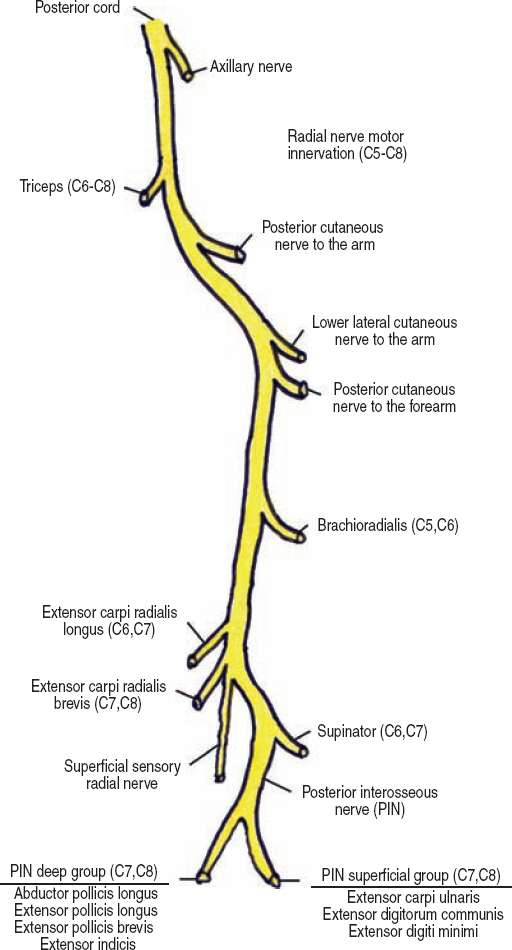
Branch Diagram (from textbook)
Below is the comprehensive branch diagram showing the full radial nerve from the posterior cord to its terminal branches:
And the anatomical view in the arm (Gray's Anatomy for Students):
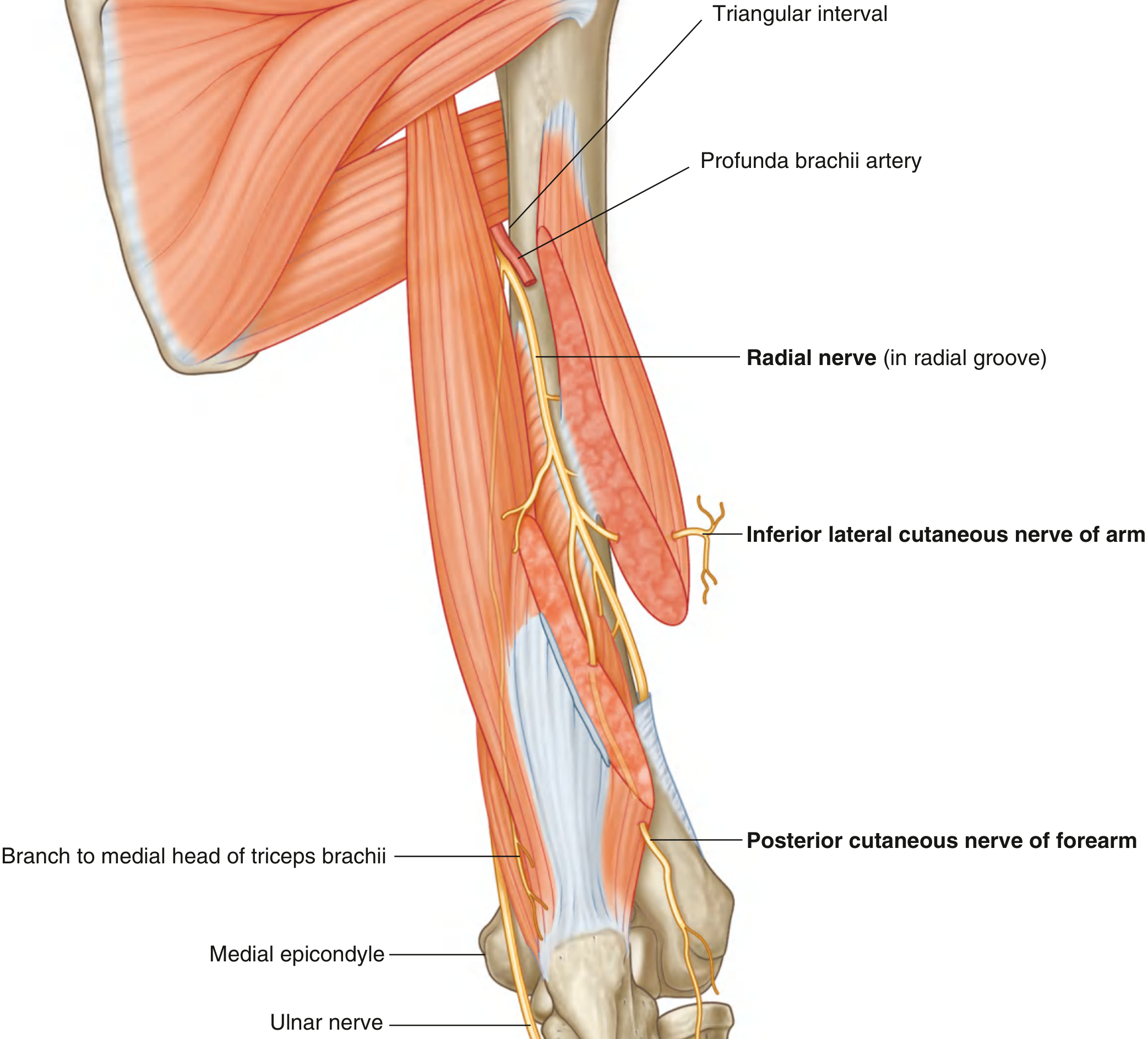
Fig. 7.69 - Radial Nerve in the Arm, showing triangular interval entry, profunda brachii artery, and cutaneous branches
Course
| Region | Key Relations |
|---|---|
| Axilla | Posterior to axillary artery; posterior wall of axilla |
| Triangular interval | Passes with profunda brachii artery into posterior compartment |
| Radial (spiral) groove | Lies directly on bone, passing medial-to-lateral |
| Lateral intermuscular septum | Passes anteriorly into anterior compartment |
| Cubital fossa (lateral wall) | Deep to brachioradialis; bifurcates into deep + superficial branches |
| Forearm | Deep branch = posterior interosseous nerve (PIN); superficial branch = sensory |
Branches and Their Territories
In the Axilla
| Branch | Target |
|---|---|
| Posterior cutaneous nerve of the arm | Skin over posterior arm |
| Branch to long head of triceps | Triceps (long head) |
| Branch to medial head of triceps | Triceps (medial head) |
In the Spiral/Radial Groove
| Branch | Target |
|---|---|
| Inferior lateral cutaneous nerve of the arm | Skin over lateral arm (distal) |
| Posterior cutaneous nerve of the forearm | Skin over posterior forearm |
| Branches to lateral head of triceps | Triceps (lateral head) |
| Branch to medial head of triceps + anconeus | Triceps (medial) + anconeus |
At the Lateral Wall of Cubital Fossa (before bifurcation)
| Branch | Target |
|---|---|
| To brachioradialis | Brachioradialis (C5, C6) |
| To extensor carpi radialis longus (ECRL) | ECRL (C6, C7) |
| To lateral part of brachialis | Brachialis (small contribution) |
Terminal Bifurcation (under brachioradialis)
The radial nerve splits into two terminal branches at the lateral border of the cubital fossa:
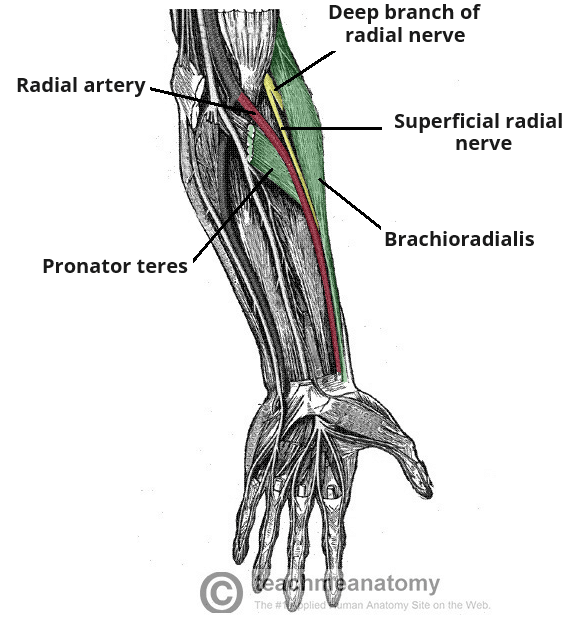
1. Deep Branch → Posterior Interosseous Nerve (PIN)
Primarily motor. Winds through the supinator muscle (Arcade of Frohse) and becomes the PIN after emerging posteriorly.
Deep branch supplies (before entering supinator):
- Extensor carpi radialis brevis (ECRB) - C7, C8
- Supinator - C6, C7
PIN supplies (after supinator):
| PIN - Superficial group (C7, C8) | PIN - Deep group (C7, C8) |
|---|---|
| Extensor carpi ulnaris (ECU) | Abductor pollicis longus (APL) |
| Extensor digitorum communis (EDC) | Extensor pollicis brevis (EPB) |
| Extensor digiti minimi (EDM) | Extensor pollicis longus (EPL) |
| Extensor indicis (EI) |
PIN terminates as articular branches to the wrist joint.
2. Superficial Branch of Radial Nerve
Purely sensory. Runs under brachioradialis alongside the radial artery, then winds posteriorly at the distal forearm to supply the dorsolateral hand and fingers.
Sensory territory:
- Posterolateral wrist and hand
- Dorsal skin of lateral 3.5 fingers (proximal phalanges - does NOT reach fingertips)
Quick Summary Table
| Level | Branch | Type | Target |
|---|---|---|---|
| Axilla | Post. cutaneous n. of arm | Sensory | Posterior arm skin |
| Axilla | Branches to triceps (long + medial head) | Motor | Triceps |
| Spiral groove | Inf. lateral cutaneous n. of arm | Sensory | Lateral arm skin |
| Spiral groove | Post. cutaneous n. of forearm | Sensory | Posterior forearm skin |
| Spiral groove | Branches to triceps (lateral head) | Motor | Triceps |
| Spiral groove | Branch to anconeus | Motor | Anconeus |
| Cubital fossa | Branch to brachioradialis | Motor | Brachioradialis (C5,C6) |
| Cubital fossa | Branch to ECRL | Motor | ECRL (C6,C7) |
| Bifurcation | Deep branch → PIN | Motor | Supinator, ECRB + all other posterior forearm muscles |
| Bifurcation | Superficial branch | Sensory | Dorsolateral hand + digits |
Clinical Relevance - Injury Levels
- Axilla (crutch palsy): All branches affected - wrist drop + loss of elbow extension + sensory loss over posterior arm/forearm/hand
- Spiral groove (midshaft humerus fracture): Wrist drop (triceps usually spared), sensory loss dorsum of hand
- PIN (radial tunnel / lateral epicondyle): Finger drop without wrist drop, no sensory loss (pure motor)
- Superficial branch (de Quervain's, tight watch strap): Sensory loss only over dorsolateral hand (Wartenberg's syndrome)
Source: Gray's Anatomy for Students (9780323934237), Ch. 7
This is a shared conversation. Sign in to Orris to start your own chat.