
Explain Dominant Recessiveand sex linked diseases from Parks
Reading File
Now let me search the library for Park's textbook content on genetic diseases.
Finding Sources
Finding Sources
Park's is in the library. Now let me search for sections on dominant, recessive, and sex-linked diseases in parallel.
Finding Sources
Finding Sources
Found the exact section. Now let me read that block comprehensively.
Reading File
Reading File
Reading File
I now have all the content I need. Let me fetch the key pedigree diagrams to include in the answer.
Loading Image
Loading Image
Loading Image
Loading Image
Reading File
I now have all the content from Park's. Let me compose the complete answer.
Dominant, Recessive, and Sex-Linked Diseases
From Park's Textbook of Preventive and Social Medicine
Background: Gene Concepts
Genes occur in pairs (like chromosomes). When both genes of a pair are identical (AA), the individual is homozygous; when different (Aa), they are heterozygous.
- Dominant gene: manifests its effect in both the heterozygous and the homozygous state.
- Recessive gene: manifests its effect only in the homozygous state.
The genotype is the total genetic constitution; the phenotype is its outward expression. The extent to which a genetically determined condition is expressed is called penetrance - lack of penetrance explains skipped generations and unexpected pedigree patterns.
Genes can mutate - mutation rate is increased by mutagens like UV rays, radiation, and chemical carcinogens. Mutation confined to a single gene is called a "point" mutation, responsible for many human diseases.
Mendelian Diseases
Mendelian diseases are inherited according to Mendel's Laws. The combined incidence is about 1% of all live-born individuals. Three major categories have been catalogued:
| Category | Number catalogued |
|---|---|
| Autosomal dominant phenotypes | 793 |
| Autosomal recessive traits | 629 |
| Sex-linked diseases | 123 |
(a) Autosomal Dominant Inheritance
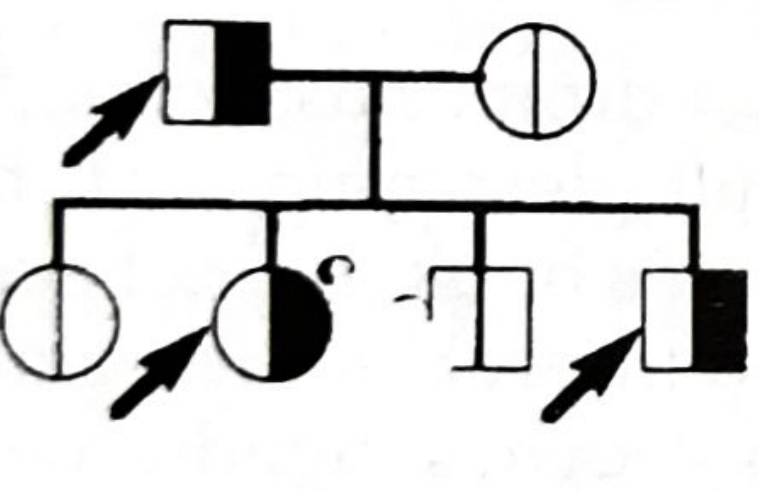
An individual with an autosomal dominant trait produces two kinds of gametes - half with the mutant gene, and half with the normal allele.
Key features:
- Offspring have a 50:50 chance of being affected (if the other parent is normal)
- Both sexes are equally affected
- The trait appears in every generation (no skipped generations unless penetrance is reduced)
Pedigree pattern:
Examples of Autosomal Dominant Diseases:
- Achondroplasia
- Huntington's chorea
- Neurofibromatosis
- Familial polyposis coli
- Brachydactyly
- Marfan's syndrome
- Retinoblastoma
- ABO blood group system
- Hyperlipoproteinaemia (types I, II, III, IV)
- Polycystic kidney disease
- Polydactyly
- Hereditary spherocytosis
(b) Autosomal Recessive Inheritance
Abnormalities caused by recessive genes occur when both parents are heterozygous (carriers). Such parents appear outwardly normal but carry one copy of the mutant gene each.
Key features:
- Each offspring has a 1 in 4 (25%) chance of being affected
- Autosomal recessive diseases occur sporadically in children of outwardly normal parents
- Both sexes are equally affected
- Consanguinity (related parents) increases the risk
Examples of Autosomal Recessive Diseases:
- Fibrocystic disease of the pancreas (cystic fibrosis)
- Phenylketonuria (PKU)
- Albinism
- Tay-Sachs disease
- Agammaglobulinaemia (Swiss type)
- Alkaptonuria
- Galactosaemia
- Haemoglobinopathies
- Maple syrup urine disease
- Megacolon (Hirschsprung's disease)
(c) Sex-Linked (X-Linked) Inheritance
In sex-linked inheritance, the mutant gene is located on the X chromosome.
Mechanism:
- In males (XY): a mutant gene on the X chromosome will express itself readily, since there is no normal allele on the Y chromosome (hemizygous state)
- In females (XX): a mutant gene on the X chromosome will not express itself in the presence of a normal allele on the other X chromosome - the female is a carrier
Pedigree pattern (carrier female x normal male):
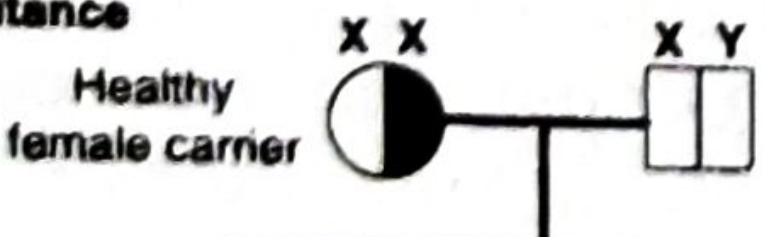
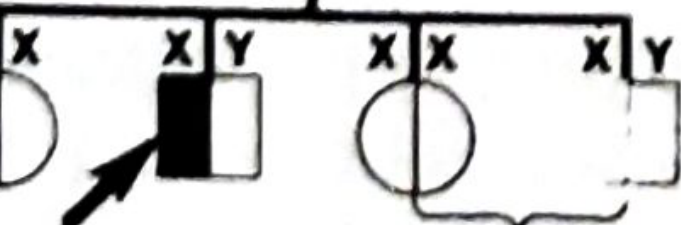
Transmission pattern:
| Cross | Sons | Daughters |
|---|---|---|
| Affected male × Normal female | All sons unaffected | All daughters become carriers |
| Carrier female × Normal male | 50% affected, 50% normal | 50% carriers, 50% normal |
Key point: Haemophilia is the outstanding example of X-linked recessive inheritance. Sons can only get the X chromosome from their mother (not from an affected father), so "no male is born without a history of the disorder" on the maternal side.
Recessive Sex-Linked Diseases:
- Haemophilia type A and B
- Duchenne muscular dystrophy
- Colour blindness
- G6PD deficiency
- Hydrocephalus (X-linked)
- Retinitis pigmentosa
- Agammaglobulinaemia, Bruton type
Dominant X-Linked Diseases:
In dominant X-linked conditions, even a single copy of the mutant gene on the X chromosome causes disease in females too.
- Vitamin D resistant rickets (Familial hypophosphataemia)
- Blood group Xg
Summary Table (Park's Table 1)
| Category | Examples |
|---|---|
| Autosomal Dominant | Achondroplasia, Huntington's chorea, Neurofibromatosis, Marfan's syndrome, Retinoblastoma, Polydactyly |
| Autosomal Recessive | PKU, Albinism, Tay-Sachs, Cystic fibrosis, Galactosaemia, Haemoglobinopathies |
| Recessive X-Linked | Haemophilia A & B, Duchenne MD, Colour blindness, G6PD deficiency |
| Dominant X-Linked | Vit. D resistant rickets, Familial hypophosphataemia, Blood group Xg |
Source: Park's Textbook of Preventive and Social Medicine, Chapter on Genetics and Disease (pp. 925-927).
Note on muscular dystrophy: Park's highlights this as a special case where three different genetic mechanisms can cause the same phenotype - one sex-linked recessive gene, one autosomal recessive gene, and one autosomal dominant gene - illustrating that the same disease can have multiple genetic causes.
Explain in easy
Dominant, Recessive & Sex-Linked Diseases - Made Simple 🧬
First, understand the basics
Think of genes like instructions inside your body. You get 2 copies of every instruction - one from your mom, one from your dad.
- If both copies are the same → Homozygous (AA or aa)
- If copies are different → Heterozygous (Aa)
1. DOMINANT Diseases 💪
"One bad copy is enough to cause disease"
Imagine you have 2 workers. Even if ONE worker is lazy, the work still gets messed up.
Rules to remember:
- Only ONE faulty gene needed
- Both mom and dad can pass it
- Affects boys and girls equally
- If parent has it → child has 50% chance of getting it
- Disease appears in every generation (no skipping)
Easy memory trick: "One is enough to DOM-inate"
Examples:
| Disease | What it does |
|---|---|
| Huntington's chorea | Brain damage, jerky movements |
| Achondroplasia | Short limbs (dwarfism) |
| Marfan's syndrome | Tall, long fingers, heart problems |
| Neurofibromatosis | Skin tumors/patches |
| Retinoblastoma | Eye cancer in children |
| Polydactyly | Extra fingers/toes |
2. RECESSIVE Diseases 😴
"BOTH bad copies needed to cause disease"
Imagine you have 2 workers. If one is lazy but one works hard, the work still gets done. Disease only happens when BOTH are lazy.
Rules to remember:
- BOTH copies must be faulty
- Parents look completely normal (they are silent carriers)
- Child has 25% (1 in 4) chance of being affected
- Disease appears suddenly in otherwise healthy families
- Common when parents are related (cousins marrying)
Easy memory trick: "Two bad copies to RE-CESS into disease"
Who is a carrier? Someone with one bad copy (Aa) - they are healthy but can pass it to their child.
Examples:
| Disease | What it does |
|---|---|
| Cystic fibrosis | Thick mucus in lungs |
| Phenylketonuria (PKU) | Brain damage if untreated |
| Albinism | No skin/hair pigment |
| Tay-Sachs | Brain destruction in infants |
| Galactosaemia | Can't digest milk sugar |
| Sickle cell / Thalassemia | Blood disorders |
3. SEX-LINKED (X-Linked) Diseases 🧬
"The faulty gene is on the X chromosome"
First, understand chromosomes:
- Female = XX (two X chromosomes)
- Male = XY (one X, one Y)
The Y chromosome is like a small, almost empty version - it has very few genes.
Why males are MORE affected:
Think of it like this - females have a backup X to save them. Males don't.
| Female (XX) | Male (XY) | |
|---|---|---|
| Has one faulty X | Has a good X to cover it ✅ | No backup - GETS SICK ❌ |
| Has two faulty X | Gets sick ❌ | (very rare) |
X-Linked RECESSIVE (most common type)
Mother is a carrier (has one bad X, looks healthy) × Normal father
| Offspring | Result |
|---|---|
| 50% of sons | Affected (sick) |
| 50% of sons | Normal |
| 50% of daughters | Carrier (healthy but carries the gene) |
| 50% of daughters | Completely normal |
Key rule from Park's: "If an affected male marries a normal female - all daughters become carriers, but sons escape."
Easy memory trick: "Sons suffer, daughters carry"
Examples:
| Disease | What it does |
|---|---|
| Haemophilia A & B | Blood doesn't clot |
| Duchenne Muscular Dystrophy | Progressive muscle weakness |
| Colour blindness | Can't distinguish red/green |
| G6PD deficiency | Red blood cells break down |
| Retinitis pigmentosa | Progressive blindness |
X-Linked DOMINANT (rare)
- Even one bad copy on X causes disease
- Females can also be affected (unlike recessive)
- Example: Vitamin D resistant rickets, Blood group Xg
QUICK COMPARISON TABLE
| Feature | Autosomal Dominant | Autosomal Recessive | X-Linked Recessive |
|---|---|---|---|
| Copies needed | 1 | 2 | 1 (in males) |
| Parents look normal? | Usually NOT | YES | Mother looks normal |
| Who gets affected? | Both sexes equally | Both sexes equally | Mostly males |
| Chance of child being sick | 50% | 25% | 50% of sons |
| Skips generations? | No | Yes | Yes |
| Example | Huntington's | PKU, Cystic fibrosis | Haemophilia |
SUPER SIMPLE SUMMARY 🎯
DOMINANT   = 1 bad gene = SICK (like a bully - one is enough)
RECESSIVE  = 2 bad genes = SICK (need both parents to contribute)
X-LINKED   = bad gene on X = mostly BOYS get sick
             (boys have no backup X to protect them)
That's it! The whole concept of genetic disease inheritance in a nutshell, straight from Park's.
This is a shared conversation. Sign in to Orris to start your own chat.