
Hello, अ, मैं doctor हूँ, MBBS. मेरे पास अभी COVID के अंदर एक 18 years old patient आई। उन्होंने मुझे complaint की कि उनका वज़न बढ़ रहा है, उनको acne कर रहा है, उनको unwanted hair growth हो रही है और उनके periods oligomenorrhea की तरफ जा रहे हैं, तीन-चार महीने से। उनके जब हमने CBC वगैरह कराया तो CBC ठीक था और उसके अंदर WBCs 11.6 क्या आ रहे थे और न्यूट्रोफिल्स और लिम्फोसाइट्स ठीक थे। और patient ने मुझे एक complaint ये भी की थी कि उनको urine करने के बाद अभी भी ऐसा लगता है कि थोड़ा...
Reading File
आपकी history सुनकर लग रहा है यह case PCOS (Polycystic Ovary Syndrome) की तरफ point कर रहा है - weight gain, acne, hirsutism, oligomenorrhea एक classic triad है। WBC 11.6 थोड़ा raised है जो low-grade inflammation suggest करता है (PCOS में common है)।
लेकिन आप urine वाली complaint अधूरी छोड़ गए - वो पूरा करें। क्या वो incomplete voiding feel करती है, या burning, या frequency?
पहले मैं PCOS का detailed workup pull करता हूँ।
Searching sources...
Finding Sources
Finding Sources
Finding Sources
Finding Sources
Goldman-Cecil और Harrison's दोनों से PCOS section पढ़ता हूँ - ये most comprehensive होंगे।
Reading File
Reading File
अब Berek & Novak's Gynecology से detailed PCOS section और diagnosis criteria पढ़ता हूँ, साथ ही PCOS workup/investigations के लिए भी search करता हूँ:
Reading File
Finding Sources
Reading File
Reading File
Excellent! अब treatment और investigations के लिए थोड़ा और पढ़ता हूँ:
Reading File
अब मेरे पास comprehensive textbook data है। PCOS diagnostic algorithm image भी fetch करता हूँ:
Loading Image
अब मेरे पास सब कुछ है। एक comprehensive, structured response देता हूँ - लेकिन पहले note करता हूँ कि आपकी urine वाली complaint अधूरी रह गई। मैं PCOS का पूरा analysis दे रहा हूँ और उसके बाद urine complaint के बारे में clarify करूँगा।
PCOS - Clinical Assessment and Management
आपकी Patient की Summary (18F)
| Feature | Finding | Significance |
|---|---|---|
| Weight gain | Present | Hyperinsulinemia/IR |
| Acne | Present | Clinical hyperandrogenism |
| Hirsutism (unwanted hair) | Present | Clinical hyperandrogenism |
| Oligomenorrhea (3-4 months) | Present | Ovarian dysfunction |
| WBC 11.6 (mild leukocytosis) | Present | Low-grade chronic inflammation (PCOS में common) |
यह Rotterdam Criteria के अनुसार पहले से ही 2/3 criteria fulfill हो रही हैं - clinical hyperandrogenism (acne + hirsutism) + ovarian dysfunction (oligomenorrhea) - यानी PCOS clinically strongly probable है।
Rotterdam Criteria 2023 (Updated) - Diagnosis के लिए 3 में से 2 चाहिए:
- Irregular menses - <9 periods/year या cycles >35 days
- Clinical या Biochemical Hyperandrogenism - hirsutism (Ferriman-Gallwey score ≥4-6), acne, alopecia; या elevated free/total testosterone
- Polycystic Ovary Morphology (PCOM) on USG - ≥20 antral follicles in either ovary (2-9 mm) और/या ovarian volume ≥10 mL; या elevated AMH
⚠️ Adolescent Note: Harrison's 22E (2025) के अनुसार, 18 साल की उम्र में ultrasound और AMH criteria reliable नहीं हैं। Adolescents में diagnosis irregular menses + clinical/biochemical hyperandrogenism के आधार पर करनी चाहिए। Menarche के 3 साल तक wait करना suggest किया जाता है। (- Harrison's Principles of Internal Medicine 22E, p.3135)
Investigations - क्या कराएं
Diagnosis Confirm करने के लिए:
- Fasting LH/FSH ratio - PCOS में LH:FSH >2:1 (lean PCOS में high LH)
- Total Testosterone (free testosterone सबसे sensitive) - usually ≤2x upper limit; if >200 ng/dL, ovarian tumor rule out करें
- Free androgen index (FAI) या SHBG
- 17-OHP (basal, follicular phase) - Non-classic congenital adrenal hyperplasia (NCAH/21-hydroxylase deficiency) rule out करने के लिए - यह PCOS जैसी presentation देता है
- Pelvic USG (transvaginal/transabdominal) - PCO morphology देखें
Exclusion Diagnoses (ज़रूरी):
- TSH - Hypothyroidism rule out करें (weight gain + menstrual irregularity दोनों cause करता है)
- Serum Prolactin - Hyperprolactinemia rule out करें
- Serum DHEA-S - Adrenal source of androgens
- Morning cortisol / 24-hr urinary free cortisol - यदि Cushing's suspect करें (central obesity prominent हो)
Metabolic Workup (PCOS comorbidities screen):
- Fasting glucose + HbA1c / 75g OGTT - Insulin resistance, pre-diabetes, T2DM
- Fasting lipid profile - Dyslipidemia
- BMI + Waist circumference
- Blood pressure
Diagnostic Algorithm
यहाँ Berek & Novak's Gynecology का official diagnostic flowchart है:
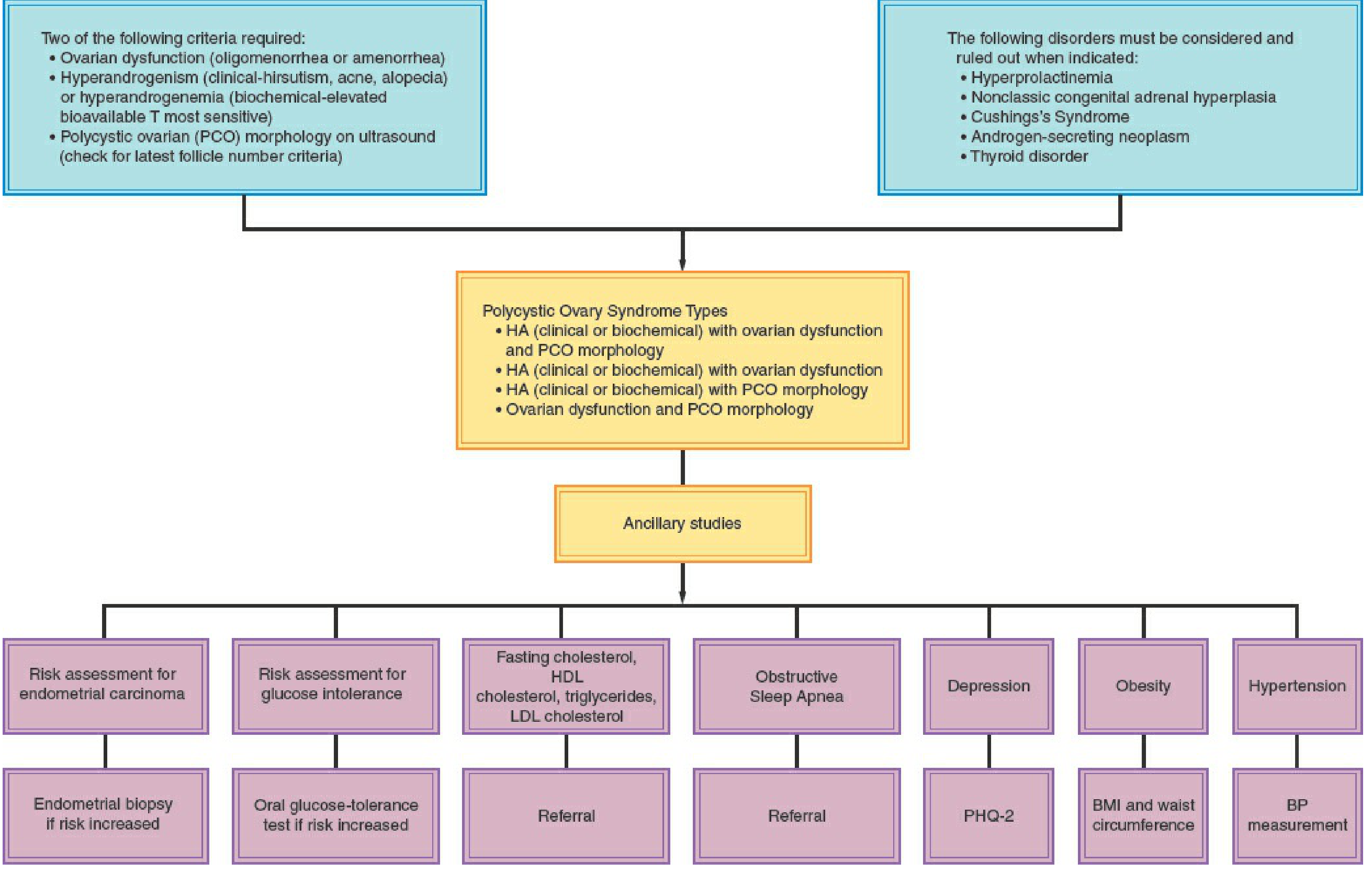
WBC 11.6 के बारे में
PCOS में chronic low-grade systemic inflammation होती है। Borderline leukocytosis (11.6 x10⁹/L) with normal neutrophil/lymphocyte ratio - यह PCOS-associated inflammatory state हो सकता है। लेकिन infection rule out करना ज़रूरी है (UTI जो आप mention करने वाले थे)।
Differential Diagnoses to Rule Out
| Condition | Key Differentiator |
|---|---|
| Non-classic CAH | 17-OHP elevated (>200 ng/dL) |
| Hypothyroidism | TSH elevated, cold intolerance, bradycardia |
| Hyperprolactinemia | Galactorrhea, prolactin elevated |
| Cushing's Syndrome | Striae, central obesity, buffalo hump, cortisol elevated |
| Androgen-secreting tumor | Rapid virilization, testosterone >200 ng/dL |
Management (PCOS confirmed होने पर)
Lifestyle (सभी में first-line):
- Weight loss 5-10% भी menstrual regularity restore कर सकती है
- Regular aerobic exercise, low-glycemic diet
Pharmacological:
- Combined Oral Contraceptive Pill (COCP) - First-line, menstrual regulation + androgen suppression (SHBG बढ़ाता है); acne और hirsutism में benefit 2-3 months में दिखता है, पर hirsutism improvement 6 months लगते हैं
- Spironolactone (anti-androgen) - COCP के 6 months बाद inadequate response हो तो add करें; hirsutism के लिए
- Metformin - Overweight/obese PCOS में insulin resistance और cardiometabolic risk के लिए; infertility treatment नहीं है
- Endometrial protection - Irregular cycles में, medroxyprogesterone acetate 10 mg × 10-14 days हर 3 months (endometrial hyperplasia prevention)
(Source: Harrison's Principles of Internal Medicine 22E, 2025, p.3135; Berek & Novak's Gynecology, p.1919-1923)
एक Important बात
आप urine complaint बताते-बताते रुक गए। क्या patient को:
- Post-void residual feeling (incomplete emptying) था?
- या burning/dysuria/frequency था (जो UTI suggest करे)?
अगर UTI है, तो WBC 11.6 भी उससे explain होगा। UTI + PCOS दोनों coexist कर सकते हैं। कृपया वो complaint complete करें - उसके अनुसार further guidance दे सकता हूँ।
इसे मुझे आप English में बताएँ। मुझे हिंदी नहीं आती है।
Here is a full English summary of the clinical assessment for your patient.
Patient Summary (18F) — Likely PCOS
| Feature | Finding | Significance |
|---|---|---|
| Weight gain | Present | Hyperinsulinemia / Insulin resistance |
| Acne | Present | Clinical hyperandrogenism |
| Unwanted hair growth (hirsutism) | Present | Clinical hyperandrogenism |
| Oligomenorrhea (3-4 months) | Present | Ovarian dysfunction / Anovulation |
| WBC 11.6 (mild leukocytosis) | Present | Low-grade chronic inflammation (common in PCOS) |
This patient already satisfies 2 out of 3 Rotterdam Criteria — clinical hyperandrogenism (acne + hirsutism) + ovarian dysfunction (oligomenorrhea) — making PCOS strongly probable clinically.
Rotterdam Criteria 2023 (Updated) — Diagnosis requires 2 of 3:
- Irregular menses - fewer than 9 periods/year or cycle length >35 days
- Clinical or Biochemical Hyperandrogenism - hirsutism (Ferriman-Gallwey score ≥4-6 depending on ethnicity), acne, alopecia; OR elevated free/total testosterone
- Polycystic Ovary Morphology (PCOM) on ultrasound - ≥20 antral follicles (2-9 mm) in either ovary and/or ovarian volume ≥10 mL; OR elevated AMH
⚠️ Adolescent Note (Important for this patient): According to Harrison's 22E (2025), in adolescents the ultrasound and AMH criteria are not yet established as reliable. In this age group, diagnosis should rest on irregular menses + clinical/biochemical hyperandrogenism only. It is also recommended to wait at least 3 years post-menarche before confirming the diagnosis, to avoid over-diagnosing physiological anovulation.
Investigations to Order
To Confirm Diagnosis:
- LH / FSH (fasting) — LH:FSH ratio >2:1 in lean PCOS (high LH drives ovarian androgen production)
- Total Testosterone (free testosterone is most sensitive) — usually ≤2x upper limit in PCOS; if >200 ng/dL, rule out androgen-secreting ovarian tumor
- SHBG (Sex Hormone Binding Globulin) — decreased in PCOS; used to calculate Free Androgen Index
- Basal follicular-phase 17-OHP — to exclude Non-classic Congenital Adrenal Hyperplasia (NCAH), which mimics PCOS closely
- Pelvic Ultrasound (transabdominal in adolescents) — assess PCO morphology
To Exclude Mimics (mandatory):
| Test | Rules Out |
|---|---|
| TSH | Hypothyroidism (weight gain + menstrual irregularity) |
| Serum Prolactin | Hyperprolactinemia |
| DHEA-S | Adrenal source of excess androgens |
| Morning cortisol / 24-hr UFC | Cushing's syndrome (if central obesity prominent) |
Metabolic Workup (screen for comorbidities):
- Fasting glucose + HbA1c (or 75g OGTT) — insulin resistance, pre-diabetes, T2DM
- Fasting lipid profile — dyslipidemia is common in PCOS
- BMI + waist circumference
- Blood pressure
Diagnostic Algorithm
Differential Diagnoses to Rule Out
| Condition | Key Differentiating Feature |
|---|---|
| Non-classic CAH (21-OH deficiency) | 17-OHP elevated (>200 ng/dL basal; >1000 on stimulation) |
| Hypothyroidism | Elevated TSH, cold intolerance, bradycardia |
| Hyperprolactinemia | Galactorrhea, elevated prolactin, possible headache/visual field defect |
| Cushing's Syndrome | Striae, buffalo hump, hypertension, elevated cortisol |
| Androgen-secreting tumor | Rapid virilization, testosterone >200 ng/dL |
Management (once PCOS is confirmed)
Lifestyle — First-line in ALL patients:
- Even 5-10% weight loss can restore menstrual regularity and reduce androgen levels
- Low-glycemic diet, regular aerobic exercise
Pharmacological:
- Combined Oral Contraceptive Pill (COCP) — First-line therapy; regulates menstrual cycles and suppresses androgens by raising SHBG. Androgen levels fall within 2-3 months; visible improvement in acne/hirsutism may take up to 6 months
- Spironolactone (anti-androgen) — Add if inadequate response to COCP after 6 months; particularly for hirsutism
- Metformin — For overweight/obese patients to address insulin resistance and cardiometabolic risk; not a standalone treatment for hyperandrogenic symptoms or infertility
- Endometrial protection — Medroxyprogesterone acetate 10 mg for 10-14 days every 3 months if cycles remain irregular (prevents endometrial hyperplasia from unopposed estrogen)
(Sources: Harrison's Principles of Internal Medicine 22E, 2025; Berek & Novak's Gynecology, pp. 1919-1923)
About the WBC 11.6
PCOS is associated with chronic low-grade systemic inflammation, which can produce a borderline leukocytosis with normal neutrophil/lymphocyte distribution — which matches your CBC findings. However, you were in the middle of describing a urinary complaint when you stopped. Could you complete that? If there is dysuria, frequency, or burning, a concurrent UTI could also explain the elevated WBC, and both conditions can coexist. Please share the rest of that history so I can give you further guidance.
This is a shared conversation. Sign in to Orris to start your own chat.