
Aortic regurgitation
Reading File
Now I'll search the library and PubMed in parallel for comprehensive coverage.
Finding Sources
Searching PubMed
"aortic regurgitation"[MeSH Terms] AND management
Good. I'll now read the key sections from Braunwald's Heart Disease (most authoritative for AR) and the Echocardiography textbook in parallel.
Reading File
Reading File
Reading File
I need the main Braunwald's AR chapter. Let me find it and read the echocardiography details in parallel.
Finding Sources
Reading File
Now let me read the main Braunwald's AR chapter (block9) which contains the clinical stages, pathophysiology, and treatment sections.
Reading File
Reading File
Excellent. I have the clinical stages table. Now let me read the treatment section and acute AR section.
Reading File
I now have comprehensive information. Let me also quickly read the acute AR section and get an image.
Reading File
Searching Images
aortic regurgitation echocardiography color Doppler
I now have comprehensive data from Braunwald's Heart Disease to deliver a thorough answer. Let me compile it.
Aortic Regurgitation (AR)
Definition & Pathophysiology
Aortic regurgitation is diastolic backflow of blood from the aorta into the left ventricle (LV) due to incompetent aortic valve leaflets or aortic root dilatation. Unlike mitral regurgitation — where the LV ejects into the low-pressure left atrium — in AR the entire stroke volume is ejected into the high-pressure aorta, imposing both increased preload (from regurgitant volume refilling the LV) and increased afterload (wall stress from LV dilation per Laplace's law).
The LV compensates via eccentric hypertrophy — sarcomeres replicate in series, myocytes elongate, and the LV dilates while maintaining wall thickness proportional to radius (normal end-diastolic wall stress). Over time, wall thickening fails to keep pace, end-systolic wall stress rises (afterload mismatch), and LVEF falls. LV mass in AR is often among the highest seen in any cardiac condition. — Braunwald's Heart Disease
Etiology
| Leaflet Abnormalities | Aortic Root Abnormalities |
|---|---|
| Rheumatic disease | Chronic hypertension |
| Bicuspid / unicuspid / quadricuspid valve | Marfan syndrome / annulo-aortic ectasia |
| Infective endocarditis | Aortic dissection |
| Myxomatous valve disease | Ehlers-Danlos / Osteogenesis imperfecta |
| Calcific valve disease | Ankylosing spondylitis / reactive arthritis |
| Post-TAVI paravalvular leak | Syphilitic aortitis |
| Leaflet fenestration, irradiation, trauma | Giant cell arteritis |
Root disease causes AR by distorting leaflet geometry even when leaflets themselves are normal — annular dilation reduces leaflet apposition.
Clinical Stages (ACC/AHA 2020)
| Stage | Definition | Echocardiographic Criteria |
|---|---|---|
| A | At risk | Bicuspid valve, aortic disease; no AR |
| B | Progressive (mild–mod) | Jet width <65% LVOT; vena contracta <0.6 cm; RVol <60 mL/beat; RF <50%; ERO <0.30 cm² |
| C1 | Asymptomatic severe, compensated | Jet width ≥65% LVOT; vena contracta >0.6 cm; RVol ≥60 mL; RF ≥50%; ERO ≥0.30 cm²; LVEF >55%; LVESD ≤50 mm |
| C2 | Asymptomatic severe, decompensated | As above + LVEF ≤55% or LVESD >50 mm |
| D | Symptomatic severe | Any of above + exertional dyspnea, angina, or HF symptoms |
— Braunwald's Heart Disease, Table 73.2
Clinical Features
Chronic AR
- Long asymptomatic period (sometimes decades)
- Symptoms: exertional dyspnea, orthopnea, angina (rare without CAD — due to reduced diastolic coronary perfusion + increased oxygen demand)
- Classic signs from widened pulse pressure (high systolic, low diastolic pressure):
- Corrigan's (water-hammer) pulse — bounding, rapidly collapsing
- de Musset's sign — head bobbing with each heartbeat
- Quincke's sign — pulsatile capillary pulsation in fingernails
- Duroziez's sign — systolic/diastolic bruit over femoral artery
- Hill's sign — popliteal SBP exceeds brachial SBP by >20 mmHg
- Traube's sign — "pistol-shot" femoral pulse sounds
Note: Widened pulse pressure is less helpful in older adults because age-related arterial stiffening produces it independently.
Auscultation
- High-pitched, blowing, decrescendo diastolic murmur heard best at lower left sternal border (valvular AR) or upper right sternal border (root AR), with patient sitting forward
- Austin Flint murmur: low-pitched mid-diastolic rumble at apex — from regurgitant jet impinging on anterior mitral leaflet, mimicking mitral stenosis
- Often accompanied by a systolic ejection murmur (due to increased forward stroke volume, not obstruction)
Diagnosis & Severity Assessment
Echocardiography (primary modality)
Structural assessment: identifies bicuspid valve, vegetations, leaflet prolapse, root dilation, annular dilation.
Color Doppler: regurgitant jet area in LVOT as % of LVOT width:
- Mild: <25% LVOT
- Moderate: 25–64%
- Severe: ≥65%
Quantitative parameters (severe AR):
- Vena contracta >0.6 cm
- Regurgitant volume ≥60 mL/beat
- Regurgitant fraction ≥50%
- ERO ≥0.30 cm²
- Holodiastolic flow reversal in the proximal abdominal aorta
- Short pressure half-time (<200 ms) on CW Doppler
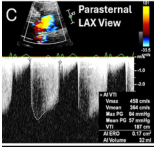
Parasternal LAX color Doppler and spectral Doppler of severe AR. ERO 0.17 cm², AI volume 32 mL, Vmax 458 cm/s.
LV response: LVESD, LVEDD, LVEF are tracked serially. LVEF ≤55% or LVESD >50 mm are surgical thresholds in asymptomatic patients.
CMR: Used when echo windows are suboptimal; accurately quantifies regurgitant fraction via phase-contrast flow measurement across the aortic root.
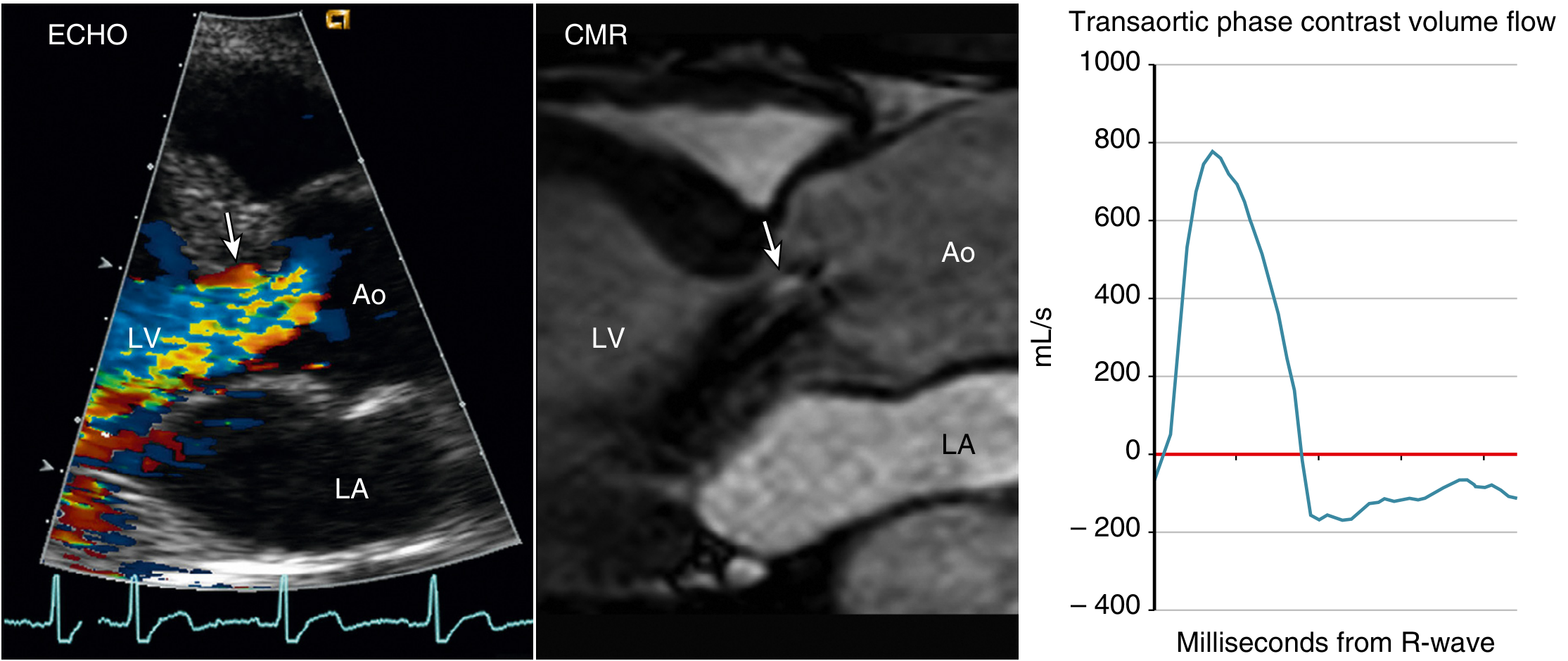
Fig. 12.17 — CMR quantification of severe AR from bicuspid valve. — Textbook of Clinical Echocardiography
Management
Chronic AR — Medical Therapy
- No disease-modifying drug therapy exists for AR; randomized trials of CCBs and ACE inhibitors have not shown consistent benefit in slowing LV dilation or delaying AVR.
- Treat hypertension (SBP >140 mm Hg) — vasodilators reduce regurgitant fraction by lowering diastolic arterial pressure.
- Manage CAD, arrhythmias, and comorbidities per guidelines.
- In inoperable symptomatic patients: evidence-based HF regimen — ACE inhibitors, diuretics, ± vasodilators; beta-blockers may help. Nitrates can be tried for angina.
- Pre-operative stabilization of decompensated LV: IV nitroprusside or vasodilators.
Chronic AR — Surgical Indications (AVR)
| Indication | Class |
|---|---|
| Any symptoms (NYHA I–IV) with severe chronic AR | I (mandatory) |
| Asymptomatic severe AR + LVEF ≤55% (C2) | I |
| Asymptomatic severe AR + LVESD >50 mm (or indexed >25 mm/m²) (C2) | I |
| Asymptomatic severe AR + undergoing other cardiac surgery | I |
| Asymptomatic severe AR + LVEF 55–60% or LVESD 50–60 mm on serial echo | IIa (reasonable) |
Key threshold update in 2020 ACC/AHA guidelines: LVEF <55% (previously <50%) is now the cut-off for surgery, as data show higher long-term mortality when operating below 55%. — Braunwald's Heart Disease
Operative mortality: <3% at experienced centers with normal LV; rises to ~14% when LVEF <35%.
Aortic valve repair (instead of replacement) is feasible in select patients — especially those with root dilation but preserved leaflets (Marfan syndrome), or bicuspid valve with isolated prolapse.
TAVR for AR: Increasingly reported in high-risk patients; standard TAVR is challenging because AR lacks the calcification that anchors transcatheter valves. Dedicated devices (e.g., JenaValve) are under investigation.
Acute Aortic Regurgitation
Causes
- Infective endocarditis (leaflet perforation/destruction)
- Aortic dissection (Type A)
- Trauma
Pathophysiology (distinct from chronic)
The LV is normal-sized and cannot accommodate the sudden large regurgitant volume. LV diastolic pressure rises rapidly above left atrial pressure → premature mitral valve closure → tachycardia (compensatory). Unlike chronic AR, there is no time for eccentric remodeling → severely reduced forward stroke volume → cardiogenic shock rapidly.
Presentation
- No widened pulse pressure (LV hasn't dilated yet)
- Soft or absent diastolic murmur (rapid equalization of aortic/LV pressures)
- Pulmonary edema on CXR; normal-sized cardiac silhouette (no cardiomegaly yet)
- Tachycardia, hemodynamic instability
Management — Surgical Emergency
- Prompt AVR is the primary treatment — acute severe AR is nearly always fatal without surgery
- Bridge therapy: IV dopamine or dobutamine (inotrope) + IV nitroprusside (vasodilator to reduce afterload)
- Beta-blockers are CONTRAINDICATED (tachycardia is compensatory; slowing HR causes decompensation)
- Intra-aortic balloon pump is CONTRAINDICATED (augments diastolic pressure → worsens regurgitation)
- Endocarditis: 5–7 days of IV antibiotics if hemodynamically stable, then surgery; operate immediately at any hemodynamic instability or abscess formation
- Aortic dissection causing AR: aortic repair/replacement combined with AVR
Surveillance (Asymptomatic Patients)
| Severity | Follow-up interval |
|---|---|
| Mild AR, normal LV | Every 3–5 years |
| Moderate AR | Every 1–2 years |
| Severe AR, compensated (C1) | Every 6–12 months; serial echo |
Exercise testing is reasonable in Stage C1 to unmask symptoms.
Key take-aways:
- Chronic AR causes a massive eccentric LV — the "cor bovinum." Compensation can last decades.
- Operate when symptomatic (any symptom), LVEF ≤55%, or LVESD >50 mm — don't wait for severe dysfunction.
- Acute AR is a surgical emergency; pulse pressure may be normal and the heart not enlarged — diagnosis is clinical + echo.
- No vasodilator drug therapy has proven benefit for delaying surgery in asymptomatic AR; treat hypertension and comorbidities.
— Braunwald's Heart Disease (9780323722193), Textbook of Clinical Echocardiography (9780323882088)
This is a shared conversation. Sign in to Orris to start your own chat.