
Triple phosphate present in urine
I'll look this up in the medical library first.
Reading File
Searching sources...
Finding Sources
Finding Sources
Good results. Let me pull the detailed content from the nephrology and urology textbooks, and also fetch the crystal image.
Reading File
Reading File
Reading File
Loading Image
Now let me also fetch the microscopy image of triple phosphate crystals from Comprehensive Clinical Nephrology.
Reading File
Reading File
Let me fetch the microscopy image of the actual struvite crystal.
Loading Image
That image showed casts, not crystals. Let me fetch the actual crystal microscopy image from Comprehensive Clinical Nephrology (Fig 4.4E).
Loading Image
I have all the information needed. Here is a comprehensive answer:
Triple Phosphate (Struvite) Crystals in Urine
What Are They?
Triple phosphate crystals - also called struvite crystals - are composed of magnesium ammonium phosphate (MgNH₄PO₄). The name "triple phosphate" historically refers to the three cations: magnesium, ammonium, and potassium (though the primary composition is Mg-NH₄-PO₄).
Appearance
The hallmark microscopic appearance is the "coffin lid" shape - beveled rectangular prisms with a flat, rectangular face resembling the lid of a coffin. Variants include flower-like and scissors-like structures.
Crystal types compared visually:
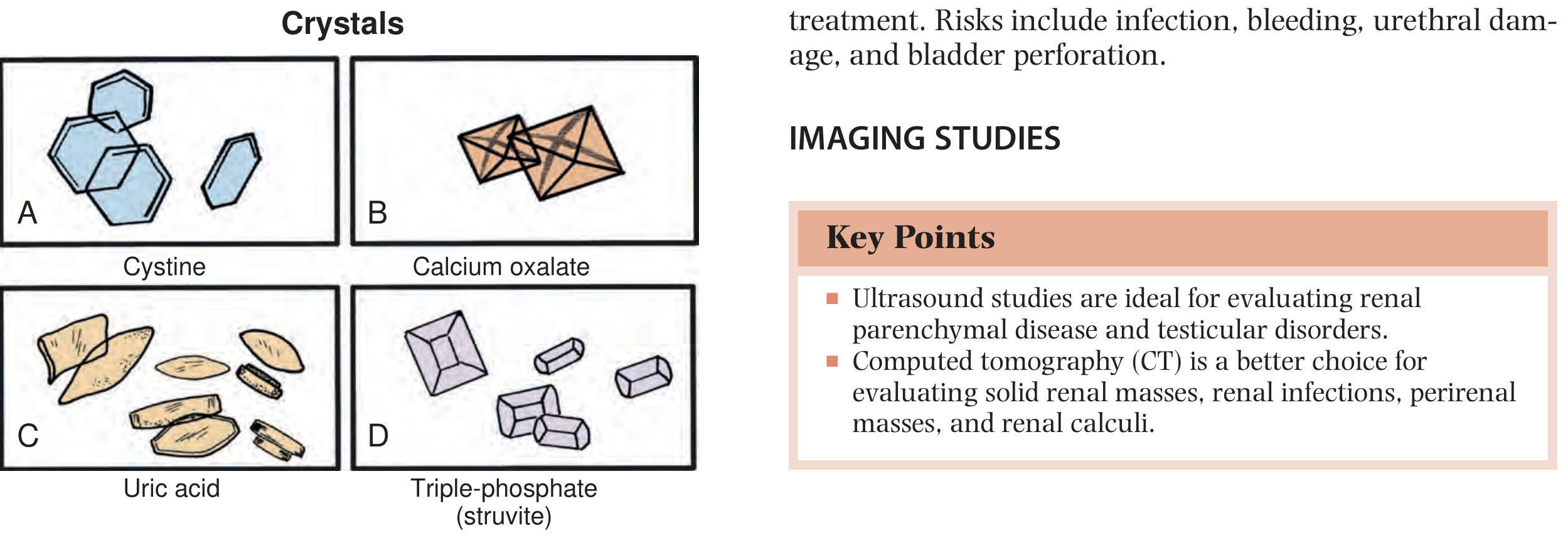
- Under polarized light, triple phosphate crystals polarize light strongly
- They precipitate in alkaline urine (pH ≥ 7.0)
Conditions for Formation
Triple phosphate crystals appear almost exclusively in alkaline urine and are strongly associated with:
- Urinary tract infections with urease-producing bacteria - the bacteria break down urea to ammonium (NH₄⁺) and OH⁻, making urine highly alkaline and causing phosphate to precipitate with Mg²⁺ and NH₄⁺.
Key urease-producing organisms include:
- Proteus spp. (most common)
- Klebsiella
- Pseudomonas
- Haemophilus
- Yersinia spp.
- Staphylococcus epidermidis
- Serratia
- Ureaplasma urealyticum (does not grow on routine culture - requires specific culture request)
Note: E. coli - the most common UTI organism - is NOT a urease producer and does not cause struvite formation.
- Urinary stasis - indwelling catheters, neurogenic bladder, genitourinary anomalies, spinal cord lesions.
Clinical Significance: Struvite/Infection Stones
When triple phosphate crystals aggregate into stones, they are called struvite stones (also "infection stones"). Key features:
| Feature | Detail |
|---|---|
| Growth rate | Rapid - grow quickly to large size |
| Stone type | Most staghorn calculi are struvite |
| Can reduce GFR | Yes, in the affected kidney |
| Gender predisposition | Women > men (higher UTI prevalence) |
| Also called | "Stone cancer" due to significant morbidity |
| Composition | Magnesium ammonium phosphate + calcium carbonate apatite |
| Radiograph | Radiopaque (visible on plain X-ray) |
Diagnosis is suggested by: alkaline urine (pH ≥ 7.0) + culture of urease-producing bacteria + large stones.
Urine Color Note
In large quantities, triple phosphate (struvite) crystals can cause white/turbid urine (from calcium phosphate or struvite precipitation) - and rarely a pink/red-brown hue.
Treatment of Struvite Stones
- Complete stone removal is essential - bacteria persist in stone interstices and stones regrow unless fully eradicated
- Small stones (<2 cm): ESWL may suffice
- Larger stones: Percutaneous nephrolithotomy (PCNL), often combined with ESWL
- Antibiotic therapy: Culture-directed; once urine is sterile (~2 weeks post-initiation), dose is halved; monthly cultures for 3 months; continue surveillance for a full year
- Stone fragments should be cultured
Quick Summary Table
| Property | Triple Phosphate (Struvite) |
|---|---|
| Composition | Magnesium ammonium phosphate |
| Urine pH | Alkaline (≥ 7.0) |
| Shape | Coffin lid (beveled rectangular prism) |
| Polarized light | Strongly birefringent |
| Associated with | Urease-producing UTI, urinary stasis |
| Key organism | Proteus spp. |
| Stone type | Staghorn calculi |
- Comprehensive Clinical Nephrology, 7th Ed., p. 69-70
- National Kidney Foundation Primer on Kidney Diseases, 8th Ed., p. 58-59
- Campbell-Walsh-Wein Urology
- Bailey & Love's Short Practice of Surgery, 28th Ed.
This is a shared conversation. Sign in to Orris to start your own chat.