
Muscles of inspiration and expiration diagram
Reading File
Finding Sources
Finding Sources
Reading File
Finding Sources
Reading File
Reading File
Reading File
Finding Sources
Loading Image
Reading File
Generating Image
Loading Image
I now have all the content needed. Here is a complete, well-organized answer.
Muscles of Inspiration and Expiration
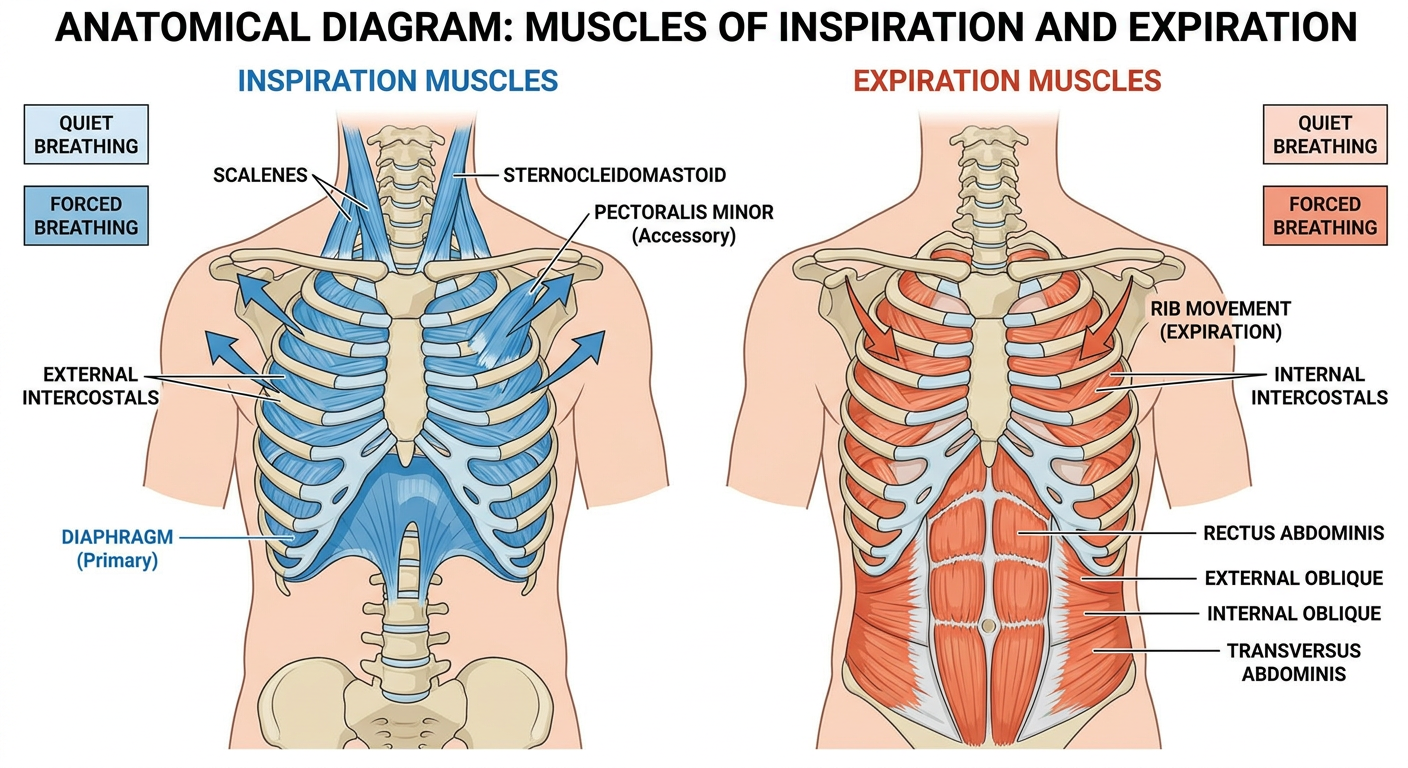
Generated Diagram
Textbook Diagram - Mechanics of Respiration
The figure below (from the Color Atlas of Human Anatomy, Vol. 2) shows positions of the thoracic cage and diaphragm during inspiration (A) and expiration (B), with arrows indicating the three diameter changes:
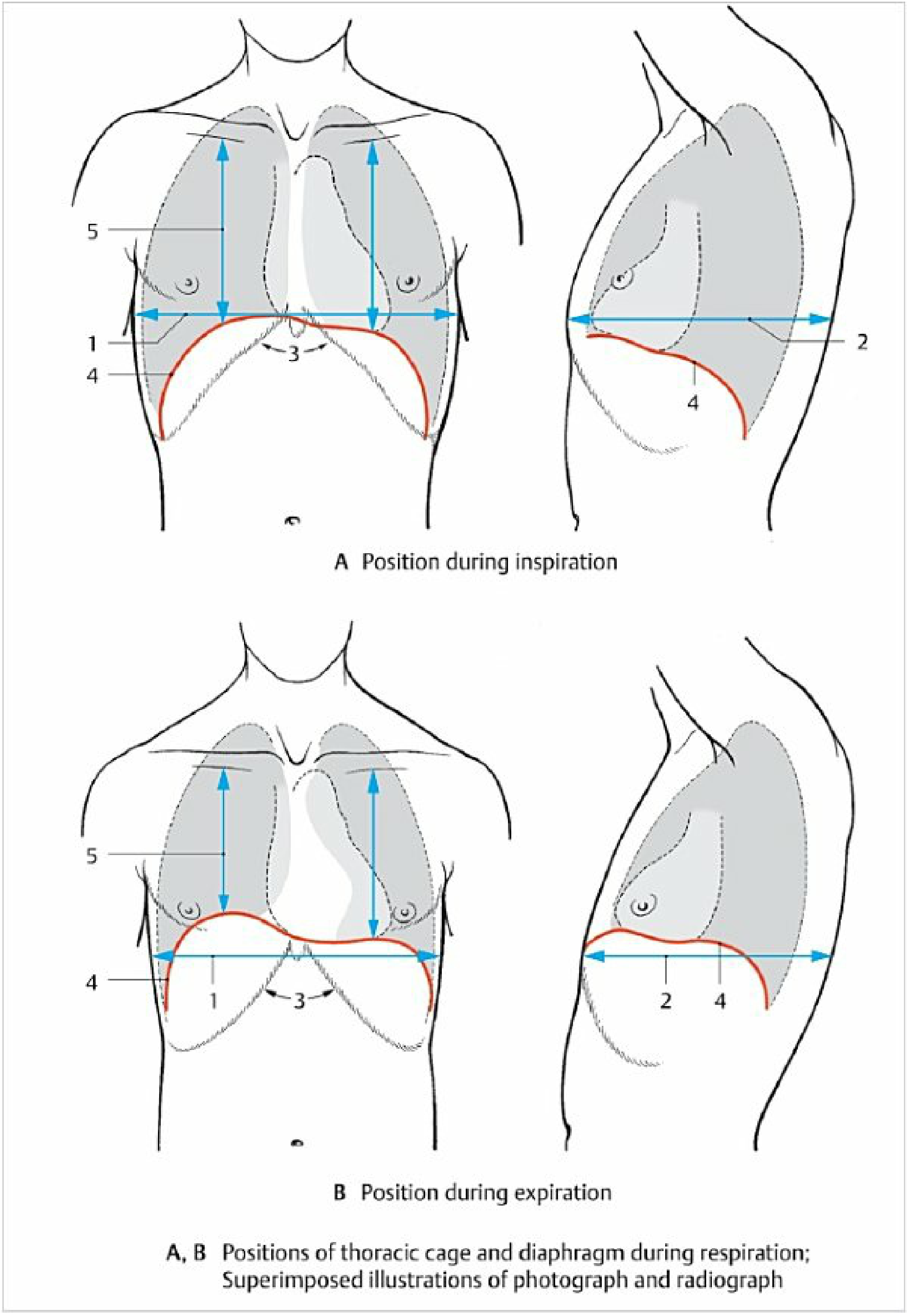
- 1 = transverse diameter
- 2 = sagittal (anteroposterior) diameter
- 3 = epigastric angle
- 4 = diaphragm position
- 5 = vertical (rostrocaudal) diameter
During inspiration (A), all diameters increase. During expiration (B), all diameters decrease back to resting position.
Complete Muscle Table
(Based on TABLE 32-1, Medical Physiology)
Muscles of Inspiration
| Category | Muscle | Nerve | Spinal Level |
|---|---|---|---|
| Primary | Diaphragm | Phrenic nerve | C3-C5 |
| Primary | External intercostal muscles | Intercostal nerves | Thoracic spinal cord |
| Secondary (accessory) | Sternocleidomastoid | Accessory nerve (CN XI) | C1-C5 |
| Secondary (accessory) | Scalenes | Cervical nerves | C3-C8 |
| Secondary (accessory) | Neck and back muscles (elevate pectoral girdle) | Various | - |
| Secondary (accessory) | Larynx and pharynx | Vagus (CN X), Glossopharyngeal (CN IX) | Nucleus ambiguus |
| Secondary (accessory) | Tongue | Hypoglossal (CN XII) | Hypoglossal nucleus |
| Secondary (accessory) | Nares | Facial nerve (CN VII) | Facial motor nucleus |
Muscles of Expiration
| Category | Muscle | Nerve | Spinal Level |
|---|---|---|---|
| Primary (forced) | Internal intercostal muscles | Intercostal nerves | Thoracic spinal cord |
| Primary (forced) | Abdominal muscles (rectus abdominis, external/internal oblique, transversus abdominis) | Spinal nerves | Lumbar spinal cord |
How They Work
Inspiration (always active)
- The diaphragm (phrenic nerve, C3-C5) is the workhorse - it contracts and descends ~1 cm during quiet breathing, increasing the rostrocaudal diameter of the thorax.
- External intercostals (most rostral and dorsal fibers) + parasternal internal intercostals rotate ribs 2-10 upward and outward ("bucket-handle" effect), increasing transverse diameter, and lift the sternum ("water pump-handle" effect), increasing the AP diameter.
- During forced/deep inspiration, accessory muscles kick in: scalenes lift the first two ribs; sternocleidomastoids lift the sternum; neck and back muscles elevate the pectoral girdle and extend the back.
Expiration (quiet = passive)
- Quiet expiration requires no muscular effort - the elastic recoil of the chest wall and lungs passively returns the thorax to FRC. - Costanzo Physiology, p. 204
- Forced expiration (exercise, coughing, asthma) recruits active muscles:
- Abdominal muscles compress the abdominal cavity, pushing the diaphragm upward.
- Internal intercostals pull ribs downward and inward.
Key rule to remember
Inspiration is always active. Quiet expiration is always passive. Forced expiration becomes active.
Sources: Medical Physiology (Boron & Boulpaep), Table 32-1 | Costanzo Physiology 7th Ed., p. 204 | Color Atlas of Human Anatomy Vol. 2, Fig. 3.21 (Mechanics of Respiration)
This is a shared conversation. Sign in to Orris to start your own chat.