
Fibroid and polyp
Reading File
The query is broad — "fibroid and polyp" could mean many things. Let me clarify before diving into research.
Asking for Preferences
What aspect of fibroids and polyps are you interested in? · Who is this for?
Finding Sources
Finding Sources
Finding Sources
Finding Sources
Finding Sources
Finding Sources
Good results found. Now let me read the detailed sections from the key textbooks:
Reading File
Reading File
Reading File
Reading File
Finding Sources
I now have excellent textbook content. Let me also search for an image:
Searching Images
uterine fibroid leiomyoma vs endometrial polyp comparison diagram
I have comprehensive information. Here is a detailed comparison for exam preparation:
Uterine Fibroids vs. Endometrial Polyps — Exam Comparison
1. Definition & Origin
| Feature | Uterine Fibroid (Leiomyoma) | Endometrial Polyp |
|---|---|---|
| Definition | Benign monoclonal tumor of smooth muscle (myometrium) | Focal overgrowth of endometrial glands and stroma |
| Origin layer | Myometrium | Endometrium |
| Nature | Solid smooth muscle tumor | Glandular/stromal overgrowth |
"A uterine myoma (fibroid, leiomyoma) is a benign tumor that originates from the myometrial layer of the uterus." — Creasy & Resnik's Maternal-Fetal Medicine
"Uterine polyps are an overgrowth of endometrial glands and stroma that either lie flat (sessile) or project into the cavity (pedunculated)." — Sabiston Textbook of Surgery
2. Epidemiology & Risk Factors
| Feature | Fibroid | Polyp |
|---|---|---|
| Prevalence | Up to 70% of women by age 50 | Common; especially peri/postmenopausal |
| Racial disparity | Black women disproportionately affected (earlier onset, larger, more severe) | No strong racial predisposition |
| Hormone dependence | ↑ Estrogen + progesterone (grow in reproductive years, regress after menopause) | ↑ Estrogen (unopposed estrogen exposure) |
| Risk factors | Familial predisposition, obesity, dietary factors | Age ↑, menopause, tamoxifen use, obesity, HTN, PCOS, hereditary cancer syndromes (Lynch) |
3. Types / Classification
Fibroid — FIGO Classification:
| Type | Location | Approach |
|---|---|---|
| 0 | Intracavitary/pedunculated | Hysteroscopic |
| 1–2 | Submucosal | Hysteroscopic |
| 3–5 | Intramural | Open/laparoscopic |
| 6–7 | Subserosal (7 = pedunculated) | Open/laparoscopic |
| 8 | Cervical/parasitic | Open/laparoscopic |
Polyp: Sessile (flat base) or pedunculated (on a stalk with a "feeder vessel" detectable on Doppler).
4. Clinical Presentation
| Symptom | Fibroid | Polyp |
|---|---|---|
| Abnormal uterine bleeding | Menorrhagia (heavy menstrual) | Intermenstrual spotting / postmenopausal bleeding |
| Pelvic pain / pressure | Yes — from bulk/size | Uncommon |
| Infertility / pregnancy loss | Submucosal fibroids → infertility, preterm delivery | Associated with early pregnancy loss |
| Bladder/bowel symptoms | Yes (large fibroids compress adjacent organs) | No |
| Asymptomatic | Common | Often asymptomatic |
5. Malignant Potential
| Fibroid | Polyp | |
|---|---|---|
| Malignant transformation | Extremely rare (leiomyosarcoma <0.5%) | Up to 5% undergo malignant transformation |
| Main concern | Benign; sarcoma is a separate entity | Rule out endometrial carcinoma, especially postmenopausal |
6. Diagnosis & Imaging
| Fibroid | Polyp | |
|---|---|---|
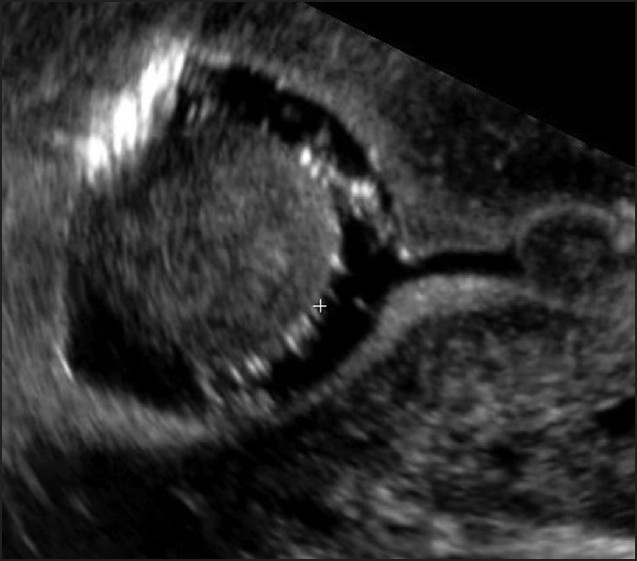
| Ultrasound (TVUS) | Hypoechoic, well-defined, spherical mass arising from myometrium; may shadow | Echogenic/isoechoic mass within endometrial cavity |
| Saline infusion sonohysterography (SIS) | Clearly outlines submucosal component | Best test to visualize polyps; feeder vessel on Doppler |
| MRI | Gold standard for mapping location/number | Useful for large/complex polyps |
| Hysteroscopy | Useful for submucosal fibroids | Gold standard for diagnosis AND treatment |
| Endometrial biopsy | Not diagnostic for fibroids | Required in postmenopausal women; age ≥45 with AUB |
7. Treatment
| Fibroid | Polyp | |
|---|---|---|
| Medical | GnRH agonists, progestins, tranexamic acid, ulipristal acetate | Progestins (limited); observation for small asymptomatic polyps |
| Hysteroscopic resection | Submucosal (FIGO 0–1) | Treatment of choice for all polyps |
| Myomectomy | Intramural/subserosal; fertility-sparing | Not applicable |
| Uterine artery embolization | Yes (non-surgical option) | Not used |
| Hysterectomy | Definitive treatment | Only if malignant transformation |
| Observation | Asymptomatic, small | Small polyps in premenopausal women (often resolve) |
8. Key Exam Mnemonics
PALM-COEIN classification (AUB causes — FIGO):
- Polyp, Adenomyosis, Leiomyoma, Malignancy → structural
- Coagulopathy, Ovulatory, Endometrial, Iatrogenic, Not classified → non-structural
Fibroid buzzwords: Smooth muscle · Myometrium · Whorled pattern on histology · Responds to hormones · Regresses at menopause
Polyp buzzwords: Endometrial glands + stroma · Feeder vessel (Doppler) · Tamoxifen · Hysteroscopy = gold standard · 5% malignant potential
9. Quick High-Yield Comparison Table
| Parameter | Fibroid | Polyp |
|---|---|---|
| Tissue origin | Myometrium (smooth muscle) | Endometrium (glands + stroma) |
| Common symptom | Menorrhagia + bulk symptoms | Intermenstrual/postmenopausal bleeding |
| Malignant potential | Very low (<0.5%) | Up to 5% |
| Hormone driver | Estrogen + progesterone | Estrogen (unopposed) |
| Best imaging | MRI | Saline sonohysterography + Doppler |
| Gold standard Tx | Myomectomy / UAE | Hysteroscopic polypectomy |
| Tamoxifen link | No | Yes |
| Regresses at menopause | Yes | No (may persist/grow) |
Sources: Sabiston Textbook of Surgery 21e; Creasy & Resnik's Maternal-Fetal Medicine; Robbins & Kumar Basic Pathology; Schwartz's Principles of Surgery 11e
This is a shared conversation. Sign in to Orris to start your own chat.