
Drug dependence
Reading File
Searching sources...
Finding Sources
Finding Sources
Searching PubMed
"drug dependence" OR "substance use disorder"
Reading File
Finding Sources
Reading File
Reading File
Reading File
Reading File
Reading File
Reading File
Finding Sources
Loading Image
Finding Sources
Now I have comprehensive material from multiple authoritative textbooks. Let me compile a thorough answer.
Drug Dependence
Definition
Drug dependence is defined by the WHO as: "a state, psychic and sometimes also physical, resulting from the interaction between a living organism and a drug, characterized by behavioural and other responses that always include a compulsion to take the drug on a continuous or periodic basis in order to experience its psychic effects, and sometimes to avoid the discomfort of its absence."
A drug (WHO) is any substance that, when taken into a living organism, may modify one or more of its functions. Drug abuse refers to self-administration for non-medical reasons, in quantities and frequencies that impair functioning and cause social, physical, or emotional harm.
- Park's Textbook of Preventive and Social Medicine, p. 936
Dependence vs. Addiction - A Critical Distinction
These two terms are often confused but represent distinct phenomena:
| Feature | Physical Dependence | Addiction |
|---|---|---|
| Definition | Biological adaptation after chronic drug use | Compulsive, relapsing drug use despite negative consequences |
| Key features | Tolerance + Withdrawal | Loss of control, craving, drug-seeking behavior |
| Synonymous with addiction? | No | No |
| Can occur without the other? | Yes (e.g., patients on long-term opioids for pain) | Yes (relapse after successful withdrawal) |
- Tolerance: The need to use increasingly higher doses to achieve the same effect.
- Withdrawal: Physical and/or psychological symptoms on abrupt drug cessation; may be life-threatening (e.g., convulsions with alcohol/benzodiazepines).
- Addiction (psychological dependence): Compulsive use driven by cravings, often triggered by contextual cues, continuing despite negative consequences.
Notably, only a small fraction of users develop compulsive addiction - only 1 in 6 people who first use cocaine become addicted within 10 years, and very few patients receiving opioids for analgesia develop addiction. Conversely, relapse is common after withdrawal.
- Katzung's Basic and Clinical Pharmacology (16th ed.), p. 906
- Lippincott Illustrated Reviews: Pharmacology, p. 1542
- Maudsley Deprescribing Guidelines
ICD-10 Classification of Dependence-Producing Drugs
ICD-10 recognizes the following psychoactive substances that may produce dependence:
- Alcohol
- Opioids
- Cannabinoids
- Sedatives or hypnotics
- Cocaine
- Other stimulants (including caffeine)
- Hallucinogens
- Tobacco
- Volatile solvents
- Other psychoactive substances and combinations
- Park's Textbook of Preventive and Social Medicine, p. 937
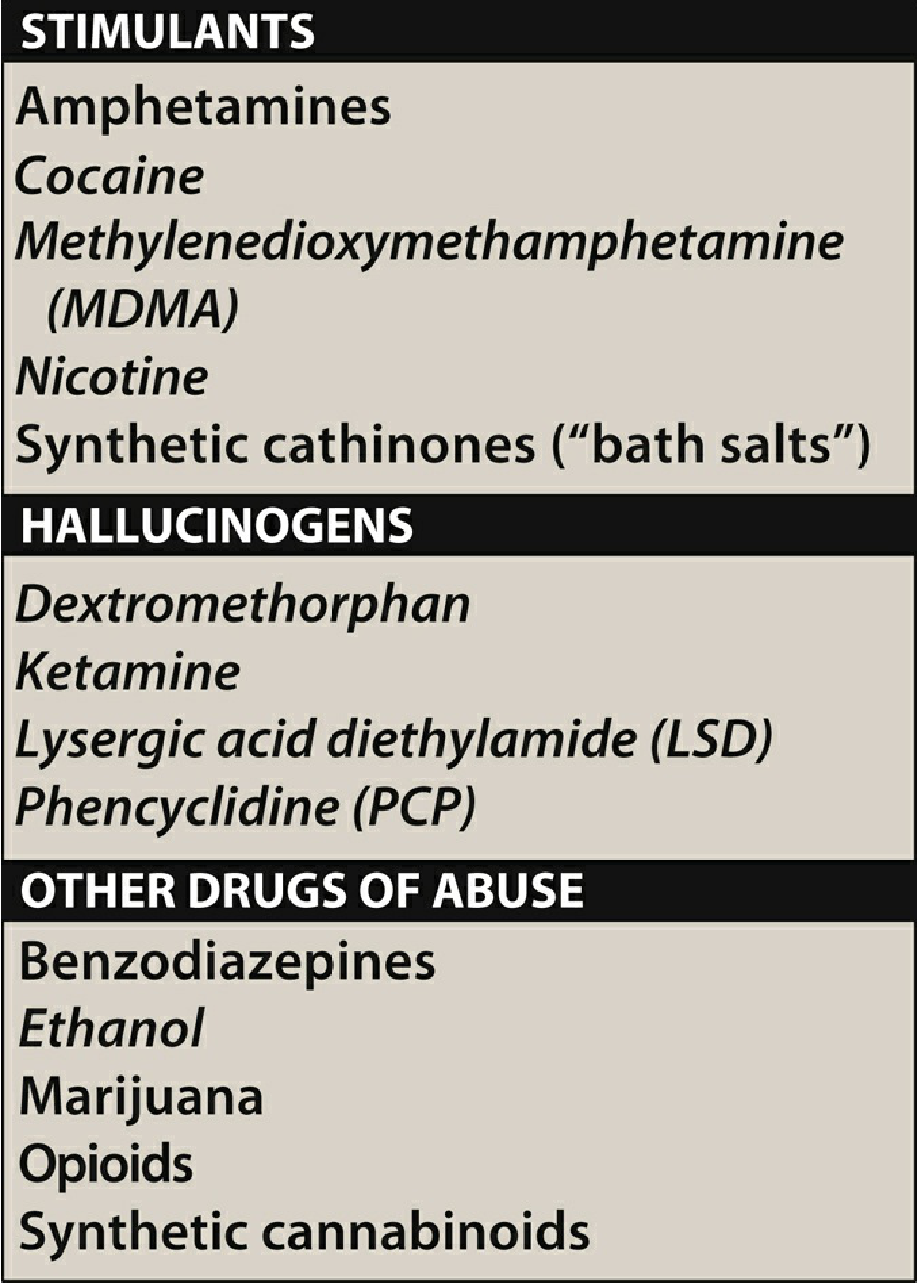
Profiles of Major Dependence-Producing Drugs
1. Amphetamines & Cocaine
- Amphetamines: Synthetic, CNS stimulants structurally similar to adrenaline. Produce mood elevation, elation, increased alertness, and heightened energy ("superman drugs"). Cause psychic dependence, rapid and strong with large doses.
- Cocaine: Derived from coca plant leaves. Potent CNS stimulant; produces no tolerance and no physical dependence or withdrawal symptoms per se. Cocaine produces intense but short-lived euphoria, leading to strong psychic/psychological dependence.
2. Opioids (Heroin, Morphine, Codeine, Methadone, Pethidine)
- Heroin addiction is considered among the worst types: produces intense craving.
- Strong psychic dependence develops early; tolerance develops rapidly, requiring escalating doses.
- Produces both physical and psychological dependence with a defined withdrawal syndrome.
3. Barbiturates & Sedatives
- Produce both physical and psychic dependence (craving, severe withdrawal). Addiction is among the most severe forms.
4. Cannabis (Marijuana, Hashish, Bhang, Ganja)
- Most widely used drug globally.
- Produces psychic dependence (not significant physical dependence in most users).
- Effects: euphoria, altered perception of time/space, relaxation, paranoia; lasts 1-4 hours when smoked.
5. Alcohol
- Pharmacologically a CNS depressant. Produces psychic dependence of varying degrees; physical dependence develops slowly.
- Considered a disease agent causing cirrhosis, toxic psychosis, gastritis, pancreatitis, cardiomyopathy, and peripheral neuropathy. Associated with cancer (mouth, pharynx, larynx, oesophagus) and suicide/accidents.
6. Tobacco/Nicotine
- Causes more deaths than all other psychoactive substances combined (~7 million premature deaths/year worldwide).
- Strong psychic and physical dependence; nicotine withdrawal is well-characterized.
7. LSD (Lysergic Acid Diethylamide)
-
Potent psychotogenic agent; active at 100-250 µg orally.
-
No physical dependence; no withdrawal syndrome. No addiction liability in the traditional sense.
-
Effects: intense perceptual distortions, depersonalization, synesthesia.
-
Park's Textbook of Preventive and Social Medicine, pp. 937-940
Neurobiology: The Mesolimbic Dopamine System
The central mechanism of addiction involves the mesolimbic dopamine (reward) pathway:
- Ventral Tegmental Area (VTA) dopamine neurons project to the nucleus accumbens, amygdala, hippocampus, and prefrontal cortex.
- All addictive drugs increase dopamine release in the nucleus accumbens, either directly (cocaine, amphetamines) or indirectly (opioids, alcohol, nicotine, THC).
- This dopamine surge encodes reward prediction error - the basis of reinforcement learning.
- With chronic exposure, synaptic plasticity (LTP/LTD at glutamatergic synapses) in this circuit underlies tolerance, craving, and relapse.
Key processes:
-
Tolerance: Homeostatic downregulation of reward mechanisms - the brain suppresses its own endogenous reward in response to repeated drug stimulation.
-
Sensitization: Increased behavioral response (locomotor activity) to intermittent drug exposure - may reflect enhanced incentive salience.
-
Conditioned cues: Environmental cues associated with past drug use become powerful triggers for craving and relapse, even after withdrawal - mediated by synaptic plasticity in the VTA, nucleus accumbens, and prefrontal cortex.
-
Katzung's Basic and Clinical Pharmacology (16th ed.), pp. 906-910
-
Goodman & Gilman's Pharmacological Basis of Therapeutics
Host (Individual) Factors
Vulnerability to drug dependence is influenced by:
- Age: Adolescents are particularly susceptible (developing brain, peer influence)
- Mental health: Psychiatric comorbidities (depression, anxiety, PTSD) increase risk
- Genetics: Heritable predisposition
- Social environment: Peer pressure, family drug use, stress, poverty
Environmental / Agent Factors
- Availability and accessibility of drugs
- Price and legal status
- Cultural and social norms
- Marketing of alcohol and tobacco
- Route of administration (intravenous > inhaled > oral in terms of addictive potential)
Complications of Drug Dependence
| System | Effects |
|---|---|
| Medical | HIV/AIDS (IV drug use), hepatitis B/C, endocarditis, overdose, organ damage |
| Neurological | Toxic psychosis, neuropathy, seizures (withdrawal) |
| Psychiatric | Depression, anxiety, paranoia, psychosis |
| Social | Family breakdown, crime, loss of employment, homelessness |
| Economic | Loss of productivity, healthcare costs |
Management / Treatment Principles
Treatment of drug dependence requires a multi-modal approach:
- Detoxification - supervised withdrawal; medically managed for alcohol/benzodiazepines (risk of seizures, delirium tremens) and opioids
- Pharmacotherapy:
- Opioid use disorder: methadone, buprenorphine (opioid substitution therapy), extended-release naltrexone
- Alcohol use disorder: disulfiram, naltrexone, acamprosate
- Nicotine: nicotine replacement therapy, varenicline, bupropion
- Psychosocial interventions: Cognitive behavioral therapy (CBT), motivational interviewing, 12-step programs
- Harm reduction: Needle exchange programs, naloxone distribution
- Rehabilitation and relapse prevention
Approximately 80% of active drug users in the United States are not in treatment. Access to opioid substitution therapy remains a key public health gap.
- Goldman-Cecil Medicine
- Lippincott Illustrated Reviews: Pharmacology, p. 1542
Public Health & Prevention Strategies
Per WHO recommendations:
-
Regulate marketing of addictive substances (especially toward youth)
-
Restrict availability and raise prices through taxation
-
Implement drink-driving policies
-
Expand accessible treatment services
-
Screening and brief interventions in primary care
-
The SDG target 3.5.1 tracks treatment coverage for alcohol and drug dependence
-
Park's Textbook of Preventive and Social Medicine
Summary of Dependence Type by Drug
| Drug | Psychic Dependence | Physical Dependence | Tolerance | Withdrawal |
|---|---|---|---|---|
| Opioids | Strong | Strong | Yes (rapid) | Yes (severe) |
| Alcohol | Moderate-strong | Yes (develops slowly) | Yes | Yes (severe; seizures) |
| Cocaine | Strong | Minimal | No | Mild |
| Amphetamines | Strong | Moderate | Yes | Yes |
| Barbiturates | Strong | Strong | Yes | Yes (severe) |
| Cannabis | Moderate | Mild | Mild | Mild |
| Benzodiazepines | Moderate | Yes | Yes | Yes (severe) |
| LSD | Minimal | None | None | None |
| Tobacco | Strong | Yes | Yes | Yes |
This is a shared conversation. Sign in to Orris to start your own chat.