
1st pass metabolism
Reading File
First-pass metabolism (presystemic metabolism) is the biotransformation of a drug in the gut wall and/or liver before it reaches systemic circulation. After oral ingestion, a drug is absorbed from the GI tract, enters the portal vein, and passes through the liver - where metabolic enzymes (mainly CYP450) can substantially reduce the amount of active drug that actually reaches the bloodstream.
Searching sources...
Finding Sources
Finding Sources
Reading File
Reading File
Finding Sources
Loading Image
Finding Sources
Reading File
Reading File
Loading Image
Finding Sources
I now have comprehensive information from multiple authoritative sources. Here is the complete answer:
First-Pass Metabolism (Presystemic Elimination)
Definition
First-pass metabolism (also called presystemic elimination or presystemic extraction) is the biotransformation of an orally administered drug in the intestinal wall and/or liver before it reaches the systemic circulation, thereby reducing the amount of active drug available to the body.
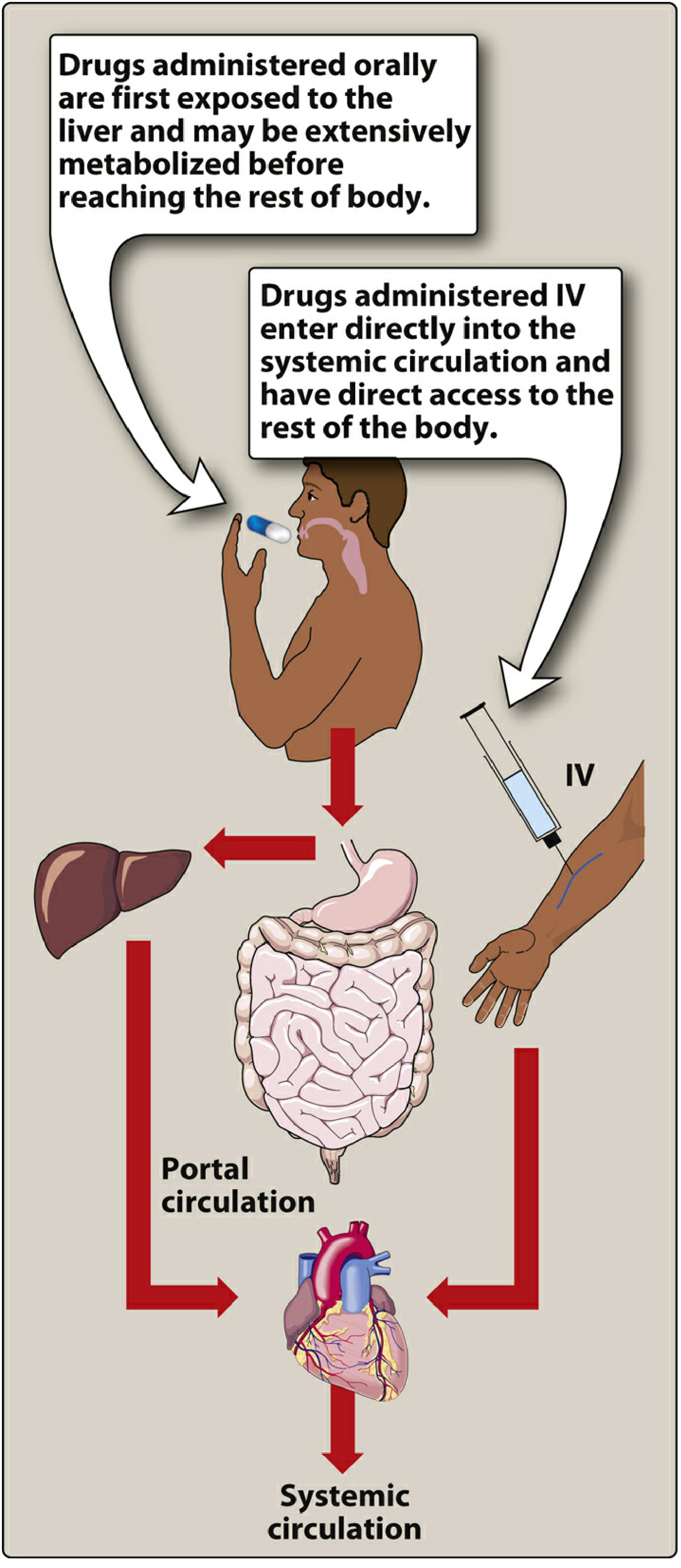
Figure: Oral drugs are exposed to the liver via portal circulation and may be extensively metabolized before reaching systemic circulation. IV drugs bypass this entirely. - Lippincott Illustrated Reviews: Pharmacology
Pathway of First-Pass Metabolism
After oral ingestion, the drug follows this sequence:
- GI lumen - drug is absorbed across the intestinal epithelium (enterocyte)
- Enterocyte - may undergo metabolism by CYP3A4 in the gut wall, or be pumped back into the lumen by P-glycoprotein (efflux transporter)
- Portal vein - absorbed drug enters the portal venous system
- Liver (hepatocyte) - drug may be metabolized by CYP450 enzymes (especially CYP3A4, CYP2D6) or excreted into bile via biliary canaliculi
- Systemic circulation - only the fraction that survives all these steps reaches the bloodstream
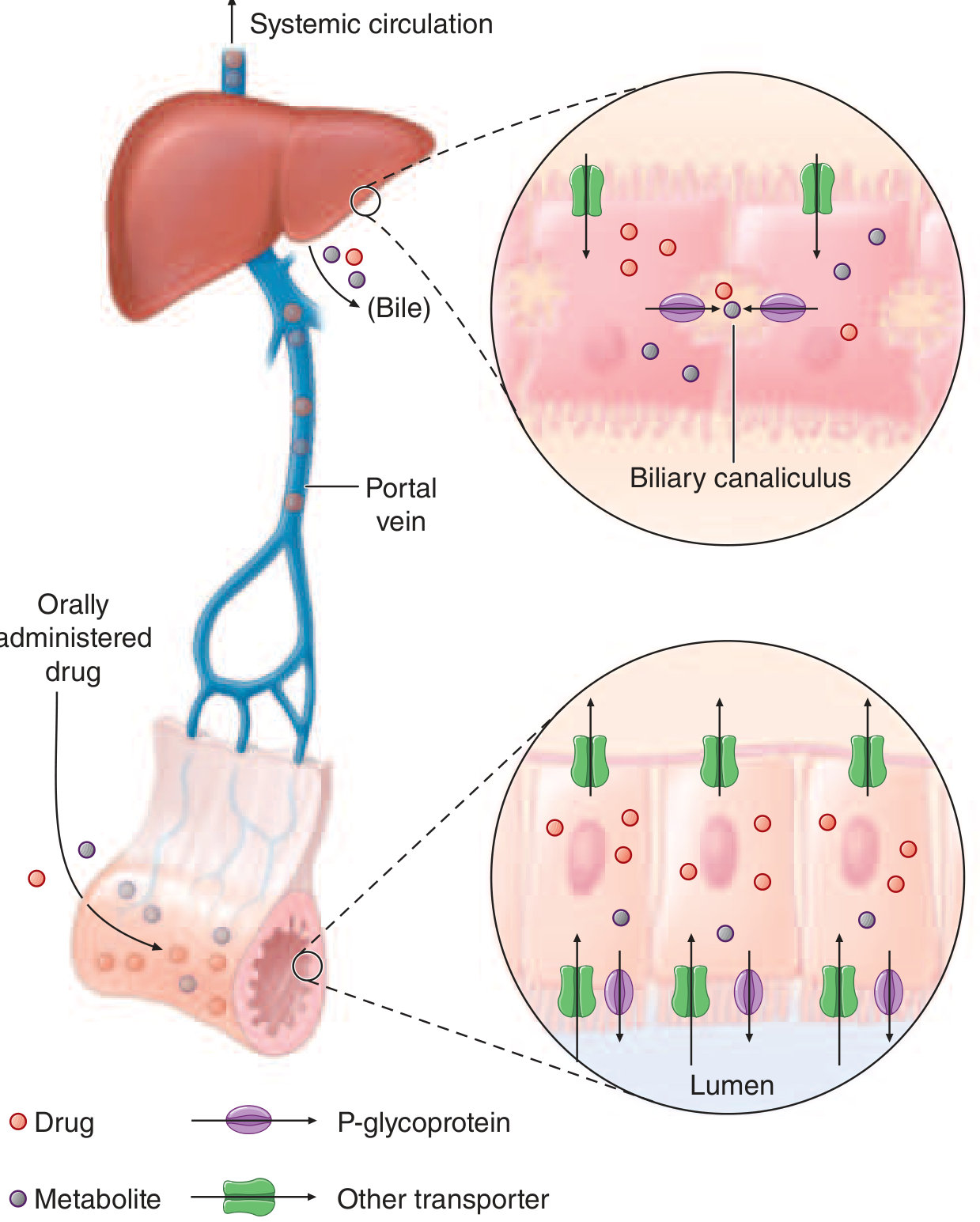
Figure: Presystemic elimination mechanisms - Harrison's Principles of Internal Medicine 22E
Effect on Bioavailability
Bioavailability (F) is the fraction of an administered dose that reaches systemic circulation unchanged. First-pass metabolism is a major reason why oral bioavailability is less than 100%.
Bioavailability (F) = AUC(oral) / AUC(IV) × 100%
The higher the hepatic extraction ratio, the greater the first-pass effect, and the lower the oral bioavailability. For high-extraction drugs, hepatic clearance approaches hepatic blood flow - these drugs have very low oral bioavailability. - Tietz Textbook of Laboratory Medicine
Classic Examples of High First-Pass Drugs
| Drug | First-Pass Effect | Clinical Implication |
|---|---|---|
| Nitroglycerin | >90% cleared | Cannot be given orally; use sublingual/transdermal/IV |
| Lidocaine | Extensive | Not used as oral agent |
| Naloxone | Extensive | IV/intranasal route required |
| Morphine | Significant | Oral dose much higher than IV dose |
| Propranolol | Large | High oral dose given to account for first-pass loss |
| Midazolam | >50% | Bioavailability <50% orally |
| Asenapine | Extensive if swallowed | Formulated as sublingual tablet |
Routes That Bypass First-Pass Metabolism
| Route | Mechanism of Bypass |
|---|---|
| Sublingual | Absorbed directly into systemic (not portal) veins |
| Transdermal | Absorbed into systemic veins, bypasses portal circulation |
| IV/IM/Subcutaneous | Directly enters systemic circulation |
| Inhalation | Bypasses hepatic first pass (but lungs may contribute minor metabolism) |
| Rectal (lower rectum) | Inferior vena cava drainage; ~50% bypass (upper rectal veins drain to portal system) |
- Katzung's Basic and Clinical Pharmacology, 16th Edition
Factors Affecting Extent of First-Pass Metabolism
- Hepatic blood flow - reduced flow (e.g., in cirrhosis, congestive heart failure, portal hypertension) decreases first-pass extraction, raising systemic drug levels and increasing toxicity risk for high-extraction drugs
- Enzyme induction/inhibition - CYP450 inducers (rifampin, phenytoin) increase first-pass and reduce bioavailability; inhibitors (ketoconazole, grapefruit) reduce first-pass and raise bioavailability
- Genetic polymorphisms - CYP2D6 poor metabolizers vs. ultra-rapid metabolizers show dramatically different first-pass effects (e.g., codeine toxicity in ultra-rapid metabolizers)
- Gut wall transporters - P-glycoprotein efflux in enterocytes reduces absorption before the drug even reaches the liver
- Age and disease - liver disease reduces first-pass effect; elderly may have reduced hepatic mass and blood flow
Clinical Significance
- Drugs with high first-pass metabolism have high oral-to-parenteral dose ratios (e.g., morphine oral dose ~3x the IV dose)
- Liver disease can dramatically increase systemic exposure to high-extraction drugs - dose reduction is required
- Drug interactions at CYP3A4 or P-glycoprotein level can unpredictably alter bioavailability of high-first-pass drugs
- Pro-drugs can exploit first-pass metabolism: codeine is converted to morphine in the liver by CYP2D6, making it an active analgesic only after first-pass conversion
Sources: Lippincott Illustrated Reviews: Pharmacology | Goodman & Gilman's Pharmacological Basis of Therapeutics | Harrison's Principles of Internal Medicine 22E | Katzung's Basic and Clinical Pharmacology 16E | Tietz Textbook of Laboratory Medicine 7E
This is a shared conversation. Sign in to Orris to start your own chat.