
Arteries and it's branches of VISCERAL BRANCHES OF ABDOMINAL AORTA for medical student in detailed notes
Arteries and it's branches of VISCERAL BRANCHES OF ABDOMINAL AORTA for medical student in detailed notes
visceral branches abdominal aorta anatomy detailed celiac trunk SMA IMA
visceral branches abdominal aorta celiac trunk superior mesenteric inferior mesenteric arteries diagram
VISCERAL BRANCHES OF THE ABDOMINAL AORTA
Detailed Anatomy Notes for Medical Students
OVERVIEW OF THE ABDOMINAL AORTA
Classification of Branches
| Category | Branches |
|---|---|
| Unpaired visceral (anterior) | Celiac trunk, Superior mesenteric artery (SMA), Inferior mesenteric artery (IMA) |
| Paired visceral (lateral/anterior) | Middle suprarenal arteries, Renal arteries, Testicular/Ovarian arteries |
| Posterior | Inferior phrenic arteries, Lumbar arteries, Median sacral artery |
PART I — UNPAIRED VISCERAL BRANCHES
1. CELIAC TRUNK (Celiac Axis / Truncus Coeliacus)
Origin & Level
- Arises from the anterior surface of the abdominal aorta immediately below the aortic hiatus
- Level: T12–L1 (anterior to upper part of vertebra LI)
- Supplies the foregut (abdominal esophagus → superior duodenum/proximal descending duodenum)
Primary Branches — "The Tripod of Haller"
CELIAC TRUNK (T12-L1)
|
__________|__________
| | |
Left Splenic Common
Gastric Artery Hepatic
Artery Artery
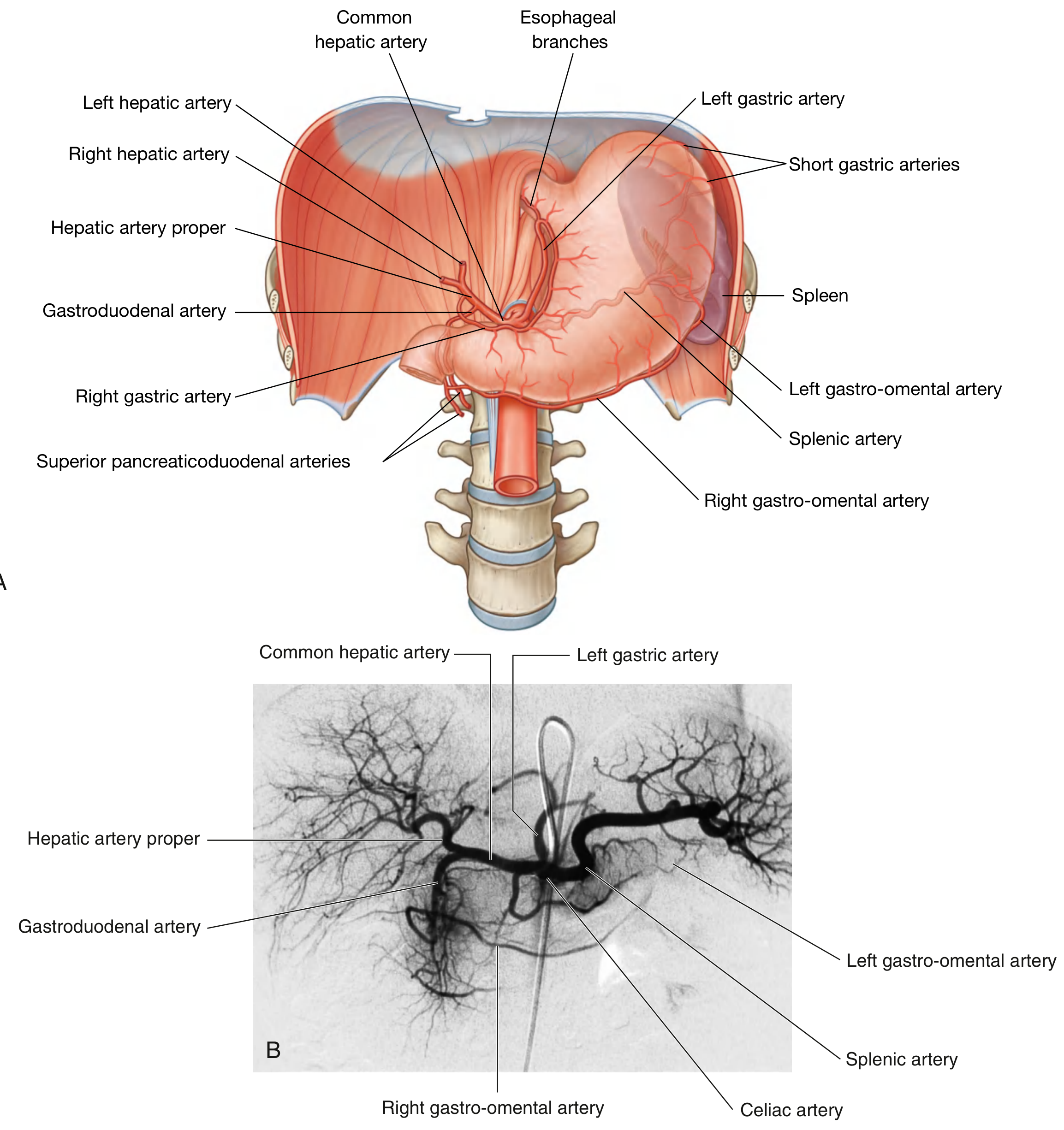
A. Left Gastric Artery
- Smallest branch of the celiac trunk
- Course:
- Ascends to the cardioesophageal junction
- Gives esophageal branches upward (some pass through the esophageal hiatus to anastomose with thoracic aortic esophageal branches)
- Turns right and descends along the lesser curvature of the stomach in the lesser omentum
- Supplies: Both surfaces of the stomach along the lesser curvature
- Anastomoses with the right gastric artery (from hepatic artery proper)
B. Splenic Artery
- Largest branch of the celiac trunk
- Course: Takes a tortuous course to the left along the superior border of the pancreas → travels in the splenorenal ligament → divides into multiple branches entering the hilum of the spleen
- Branches given off along its course:
- Pancreatic branches — numerous small branches to neck, body, and tail of pancreas
- Short gastric arteries — pass through the gastrosplenic ligament to supply the fundus of the stomach
- Left gastro-omental artery — runs rightward along the greater curvature of the stomach, anastomosing with the right gastro-omental artery
C. Common Hepatic Artery
- Medium-sized branch; the only celiac branch that passes to the right
- Divides into two terminal branches:
i. Hepatic Artery Proper
- Ascends to the liver in the free edge of the lesser omentum
- Runs left of the bile duct and anterior to the portal vein
- Divides near the porta hepatis into:
- Right hepatic artery — gives off the cystic artery to the gallbladder
- Left hepatic artery
- Also gives off: Right gastric artery — runs left along the lesser curvature, anastomosing with the left gastric artery
ii. Gastroduodenal Artery
- Descends posterior to the 1st part of duodenum
- Branches into:
- Right gastro-omental artery — runs leftward along the greater curvature of the stomach, anastomosing with the left gastro-omental artery
- Superior pancreaticoduodenal artery — divides into anterior and posterior branches that descend on each side of the head of the pancreas to anastomose with the inferior pancreaticoduodenal branches of the SMA
Key Point: The stomach receives supply from ALL THREE celiac trunk branches — it is the only organ with this distinction.
2. SUPERIOR MESENTERIC ARTERY (SMA)
Origin & Level
- Arises from the anterior surface of the abdominal aorta immediately below the celiac trunk
- Level: Lower part of vertebra LI (posterior to neck of pancreas)
- Supplies the midgut (distal duodenum → proximal 2/3 of transverse colon)
Relations
- Anterior: Splenic vein, neck of the pancreas
- Posterior: Left renal vein, uncinate process of pancreas, inferior part of duodenum
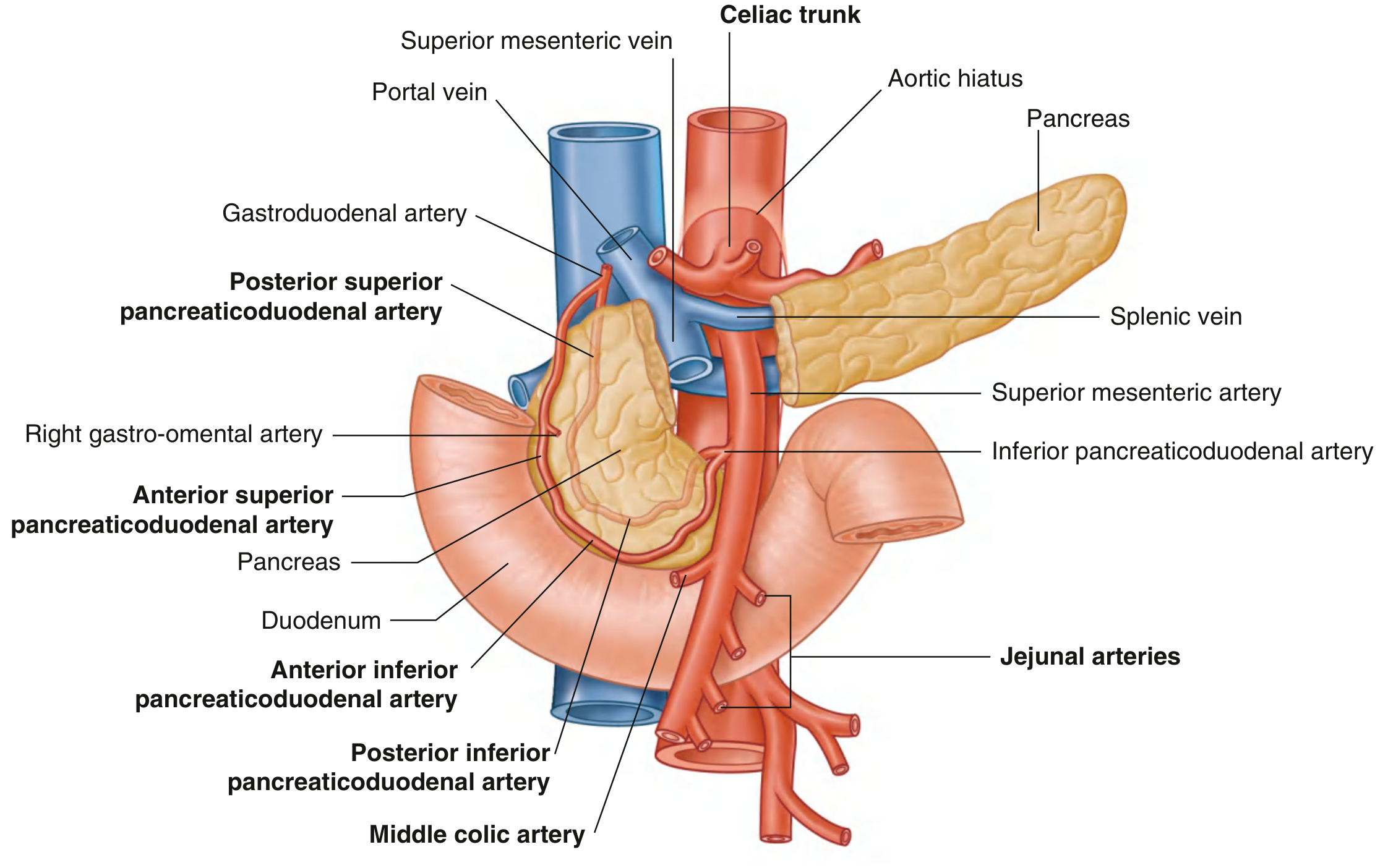
Branches
SUPERIOR MESENTERIC ARTERY (L1)
|
_________________|_________________
| | |
LEFT SIDE RIGHT SIDE (3) FIRST BRANCH
(Multiple) |
| Inferior Pancreati-
Jejunal & coduodenal Artery
Ileal arteries
| | |
Middle Right Ileocolic
Colic Colic Artery
Artery Artery
A. Inferior Pancreaticoduodenal Artery
- First branch of the SMA
- Immediately divides into anterior and posterior branches
- These ascend on either side of the head of the pancreas
- Anastomose superiorly with the anterior and posterior superior pancreaticoduodenal arteries (from gastroduodenal)
- Supplies: Head and uncinate process of pancreas, duodenum
B. Jejunal and Ileal Arteries (Left-side branches)
- Numerous branches arising from the left side of the SMA main trunk
- Pass between two layers of the mesentery
- Form anastomosing arches (arcades) — number increases progressively from jejunum to ileum:
- Jejunum: 1–2 arcades, then long vasa recta, narrow windows in the mesentery
- Ileum: Multiple (up to 4–5) arcades, then short vasa recta, wide/broad windows in mesentery
- Vasa recta = straight end-arteries providing direct supply to gut wall
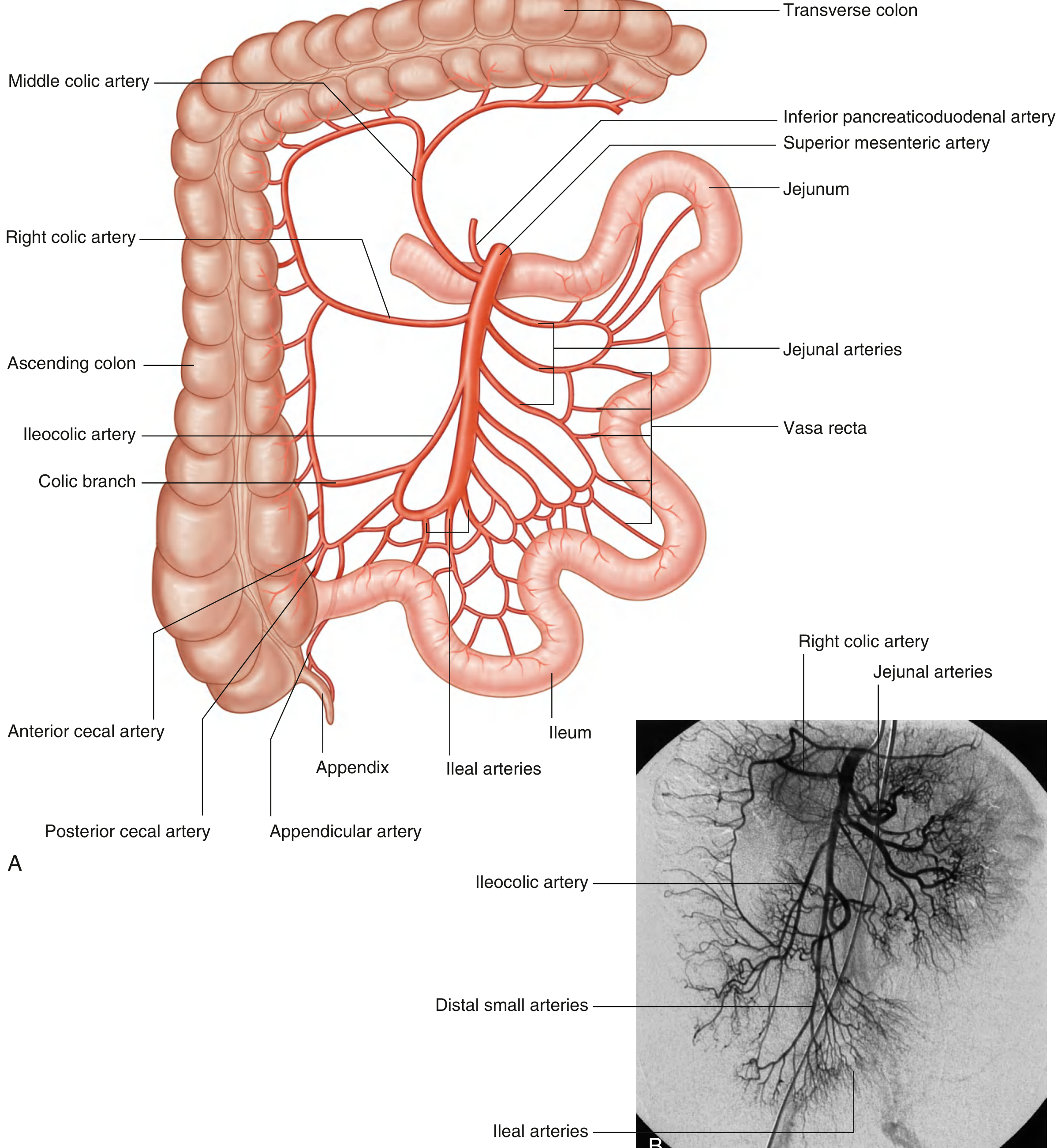
C. Middle Colic Artery (Right-side, 1st)
- Arises as SMA emerges from beneath the pancreas
- Enters the transverse mesocolon, divides into:
- Right branch → anastomoses with right colic artery
- Left branch → anastomoses with left colic artery (IMA branch)
- Supplies: Transverse colon (proximal 2/3)
D. Right Colic Artery (Right-side, 2nd)
- Inconsistent branch (may be absent or arise from ileocolic)
- Passes retroperitoneally to the right → supplies ascending colon
- Divides into:
- Descending branch → anastomoses with ileocolic artery
- Ascending branch → anastomoses with middle colic artery
E. Ileocolic Artery (Right-side, 3rd / terminal)
- Final right-side branch
- Descends toward the right iliac fossa
- Divides into superior and inferior branches:
- Superior branch → ascending colon (anastomoses with right colic artery)
- Inferior branch → divides further into:
- Colic branch — supplies first part of ascending colon
- Anterior cecal branch — anterior cecum
- Posterior cecal branch — posterior cecum
- Appendicular artery — runs in free margin of mesoappendix to supply the appendix
- Ileal branch — supplies terminal ileum; anastomoses with SMA
3. INFERIOR MESENTERIC ARTERY (IMA)
Origin & Level
- Smallest of the three anterior branches of the abdominal aorta
- Arises from the anterior surface of the abdominal aorta at vertebra LIII
- Initially descends anterior to the aorta, then passes to the left
- Supplies the hindgut (distal 1/3 transverse colon → upper rectum)
Branches
INFERIOR MESENTERIC ARTERY (L3)
|
______________|______________
| |
Left Colic Sigmoid Arteries
Artery (2-4 branches)
| |
Ascending Terminal Branch:
Branch + Superior Rectal
Descending Artery
Branch
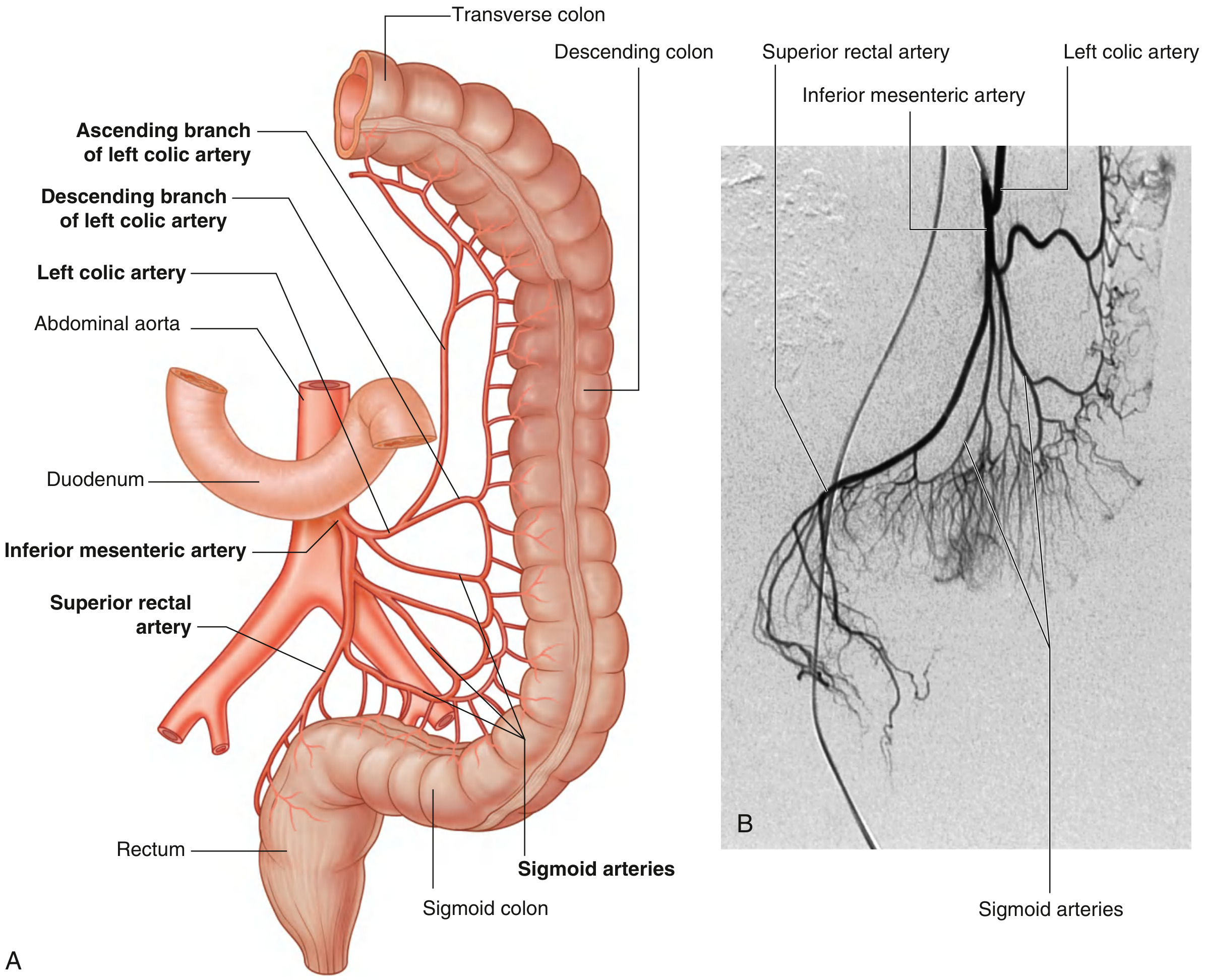
A. Left Colic Artery
- First branch of the IMA; ascends retroperitoneally
- Divides into:
- Ascending branch → passes anterior to left kidney → enters transverse mesocolon → supplies upper descending colon and distal transverse colon; anastomoses with the middle colic artery (SMA)
- Descending branch → supplies lower descending colon; anastomoses with first sigmoid artery
B. Sigmoid Arteries
- 2–4 branches descending to the left in the sigmoid mesocolon
- Supply: Lowest descending colon and sigmoid colon
- Anastomose superiorly with left colic branches, inferiorly with superior rectal artery
C. Superior Rectal Artery
- Terminal branch of the IMA
- Descends into the pelvic cavity in the sigmoid mesocolon, crossing left common iliac vessels
- At vertebra SIII it divides into two terminal branches descending on each side of the rectum
- Anastomoses with:
- Middle rectal arteries (from internal iliac artery)
- Inferior rectal arteries (from internal pudendal artery)
PART II — PAIRED VISCERAL BRANCHES
1. Middle Suprarenal Arteries
- Small, lateral branches of the abdominal aorta arising just above the renal arteries
- Part of the triple blood supply to the suprarenal gland (alongside superior suprarenal from inferior phrenic, and inferior suprarenal from renal artery)
2. Renal Arteries
- Lateral branches, largest paired visceral branches
- Arise just inferior to the SMA origin, between vertebrae LI–LII
- Right renal artery is longer (passes behind the IVC, right renal vein, head of pancreas, and descending duodenum)
- Left renal artery is shorter (passes behind the left renal vein, body of pancreas, and splenic vein)
- Each divides into segmental arteries (end-arteries) supplying kidney segments
- Also give off inferior suprarenal arteries
3. Testicular / Ovarian Arteries
- Anterior branches arising below the renal arteries
- Long, slender vessels passing downward and laterally on the anterior surface of psoas major
- Testicular arteries → pass through inguinal canal to supply testes
- Ovarian arteries → enter pelvic cavity to supply ovaries
ANASTOMOSES AND WATERSHED AREAS (Clinically Important)
Key Anastomoses
| Anastomosis | Vessels Connected | Significance |
|---|---|---|
| Gastric arcade (lesser curvature) | Left gastric ↔ Right gastric | Collateral flow; protects stomach |
| Gastro-omental arcade (greater curvature) | Left gastro-omental (splenic) ↔ Right gastro-omental (gastroduodenal) | Collateral flow |
| Pancreaticoduodenal arcade | Superior (gastroduodenal) ↔ Inferior (SMA) | Critical: connects celiac and SMA territories |
| Marginal artery of Drummond | SMA branches ↔ IMA branches along colon | Connects midgut and hindgut territories |
| Arc of Riolan | Middle colic ↔ Left colic | Central anastomosis; important in IMA occlusion |
| Rectal arcade | Superior rectal ↔ Middle rectal ↔ Inferior rectal | Connects IMA to internal iliac territory |
Watershed Zones (Vulnerable to Ischemia)
| Zone | Location | Why Vulnerable |
|---|---|---|
| Celiac–SMA watershed | Along descending duodenum | Rare ischemia |
| SMA–IMA watershed (Griffiths' point) | Splenic flexure of colon | Most vulnerable; poor collaterals; susceptible in hypotension/surgery |
| IMA–Internal Iliac watershed (Sudeck's point) | Rectosigmoid junction | Vulnerable in sigmoid resection |
Clinical Pearl: The splenic flexure watershed is clinically the most critical — it is the most common site of ischemic colitis following aortic surgery, low-flow states, or IMA ligation.
SUMMARY TABLE
| Artery | Vertebral Level | Gut Territory | Key Branches |
|---|---|---|---|
| Celiac Trunk | T12–L1 | Foregut (esophagus → proximal duodenum) | Left gastric, Splenic, Common hepatic |
| Superior Mesenteric A. | L1 | Midgut (distal duodenum → proximal 2/3 transverse colon) | Inferior pancreaticoduodenal, Jejunal/Ileal, Middle colic, Right colic, Ileocolic |
| Inferior Mesenteric A. | L3 | Hindgut (distal 1/3 transverse colon → upper rectum) | Left colic, Sigmoid arteries, Superior rectal |
| Middle Suprarenal A. | Above L1 | Suprarenal gland | — |
| Renal A. | L1–L2 | Kidney + suprarenal | Segmental, inferior suprarenal |
| Testicular/Ovarian A. | Below L2 | Gonads | — |
Make an anatomical poster showing visceral arterial distribution and collaterals
Detailed anatomical medical education poster titled "Visceral Arterial Distribution of the Abdominal Aorta" showing: MAIN CENTRAL STRUCTURE: The abdominal aorta as a thick vertical red vessel running down the center, labeled with vertebral levels T12, L1, L2, L3, L4. THREE UNPAIRED ANTERIOR BRANCHES shown as colored arteries branching from the aorta: 1. CELIAC TRUNK (T12-L1) - colored deep red/crimson, branching into: - Left Gastric Artery (smallest, arching up to esophagus and along lesser curvature) - Splenic Artery (tortuous course leftward along pancreas to spleen) - Common Hepatic Artery (rightward, splitting into Hepatic Artery Proper + Gastroduodenal Artery) - Hepatic Artery Proper splits into Right Hepatic + Left Hepatic arteries - Gastroduodenal gives Right Gastro-omental + Superior Pancreaticoduodenal arteries - Cystic artery shown off right hepatic - Short gastric arteries from splenic to fundus of stomach - Left gastro-omental artery from splenic along greater curvature 2. SUPERIOR MESENTERIC ARTERY (L1) - colored bright red/orange-red, branching into: - Inferior Pancreaticoduodenal artery (first branch, anterior + posterior divisions) - Multiple Jejunal arteries (left side, forming 1-2 arcade loops with long vasa recta) - Multiple Ileal arteries (left side, forming 4-5 arcade loops with short vasa recta) - Middle Colic artery (to transverse colon) - Right Colic artery (to ascending colon) - Ileocolic artery with colic, cecal (anterior + posterior), appendicular, and ileal branches 3. INFERIOR MESENTERIC ARTERY (L3) - colored orange-red, branching into: - Left Colic artery with ascending branch (to transverse colon) and descending branch (to descending colon) - 2-4 Sigmoid arteries (to sigmoid colon) - Superior Rectal artery (terminal branch, descending into pelvis) PAIRED BRANCHES shown smaller: - Middle Suprarenal arteries (small, just above renal arteries) - Renal arteries (L1-L2, bilateral, large) - Ovarian/Testicular arteries (below renal arteries) ORGANS illustrated in muted anatomical colors: - Liver (right upper), Gallbladder, Stomach (center), Spleen (left), Pancreas (horizontal behind stomach), Duodenum (C-shaped), Small intestine (jejunum + ileum with arcades visible in mesentery), Large intestine (ascending, transverse, descending, sigmoid colon, rectum), Kidneys (bilateral), Suprarenal glands COLLATERAL ANASTOMOSES shown as dashed golden/yellow highlighted vessels: - Gastric arcade: Left gastric ↔ Right gastric along lesser curvature (labeled "Lesser curvature arcade") - Gastro-omental arcade: Left gastro-omental ↔ Right gastro-omental along greater curvature (labeled "Greater curvature arcade") - Pancreaticoduodenal arcade: Superior PD ↔ Inferior PD (labeled "Celiac-SMA anastomosis") - Marginal artery of Drummond: Along the entire colon connecting SMA and IMA branches (thick dashed golden line labeled "Marginal Artery of Drummond") - Arc of Riolan: Short central anastomosis between middle colic and left colic (labeled "Arc of Riolan") - Rectal anastomosis: Superior rectal ↔ Middle rectal (labeled) WATERSHED ZONES marked with yellow warning triangles/stars: - "Splenic Flexure Watershed ⚠ Most Vulnerable" at splenic flexure - "SMA-IMA Junction" label - "Sudeck's Point" at rectosigmoid SIDE PANEL (right side): Color-coded legend box: - Red = Celiac Trunk territory (Foregut: T12-L1) - Orange = SMA territory (Midgut: L1) - Yellow-orange = IMA territory (Hindgut: L3) - Gold dashed = Anastomotic collaterals - Yellow triangle = Watershed zones BOTTOM PANEL: Small summary table listing all branches Style: Professional medical illustration, clean white/light cream background, precise anatomical labels with leader lines, bold title at top in dark blue/navy, color-coded territories, medical textbook quality, high detail, no cartoon style
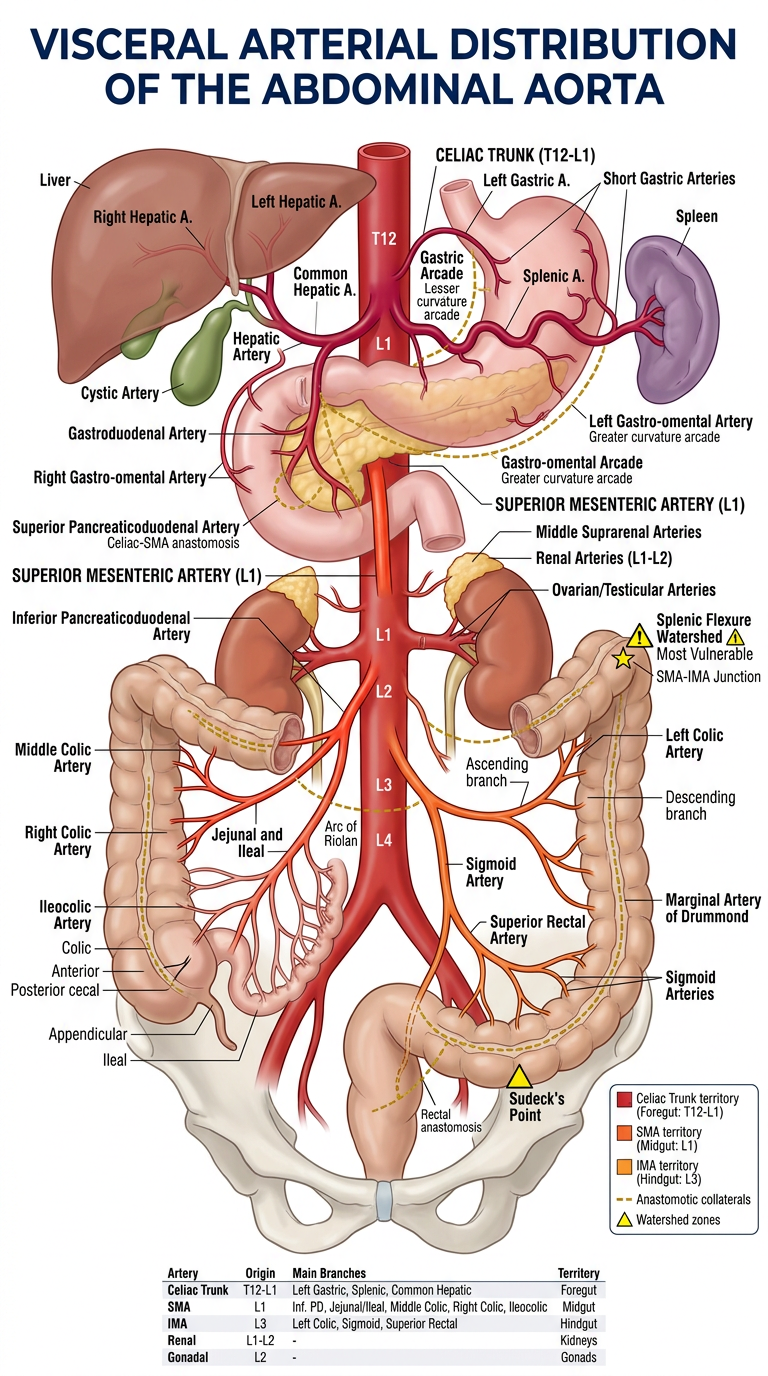
- Three unpaired anterior branches — Celiac Trunk (T12–L1), SMA (L1), and IMA (L3) — color-coded by gut territory (foregut/midgut/hindgut)
- All named branches with their organ distributions labeled
- Collateral anastomoses highlighted in gold dashed lines — gastric arcade, gastro-omental arcade, pancreaticoduodenal arcade, Marginal Artery of Drummond, and Arc of Riolan
- Watershed zones marked with warning indicators — especially the clinically critical splenic flexure (Griffiths' point) and Sudeck's point at the rectosigmoid
- Paired visceral branches — suprarenal, renal, and gonadal arteries
- A color-coded legend panel for quick reference