
Chronic heart failure. Classification. Type. C/I Durg. Treatment ( quarter therapy) .
Reading File
Now let me search the medical library for comprehensive content on chronic heart failure.
Finding Sources
Finding Sources
Finding Sources
Finding Sources
Good. Now let me read the key sections from Braunwald's Heart Disease (the gold standard cardiology reference) and Goldman-Cecil for classification, types, and treatment.
Reading File
Reading File
Excellent. Now let me get the treatment section (quadruple/quarter therapy) and contraindicated drugs.
Finding Sources
Finding Sources
The "quadruple therapy" search returned H. pylori results. The user means the "four pillars" or guideline-directed medical therapy (GDMT) for HFrEF. Let me search specifically for that and contraindicated drugs in HF.
Finding Sources
Finding Sources
Now let me read the Goldman-Cecil section on HF treatment (GDMT / four pillars) and the contraindications section:
Reading File
Reading File
Reading File
Now let me read the contraindicated drugs and SGLT2 inhibitor sections:
Reading File
Now let me get the contraindicated drugs section for HF and fetch the HF staging diagram:
Reading File
Loading Image
Now let me get the contraindicated drugs section specifically:
Finding Sources
Reading File
I now have all the content I need. Let me compile the comprehensive answer.
Chronic Heart Failure - Complete Overview
1. Definition
Chronic Heart Failure (CHF) is a clinical syndrome in which the heart is unable to pump sufficient blood to meet the body's metabolic demands, or can do so only at elevated filling pressures. It results from structural or functional cardiac abnormalities.
2. Classification
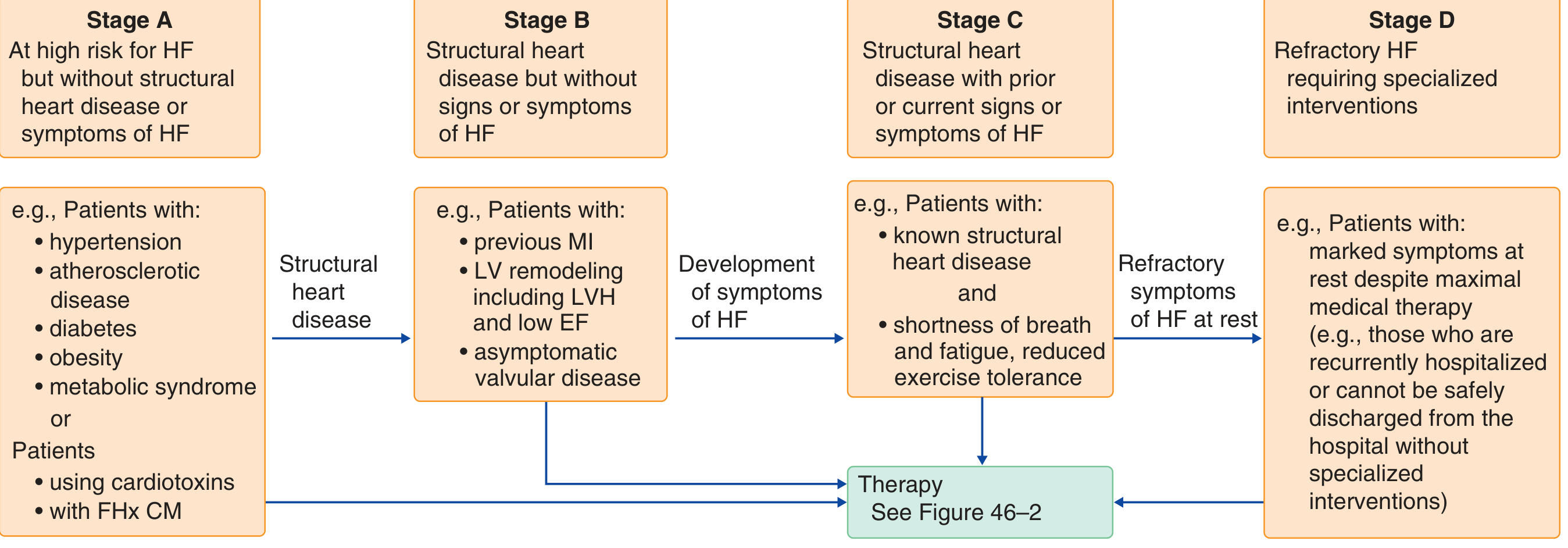
A. ACC/AHA Staging (Progression-Based)
This staging emphasizes the preventive and progressive nature of HF - stages are not reversible.
| Stage | Description | Examples |
|---|---|---|
| A | At risk for HF; NO structural disease, NO symptoms | Hypertension, DM, obesity, atherosclerosis, family Hx of cardiomyopathy |
| B | Structural heart disease; NO signs/symptoms of HF | Previous MI, LV remodeling/LVH, low EF, asymptomatic valvular disease |
| C | Structural disease + prior or current symptoms | Known structural disease + dyspnea, fatigue, reduced exercise tolerance |
| D | Refractory HF requiring specialized interventions | Marked symptoms at rest despite maximal therapy; recurrent hospitalizations |
B. NYHA Functional Classification (Symptom Severity)
| Class | Description |
|---|---|
| I | No limitation. Ordinary activity does NOT cause symptoms |
| II | Slight limitation. Comfortable at rest; ordinary activity causes symptoms |
| III | Marked limitation. Comfortable at rest; less-than-ordinary activity causes symptoms |
| IV | Unable to carry on ANY physical activity without symptoms; symptoms may be present at rest |
Note: ACC/AHA Stage B = NYHA I; Stage C = NYHA I-III; Stage D = NYHA IV
3. Types of Heart Failure (by Ejection Fraction)
| Type | EF | Features |
|---|---|---|
| HFrEF - Heart failure with Reduced EF | < 40% | Systolic dysfunction; most evidence-based therapies target this group |
| HFmrEF - Heart failure with Mildly Reduced EF | 40-49% | "Grey zone"; intermediate phenotype |
| HFpEF - Heart failure with Preserved EF | ≥ 50% | Diastolic dysfunction; fewer proven disease-modifying therapies |
By Anatomical Location:
- Left-sided HF - pulmonary congestion (dyspnea, orthopnea, PND, pulmonary edema)
- Right-sided HF - systemic congestion (JVD, peripheral edema, hepatomegaly)
- Biventricular HF - combined features
By Etiology:
- Ischemic - coronary artery disease / prior MI (~70% of cases in developed nations)
- Non-ischemic - dilated cardiomyopathy, hypertensive HD, valvular disease, myocarditis, etc.
4. Contraindicated / Harmful Drugs in CHF (HFrEF)
| Drug Class | Reason to Avoid |
|---|---|
| Non-dihydropyridine CCBs (diltiazem, verapamil) | Negative inotropy; worsens systolic function in HFrEF |
| NSAIDs / COX-2 inhibitors | Cause sodium retention, worsen renal function, blunt diuretic response, increase hospitalizations |
| Thiazolidinediones (pioglitazone, rosiglitazone) | Fluid retention, worsen HF symptoms |
| Class I antiarrhythmics (flecainide, propafenone, disopyramide) | Pro-arrhythmic; increase mortality in HF |
| Dronedarone | Increases mortality in HF |
| Milrinone / Oral inotropes (chronic use) | Increases mortality despite short-term hemodynamic improvement |
| ACE inhibitor + ARNI combination | Risk of severe angioedema (must stop ACEi 36 hrs before starting ARNI) |
| Triple RAAS blockade (ACEi + ARB + MRA) | Hyperkalemia, renal failure |
| Moxonidine | Increased mortality in clinical trials |
| Aliskiren (direct renin inhibitor) | Inferior to ACEi; not recommended as alternative |
| Phosphodiesterase-5 inhibitors + Vericiguat | Combination causes severe hypotension |
| High-dose steroids | Salt/water retention |
In hypertensive HFrEF patients already on maximal GDMT, amlodipine (a dihydropyridine CCB) may be used cautiously - it has a neutral mortality effect.
5. Treatment: Quadruple (Four-Pillar) GDMT for HFrEF
Current guidelines (2022 AHA/ACC/HFSA) recommend four foundational drug classes simultaneously for all symptomatic HFrEF patients (NYHA II-IV, EF ≤40%). This is called "Quadruple Therapy" or "Four Pillars of GDMT."
The Four Pillars
| Pillar | Drug Class | Key Agents | Mechanism | Target Dose |
|---|---|---|---|---|
| 1 | ARNI (preferred) or ACEi/ARB | Sacubitril/valsartan | Blocks RAAS + neprilysin; reduces preload/afterload, prevents fibrosis | Sacubitril/valsartan 97/103 mg BID |
| 2 | Beta-blocker | Carvedilol, Bisoprolol, Metoprolol succinate | Counters sympathetic overactivation; reduces HR, prevents arrhythmias, reverses remodeling | Titrate to max tolerated dose |
| 3 | Mineralocorticoid Receptor Antagonist (MRA) | Spironolactone, Eplerenone | Blocks aldosterone; anti-fibrotic, reduces preload, prevents sudden death | Spironolactone 25-50 mg/day |
| 4 | SGLT2 Inhibitor | Dapagliflozin, Empagliflozin | Glycosuric diuresis, cardiac protection, slows GFR decline | 10 mg once daily |
The combination of these four reduces cardiovascular mortality, HF hospitalizations, and improves quality of life compared to any subset alone.
Additional Drug Therapies (Add-on):
| Drug | Indication |
|---|---|
| Loop diuretics (furosemide, torsemide) | Symptomatic volume overload (congestion) - used for symptom relief but do NOT reduce mortality alone |
| Ivabradine | Sinus rhythm, HR ≥70 bpm despite max beta-blocker; reduces hospitalizations |
| Digoxin | Persistent symptoms or AF despite GDMT; reduces HF hospitalizations but NOT mortality |
| Hydralazine + Isosorbide dinitrate | Alternative to RAAS inhibitors if ACEi/ARB/ARNI intolerant (especially in African-Americans) |
| Vericiguat (soluble guanylyl cyclase stimulator) | NYHA II-IV with recent worsening despite full GDMT |
Device Therapy:
- ICD - primary prevention of sudden death (EF ≤35%, NYHA II-III, on optimal GDMT ≥3 months)
- CRT (Cardiac Resynchronization Therapy) - EF ≤35%, QRS ≥150 ms LBBB
- LVAD - bridge to transplant or destination therapy in Stage D
- Heart transplantation - end-stage refractory HF
Summary Table: Treatment by Stage
| Stage | Goal | Key Treatments |
|---|---|---|
| A | Prevent structural disease | Risk factor control (HTN, DM, lipids), lifestyle |
| B | Prevent symptoms | ACEi/ARB, beta-blocker (if prior MI/EF ↓); treat structural cause |
| C | Improve symptoms, reduce mortality | Full Quadruple GDMT + diuretics + devices as indicated |
| D | Palliation / advanced therapy | LVAD, heart transplant, hospice |
Sources:
- Goldman-Cecil Medicine, 26e, Chapter 46 - Evaluation and Management of Heart Failure
- Braunwald's Heart Disease, 12e, Chapter 48 - Classification & Management of HF
- Goodman & Gilman's Pharmacological Basis of Therapeutics, Chapter on HF Staging (2022 AHA/ACC/HFSA Guidelines referenced throughout)
This is a shared conversation. Sign in to Orris to start your own chat.