
I have pain on left side thigh mid and lateral only when I touch that with mild pressure from years and I tell this by elicited with same pressure on opposite side thigh
lateral thigh pain only on touch pressure allodynia meralgia paresthetica diagnosis
Most Likely Diagnosis: Meralgia Paresthetica (Bernhardt-Roth Syndrome)
- Pain only when touched (not spontaneous) on the left lateral/mid thigh
- Unilateral (left side only)
- Years of duration (can be chronic)
- Confirmed by comparison to the other side - the right thigh feels normal with the same pressure
What Is Meralgia Paresthetica?
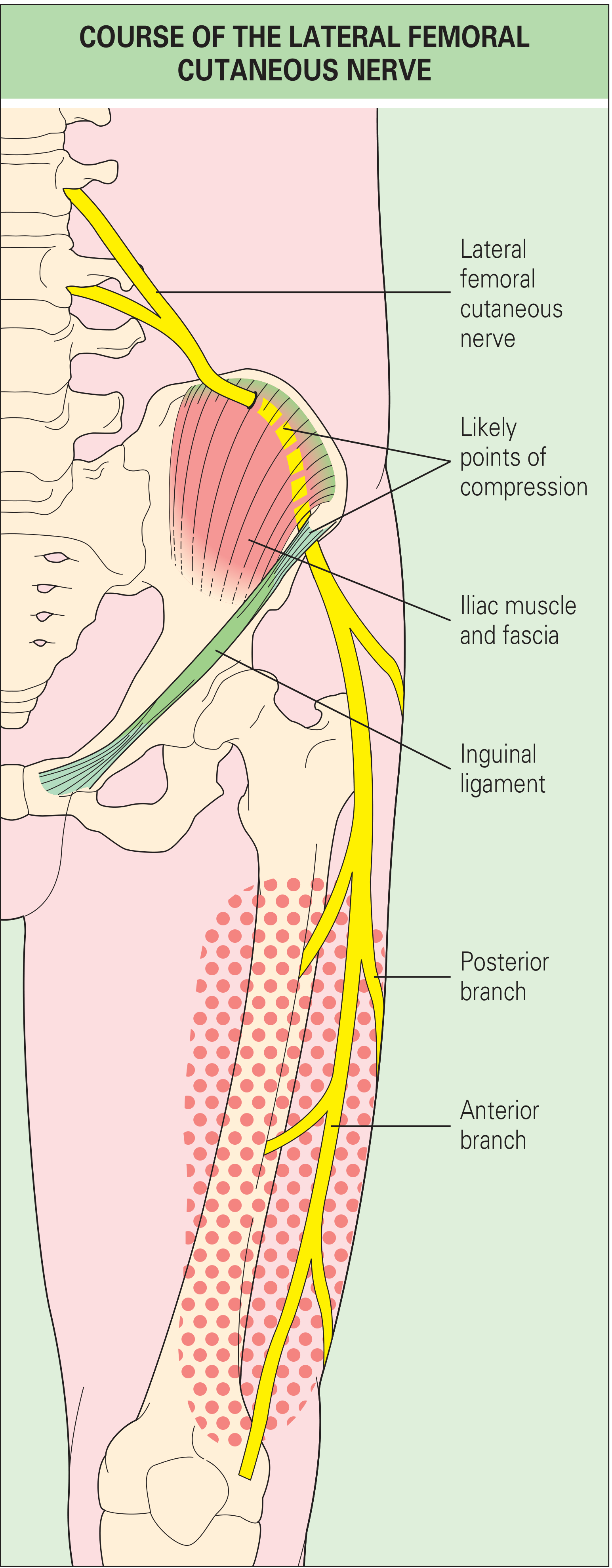
Why Your Symptoms Match So Well
| Feature | Your Symptom | Meralgia Paresthetica |
|---|---|---|
| Location | Left mid and lateral thigh | Anterolateral thigh (LFCN distribution) |
| Trigger | Touch / mild pressure | Allodynia - classic feature |
| Spontaneous pain | No (only on touch) | Often absent or mild in chronic cases |
| Duration | Years | Can be long-standing / chronic |
| Side | Unilateral (left) | Usually unilateral |
| Leg weakness | None mentioned | None - nerve is purely sensory |
What Causes the Nerve to Get Compressed?
- Tight belts, waistbands, or clothing pressing on the groin
- Excess body weight / obesity - increases pressure on the nerve at the inguinal ligament
- Prolonged standing or walking
- Pregnancy (historical or current)
- Diabetes - can make nerves more vulnerable
- Prior abdominal or hip surgery (appendectomy, hernia repair, bariatric surgery)
- Occupational postures - sitting for long periods or supporting weight on the thighs
- Sometimes no identifiable cause at all (idiopathic)
Is It Anything Else?
- L2-L3 lumbar radiculopathy - nerve root compression in the lower back can also cause lateral thigh symptoms, but usually comes with some back pain and may affect reflexes
- Femoral neuropathy - affects the front of thigh plus causes quadriceps weakness and a reduced knee reflex; your lack of weakness makes this less likely
- Fibromyalgia or myofascial pain - diffuse, bilateral; does not match your highly localized unilateral pattern
What Should You Do?
- Perform a pelvic compression test (repositioning the pelvis to change nerve tension and see if symptoms shift)
- Check sensory mapping of both thighs
- Occasionally order nerve conduction studies to confirm, though these are technically difficult for this nerve
- Order an MRI of the lumbar spine only if radiculopathy needs to be ruled out
- Loosen belts, waistbands, and clothing at the waist/hip
- Weight loss if applicable
- Avoid prolonged standing
- NSAIDs for pain relief
- Local anesthetic + corticosteroid injection near the inguinal ligament - both diagnostic and therapeutic
- Neuropathic pain medications (gabapentin, amitriptyline) for persistent cases
- Surgical decompression (neurolysis) is reserved for severe, chronic, unresponsive cases and is rarely needed
Important Note
Sources: Rheumatology 2-Volume Set (2022, Elsevier); Bradley and Daroff's Neurology in Clinical Practice; Dermatology 2-Volume Set 5e; Cleveland Clinic; POGO Physio
I thought it can tumor
thigh tumor vs meralgia paresthetica differentiating features pain only on touch years
soft tissue tumor thigh red flags symptoms that distinguish from nerve pain
Could It Be a Tumor? Probably Not - But Here Is Why
The Reassuring Side: Your Symptoms Don't Match a Tumor Well
| Feature | What You Have | Soft Tissue Tumor |
|---|---|---|
| Visible/palpable lump | Not mentioned | Almost always present - the lump itself is the first sign |
| Pain type | Only on touch, no spontaneous pain | Usually painless at first; pain only develops later as it grows and presses on nerves |
| Duration - size change | Years, presumably stable | Tumors grow over time - a sarcoma stable for years would be very unusual |
| Skin changes | None mentioned | May show visible swelling, skin changes |
| Location | Skin-level sensation | Tumors are usually deep in muscle tissue |
| Weakness | None | May develop as tumor compresses muscle/nerve |
Red Flags for a Soft Tissue Tumor (That You Should Watch For)
- A visible or palpable lump (this is the #1 sign)
- Lump larger than 5 cm (about 2 inches)
- Lump that is growing in size
- Lump that is deep (feels buried in muscle, not just under the skin)
- New onset pain around a lump
- Lump returning after being removed
- Weight loss, fatigue, or night sweats (systemic signs)
One Thing Worth Knowing: Tumors Can Occasionally Mimic Meralgia
Bottom Line
- No lump you can feel or see
- Pain only on touching the skin (surface sensation)
- Stable for years without progression
- Confined to the nerve territory of the lateral thigh
- Normal on the other side
- A doctor can physically examine the area and confirm no mass is present
- A nerve block can both confirm and treat meralgia paresthetica
- If there is any doubt, an ultrasound of the thigh (cheap, no radiation) will immediately show whether any mass exists under the skin
Can it be a bony tumor as I press hard against bone than this pain increased
bone tumor femur thigh symptoms deep pressure tenderness bony vs nerve pain differentiation
osteoid osteoma femur thigh pressure pain years benign bone tumor symptoms
Bony Tumor - A Fair Question, With an Important Distinction
Why Deeper Pressure Hurts More: The Physics Explanation First
- Skin
- Subcutaneous fat
- The lateral femoral cutaneous nerve (which runs here)
- Fascia and muscle
- The femur bone (periosteum)
Could It Be a Bone Tumor? Here Is the Honest Assessment
1. Osteoid Osteoma (Benign - Most Relevant)
| Feature | Osteoid Osteoma |
|---|---|
| Location | Femur is the #1 site (along with tibia) |
| Pain character | Dull, aching, deep, localized to the tumor site |
| Night pain | Hallmark feature - worse at night, often wakes patient |
| Response to NSAIDs | Classic - dramatic relief with aspirin/ibuprofen |
| Duration | Can last years before diagnosis |
| Age | Most common ages 4-25, but can occur in adults |
| Malignant potential | None - never becomes cancerous |
| Size | Small (<1.5 cm), does not grow or spread |
- Is your thigh pain significantly worse at night - enough to wake you or disturb sleep?
- Does ibuprofen or aspirin make the pain noticeably better?
2. Malignant Bone Tumor (e.g., Osteosarcoma) - Much Less Likely
| Red Flag Feature | Your Situation |
|---|---|
| Constant, progressive pain (not just on touch) | You have pain ONLY on touch - not spontaneous |
| Visible swelling or lump over the bone | Not mentioned |
| Pain worsening over weeks/months | Stable for years |
| Night pain waking you | Not mentioned |
| Systemic symptoms - weight loss, fever, fatigue | Not mentioned |
| Pathological fracture | No |
Where This Leaves You: Updated Picture
| Diagnosis | Likelihood | Key Distinguishing Feature |
|---|---|---|
| Meralgia paresthetica (nerve) | Most likely | Touch-only pain, skin-level, no night pain |
| Osteoid osteoma (benign bone tumor) | Possible - needs ruling out | Night pain + dramatic NSAID relief |
| Malignant bone tumor | Unlikely | Stable for years, no swelling, no spontaneous pain |
What You Should Do Now
- See a doctor and get a plain X-ray of the left femur - cheap, no radiation concerns, and an osteoid osteoma shows a characteristic appearance (small lucent nidus surrounded by thick bone). This one test rules in or out most bone pathology.
- If X-ray is inconclusive, a CT scan is the gold standard for identifying bone lesions.
- A normal X-ray + CT would essentially rule out any significant bony pathology and point back to the nerve as the cause.
A girl has period on 18 June start but in this month period not came on time and she also mention no any see in this time ..on past history shehas two time irregular interval of period like 26 march than 20 April than 17 may then 18 june and yet not come this time mention age of 28 years..thin build and small breast
Clinical Analysis: 28-Year-Old Woman With Irregular Periods
First: Understanding Her Cycle Pattern
| Period | Date | Days Since Last Period |
|---|---|---|
| 1st | 26 March | - |
| 2nd | 20 April | 25 days |
| 3rd | 17 May | 27 days |
| 4th | 18 June | 32 days |
| 5th | Not come yet | >35 days and counting (today is 23 July) |
- Slightly short (25 days), then gradually lengthening
- The last interval was 32 days (still within normal range)
- Now 35+ days with no period = she is currently in oligomenorrhea progressing toward amenorrhea
Most Important Finding: Thin Build + Small Breasts
Differential Diagnosis (Most to Least Likely)
1. Functional Hypothalamic Amenorrhea (FHA) - Most Likely
"Functional hypothalamic amenorrhea is characterized by abnormal secretion of GnRH, resulting in low LH levels and the absence of a midcycle LH surge. This leads to anovulation and low estradiol levels. Causes include stress, weight loss, anorexia nervosa, poor nutrition, and strenuous exercise."
- Thin build = low body fat = insufficient leptin signaling to the hypothalamus
- Small breasts = chronically low estrogen (long-standing suppressed hypothalamic axis)
- Gradually worsening cycle irregularity
- No spontaneous bleeding this cycle
- Does she exercise excessively?
- Is she under stress (emotional, academic, occupational)?
- Has her weight dropped recently?
- Any restrictive eating or disordered eating patterns?
2. Pregnancy - Must Always Rule Out First
3. Thyroid Dysfunction
4. Hyperprolactinemia
5. PCOS (Less Likely Given Her Build)
- Overweight or obesity
- Larger body habitus
- Signs of androgen excess (acne, facial hair)
6. Primary Ovarian Insufficiency (POI)
The Diagnostic Framework
Step 1: Rule out PREGNANCY (urine β-hCG) ← Do this TODAY

Step 2: Blood tests:
   - TSH (thyroid)
   - Prolactin (pituitary)
   - FSH + LH (ovarian/hypothalamic)
   - Estradiol (E2)
   - Testosterone + DHEAS (if signs of androgen excess)

Step 3: Progesterone challenge test
   - Give medroxyprogesterone (Provera) 10 mg/day × 10 days
   - If withdrawal bleed occurs → estrogen is present → likely anovulatory (PCOS or hypothalamic)
   - If NO bleed → low estrogen → hypothalamic, pituitary, or ovarian failure

Step 4: If prolactin elevated → MRI pituitary

Step 5: Pelvic ultrasound (ovarian morphology, endometrial thickness)
What Is Likely Happening Here
| Feature | Points Toward |
|---|---|
| Thin build | Low body fat → hypothalamic suppression |
| Small breasts | Chronic low estrogen since puberty or ongoing |
| Gradually lengthening cycles | Worsening anovulation |
| Now missed period | Anovulatory cycle |
| Age 28 | Reproductive age, secondary amenorrhea |
| No mention of acne/facial hair | Against PCOS |
- Nutritional rehabilitation - gradual weight gain, adequate calorie intake
- Reduce excessive exercise if present
- Stress reduction
- In some cases, short-term hormone therapy to protect bones (prolonged low estrogen causes osteoporosis)
- Treat the underlying trigger - the cycles often normalize with weight restoration
Sources: Swanson's Family Medicine Review; Tietz Textbook of Laboratory Medicine 7th Ed; Berek & Novak's Gynecology; Goldman-Cecil Medicine
Create a flowchart showing secondary amenorrhea evaluation pathway
A detailed medical clinical flowchart titled "Secondary Amenorrhea: Evaluation Pathway" showing the stepwise diagnostic algorithm. The flowchart starts at the top with "Secondary Amenorrhea (No period for ≥3 months or missed ≥3 cycles)" and flows downward with the following steps and branches: Step 1 box: "Step 1: Rule Out Pregnancy — Urine or serum β-hCG" with two branches: POSITIVE arrow going right to green box "PREGNANT — Obstetric care", NEGATIVE arrow continuing down. Step 2 box: "Step 2: Initial Blood Tests — TSH, Prolactin, FSH, LH, Estradiol (E2)" branching into three colored outcome boxes: - Left blue box: "TSH Abnormal → Thyroid disease (hypothyroid / hyperthyroid) → Treat thyroid" - Center orange box: "Prolactin Elevated → Check for galactorrhea, headache, visual fields → MRI Pituitary → Rule out prolactinoma" - Right purple box: "TSH + Prolactin Normal → Continue evaluation" Step 3 box (from purple branch): "Step 3: Progesterone Challenge Test — Medroxyprogesterone 10mg/day × 10 days" with two branches: - Left green branch: "WITHDRAWAL BLEED occurs (positive) → Estrogen present, outflow tract intact → Anovulatory state → Check androgens (testosterone, DHEAS) → PCOS vs Hypothalamic" - Right red branch: "NO BLEED (negative) → Low estrogen OR outflow obstruction → Estrogen + Progesterone challenge" From the No Bleed branch, another box: "Estrogen + Progesterone Challenge" with two branches: - Green: "Bleed occurs → Outflow tract intact → Low estrogen cause → Measure FSH/LH" - Red: "No bleed → Outflow tract obstruction → Asherman syndrome → Hysteroscopy" From "Measure FSH/LH" box, two branches: - Left: "FSH/LH HIGH (Hypergonadotropic) → Primary Ovarian Insufficiency (POI) → Karyotype if <30 yrs → Hormone replacement" - Right: "FSH/LH LOW/NORMAL (Hypogonadotropic) → Hypothalamic or Pituitary cause → MRI Brain/Pituitary → Rule out tumor → Functional Hypothalamic Amenorrhea (stress, low weight, exercise)" Bottom box: "Functional Hypothalamic Amenorrhea → Management: Nutrition rehabilitation, weight gain, reduce exercise, stress reduction, consider HRT for bone protection" Use clean professional medical diagram style with color-coded boxes: blue for initial steps, green for positive/normal findings, red/orange for abnormal findings, purple for diagnosis boxes. Clear arrows connecting all steps. White background.
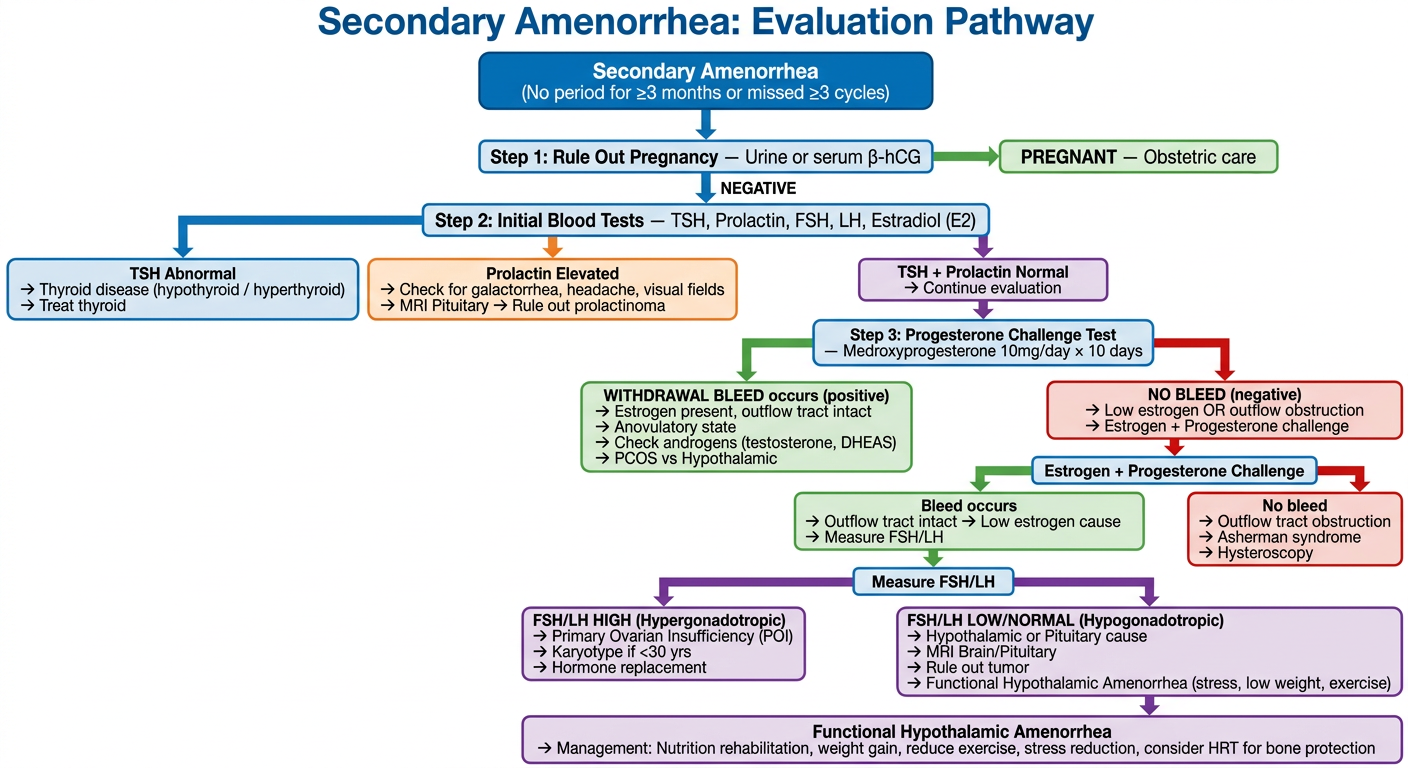
Quick Reference Summary of the Pathway
- Abnormal TSH → thyroid treatment restores cycles
- High prolactin → MRI pituitary, rule out prolactinoma
- Bleed occurs → estrogen present → anovulatory (check for PCOS)
- No bleed → either low estrogen OR blocked outflow tract
- Bleed now → outflow intact, cause is low estrogen → measure FSH/LH
- Still no bleed → Asherman syndrome (uterine scarring)
- High FSH/LH → ovaries failing (Primary Ovarian Insufficiency)
- Low/normal FSH/LH → brain/hypothalamus not signaling → Functional Hypothalamic Amenorrhea or pituitary tumor → MRI
I am 25 year old no have history of trauma , I after eating dinner i lie down on bed suddenly feel heavy in left leg like something i can't tell and then I fell chest press for a second like i will die and wake up and normal
Also I have one incident of mild dizziness for 2hich i