
A patient of 13 yr old female is suffering from shading of dead skin like any dirt from all iver her body what may he the diagnosis
Reading File
A 13-year-old female with widespread shedding of dead skin resembling dirt all over the body points strongly toward ichthyosis - a group of skin disorders characterized by generalized scaling. Let me search the textbooks for a thorough answer.
Searching sources...
Finding Sources
Finding Sources
Searching the Web
ichthyosis diagnosis teenager widespread skin shedding scaling differential
Now let me read the relevant textbook sections for detailed clinical information:
Reading File
Reading File
Reading File
Excellent - I now have comprehensive textbook information. Let me also fetch the clinical image of ichthyosis for visual reference:
Loading Image
Here is a detailed clinical answer for this case:
Likely Diagnosis: Ichthyosis (most probably Ichthyosis Vulgaris)
A 13-year-old female with widespread shedding of dead skin resembling dirt all over the body is a classic presentation of ichthyosis - a group of inherited disorders of epidermal cornification characterized by generalized, persistent skin scaling.
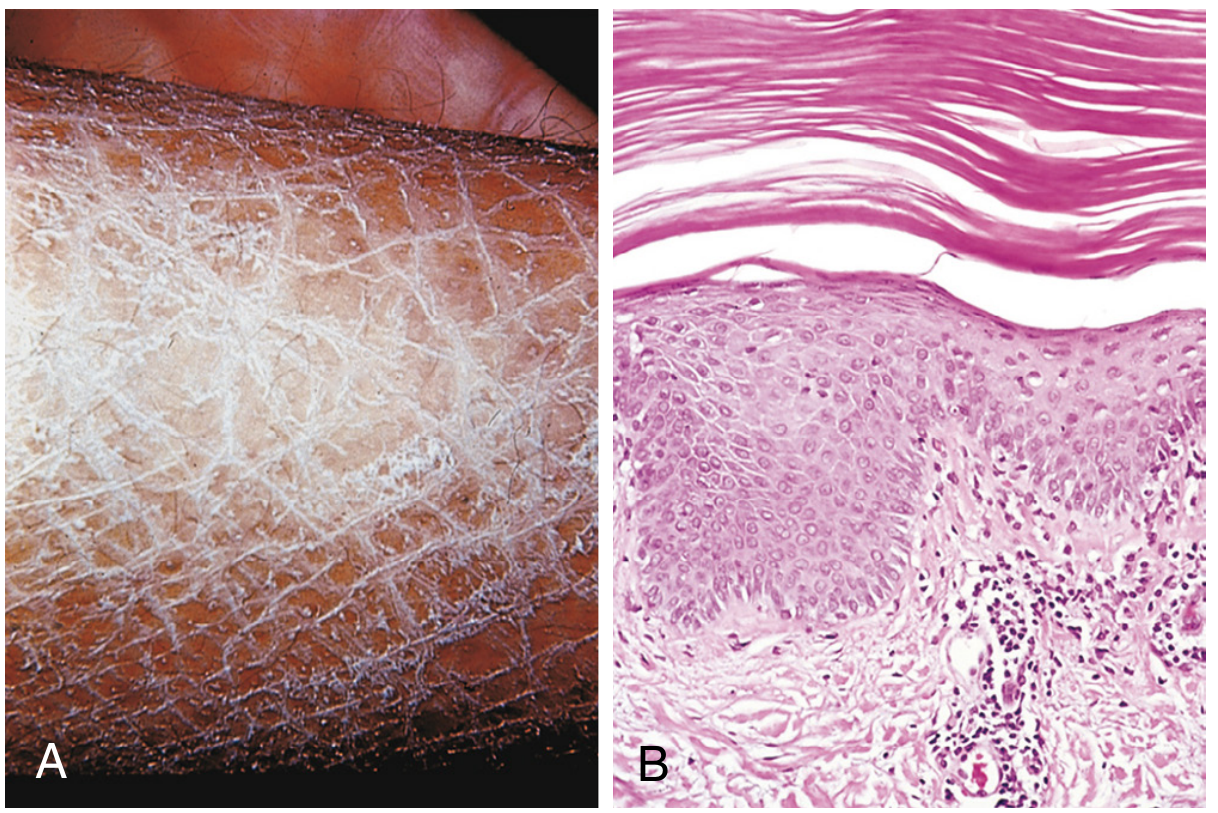
Fig. 25.20 - Robbins Pathologic Basis of Disease: Prominent fish-like scales (A) and compacted, thickened stratum corneum on histology (B).
What Is Ichthyosis?
The word comes from the Greek ichthy (fish), because the skin resembles fish scales. The core defect is impaired desquamation - dead skin cells (corneocytes) fail to shed normally and accumulate on the surface, appearing as scales or as a dirty, flaky coating. - Robbins, Cotran & Kumar Pathologic Basis of Disease
Most Likely Type in This Patient
1. Ichthyosis Vulgaris (MOST COMMON - #1 suspect)
- Inheritance: Autosomal dominant; caused by FLG (filaggrin) gene mutations
- Onset: Usually 3-12 months of age; symptoms can persist through adolescence
- Appearance: Fine, white, flaky scales that look "pasted on" over the entire body - particularly on the extremities (especially shins), trunk, and scalp
- Pattern: Flexural areas (armpits, groin, behind the knees) are typically spared due to higher humidity
- Associated features: Keratosis pilaris, hyperlinear palms, atopic dermatitis, asthma - Andrews' Diseases of the Skin
- Course: Usually improves with age; worse in cold/dry weather, better in summer
This is the most common type - affecting 1 in 250 people. The "dirt-like" appearance is very characteristic because the scales appear adherent and grayish, making skin look unwashed.
Other Types to Consider in a Female Patient
| Type | Key Features | Relevant Notes for a 13-yr Female |
|---|---|---|
| Lamellar Ichthyosis (AR) | Large, plate-like brown scales over entire body, including flexures | May present as "collodion baby" at birth; scales persist and are coarser |
| Congenital Ichthyosiform Erythroderma (AR) | Fine white scales on a red base; generalized | Fine scales with underlying redness |
| Epidermolytic Ichthyosis | Blistering + thick, warty scales; onset at birth | Associated with blistering, particularly in infancy |
| X-linked Ichthyosis | Dark, large scales; neck heavily involved ("unwashed" appearance) | Only in males - can rule out in this female |
| Acquired Ichthyosis | Develops later in life; no family history | Associated with lymphoma, malnutrition, leprosy - less likely at 13 yrs |
Key Pathophysiology
The core defect is defective desquamation of the stratum corneum. In ichthyosis vulgaris specifically, loss-of-function mutations in the FLG gene lead to:
- Defective filaggrin formation
- Impaired cornified cell envelope
- Failure of normal skin barrier
- Retention of dead skin cells (retention hyperkeratosis) - Dermatology 2-Volume Set 5e
How to Confirm Diagnosis
- Clinical history - onset in childhood, family history (autosomal dominant in vulgaris)
- Skin biopsy - shows compact orthokeratotic hyperkeratosis, reduced/absent granular layer
- Genetic testing - FLG gene mutation testing confirms ichthyosis vulgaris
- Chromosomal microarray/FISH - to exclude steroid sulfatase deficiency (X-linked type)
- Serum cholesterol sulfate levels - elevated in X-linked ichthyosis
Treatment (No Cure, Symptom Management)
- Emollients/moisturizers applied frequently, especially after bathing (mainstay of therapy)
- Keratolytics: Urea (10-40%), lactic acid, or salicylic acid creams to remove scales
- Gentle bathing to help desquamate the extra scaling
- Topical retinoids for severe forms
- Avoid cold, dry environments which worsen scaling
- Systemic retinoids (acitretin) reserved for severe lamellar ichthyosis - Andrews' Diseases of the Skin
Differential Diagnoses to Rule Out
- Severe xerosis (dry skin) - milder, no family history, fully resolves with moisturizers
- Psoriasis - silvery scales, Auspitz sign, nail changes
- Atopic dermatitis - eczematous plaques, flexural involvement, intense itch
- Pityriasis rotunda - circular scaly patches
- Tinea versicolor - superficial fungal, hypopigmented patches
Bottom line: A 13-year-old female with generalized "dirt-like" shedding of skin is most likely suffering from Ichthyosis Vulgaris - an inherited disorder of cornification caused by filaggrin deficiency. Referral to a dermatologist for skin biopsy and genetic confirmation is recommended. The condition is manageable but not curable.
This is a shared conversation. Sign in to Orris to start your own chat.