
Moa of skeletal muscle relaxant succinylcholine
Succinylcholine is a depolarizing neuromuscular blocking agent that mimics acetylcholine at the nicotinic receptor but causes prolonged depolarization, leading to muscle paralysis.
Searching sources...
Reading File
Finding Sources
Finding Sources
Reading File
Reading File
Reading File
Loading Image
Loading Image
Reading File
Here is a detailed explanation of the mechanism of action of succinylcholine, drawn from Miller's Anesthesia (10e), Katzung's Basic & Clinical Pharmacology (16e), and Barash's Clinical Anesthesia (9e):
Mechanism of Action of Succinylcholine (Suxamethonium)
Structure
Succinylcholine is structurally two acetylcholine molecules linked through their acetate methyl groups. This structural mimicry is the basis of its entire mechanism.
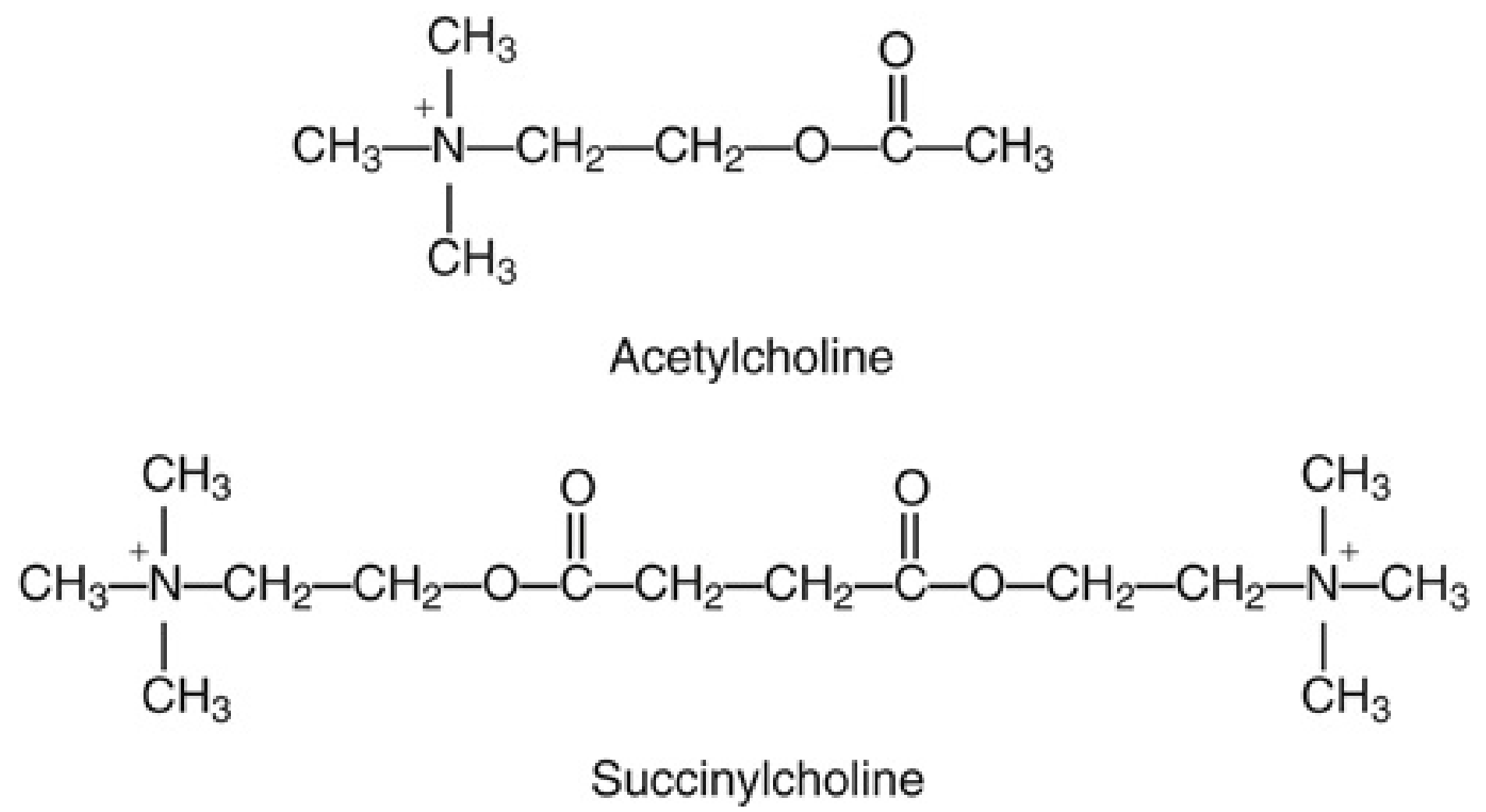
Succinylcholine = two acetylcholine molecules joined back-to-back. (Miller's Anesthesia, 10e)
Phase I Block (Depolarizing Block) - the Primary MOA
-
Binds nicotinic acetylcholine receptors (nAChR) at the neuromuscular junction (NMJ): Like acetylcholine, succinylcholine acts as an agonist at both postsynaptic (junctional) and extrajunctional nicotinic receptors. It binds the receptor and opens the ion channel, allowing Na⁺ influx and K⁺ efflux.
-
Causes sustained depolarization of the motor end plate: The initial channel opening generates an action potential that spreads to adjacent membranes, producing transient, visible muscle fasciculations (the brief twitching seen before paralysis sets in).
-
Resistance to hydrolysis at the synapse: Acetylcholine is rapidly destroyed by acetylcholinesterase (AChE) at the NMJ. Succinylcholine, however, is NOT metabolized by AChE - it is only metabolized in plasma by pseudocholinesterase (butyrylcholinesterase). Since there is little to no pseudocholinesterase at the motor end plate, succinylcholine persists and maintains continuous receptor activation.
-
Sustained depolarization → flaccid paralysis: The end plate membrane remains persistently depolarized. Adjacent voltage-gated sodium channels in the sarcolemma transition to their inactivated state and cannot be re-activated. Since excitation-contraction coupling requires end plate repolarization ("repriming") and repetitive firing to sustain muscle tension, a flaccid paralysis results.
The single-channel recording below illustrates this mechanism - at low concentrations succinylcholine causes discrete channel openings; at high concentrations it causes prolonged "flickering" as it repeatedly opens and blocks the channel:
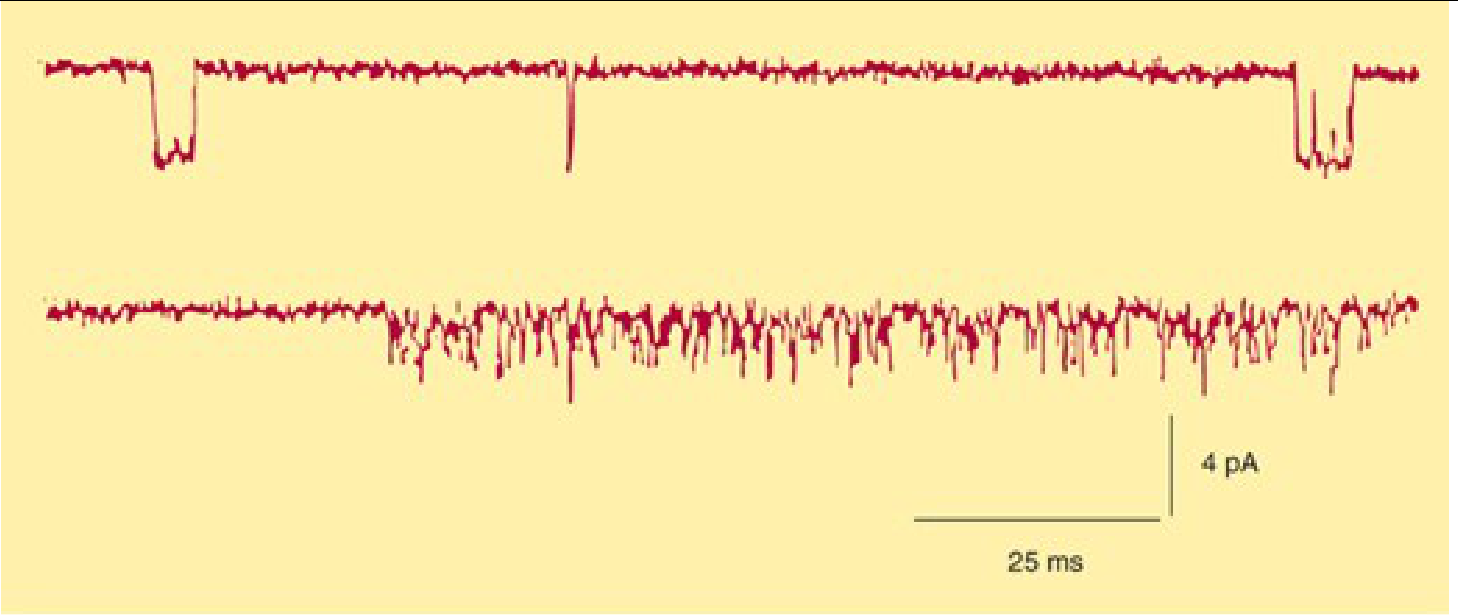
Upper trace: low dose - discrete channel openings. Lower trace: high dose - rapid flickering/blocking of channel. (Katzung, 16e, from Marshall et al., J Physiol 1990)
Phase II Block (Desensitization Block)
With prolonged or large-dose exposure (≥10× ED95, repeated doses, or continuous infusion), the mechanism shifts:
- The initial end plate depolarization decreases over time
- The membrane repolarizes, but cannot be easily depolarized again
- The receptor enters a desensitized/prolonged closed state
- The block now resembles a nondepolarizing block (fade on TOF and tetanic stimulation)
- This is called Phase II block (also historically called "dual block")
Key Distinctions from Nondepolarizing NMBDs
| Feature | Succinylcholine (Depolarizing) | Nondepolarizing (e.g., rocuronium) |
|---|---|---|
| Receptor action | Agonist - opens channel | Antagonist - blocks channel |
| Fasciculations | Yes (initial) | No |
| TOF fade | No (in Phase I) | Yes |
| Effect of neostigmine | Worsens Phase I block | Reverses block |
| Metabolism | Pseudocholinesterase (plasma) | Hepatic/renal/Hofmann |
| Onset | Fastest (~60 sec) | Slower |
Key Pharmacokinetic Points
- Only ~10% of the IV dose reaches the NMJ - the rest is hydrolyzed in plasma by pseudocholinesterase
- Metabolites: succinylmonocholine (weak NMBD) and choline
- Dose of 1 mg/kg produces complete block in ~60 seconds, with recovery to 90% strength in 9-13 minutes in patients with normal pseudocholinesterase
- Patients with atypical or reduced pseudocholinesterase (e.g., dibucaine-resistant variant) have prolonged block ("succinylcholine apnea")
Sources:
- Miller's Anesthesia, 10e - Pharmacology of Succinylcholine, p. 3228-3229
- Katzung's Basic & Clinical Pharmacology, 16e - Phase I Block, p. 754
- Barash's Clinical Anesthesia, 9e - Depolarizing NMB Drug: Succinylcholine, p. 1607-1609
This is a shared conversation. Sign in to Orris to start your own chat.