
Immunity guyton
Reading File
Finding Sources
Finding Sources
Reading File
Reading File
I have comprehensive content from Guyton. Let me compile the full immunity chapter content now.
Reading File
I now have rich content from Guyton. Let me compile a comprehensive, well-organized response.
Immunity — Guyton & Hall Textbook of Medical Physiology
1. Innate vs. Acquired Immunity
The body has two broad layers of defense:
- Innate (non-specific) immunity — pre-existing defenses (skin, phagocytes, complement, etc.) that act immediately against any foreign agent.
- Acquired (adaptive) immunity — developed after exposure to a specific invading agent; can achieve protection against doses up to 100,000 times the lethal level (e.g., botulinum and tetanus toxins).
2. Acquired (Adaptive) Immunity
Types
| Type | Mediator | Also Called |
|---|---|---|
| Humoral | Circulating antibodies (globulins) produced by B lymphocytes | B-cell immunity |
| Cell-mediated | Activated T lymphocytes | T-cell immunity |
Both types are initiated by antigens and both lymphocyte types are formed in lymphoid tissues.
3. Antigens
- Any substance that triggers acquired immunity is an antigen (antibody generator).
- Usually proteins or large polysaccharides with MW ≥ 8,000 Da.
- Antigenicity depends on regularly recurring molecular groups called epitopes on the surface of the molecule.
4. Lymphocytes — The Basis of Acquired Immunity
- Without lymphocytes (genetic lack or destruction), no acquired immunity is possible; a newborn would die of overwhelming bacterial infection within days.
- Located primarily in lymph nodes, but also in: spleen, thymus, bone marrow, GI submucosal areas, tonsils, and adenoids.
- Distribution is strategic: GI lymphoid tissue intercepts gut antigens; tonsillar tissue intercepts respiratory antigens; splenic/bone marrow lymphoid tissue intercepts bloodborne antigens.
Origin (Preprocessing)
- B lymphocytes — preprocessed in the bone marrow (in birds: bursa of Fabricius → "B").
- T lymphocytes — preprocessed in the thymus (→ "T").
- Both types are then seeded throughout peripheral lymphoid tissue.
5. B-Lymphocyte System — Humoral Immunity & Antibodies
Antibody Formation by Plasma Cells
- Antigen enters → phagocytized and presented by macrophages to adjacent B lymphocytes.
- T-helper cells are simultaneously activated and provide additional B-cell stimulation.
- Antigen-specific B lymphocytes enlarge → become lymphoblasts → plasmoblasts → plasma cells.
- Plasma cells divide ~once every 10 hours for 4 days (~9 divisions) → ~500 cells per original plasmoblast.
- Each mature plasma cell produces ~2,000 antibody molecules/second.
- Plasma cells eventually exhaust and die after days to weeks.
Memory Cells & the Secondary Response
- Some lymphoblasts don't become plasma cells but instead form memory B cells, which populate all lymphoid tissue.
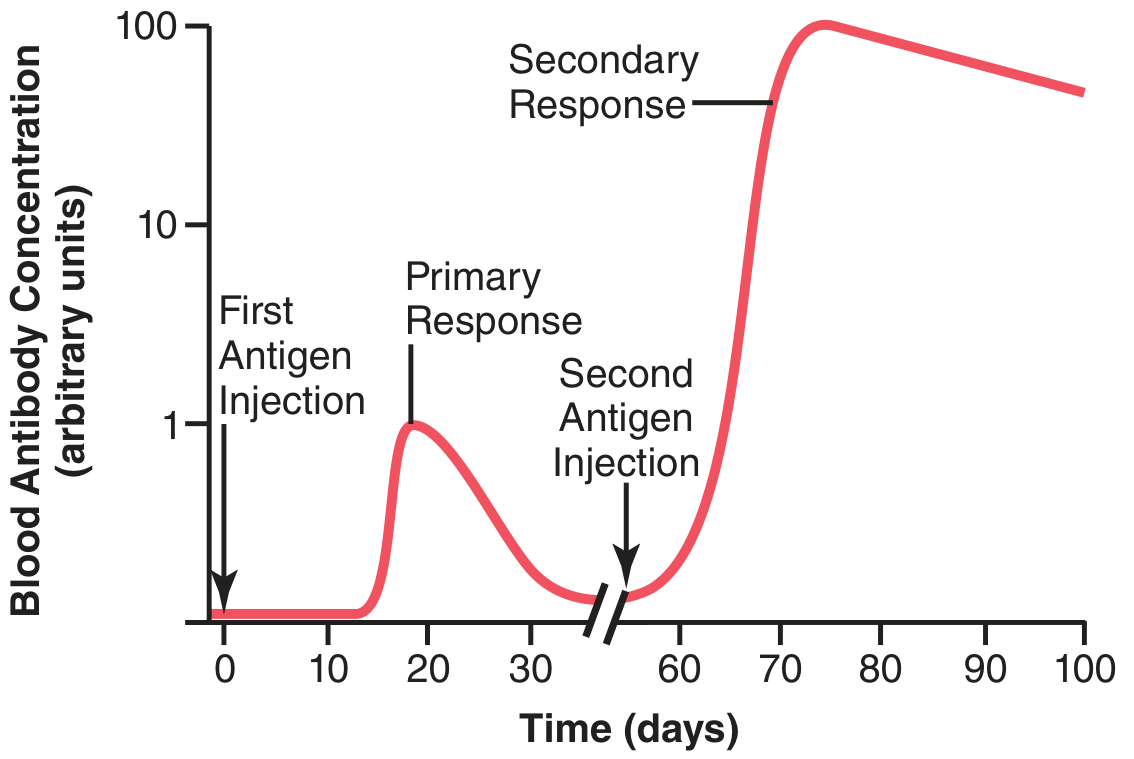
- Primary response: 1-week delay, weak, short-lived.
- Secondary response: rapid (within hours), far more potent, antibodies last for months.
- This is why immunization uses multiple doses spaced weeks to months apart.
Lifelong Immunity via Long-Lived Plasma Cells
- Short-lived plasma cells: rapid protection but undergo apoptosis within days.
- Long-lived plasma cells: reside in bone marrow and gut-associated lymphoid tissue (GALT); can produce antibodies for decades (e.g., smallpox antibodies detected 70 years post-vaccination; 1918 H1N1 survivors retained functional antibodies decades later).
6. T-Lymphocyte System — Cell-Mediated Immunity
Activation of T Cells
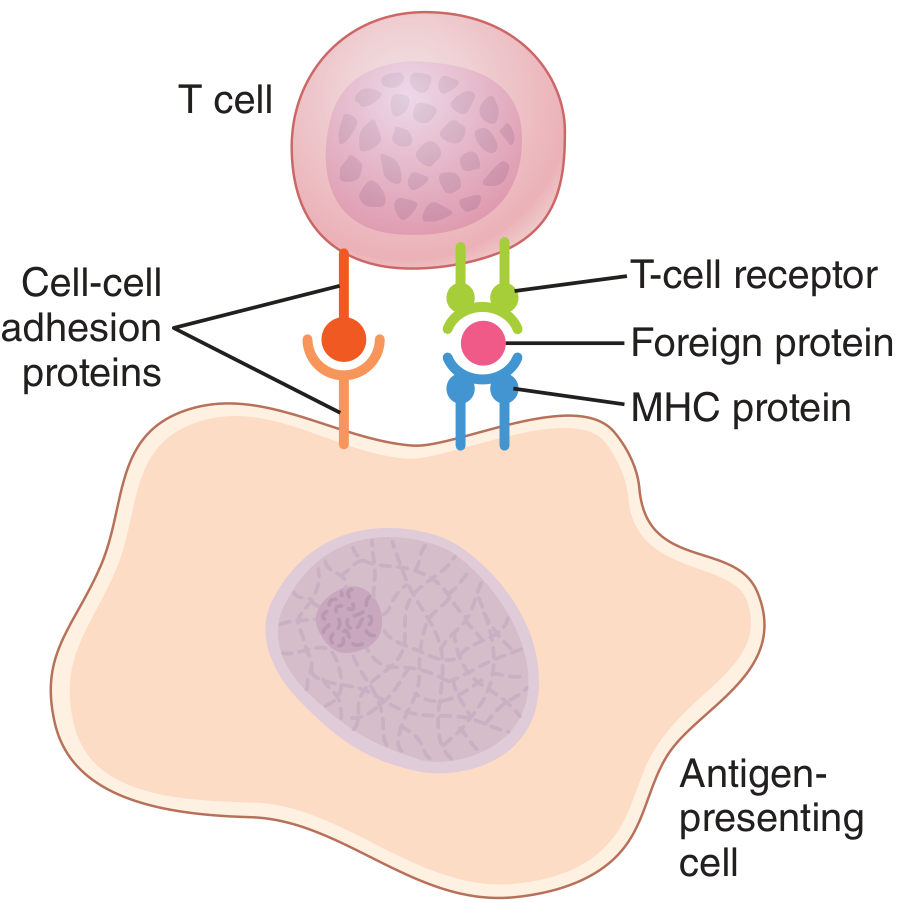
- T lymphocytes respond only to antigens bound to MHC proteins on antigen-presenting cells (APCs).
- Three major APCs: macrophages, B lymphocytes, dendritic cells (most potent).
- Upon appropriate antigen exposure, T-lymphocyte clones proliferate and release activated T cells into the lymph → circulation → tissues → lymph again.
- Circulate throughout the body for months to years.
- Memory T cells also form, enabling faster, more powerful responses on re-exposure.
MHC Proteins
| Type | Presents to | Function |
|---|---|---|
| MHC I | Cytotoxic T cells | Present endogenous (intracellular) antigens |
| MHC II | T-helper cells & regulatory T cells | Present exogenous antigens |
T-cell antigen receptors have a variable region (like antibody variable regions) and a transmembrane stem. Each T cell has up to 100,000 receptor sites.
Types of T Cells
| T Cell Type | Function |
|---|---|
| T-helper cells (CD4+) | Most numerous; activate B cells, cytotoxic T cells; secrete lymphokines (e.g., IL-2, IL-4, IL-5, IFN-γ) |
| Cytotoxic T cells (CD8+) | Directly kill target cells (virus-infected, cancer, transplanted); release perforins and granzymes |
| Regulatory T cells (Tregs) | Suppress immune responses; prevent autoimmunity |
7. Tolerance — Self vs. Non-Self
- During T-cell preprocessing in the thymus and B-cell preprocessing in the bone marrow, lymphocytes that react against the body's own tissues are clonally deleted or inactivated.
- Failure of this tolerance → autoimmune disease.
- Regulatory T cells further suppress autoreactive lymphocytes in the periphery.
8. Passive Immunity
- Acquired passively by transfer of antibodies (or activated T cells) from another individual.
- Examples: maternal IgG transfer across placenta, antitoxin injections (tetanus antitoxin), immune serum.
- Protection is immediate but temporary — antibodies degrade over weeks to months; no memory is formed.
9. Sex Differences in Immunity
- Women generally mount stronger innate and adaptive immune responses than men.
- This confers greater resistance to infection but also higher susceptibility to autoimmune diseases.
- Hormonal factors (estrogen, testosterone) and X-linked immune genes contribute to these differences.
Summary Table
| Feature | Humoral (B-cell) | Cell-Mediated (T-cell) |
|---|---|---|
| Effector | Antibodies | Activated T lymphocytes |
| Best against | Extracellular pathogens, toxins | Intracellular pathogens, cancer, transplants |
| Memory | Yes (memory B cells) | Yes (memory T cells) |
| Antigen recognition | Free antigen | Antigen + MHC on APC |
| Speed (secondary) | Hours (after 1st exposure) | Hours |
Source: Guyton and Hall Textbook of Medical Physiology, Chapter 35 (Resistance of the Body to Infection: Immunity and Allergy)
This is a shared conversation. Sign in to Orris to start your own chat.