
38 year male had accident by bike now he has injury in his left hand and leg suggest treatment and x ray
I'll read the medical library skill first, then research trauma management in parallel.
Reading File
Now let me search the library and web in parallel for trauma management, fracture treatment, and X-ray indications.
Finding Sources
Finding Sources
Searching the Web
bike accident fracture hand leg X-ray indications treatment protocol emergency
Now let me read the relevant textbook sections in parallel:
Reading File
Reading File
Finding Sources
Let me fetch relevant X-ray images and get more clinical content on leg fractures:
Loading Image
Loading Image
Finding Sources
Finding Sources
Let me get more detail on open fracture management and leg fracture treatment:
Reading File
Finding Sources
Reading File
Reading File
I now have comprehensive information to provide a thorough, evidence-based response. Here is the full clinical guide:
Trauma Management: Bike Accident with Left Hand and Leg Injuries
1. Initial Emergency Assessment (ABCDE Approach)
Before focusing on the limbs, stabilize the patient:
- A - Airway: Ensure patent airway
- B - Breathing: Check respiratory rate, oxygen saturation
- C - Circulation: Check BP, pulse, signs of haemorrhage (tibial/fibula fractures alone can cause 500 mL blood loss; femur fracture up to 1,000 mL - Rosen's Emergency Medicine)
- D - Disability: GCS, pupillary response (rule out head injury from bike accident)
- E - Exposure: Full skin survey for road rash, open wounds, deformity
2. X-Ray Imaging - What to Order
For the Left Hand/Wrist
Standard views: Anteroposterior (AP), Lateral, and Oblique views
"Almost every hand evaluation should include plain X-rays of the injured or affected part. A standard, anteroposterior, lateral, and oblique view of the hand or wrist is rapid, inexpensive, and usually provides sufficient information about the bony structures to achieve a diagnosis." - Schwartz's Principles of Surgery, 11th Ed.
What to look for on hand X-ray:
- Fracture lines (lucencies in bone)
- Congruency of MP and IP joints (rotation of finger = incongruency)
- Gilula's arcs at the wrist (disruption = ligament injury or dislocation)
- Commonly missed: scaphoid fracture (may appear normal on initial X-ray)
Example - Colles' fracture X-ray (common wrist fracture in falls):
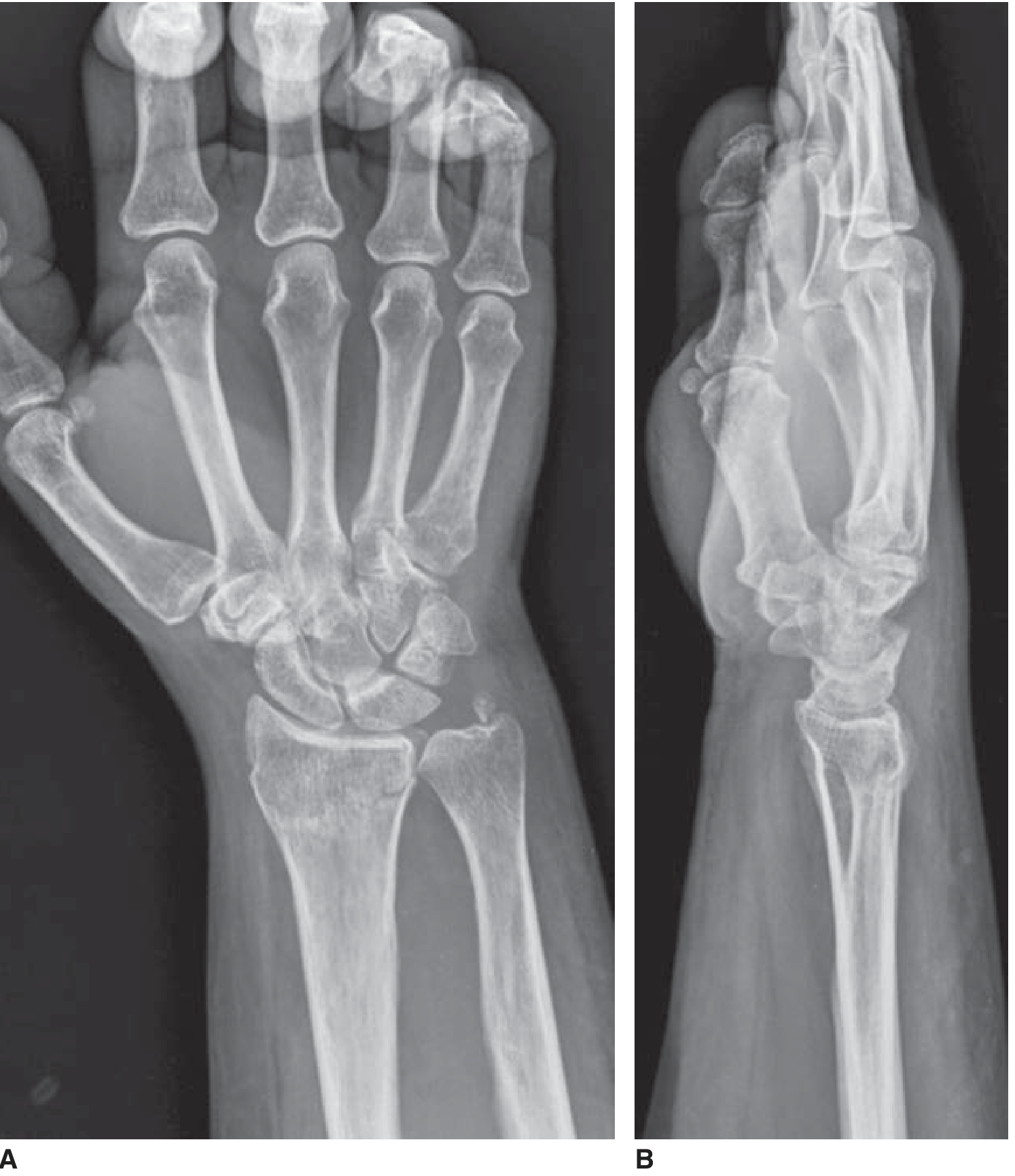
If X-ray is negative but pain persists:
- Repeat X-ray at 14 days (scaphoid fracture classically appears late)
- CT scan for suspected scaphoid fracture, CMC fractures, or comminuted distal radius
- MRI for suspected ligament or tendon injury
For the Left Leg
Standard views:
- Tibia/fibula: AP + lateral (include BOTH knee AND ankle joints in the same film)
- If knee pain: AP, lateral, and skyline (patella) views of the knee
- If ankle involvement: AP, lateral, mortise view of ankle
Example - Lower leg tibia/fibula fracture X-ray:
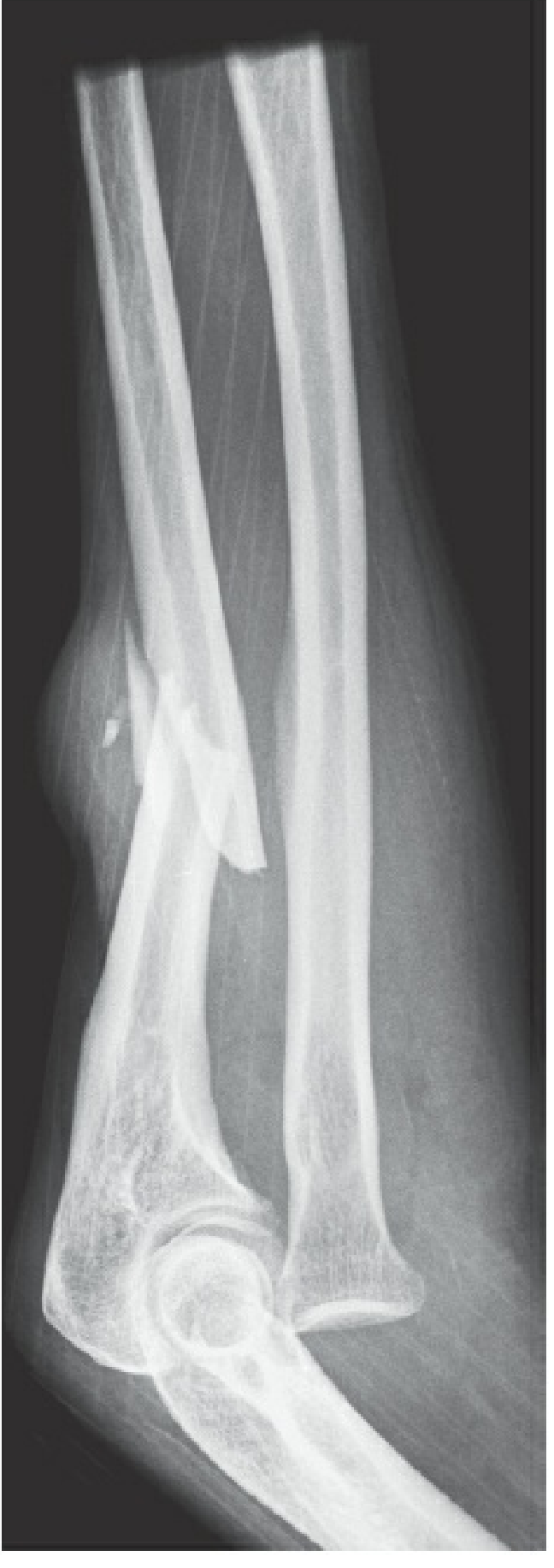
3. Treatment Plan
A. Closed Fractures (Skin Intact)
Hand/Wrist Fractures
| Fracture Type | Initial ED Treatment | Definitive Treatment |
|---|---|---|
| Distal radius (Colles') - non-displaced | Splint in neutral | Cast 6-8 weeks |
| Distal radius - displaced | Reduction + sugar-tong splint | Orthopedic follow-up within 1 week |
| Distal radius - unstable (>50% articular involvement) | Splint + emergent ortho consult | ORIF |
| Metacarpal fracture | Buddy splinting or ulnar gutter splint | Cast or ORIF if displaced |
| Scaphoid fracture | Thumb spica splint | Cast 8-12 weeks or ORIF if displaced |
| Finger phalanx - non-displaced | Buddy taping | 3-4 weeks protection |
Leg Fractures
Tibial shaft fracture (most common in bike accidents):
- Non-displaced, non-comminuted: closed reduction + above-knee cast for 4-6 weeks, then functional brace
- Comminuted or angulated: intramedullary (IM) nailing is preferred - allows early weight bearing
- Fibula shaft fracture (often accompanies tibial fracture): usually heals without surgery
- Plate and screw fixation used for fractures at diaphyseal-metaphyseal junction
"Most tibial shaft fractures, especially comminuted and angulated fractures, are treated with an intramedullary nail placed down the tibial canal, with interlocking screws placed proximally and distally. Weight-bearing can begin soon after surgery." - Schwartz's Principles of Surgery, 11th Ed.
Ankle fracture:
- Single column injury (stable): cast or splint 6-8 weeks
- Two or three column injury (unstable)/talar shift: ORIF
B. Open Fractures (Skin Wound Over Fracture)
Bike accidents frequently cause road rash or lacerations over fractures. Classify by Gustilo-Anderson:
| Grade | Description | Antibiotics |
|---|---|---|
| I | Wound <1 cm, clean | Cefazolin 2g IV q8h |
| II | Wound 1-10 cm | Cefazolin + Gentamicin 5mg/kg OD |
| III | Wound >10 cm or high energy | Cefazolin + Gentamicin ± Penicillin (farm injury) |
ED Goals for open fractures (Rosen's Emergency Medicine):
- Control bleeding with sterile pressure dressing - remove gross debris only
- Splint without reduction (unless vascular compromise)
- Irrigate with saline; cover with saline-soaked dressings
- IV antibiotics as early as possible (ideally within 1 hour)
- Tetanus prophylaxis (tetanus toxoid + immune globulin for large crush wounds)
- Wound debridement and irrigation within 24 hours
4. Compartment Syndrome - Must Not Miss
Bike accidents with leg trauma carry a real risk of compartment syndrome:
Warning signs:
- Pain out of proportion to the injury
- Pain on passive stretch of muscles
- Tense/taut leg swelling
- Paresthesia or weakness (late signs)
Diagnosis: Compartment pressure within 30 mmHg of diastolic BP is diagnostic
Treatment: Emergency fasciotomy - do not delay
5. Analgesia and Supportive Care
| Step | Drug/Action |
|---|---|
| Pain | IV morphine 0.1 mg/kg or IV ketorolac (if no vascular injury) |
| Limb elevation | Elevate both hand and leg above heart level |
| Splinting | Immobilize fracture in position of comfort |
| IV access | Two large-bore cannulas - give IV fluids if haemodynamically unstable |
| Tetanus | Update if wound present and vaccination not current |
6. Orthopaedic Referral Indications
Seek urgent/emergent orthopaedic consultation for:
- Open fractures of any kind
- Vascular or nerve compromise
- Displaced intra-articular fractures
- Compartment syndrome
- Barton's fracture (>50% articular involvement or carpal subluxation)
- Unstable ankle fractures with talar shift
7. Follow-Up Imaging
- If initial X-ray is negative but scaphoid tenderness is present: CT or MRI within 48-72 hours, or repeat X-ray in 2 weeks
- Post-reduction X-rays for all manipulated fractures to confirm alignment
- CT scan for pilon fractures after initial external fixation (to plan ORIF)
Sources: Rosen's Emergency Medicine, 9th Ed. | Tintinalli's Emergency Medicine, 9th Ed. | Schwartz's Principles of Surgery, 11th Ed. | Bailey & Love's Short Practice of Surgery, 28th Ed. | Rockwood & Green's Fractures in Adults, 10th Ed.
Disclaimer: This is a clinical reference guide. All treatment decisions must be made by the treating physician after direct patient assessment.
This is a shared conversation. Sign in to Orris to start your own chat.