
Histology of growth plate. Factors causing growth disturbance. Principles of guided growth modulation.?Answer this question for ms orthopaedic university exam 10 marks in handwritten notes image format
Handwritten medical exam notes on white lined paper with blue ink pen, realistic handwriting style, for MS Orthopaedics 10-mark question. The notes are organized neatly with underlined headings and bullet points. Content: Title (underlined, bold): GROWTH PLATE (PHYSIS) - HISTOLOGY, GROWTH DISTURBANCE & GUIDED GROWTH MODULATION SECTION 1 (underlined): HISTOLOGY OF GROWTH PLATE The physis lies between epiphysis and metaphysis. Contains 4 zones from epiphysis to diaphysis: 1. Zone of Resting (Reserve) Cartilage - Small, scattered chondrocytes in abundant matrix - Low metabolic activity; stores lipids/glycogen - Anchors physis to epiphysis - Stem cell-like progenitor cells 2. Zone of Proliferation - Chondrocytes divide rapidly → form columns (like stacked coins) - Most active zone for longitudinal growth - Produces collagen type II matrix - WEAKEST zone mechanically → fractures occur here 3. Zone of Hypertrophy (Maturation) - Cells enlarge 5-10x; mineralization begins - 3 sub-zones: maturation → degeneration → provisional calcification - Vascular invasion begins here 4. Zone of Ossification (Calcification/Primary Spongiosa) - Capillaries invade → osteoblasts deposit bone on calcified cartilage trabeculae - Cartilage replaced by primary spongiosa → remodelled to secondary spongiosa [Small diagram showing zones labeled as arrows from top: Epiphysis → Reserve → Proliferative → Hypertrophic → Calcification → Metaphysis] SECTION 2 (underlined): FACTORS CAUSING GROWTH DISTURBANCE A) TRAUMATIC - Salter-Harris types III, IV, V → direct physeal damage - S-H V (crush injury) → worst prognosis - Peripheral bar → angular deformity; Central bar → shortening B) INFECTION - Haematogenous osteomyelitis (esp. in neonates) - Metaphyseal vessels cross physis in <18 months age - Septic arthritis → direct enzymatic destruction C) RADIATION - Doses >2000 cGy → chondrocyte damage - Causes growth arrest / angular deformity D) VASCULAR / ISCHAEMIC - AVN femoral head (Perthes disease) - Sickle cell disease → physeal infarction E) NUTRITIONAL / METABOLIC - Rickets → widened disorganised physis - Scurvy → zone of provisional calcification affected - Hypothyroidism, GH deficiency F) IATROGENIC - Hardware crossing physis - Smooth K-wires preferred over threaded G) TUMOURS / DYSPLASIAS - Multiple hereditary exostoses - Achondroplasia (FGFR3 mutation) → reduced proliferative zone activity SECTION 3 (underlined): PRINCIPLES OF GUIDED GROWTH MODULATION Definition: Temporary reversible partial physeal tethering to correct angular or length deformity in growing child. PRINCIPLE (Hueter-Volkmann Law): - Increased compression → inhibits physeal growth - Decreased compression → stimulates physeal growth METHODS: 1. Stapling (Blount, 1949) - Metallic staples placed across physis on convex side - Disadvantages: physis damage, unpredictable correction 2. Tension Band Plate (8-plate / TomoFix) - Two screws + bridging plate spanning physis - Screws diverge as growth occurs → creates tension band effect - Reversible: plate removed when correction achieved - Indications: genu valgum/varum, limb length discrepancy 3. Transphyseal Screw (single screw epiphysiodesis) - Single cannulated screw crossing physis - Simple, minimally invasive ADVANTAGES of Guided Growth over Osteotomy: ✓ Less invasive, outpatient procedure ✓ Reversible - correction adjustable ✓ No acute correction (gradual) ✓ Can be repeated if overcorrection TIMING: Best done when sufficient growth remains - Predict by Moseley straight-line graph / Green-Anderson tables - Rule: Angular correction = ~1° per month (knee) COMPLICATIONS: - Overcorrection / rebound - Hardware failure - Physeal damage (rare with smooth implants) - Loss of correction after removal Sources: Campbell's Operative Orthopaedics 15e, Histology Text & Atlas (Eroschenko)
Clean, legible handwritten medical study notes on white paper with blue ink, realistic student handwriting, clearly readable text, organized exam answer format for MS Orthopaedics. All text must be perfectly readable English. No garbled words. Title is underlined. GROWTH PLATE - HISTOLOGY, GROWTH DISTURBANCE & GUIDED GROWTH ═══════════════════════════════════════ 1. HISTOLOGY OF GROWTH PLATE (Physis) ──────────────────────────────────── The physis lies between epiphysis & metaphysis. Contains 4 zones (epiphysis → diaphysis direction): [ZONE DIAGRAM: Simple labeled diagram from top to bottom] ┌─────────────┐ ← EPIPHYSIS │ ZONE 1: Reserve (Resting) │ • Small chondrocytes in rich matrix │ • Stem cell-like progenitor cells │ • Stores lipids & glycogen │ │ ZONE 2: Proliferative ← GROWTH occurs here │ • Chondrocytes divide → coin-stack columns │ • Active matrix production (Collagen II) │ • Weakest zone → fractures occur here │ │ ZONE 3: Hypertrophic │ • Cells enlarge 5-10x │ • Provisional calcification begins │ • Vascular invasion starts │ │ ZONE 4: Zone of Ossification │ • Capillaries invade, osteoblasts deposit bone │ • Primary spongiosa formed └─────────────┘ ← METAPHYSIS ═══════════════════════════════════════ 2. FACTORS CAUSING GROWTH DISTURBANCE ────────────────────────────────────── A) TRAUMA - Salter-Harris injuries • SH III, IV, V → physeal damage • Bony bar → shortening / angular deformity • SH V (crush) → worst prognosis B) INFECTION • Neonatal osteomyelitis - vessels cross physis • Septic arthritis → enzymatic destruction C) RADIATION • >2000 cGy → chondrocyte death → growth arrest D) VASCULAR • Perthes disease (AVN femoral head) • Sickle cell → physeal infarction E) METABOLIC / NUTRITIONAL • Rickets → widened disorganised physis • Hypothyroidism, GH deficiency F) IATROGENIC • Implants crossing physis • Use smooth wires, remove early G) TUMOUR / DYSPLASIA • Multiple hereditary exostoses • Achondroplasia (FGFR3 mutation) ═══════════════════════════════════════ 3. GUIDED GROWTH MODULATION ──────────────────────────── Definition: Temporary partial physeal tethering to correct angular deformity / LLD in a growing child Principle (Hueter-Volkmann Law): ↑ Compression → INHIBITS growth ↓ Compression → STIMULATES growth Methods: a) Stapling (Blount 1949): staples on convex side Disadvantage: physeal damage, less predictable b) 8-Plate / Tension Band Plate (preferred): • Plate spans physis with 2 diverging screws • Screws diverge as child grows • Fully REVERSIBLE - removed when corrected • Indications: genu valgum, varum, LLD c) Transphyseal Screw: single cannulated screw Timing: Use Moseley straight-line graph Correction rate: ~1° per month at knee Advantages over osteotomy: ✓ Minimally invasive, outpatient ✓ Reversible & adjustable ✓ Gradual correction, no acute trauma Complications: × Overcorrection / rebound deformity × Hardware failure × Physeal damage (rare)
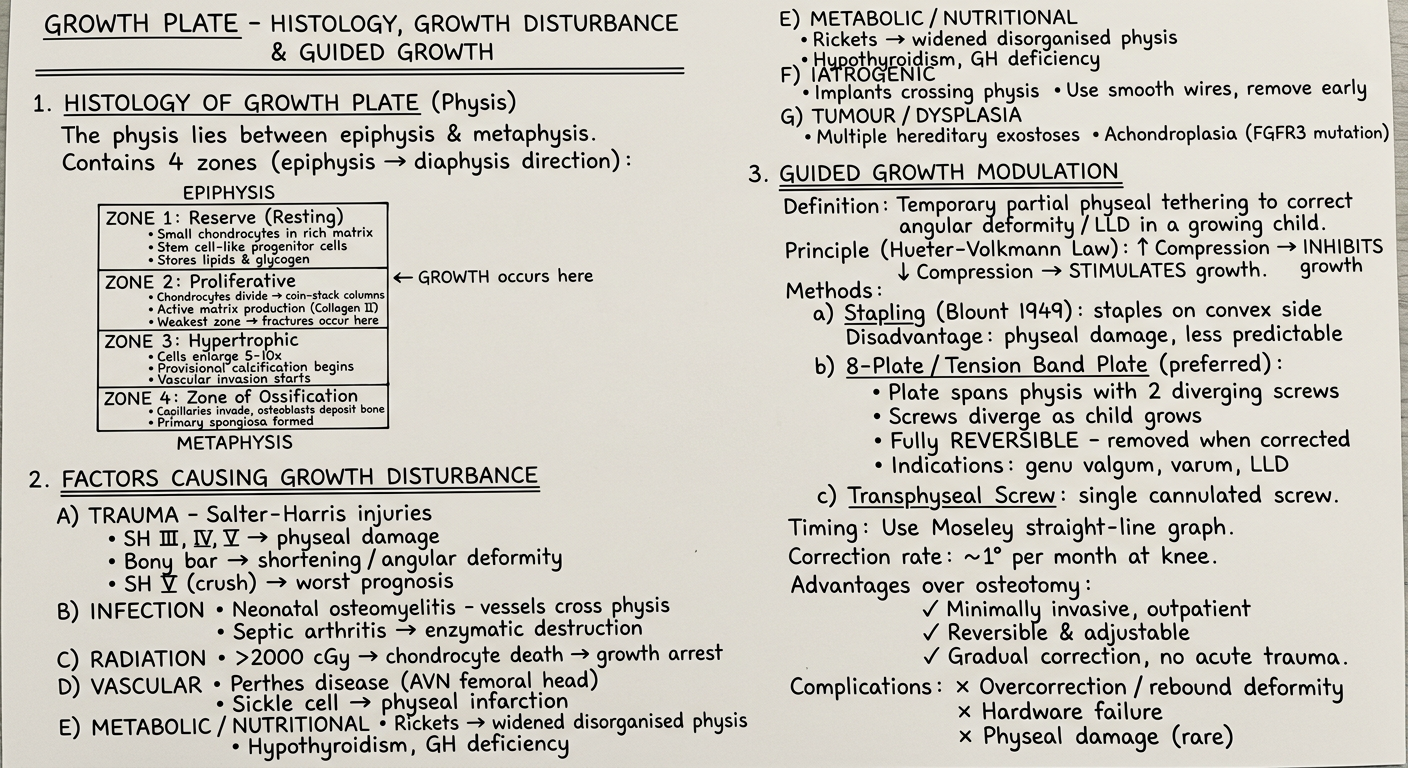
GROWTH PLATE (PHYSIS) - HISTOLOGY, GROWTH DISTURBANCE & GUIDED GROWTH MODULATION
1. HISTOLOGY OF GROWTH PLATE
| Zone | Key Features |
|---|---|
| Zone 1 - Reserve (Resting) | Small scattered chondrocytes; stem cell-like progenitor cells; stores lipids/glycogen; anchors physis to epiphysis |
| Zone 2 - Proliferative | Chondrocytes divide into "coin-stack" columns; most active growth zone; produces collagen type II; weakest zone - fractures occur here |
| Zone 3 - Hypertrophic | Cells enlarge 5-10x; three sub-zones: maturation, degeneration, provisional calcification; vascular invasion begins |
| Zone 4 - Ossification (Primary Spongiosa) | Capillary invasion; osteoblasts deposit bone on calcified cartilage scaffold; remodelled to secondary spongiosa |
2. FACTORS CAUSING GROWTH DISTURBANCE
- Salter-Harris (SH) types III, IV, V carry highest risk
- SH V (crush/compression) - worst, often missed acutely
- Bony physeal bar: peripheral bar → angular deformity; central bar → shortening
- Most physeal fractures run through the proliferative zone
- Neonatal haematogenous osteomyelitis: metaphyseal vessels cross physis in children <18 months
- Septic arthritis: proteolytic enzymes directly destroy cartilage
- Especially dangerous: hip (proximal femur physis)
- Doses >2000 cGy cause chondrocyte death
- Growth arrest or angular deformity depending on field
- Perthes disease (AVN femoral head)
- Sickle cell disease: physeal infarction
- Disruption of perichondrial ring of LaCroix
- Rickets: widened, cupped, frayed physis; disorganised zones
- Scurvy: zone of provisional calcification primarily affected
- Hypothyroidism, growth hormone deficiency
- Hardware crossing physis (threaded pins most damaging)
- Principle: use smooth wires, smallest diameter, remove as soon as stable
- Multiple hereditary exostoses: osteochondromas tether physis
- Achondroplasia: FGFR3 mutation - reduced proliferative zone activity
3. PRINCIPLES OF GUIDED GROWTH MODULATION
- Increased compressive load → inhibits physeal growth
- Decreased compressive load → stimulates physeal growth
- Tethering the convex side slows growth there, allowing the concave side to "catch up"
-
Stapling (Blount, 1949)
- Metallic staples across physis on convex side
- Disadvantages: can damage physis, staples may "walk out," less predictable
-
Tension Band Plate / 8-Plate (Metaizeau; popularised by Stevens)
- Plate spans physis with 2 screws (one epiphyseal, one metaphyseal)
- As limb grows, screws diverge in a tension-band effect
- Fully reversible - plate removed once deformity corrected
- Indications: genu valgum, genu varum, tibia vara, limb length discrepancy, knee flexion contracture
- Timing: condyle must be large enough for smallest screw (>16 mm)
-
Transphyseal Screw
- Single cannulated screw crossing physis
- Minimally invasive, simple technique
- Predict using Moseley straight-line graph or Green-Anderson tables
- Correction rate approximately 1° per month at the knee
- Must have adequate growth remaining
- Minimally invasive, often outpatient
- Reversible and adjustable
- Gradual correction (no acute deformity)
- Can be repeated if overcorrection occurs
- Overcorrection/rebound deformity after plate removal
- Hardware failure or migration
- Physeal damage (rare with smooth implants)
- Loss of correction