
Explain the TCA cycle in details
The TCA (tricarboxylic acid) cycle, also called the Krebs cycle or citric acid cycle, is a central metabolic pathway in the mitochondrial matrix that oxidizes acetyl-CoA to CO₂ while capturing energy as NADH, FADH₂, and GTP. It is the hub of aerobic metabolism, connecting carbohydrate, fat, and amino acid catabolism.
Searching sources...
Reading File
Now let me search the medical library for TCA cycle content in parallel:
Finding Sources
Searching the Web
TCA cycle tricarboxylic acid Krebs cycle steps enzymes biochemistry
Excellent results. Now let me read the key sections from Harper's (most detailed biochemistry source) and Guyton & Hall in parallel:
Reading File
Reading File
Now let me read more of the detailed reaction steps and the regulation/roles sections:
Reading File
Reading File
Now let me fetch the key diagram images from Harper's and read the regulation section:
Loading Image
Loading Image
Reading File
I now have comprehensive information from Harper's Illustrated Biochemistry. Let me compose the full detailed answer.
The TCA (Tricarboxylic Acid) Cycle - Detailed Explanation
Source: Harper's Illustrated Biochemistry, 32nd Ed; Guyton & Hall Textbook of Medical Physiology
Overview
The citric acid cycle (also called the Krebs cycle or TCA cycle) is the final common oxidative pathway for carbohydrates, lipids, and proteins. Their shared end-metabolite, acetyl-CoA (a 2-carbon unit), enters the cycle by reacting with oxaloacetate. Through a series of dehydrogenations and decarboxylations, citrate is degraded - releasing 2 CO₂, reducing coenzymes (NADH, FADH₂), generating one GTP, and regenerating oxaloacetate to sustain the cycle.
The cycle is located in the mitochondrial matrix, immediately adjacent to the enzymes of the respiratory chain and oxidative phosphorylation.
The Detailed Reactions (8 Steps)
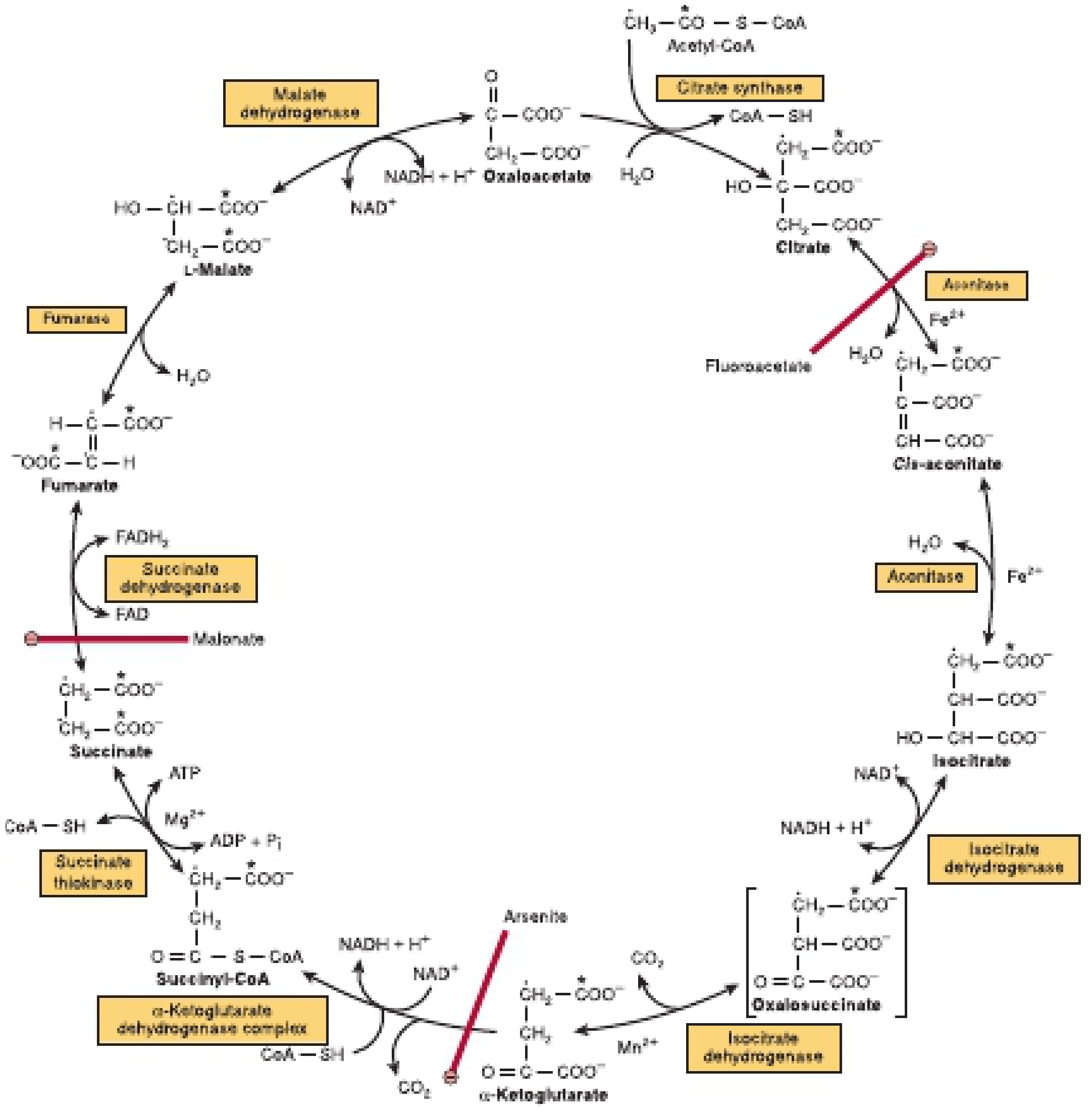
Here is the full structural diagram from Harper's showing each enzyme, intermediate, and inhibitor:
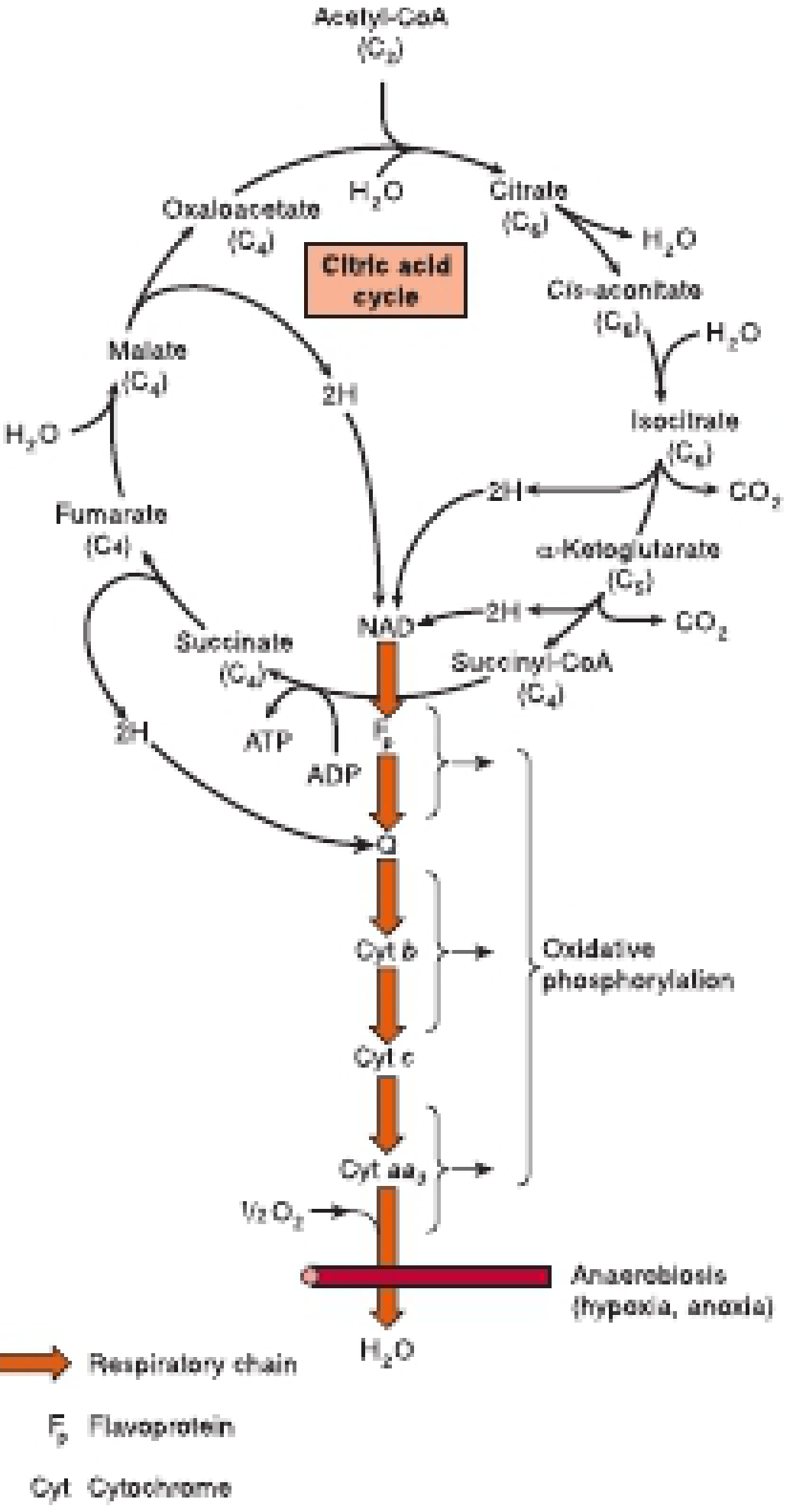
And the overview showing connection to the respiratory chain and ATP synthesis:
Step 1 - Acetyl-CoA + Oxaloacetate → Citrate
- Enzyme: Citrate synthase
- Acetyl-CoA (C2) condenses with oxaloacetate (C4) to form citrate (C6), releasing free CoA-SH
- The thioester bond of citryl-CoA is hydrolyzed - exothermic and essentially irreversible
- Citrate is a tricarboxylic acid (giving the cycle its name)
- The released CoA is recycled by pyruvate dehydrogenase
- Inhibited by: ATP, long-chain fatty acyl-CoA (allosteric inhibition)
Step 2 - Citrate → Isocitrate
- Enzyme: Aconitase (aconitate hydratase)
- A two-step reaction: dehydration of citrate → cis-aconitate, then rehydration → isocitrate
- Aconitase requires Fe²⁺
- Although citrate is symmetrical, aconitase reacts asymmetrically via "channeling" - transferring the product of citrate synthase directly onto its active site without entering free solution
- The 2 carbons lost as CO₂ later in the cycle are NOT the carbons that entered from acetyl-CoA (they come from the oxaloacetate portion)
- Inhibited by: Fluoroacetate (a poison) → forms fluorocitrate which blocks aconitase, causing citrate to accumulate lethally
Step 3 - Isocitrate → α-Ketoglutarate + CO₂
- Enzyme: Isocitrate dehydrogenase (NAD⁺-dependent, mitochondrial isoform)
- Two-part reaction: dehydrogenation → oxalosuccinate (enzyme-bound intermediate), then oxidative decarboxylation → α-ketoglutarate
- Produces: 1 NADH + H⁺, releases 1 CO₂
- Requires Mg²⁺ or Mn²⁺
- Rate-limiting step of the cycle
- Activated by: ADP, Ca²⁺ - Inhibited by: ATP, NADH
Step 4 - α-Ketoglutarate → Succinyl-CoA + CO₂
- Enzyme: α-Ketoglutarate dehydrogenase complex (multienzyme, analogous to pyruvate dehydrogenase)
- Oxidative decarboxylation; same cofactors required: thiamin diphosphate (B₁), lipoate, NAD⁺, FAD, CoA
- Produces: 1 NADH + H⁺, releases 1 CO₂, forms succinyl-CoA (C4 thioester)
- Reaction is physiologically irreversible
- Inhibited by: Arsenite (causes α-ketoglutarate to accumulate), NADH, succinyl-CoA; Activated by: Ca²⁺
At this point, both carbons of acetyl-CoA have been released as CO₂, though not literally the same carbons - the label appears in subsequent turns via labeled oxaloacetate.
Step 5 - Succinyl-CoA → Succinate + GTP (or ATP)
- Enzyme: Succinate thiokinase (succinyl-CoA synthetase)
- Cleavage of the thioester bond drives substrate-level phosphorylation - the only such step in the TCA cycle
- In gluconeogenic tissues (liver, kidney): two isoenzymes exist - one GDP-specific, one ADP-specific
- The GTP produced is used for decarboxylation of oxaloacetate → phosphoenolpyruvate in gluconeogenesis
- Produces: 1 GTP (or ATP)
Step 6 - Succinate → Fumarate
- Enzyme: Succinate dehydrogenase
- Removes 2 H atoms from succinate to form fumarate
- The only TCA cycle enzyme embedded in the inner mitochondrial membrane (rather than free in the matrix)
- Electrons pass directly to FAD → FADH₂ (does not reduce NAD⁺)
- Produces: 1 FADH₂
- Inhibited by: Malonate (a structural analogue of succinate - competitive inhibitor), oxaloacetate
- Riboflavin (vitamin B₂) is the cofactor as FAD
Step 7 - Fumarate → L-Malate
- Enzyme: Fumarase (fumarate hydratase)
- Addition of water across the double bond; stereospecific - produces only L-malate
Step 8 - L-Malate → Oxaloacetate
- Enzyme: Malate dehydrogenase
- NAD⁺-dependent oxidation; regenerates oxaloacetate to continue the cycle
- Produces: 1 NADH + H⁺
- Equilibrium favors malate, but oxaloacetate is continuously removed by citrate synthase, pulling the reaction forward
Energy Yield Per Turn
| Product | Quantity | ATP equivalent (via ETC) |
|---|---|---|
| NADH | 3 | ~7.5 ATP (2.5 each) |
| FADH₂ | 1 | ~1.5 ATP |
| GTP/ATP | 1 | 1 ATP (direct) |
| Total | ~10 ATP per acetyl-CoA |
Per molecule of glucose (2 pyruvates → 2 acetyl-CoA), the cycle yields ~20 ATP equivalents (before counting the entry step NADH from pyruvate dehydrogenase).
Regulation
Regulation is primarily through supply of oxidized cofactors (NAD⁺, FAD). Since oxidation is tightly coupled to phosphorylation, the cycle speed is ultimately governed by ADP availability - i.e., how fast the cell uses ATP.
| Regulatory Site | Activated by | Inhibited by |
|---|---|---|
| Pyruvate dehydrogenase (entry) | ADP, Ca²⁺, CoA, NAD⁺ | Acetyl-CoA, NADH, ATP |
| Citrate synthase | Oxaloacetate (substrate) | ATP, NADH, long-chain acyl-CoA |
| Isocitrate dehydrogenase | ADP, Ca²⁺ | ATP, NADH |
| α-Ketoglutarate dehydrogenase | Ca²⁺ | Succinyl-CoA, NADH, ATP |
Ca²⁺ is a key activator during muscle contraction and glandular secretion - linking energy demand directly to cycle flux.
Amphibolic Nature (Anabolism + Catabolism)
The TCA cycle is amphibolic - it functions in both degradation and synthesis:
| Function | Pathway | Key Intermediate |
|---|---|---|
| Gluconeogenesis | Oxaloacetate → PEP | Oxaloacetate |
| Amino acid synthesis | Transamination | α-Ketoglutarate, oxaloacetate |
| Fatty acid synthesis | Citrate export → cytosol → acetyl-CoA | Citrate |
| Heme synthesis | - | Succinyl-CoA |
| Amino acid catabolism input | Glutamate → α-ketoglutarate | α-Ketoglutarate |
Anaplerosis = entry of carbon into the cycle (e.g., pyruvate carboxylase converts pyruvate → oxaloacetate)
Cataplerosis = exit of carbon from the cycle (e.g., oxaloacetate → PEP for gluconeogenesis)
These must remain balanced to sustain the cycle.
Vitamins Required
Four B vitamins are essential cofactors:
| Vitamin | Form | Role |
|---|---|---|
| Thiamin (B₁) | Thiamin diphosphate | α-Ketoglutarate dehydrogenase |
| Riboflavin (B₂) | FAD | Succinate dehydrogenase |
| Niacin (B₃) | NAD⁺ | Isocitrate DH, α-KG DH, malate DH |
| Pantothenic acid (B₅) | Coenzyme A | Acetyl-CoA, succinyl-CoA formation |
Clinical Relevance
- Thiamin deficiency (Wernicke's encephalopathy): Blocks α-ketoglutarate dehydrogenase → α-ketoglutarate accumulates; cycle flux and ATP production fall - especially damaging to the brain
- Arsenite poisoning: Inhibits α-ketoglutarate dehydrogenase (and pyruvate dehydrogenase) via lipoate oxidation
- Fluoroacetate poisoning: Converted to fluorocitrate → inhibits aconitase → citrate accumulates (used in some rodenticides)
- Malonate: Competitive inhibitor of succinate dehydrogenase - used in experimental biochemistry
- Hyperammonemia (liver disease): α-Ketoglutarate is withdrawn to form glutamate and glutamine, depleting all cycle intermediates and impairing ATP generation - contributing to hepatic encephalopathy
- Cancer metabolism (Warburg effect): Many cancers use TCA intermediates for biosynthesis, downregulate oxidative phosphorylation, and show mutations in IDH1/IDH2 (isocitrate dehydrogenase) - producing the oncometabolite 2-hydroxyglutarate
Harper's Illustrated Biochemistry, 32nd Ed, pp. 168-171 (Chapter 16)
This is a shared conversation. Sign in to Orris to start your own chat.