
which investigation is preferred in meckels diverticulum in adults and child
I'll read the medical library skill first, then search for information on Meckel's diverticulum investigations.
Reading File
Now let me search the medical library and PubMed in parallel for Meckel's diverticulum investigations.
Finding Sources
Finding Sources
Searching PubMed
"Meckel diverticulum"[MeSH Terms] AND diagnosis
Now let me read the key sections from multiple textbooks in parallel:
Reading File
Reading File
Reading File
Reading File
Let me get the continuation from Sleisenger (key diagnostic section) and the Grainger radiology section on Meckel's imaging:
Reading File
Reading File
Reading File
I now have comprehensive information from multiple authoritative textbooks. Let me fetch the key Meckel scan image and compile the full answer.
Loading Image
Here is a comprehensive answer based on multiple authoritative textbooks:
Investigation of Meckel's Diverticulum: Children vs Adults
The investigation of choice differs significantly between children and adults, driven by the difference in predominant complications in each group.
In Children - Meckel's Scan (99mTc-Pertechnetate Scintigraphy)
This is the investigation of choice in children.
The Meckel scan (also called Meckel's scintigraphy) uses sodium pertechnetate labeled with 99m-Technetium (99mTc). The isotope is taken up by the mucus-secreting cells of both normal gastric mucosa and ectopic gastric mucosa within the diverticulum - making it ideal for detecting the bleeding Meckel's.
Why it works in children:
- In children, the dominant presentation is painless rectal bleeding
- Bleeding almost always originates from ectopic gastric mucosa (present in ~80-85% of symptomatic cases)
- Since bleeding Meckel's virtually always contain gastric mucosa, the scan is highly effective
Performance in children:
- Sensitivity: 80-90%
- Specificity: 95%
Ways to enhance the scan:
| Agent | Mechanism |
|---|---|
| Cimetidine (H2 blocker) - Preferred | Decreases pertechnetate secretion from gastric mucosa, retaining it longer for better imaging |
| Glucagon | Inhibits peristalsis, preventing washout and dilution of the radionuclide |
| Pentagastrin | Increases mucus cell metabolism (NOT preferred - risk of inducing perforation) |
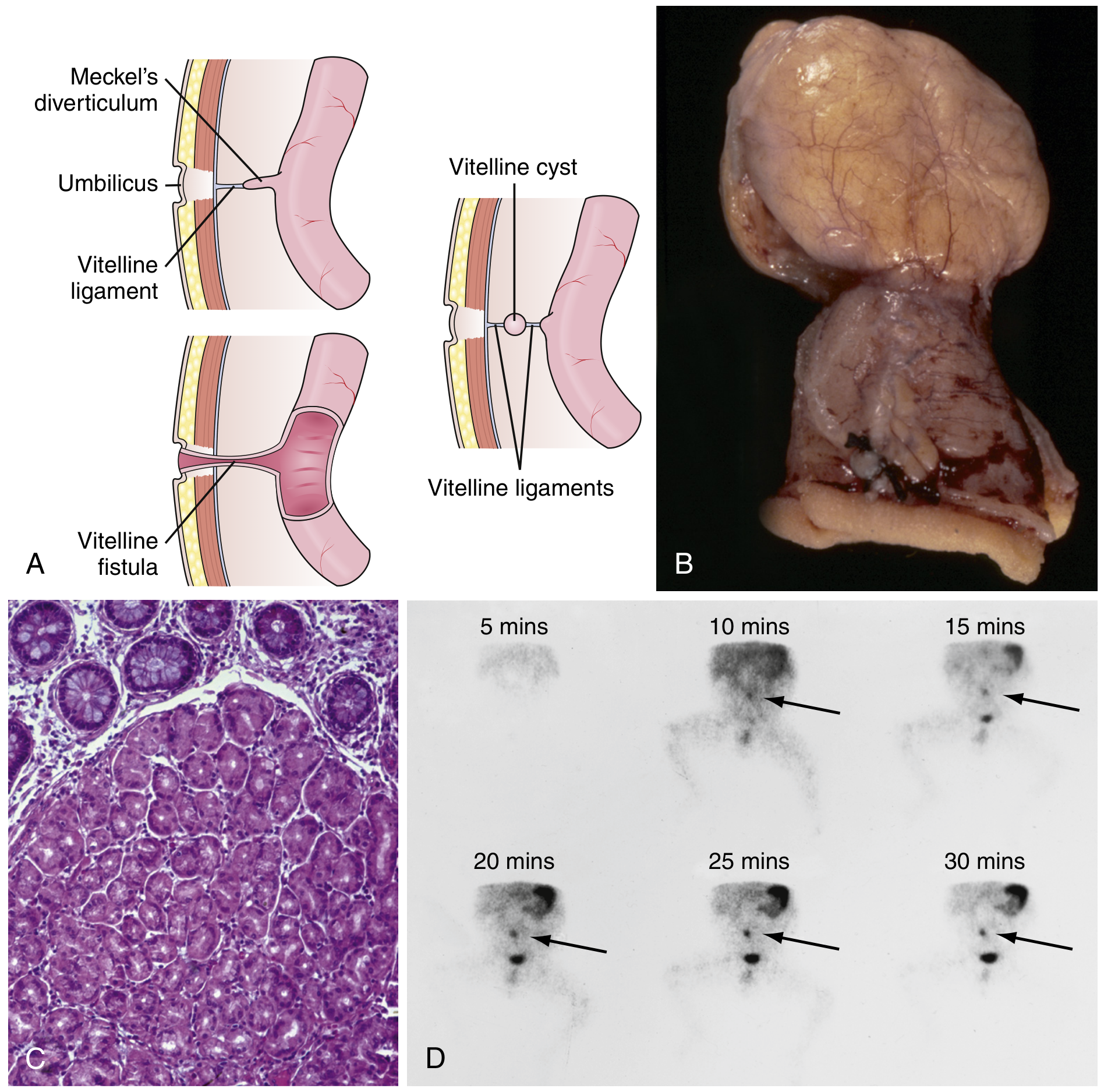
Panel D shows serial Meckel scan images demonstrating progressive uptake of 99mTc-pertechnetate (arrows) in the diverticulum. Panel C shows the ectopic gastric mucosa (H&E) that makes the scan positive. - Sleisenger and Fordtran's Gastrointestinal and Liver Disease
Key caveat: The scan only detects Meckel's if ectopic gastric mucosa is present. A negative scan does NOT rule out a Meckel's diverticulum.
If Meckel's scan is negative in a bleeding child: 99mTc-labeled red blood cell scan, splanchnic angiography, wireless capsule endoscopy, or double-balloon enteroscopy can be used as second-line options.
In Adults - CT Scan / CT Enterography
In adults, the investigation of choice shifts to CT scan, particularly CT enterography.
Why the difference?
- In adults, the most common complication is intestinal obstruction (not bleeding)
- Adults can also present with Meckel's diverticulitis (mimicking appendicitis) and other structural complications
- Ectopic gastric mucosa is less reliably present in adults, so the Meckel's scan has high false-positive and false-negative rates in adults - even in those with active bleeding
CT findings of Meckel's diverticulum:
- A tubular, blind-ending structure arising from the antimesenteric border of the terminal ileum
- CT enterography increases detection sensitivity further by distending the bowel with enteric contrast
Other investigations used in adults:
| Investigation | Role |
|---|---|
| CT enterography | Best overall structural detection; shows obstruction, diverticulitis, perforation |
| Angiography | Localizes active bleeding; may demonstrate the vitelline artery (distal branch of SMA) with its characteristic tortuous vessel blush |
| 99mTc-RBC scan | Detects active GI bleeding, localizes site |
| Capsule endoscopy | Useful for obscure GI bleeding |
| Double-balloon enteroscopy | Allows direct visualization and tissue sampling |
| MR enterography | Useful for localization when lesion is far from the ileocecal valve |
| Barium follow-through | Low sensitivity; diverticulum often doesn't fill; enteroclysis (pressurized) is better if used |
Summary Table
| Feature | Children | Adults |
|---|---|---|
| Most common complication | Painless rectal bleeding | Intestinal obstruction / Diverticulitis |
| Investigation of choice | Meckel's Scan (99mTc-pertechnetate) | CT scan / CT enterography |
| Basis | Ectopic gastric mucosa uptake | Structural imaging for obstruction/inflammation |
| Sensitivity of Meckel scan | 80-90% | Low (high false +ve and -ve) |
| Second-line | RBC scan, angiography, capsule endoscopy | Angiography, capsule endoscopy, MR enterography |
Sources:
- Sleisenger and Fordtran's Gastrointestinal and Liver Disease - Diagnosis of Meckel Diverticulum
- Yamada's Textbook of Gastroenterology, 7th ed. - Meckel diverticulum diagnosis section
- Grainger & Allison's Diagnostic Radiology - Meckel Diverticulum imaging
- Rosen's Emergency Medicine - Meckel Diverticulum clinical features
- Meckel diverticulum scintigraphy review (Aboughalia et al., Pediatric Radiology 2023, PMID: 36323958)
This is a shared conversation. Sign in to Orris to start your own chat.