
Branches of inferior mesenteric artery. Origin nerve supply function of sterno cleidomastoid
I'll look up both topics in the medical library simultaneously.
Reading File
Now searching both topics in parallel:
Finding Sources
Finding Sources
Good results found. Now reading the key sections in parallel:
Reading File
Reading File
Finding Sources
Now reading the SCM dedicated sections and the IMA branches section in parallel:
Reading File
Reading File
Reading File
Excellent! I now have comprehensive information for both topics. Let me also fetch the IMA diagram and the SCM diagram to include in the answer:
Loading Image
Loading Image
I now have everything needed for a comprehensive answer.
Branches of the Inferior Mesenteric Artery (IMA)
Origin
The IMA arises from the anterolateral aspect of the abdominal aorta at approximately vertebral level L3 (some sources say L3-L4 interspace). It courses caudally and to the left, supplying the hindgut derivatives.
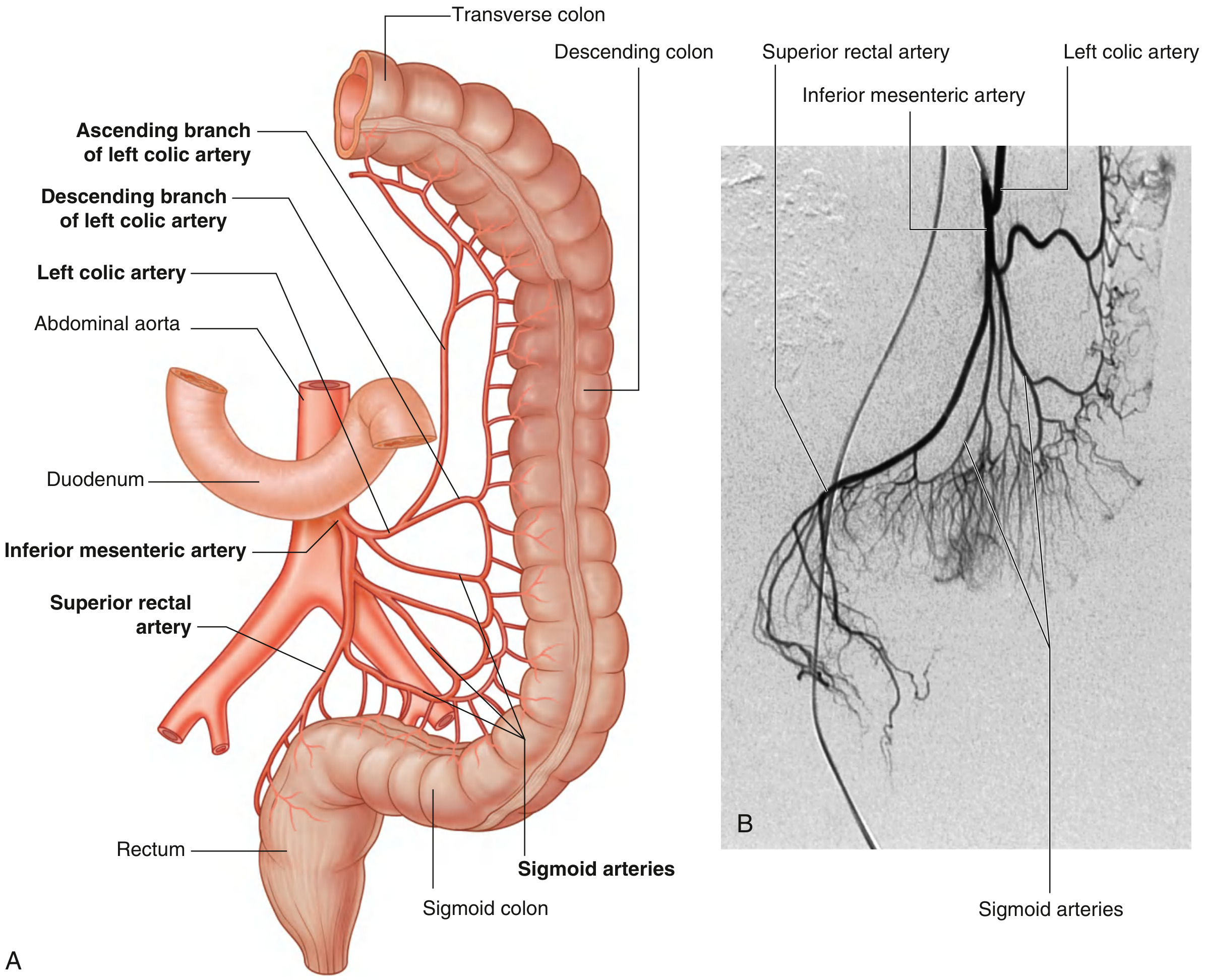
Branches (in sequence)
| Branch | Supply |
|---|---|
| 1. Left colic artery | Descending colon and variable part of the splenic flexure. Has an ascending branch (anastomoses with the middle colic via the marginal artery) and a descending branch |
| 2. Sigmoid arteries (2-3 branches) | Sigmoid colon; form arcades in the sigmoid mesocolon |
| 3. Superior rectal artery | Terminal branch. Descends into the pelvis in the sigmoid mesocolon, crosses the left common iliac vessels, and at vertebra S3 divides into two branches supplying the rectum and upper anal canal |
Key anastomoses
- Arc of Riolan / Marginal artery of Drummond: left colic (IMA) anastomoses with middle colic (SMA) - clinically important collateral
- Superior rectal (IMA) anastomoses with middle rectal (internal iliac) and inferior rectal (internal pudendal)
- Watershed zone at the splenic flexure (between SMA and IMA territories) is highly vulnerable to ischemia
Gray's Anatomy for Students; Yamada's Textbook of Gastroenterology, 7e
Sternocleidomastoid (SCM)
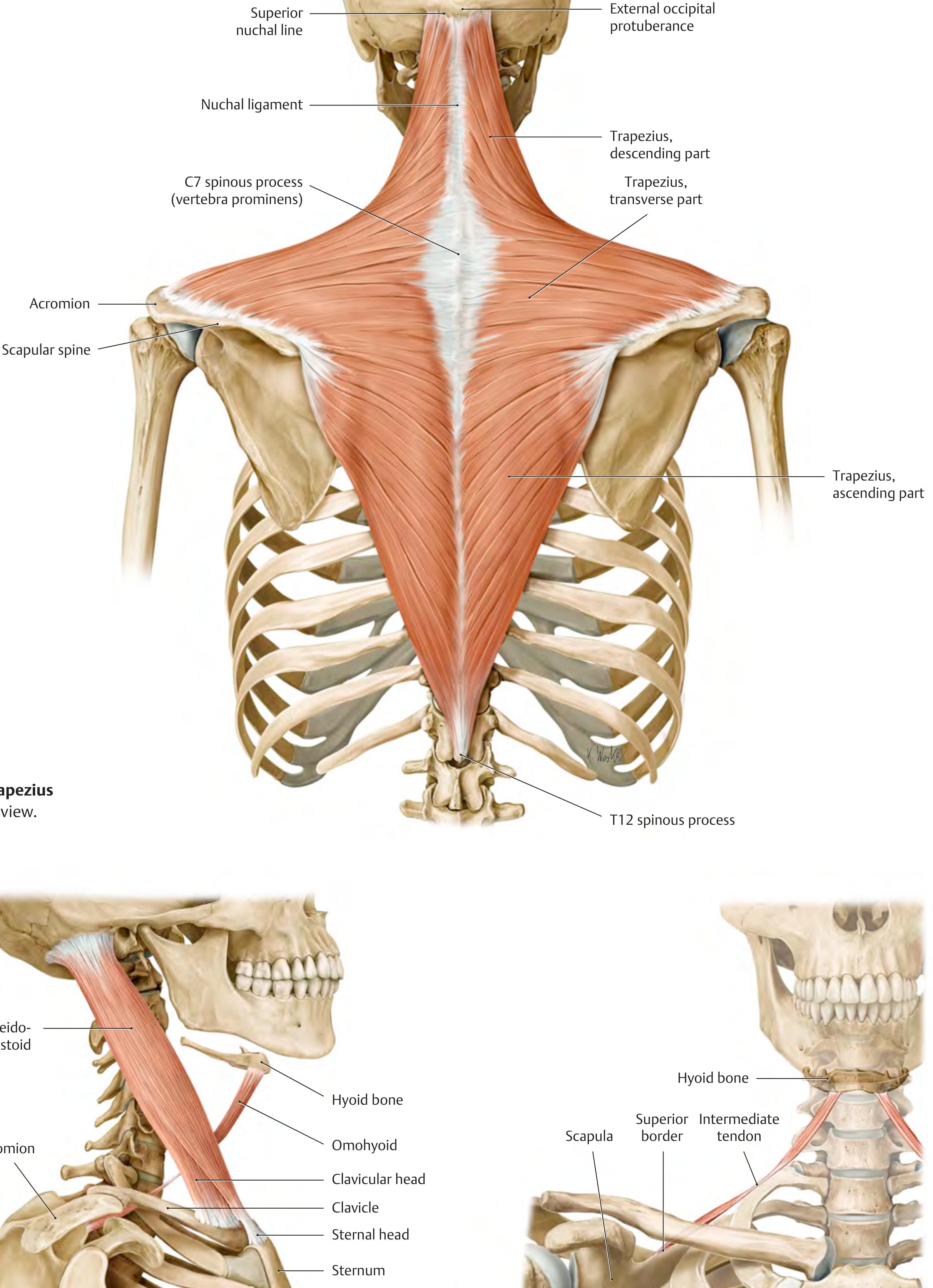
Origin (Two heads)
| Head | Origin |
|---|---|
| Sternal head | Anterior surface of the manubrium sterni |
| Clavicular head | Medial third of the clavicle |
Insertion
Mastoid process and the lateral half of the superior nuchal line of the occipital bone.
Nerve Supply
- Motor (primary): Spinal accessory nerve - CN XI
- Sensory (proprioception): Cervical plexus - C2, C3
Note: CN XI provides motor innervation to both SCM and trapezius. Damage to CN XI causes weakness/paralysis of both muscles.
Functions
| Action | Condition |
|---|---|
| Tilts (laterally flexes) the head to the same (ipsilateral) side | Unilateral contraction |
| Rotates the face to the opposite (contralateral) side | Unilateral contraction |
| Extends the head (capital extension at atlanto-occipital joint) | Bilateral contraction |
| Assists in forced inspiration (elevates sternum and clavicle) | When head is fixed (bilateral) |
Clinical correlate - Torticollis
Fibrosis or shortening of the SCM causes torticollis (wry neck): head tilts toward the affected side with the face rotated away. In neonatal torticollis, a fibrous mass ("SCM tumor") may be palpable in the muscle belly.
CN XI testing
Ask the patient to turn the head against resistance (tests contralateral SCM) and shrug the shoulders (tests trapezius). Weakness on both confirms CN XI palsy.
THIEME Atlas of General Anatomy and Musculoskeletal System; Localization in Clinical Neurology, 8e; Bailey and Love's Surgery, 28e
This is a shared conversation. Sign in to Orris to start your own chat.