
What Is drug efficacy and where is it situated in kd tripathi
Drug efficacy refers to the maximum effect a drug can produce, regardless of dose. It reflects the intrinsic ability of a drug-receptor complex to produce a biological response. A drug with high efficacy produces a greater maximal response than one with low efficacy, even if the latter is given at much higher doses. Efficacy is distinct from potency - potency is about the dose needed, efficacy is about the ceiling effect achievable.
Searching sources...
Reading File
Finding Sources
KD Tripathi's "Essentials of Medical Pharmacology" is not in this library, but I can answer comprehensively from the available pharmacology textbooks and my own knowledge of what Tripathi covers on this topic.
Finding Sources
Finding Sources
Finding Sources
Finding Sources
Reading File
Reading File
Loading Image
Loading Image
Here is a complete answer on drug efficacy, presented as it appears in standard pharmacology textbooks (in the same manner as KD Tripathi's "Essentials of Medical Pharmacology"):
Drug Efficacy
Location in KD Tripathi
In KD Tripathi's Essentials of Medical Pharmacology, drug efficacy is discussed in:
- Chapter 4 - Pharmacodynamics: Mechanism of Drug Action (or Chapter 3 in older editions)
- Specifically under the subsection "Dose-Response Relationship" - within the topic of Graded Dose-Response Curves
- It appears alongside potency, EC50, agonists/partial agonists, and the therapeutic index
Definition of Drug Efficacy
Efficacy (also called intrinsic efficacy or maximal efficacy, Emax) is the magnitude of the maximum response a drug can produce when it interacts with its receptor, regardless of the dose given.
"Efficacy is the magnitude of response a drug causes when it interacts with a receptor. It is dependent on the number of drug-receptor complexes formed and the intrinsic activity of the drug (its ability to activate the receptor and cause a cellular response). Maximal efficacy (Emax) assumes that the drug occupies all receptors, and no further increase in response is observed with higher concentrations."
- Lippincott Illustrated Reviews: Pharmacology, p. 96
Key Points About Efficacy
| Concept | Explanation |
|---|---|
| Emax | Maximum effect a drug can produce - the ceiling of its response |
| Intrinsic activity | The ability of the drug-receptor complex to activate the receptor and produce a cellular response |
| Full agonist | Has high intrinsic activity; produces maximal response (Emax = 100%) |
| Partial agonist | Has intermediate intrinsic activity; produces less than maximal response even at full receptor occupancy |
| Antagonist | Has zero intrinsic activity; Emax = 0, even when occupying 100% of receptors |
Efficacy vs. Potency (Critical Distinction)
These two terms are frequently confused:
- Potency = how much drug is needed to produce 50% of maximal effect (EC
50). A lower EC50= higher potency. - Efficacy = the ceiling of the response. How much effect the drug can produce at all.
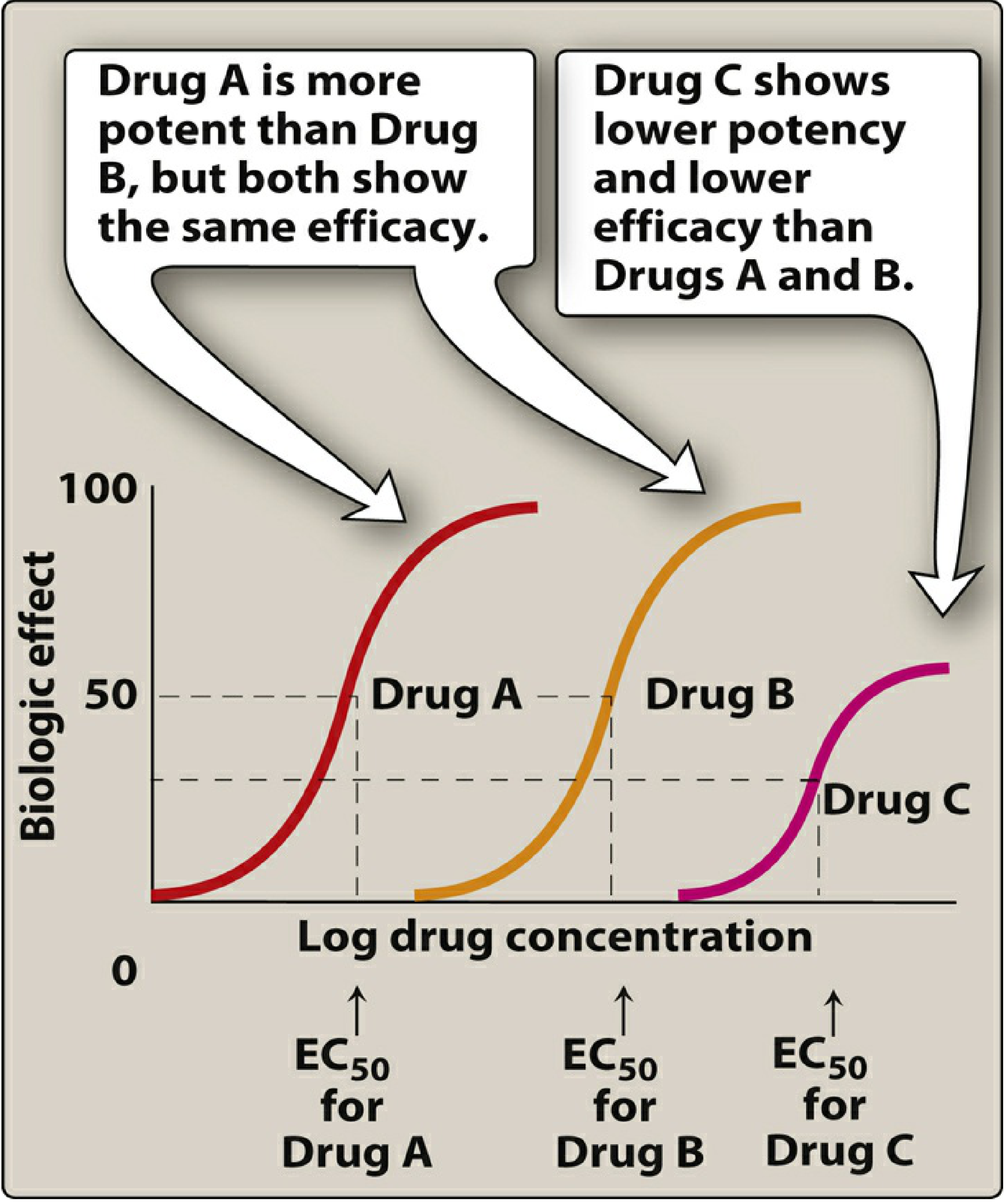
As shown above: Drug A and Drug B have the same efficacy (reach the same Emax 100%) but Drug A is more potent (its EC50~ is lower, i.e., curve is shifted to the left). Drug C has both lower potency AND lower efficacy - it cannot reach the same maximal response as A or B, no matter how high the dose.
Clinical Importance
Efficacy is more clinically relevant than potency:
- A drug with greater efficacy is more therapeutically useful than one that is merely more potent.
- Example: A partial agonist opioid like buprenorphine has lower intrinsic efficacy than morphine (a full agonist). No matter how much buprenorphine is given, it cannot match the maximal analgesic ceiling of morphine in severe pain.
- Example: Ibuprofen vs. naproxen - both have the same maximal efficacy at relieving headache/fever. Even though naproxen is more potent (lower dose needed), they are therapeutically equivalent because their Emax values are the same.
- Lippincott Illustrated Reviews: Pharmacology, p. 97
How Efficacy is Expressed
"Efficacy is a measure of drug effectiveness at producing an effect once it occupies a receptor. Drugs that achieve maximal effect are known as full agonists, and those that have an effect less than maximal are known as partial agonists."
- Miller's Anesthesia, 10e, p. 1745
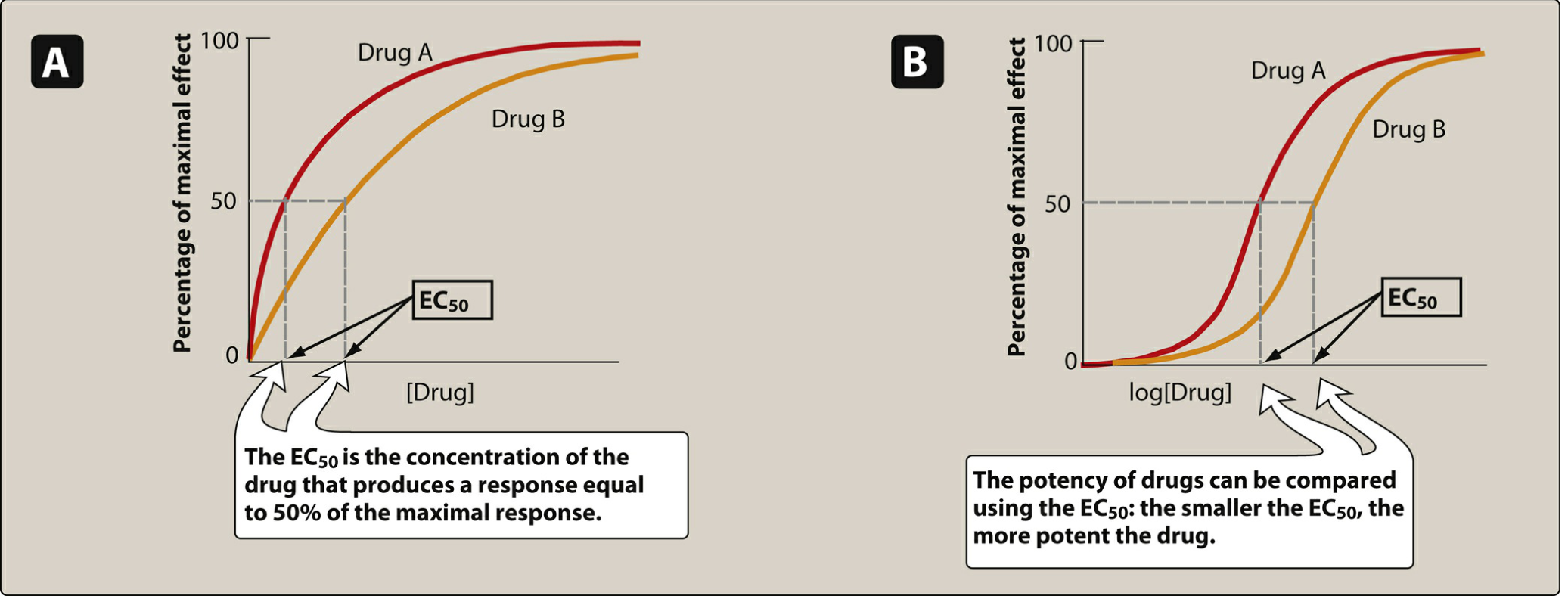
The dose-response graph below shows EC50 (potency indicator) on the x-axis and Emax (efficacy) as the plateau of the sigmoid curve:
Summary (KD Tripathi Style)
- Efficacy = maximum effect (Emax) a drug can produce
- It depends on intrinsic activity of the drug
- Full agonists > Partial agonists > Antagonists in terms of efficacy
- Efficacy is a property of the drug-receptor interaction, not of the dose
- Clinically, a higher efficacy drug is preferred when a strong maximal response is needed (e.g., severe pain, acute pulmonary edema)
- Potency is a separate concept - it only tells you what dose you need, not how much effect you will get
This is a shared conversation. Sign in to Orris to start your own chat.