
SERM
Reading File
SERMs (Selective Estrogen Receptor Modulators) are drugs that act as estrogen agonists in some tissues and antagonists in others, depending on the receptor coactivator/corepressor environment. Key examples include tamoxifen (breast cancer), raloxifene (osteoporosis/breast cancer prevention), and clomiphene (ovulation induction).
Searching sources...
Finding Sources
Searching PubMed
"selective estrogen receptor modulator" SERM
Finding Sources
Reading File
Reading File
Reading File
Finding Sources
Finding Sources
Reading File
Reading File
Reading File
Reading File
Now let me fetch the chemical structure image and also look at the diagram for action of steroid hormones/antiestrogens:
Loading Image
Loading Image
Here is a thorough breakdown of SERMs from authoritative pharmacology textbooks.
Selective Estrogen Receptor Modulators (SERMs)
SERMs are a class of estrogen-related compounds that display selective agonism or antagonism at estrogen receptors (ERs) depending on the tissue. This category includes tamoxifen, raloxifene, bazedoxifene, clomiphene, and ospemifene.
Mechanism of Action
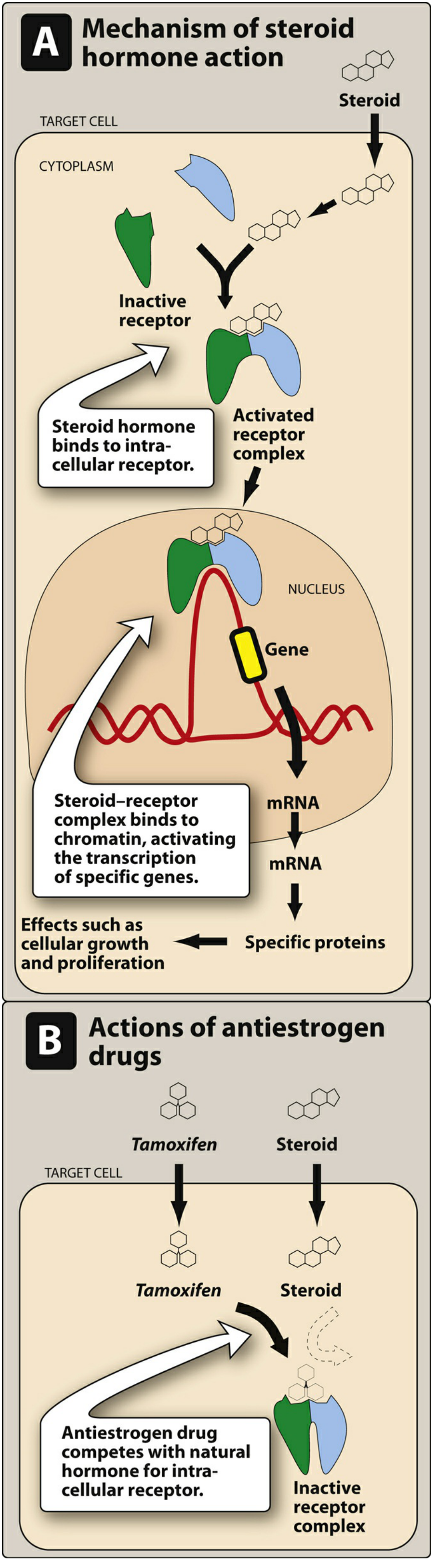
All SERMs bind to the ligand-binding pocket of both ERα and ERβ, competitively blocking estradiol binding. However, the key to tissue selectivity lies in how the receptor is bound:
- When estrogen or a SERM binds, the ER adopts a different 3D conformation depending on the ligand.
- Each conformation recruits different coactivators and corepressors at target gene promoters.
- Combined with the fact that different tissues express different co-regulatory proteins, this creates tissue-specific agonist or antagonist effects.
Individual SERM Drug Profiles
1. Tamoxifen
| Feature | Detail |
|---|---|
| Class | Triphenylethylene (same stilbene nucleus as diethylstilbestrol) |
| Receptor action | Antagonist in breast; partial agonist in uterus/endometrium and bone |
| Uses | ER+ breast cancer (treatment + adjuvant after mastectomy/radiotherapy); prophylaxis in high-risk women; male breast cancer |
| Metabolism | CYP3A4 and CYP2D6 → active metabolites (4-hydroxytamoxifen, endoxifen); excreted via bile into feces |
| PK note | CYP2D6 poor metabolizers produce less active metabolite → reduced efficacy |
| Drug interactions | Inhibitor of CYP3A4 and P-glycoprotein |
Adverse effects:
- Hot flashes, nausea, vomiting, skin rash
- Endometrial hyperplasia/carcinoma (due to ER agonism in endometrium)
- Thromboembolism (DVT, PE)
- QT prolongation - avoid with other QT-prolonging agents (amiodarone, clarithromycin, trazodone)
- Visual disturbances
2. Raloxifene
| Feature | Detail |
|---|---|
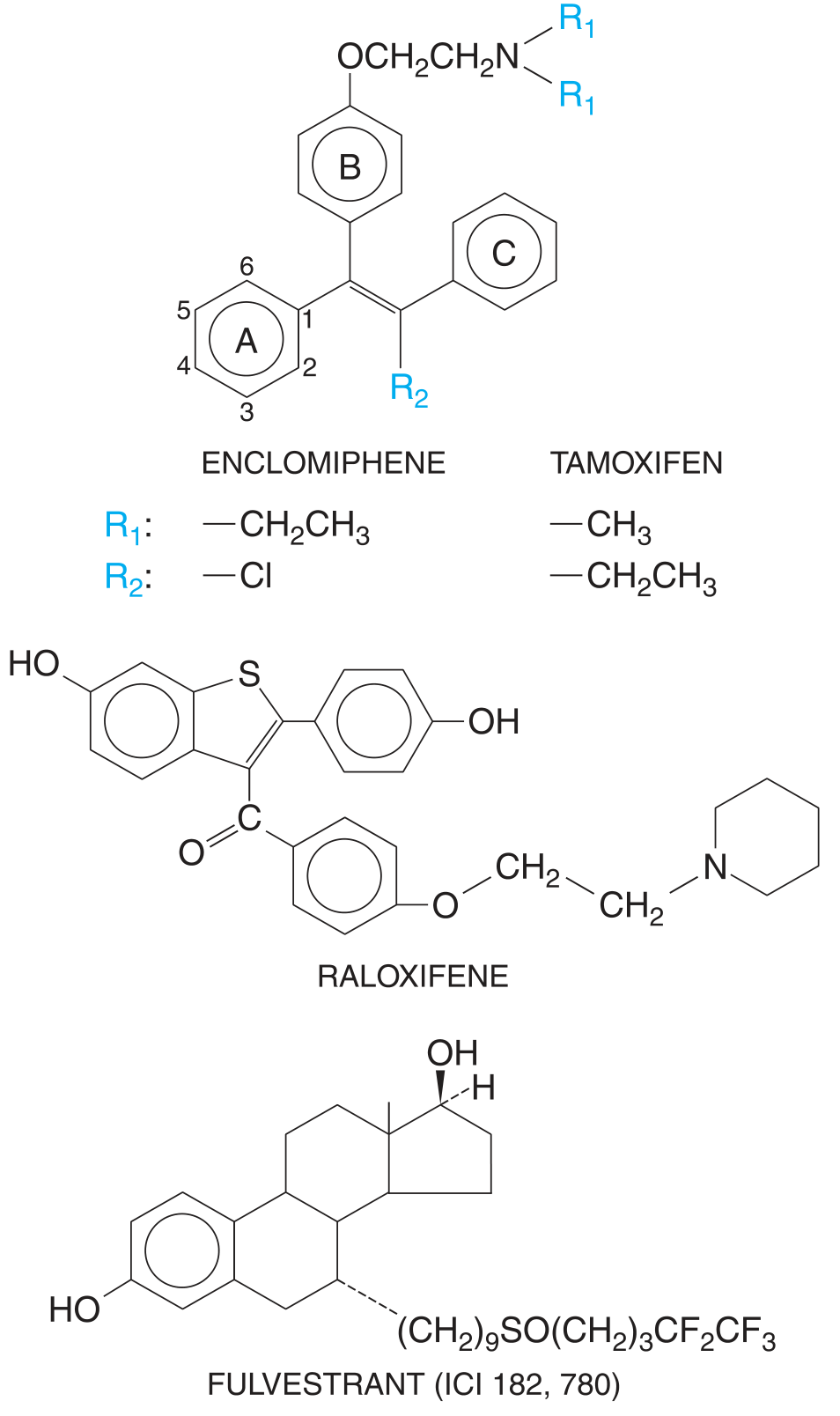
| Class | Polyhydroxylated nonsteroidal compound with a benzothiophene core |
| Receptor action | Antagonist in breast and uterus; agonist in bone |
| Uses | Prevention and treatment of postmenopausal osteoporosis; reduce risk of ER+ invasive breast cancer in postmenopausal women |
| Bone effect | Inhibits bone resorption; reduces vertebral fracture risk ~30-50%; does NOT reduce hip fracture risk |
| Lipid effect | Lowers serum total cholesterol and LDL |
| Key advantage over tamoxifen | No estrogenic activity in endometrium → does NOT increase endometrial cancer risk; less vaginal discharge |
Adverse effects:
- Hot flashes, leg cramps
- DVT (absolute risk ~1 in 400, similar to oral estrogen HRT)
- Associated with increased risk of fatal stroke in high-baseline-risk women (caution in women >65)
3. Clomiphene
| Feature | Detail |
|---|---|
| Isomers | Zuclomiphene (cis; weak agonist) + Enclomiphene (trans; potent antagonist) |
| Mechanism | Acts as a partial ER agonist/antagonist at the hypothalamus; blocks negative estrogen feedback → increases GnRH and gonadotropin (FSH/LH) secretion → stimulates ovulation |
| Use | Treatment of infertility in anovulatory women |
4. Bazedoxifene
| Feature | Detail |
|---|---|
| Action | Antagonizes estrogen at the uterus (reduces endometrial hyperplasia) |
| Available as | Fixed combination with conjugated equine estrogens (DUAVEE) for menopausal symptoms in women with intact uterus |
| Fracture data | Reduces vertebral fractures by ~42% |
5. Ospemifene
- Indicated for dyspareunia (painful intercourse) related to menopause.
Chemical Structures
Tissue-Selective Summary Table
| Drug | Breast | Uterus | Bone | Uses |
|---|---|---|---|---|
| Tamoxifen | Antagonist | Agonist | Agonist | Breast cancer Tx/prophylaxis |
| Raloxifene | Antagonist | Antagonist | Agonist | Osteoporosis, breast cancer prophylaxis |
| Clomiphene | Antagonist (hypothalamus) | - | - | Infertility/anovulation |
| Bazedoxifene | Antagonist | Antagonist | Agonist | Menopausal symptoms + osteoporosis |
| Ospemifene | Antagonist | Mixed | - | Menopausal dyspareunia |
Pharmacokinetics (Class)
- All SERMs are orally active and rapidly absorbed.
- Tamoxifen: extensive hepatic CYP metabolism with active metabolites; CYP3A4/CYP2D6.
- Raloxifene: rapid conversion to glucuronide conjugates (first-pass metabolism).
- Both undergo enterohepatic recycling; primary excretion via bile into feces.
SERMs vs. SERDs vs. Aromatase Inhibitors
For ER+/PR+ breast cancer, three major antiestrogen strategies exist:
- SERMs (e.g., tamoxifen): competitive ER blockade, tissue-selective
- SERDs (e.g., fulvestrant): pure ER antagonists that cause receptor downregulation - no agonist activity in any tissue
- AIs (e.g., anastrozole, letrozole, exemestane): reduce estrogen synthesis in postmenopausal women by blocking peripheral aromatization
Sources: Lippincott Illustrated Reviews Pharmacology, p. 838-839; Goodman & Gilman's Pharmacological Basis of Therapeutics, p. 987-988; Goldman-Cecil Medicine, p. 784-786
This is a shared conversation. Sign in to Orris to start your own chat.